
Cloud of Suspicion
Gengo makes conversion feel like insight by combining real political criticism with altered memory, and Shikamaru survives by remembering who shares his future.
Bottom line
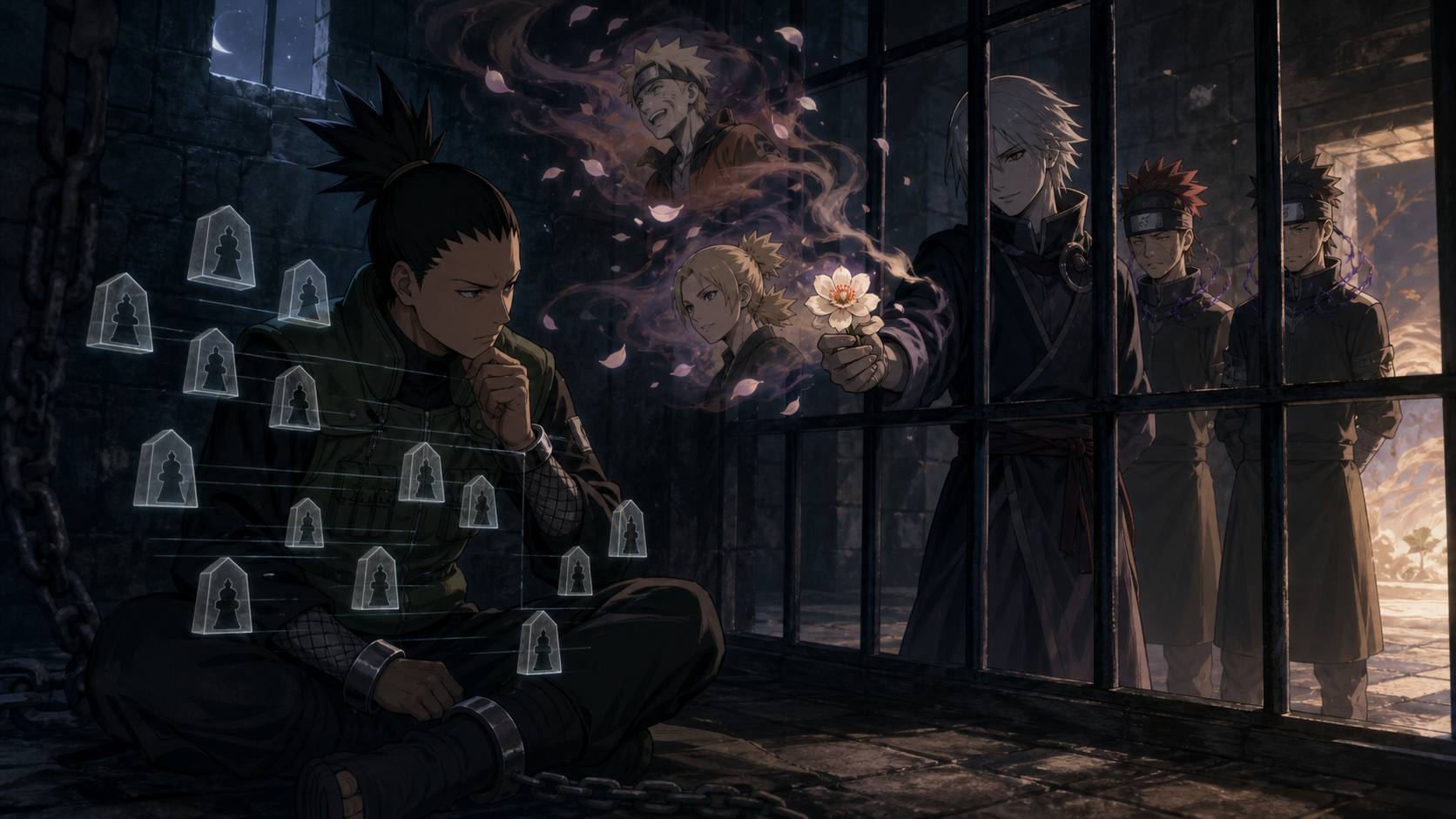
“Cloud of Suspicion” proves that Shikamaru's rescue does not come from thinking harder than everyone around him. He wakes shackled after using Shadow Strangle on himself, passes captivity by replaying shogi positions, and listens while Gengo works on Ro and Soku through trauma the hidden-village system never addressed. Gengo explains his ideology beside a flower that withers outside its proper environment. The comparison is persuasive because shinobi really are trained for violence and then expected to adapt to peace without enough support. Yet Gengo does not restore an environment where people can grow. The flower's scent triggers painful memories, his voice narrows their meaning, and his followers replace one institution with obedience to him. Shikamaru escapes, damages his hearing to resist the voice, and nearly reaches Gengo before Sai and converted teammates stop him. Then Ino, Choji, and Temari arrive. Their presence is not a convenient rescue that diminishes his intelligence. They are the answer to his core mistake. Shikamaru left them behind because he believed protecting friends required controlling risk alone. They choose the risk anyway, hand him Asuma's chakra blades, and prove that shared responsibility is stronger than solitary sacrifice.
Episode 492 continues the Shikamaru Hiden adaptation
Episode 492 is titled “Cloud of Suspicion.” The episode aired in Japan on February 2, 2017, and adapts Shikamaru's captivity and second attempt against Gengo from *Shikamaru Hiden: A Cloud Drifting in Silent Darkness*.
The anime emphasizes the flower, the rescue by Team 10 and Temari, and Shikamaru's tactical damage to his own hearing.
Shikamaru wakes inside a cell
Shadow Strangle rendered him unconscious before Gengo could complete the conversion. Survival leaves him shackled, isolated, and uncertain about his teammates.
Resistance bought time rather than freedom.
His throat carries the cost
The technique intended for enemies became an emergency restraint against his own mind. Physical pain now records how close coercion came.
Self-protection took a dangerous form.
Shackles restrict his usual options
Limited movement and controlled lighting interfere with shadow techniques. The prison is designed for shinobi whose bodies can become escape tools.
Architecture anticipates specialized agency.
Shikamaru replays shogi positions
He moves imaginary pieces to keep attention active and prevent Gengo's language from filling every thought. Strategy becomes a mental anchor.
Habit protects identity under confinement.
The board exists only in his mind
No physical opponent can change the position or confirm his reading. Solitary analysis risks becoming another closed loop.
Thought needs relationship to remain flexible.
Ro is imprisoned nearby
The veteran's presence gives Shikamaru proof that at least one teammate survived capture. Walls prevent direct assistance while allowing sound to carry.
Connection exists through partial access.
Shikamaru urges Ro not to surrender
He promises they will find a way out despite lacking a complete plan. Leadership becomes emotional steadiness before tactical certainty.
Hope is offered without evidence of control.
Ro hears more than an order
The reassurance challenges his old belief that survival while comrades suffer is shameful. Remaining alive beside Shikamaru can be participation rather than cowardice.
Endurance gains a communal meaning.
Soku faces Gengo separately
Her dissatisfaction makes her a priority for direct conversion. Isolation prevents Shikamaru and Ro from interrupting the voice or validating her perspective.
Coercion separates people before redefining belonging.
Captors use the sound of suffering
Shikamaru hears what may be interrogation or torture without seeing the source. Uncertainty lets imagination produce the harshest possible version.
Information deprivation becomes pressure.
He cannot verify whether teammates resist
The strategist who depends on accurate positions receives only controlled fragments. Gengo turns missing information into emotional destabilization.
Ignorance becomes part of the prison.
Time stretches across confinement
Routine disappears, and repeated visits make Gengo's voice harder to separate from Shikamaru's own thoughts. Captivity attacks continuity as much as comfort.
Identity needs temporal anchors.
Gengo visits conversationally
He does not rely only on overt torture. Calm discussion presents conversion as reasonable agreement between intelligent men.
Politeness can disguise domination.
He wants Shikamaru as a strategist
The alliance official possesses diplomatic knowledge, operational skill, and proximity to the future Hokage. Converting him would strengthen Gengo politically and symbolically.
Recruitment values usefulness before personhood.
Gengo calls current peace artificial
The Five Great Nations united against a common enemy and now enforce stability through superior military power. Smaller countries have limited influence over that arrangement.
The critique identifies an uneven peace.
Great-nation cooperation can become exclusion
An alliance among dominant villages does not automatically distribute resources, voice, or security to the regions damaged by their wars. Silence at the margins may reflect lack of access.
Stability can preserve hierarchy.
Gengo presents a delicate flower
The plant can survive only within particular environmental conditions. Removed from that setting, the flower weakens and dies.
Biology becomes political metaphor.
He compares the flower with shinobi
People trained through danger may lose purpose when peace removes missions, status, and familiar struggle. Missing-nin become evidence of failed adaptation.
Postwar transition requires more than disarmament.
The comparison contains a real warning
Veterans need work, care, community, and identities beyond combat. Institutions that ignore those needs leave space for recruiters promising renewed significance.
Peace must include reintegration.
Gengo treats violence as the natural environment
His conclusion assumes shinobi can flourish only through conflict and rule by force. The claim freezes people inside the training system he condemns.
Adaptation is denied before being tested fairly.
The flower's scent affects memory
An aroma stirs painful experiences and makes listeners more receptive to Gengo's interpretation. His persuasion uses chemical or chakra assistance alongside voice.
The conversation is never fully voluntary.
Shikamaru recognizes the trigger
Unpleasant memories intensify in the flower's presence rather than appearing randomly. Identifying the environmental component gives him a tactical opening.
Diagnosis restores part of agency.
Gengo's voice completes the manipulation
Cajolery of Glamour directs activated pain toward loyalty to the speaker. The technique does not merely share an argument.
Genjutsu narrows which conclusions feel possible.
Followers call conversion enlightenment
The language frames coerced certainty as freedom from false consciousness. Doubt becomes evidence that a person has not yet awakened.
Closed ideology protects itself from disagreement.
Shikamaru cannot refute every criticism
The shinobi system did create many of the wounds Gengo names. Honest resistance cannot depend on pretending villages are already just.
Defense requires a better future rather than a false past.
Naruto gives him one reason to continue
The future Hokage represents a leader whose strength came through seeing rejected people and changing enemies into partners. Naruto is not a complete institutional plan.
He is evidence that institutions can be challenged from within.
Temari gives him another reason
Her anger, concern, diplomatic competence, and refusal to accept silence prove that alliance can become personal trust across village lines. She contradicts Gengo's claim that every bond is instrumental.
Relationship makes reform imaginable.
Shikamaru escapes confinement
He turns observation, timing, and shadow control into a route out. Freedom arrives through accumulated details rather than sudden power.
Patience converts analysis into movement.
He returns toward Gengo
Leaving alone would preserve his life while abandoning Sai, Ro, Soku, and the mission. Shikamaru chooses another attempt despite the first failure.
Responsibility requires return without martyrdom.
Ro appears as Gengo's guard
The teammate Shikamaru encouraged has been converted and now protects the captor. Trauma-based persuasion has redirected veteran discipline.
Professional loyalty becomes a weapon.
Soku stands beside him
Her chakra needles now defend the system that exploited her desire for recognition. Gengo offers status while removing the freedom necessary to choose status.
Validation becomes captivity.
Shikamaru fights without treating them as traitors
He understands that converted conduct is not free betrayal. Tactics must neutralize skilled opponents while preserving people he came to recover.
Accountability begins with correct attribution.
Gengo keeps speaking during combat
Every exchange exposes Shikamaru to renewed influence. Fighting the guards while hearing the leader creates simultaneous physical and psychological fronts.
Attention becomes a scarce resource.
Soku's needles become an unlikely solution
Shikamaru positions himself so her attack damages his ears. The same technique used to stop him can reduce access to Gengo's voice.
An enemy-controlled tool is redirected defensively.
Hearing loss carries serious risk
Damaging a sense is not a clever trick without consequence. Shikamaru sacrifices communication, balance, and environmental awareness to survive the immediate genjutsu.
Tactical necessity does not make bodily harm trivial.
Silence weakens Gengo's influence
Without clear access to the voice, the persuasive effect loses its main channel. Shikamaru can act from remembered purpose rather than continuously amplified doubt.
Control depends on reaching the listener.
He nearly captures Gengo
Shadow Possession approaches the leader while converted guards struggle to stop him. The second plan comes closer because Shikamaru understands the mechanism.
Knowledge improves resistance.
Sai's ink lion intervenes
The friend remains under Gengo's control and uses art to block Shikamaru again. Sai's conversion is deeper than physical captivity.
Rescue cannot happen through untying restraints.
Soku strikes Shikamaru's head
A chakra needle ends his attack and drops him before Gengo escapes. The precision that enabled infiltration now prevents the capture.
Team strength remains dangerous under stolen allegiance.
Shikamaru falls into remembered criticism
His mind returns to Shikaku commenting on repeated defeats and the need to clarify resolve. Memory mixes parental challenge with current self-doubt.
Unconsciousness reopens the internal trial.
He assumes the arriving figures are a dream
Ino, Choji, and Temari appear when isolation has made rescue feel implausible. Shikamaru cannot immediately accept that friends chose to follow.
Self-erasure distorted his expectation of care.
Temari's slap convinces him otherwise
The physical gag confirms reality but should not be treated as ideal communication. Her justified anger at deception can be expressed without hitting him.
Affection does not excuse aggression.
Temari confronts the lie by omission
Shikamaru denied her relevant information and left without allowing partnership. Her arrival rejects his claimed authority to decide whose risk matters.
Protection without consent becomes control.
Ino and Choji arrive as Team 10
The people he tried to spare enter the mission because their bond includes choosing danger together. Their presence does not invalidate his leadership.
Shared authority makes leadership sustainable.
Ino can reach compromised minds
Her clan technique and emotional knowledge make her uniquely suited to helping Sai and the converted operatives. Shikamaru could not replace that skill through planning.
Rescue needs the right relationship and ability.
Choji can absorb physical pressure
His expansion techniques create space against multiple controlled fighters while protecting teammates from lethal response. The friend once injured under Shikamaru's command now returns by choice.
Past risk does not cancel present agency.
Temari brings Asuma's chakra blades
The weapons connect Shikamaru's next move to a teacher who trusted Ino-Shika-Cho as a formation. Asuma's legacy arrives through collaboration rather than solitary sacrifice.
Memory becomes equipment for shared work.
Shikamaru accepts the blades
Taking them means accepting help, history, and the responsibility to continue instead of disappearing into guilt. The tool extends shadow techniques through a physical anchor.
Support changes what strategy can reach.
The rescuers divide responsibilities
Ino and Choji engage converted teammates while Temari helps clear the path. Shikamaru can pursue Gengo because others choose to hold the immediate line.
Delegation becomes trust rather than abandonment.
The final route opens
Asuma's blades cut through obstruction and give Shikamaru another path toward the leader. Success now depends on a team larger than the covert unit he selected.
Isolation has been tactically defeated first.
The flower metaphor hides a forced conclusion
Gengo is right that living beings need conditions where they can grow. Shinobi trained for violence cannot be dropped into peace without work, care, purpose, and community. The flower becomes dishonest when he insists that combat and obedience to him are the only natural environment available. He condemns villages for defining people through usefulness, then offers usefulness under a new flag.
Adaptation is possible because people are not plants locked to one soil. Veterans can teach, build, heal, govern, farm, create, parent, study, and choose identities beyond missions. They need material support and time, not a leader using altered memory to make every alternative feel impossible.
Memory manipulation attacks authorship
The scent brings pain forward. Gengo’s voice assigns the pain one meaning. Ro’s survival becomes cowardice caused by village betrayal. Soku’s underrecognition becomes proof only his movement can value her. Sai’s replacement fear becomes evidence that Team 7 never truly chose him. Each wound is real; the imposed conclusion is not.
Recovery cannot simply replace Gengo’s conclusion with Konoha loyalty. People need room to revisit the memory, name institutional failure, and decide what belief follows without punishment. A mind is free when doubt remains possible.
Damaging his hearing is not a triumphant solution
Shikamaru recognizes the channel and interrupts it with Soku’s attack. The tactic is brilliant and costly. Hearing affects balance, communication, awareness, and future work. Treating the injury as a clever trick would repeat the shinobi habit of praising bodies only when they remain useful after sacrifice.
He needs medical care, documentation, and a debrief that asks why self-harm keeps becoming his emergency answer. Surviving the mission does not make the method sustainable.
Temari’s arrival restores political partnership
She is not only the woman angry that a man kept secrets. She represents an allied village with a stake in missing-nin recruitment and regional stability. Shikamaru excluded both a trusted partner and a diplomat capable of widening the mission’s legitimacy. Her decision to come rejects his unilateral control over shared danger.
The slap remains aggression, even when the episode uses it as comedy. Her argument is stronger without it: he lied by omission, denied her agency, and made an alliance problem look like private Konoha property.
Ino and Choji choose the risk
Shikamaru remembers their childhood injuries as proof leadership harms friends. Their arrival offers another interpretation. They are adults with expertise, relationships, and the right to decide what danger they will share. Protecting them cannot mean treating their consent as irrelevant.
Ino can enter minds Shikamaru cannot reach. Choji can protect bodies and create space he cannot produce alone. Teamwork is not emotional decoration around strategy. It changes what rescue is technically possible.
Asuma’s blades return as shared inheritance
Shikamaru accepts the weapon through Temari while Ino and Choji hold the line. The moment refuses a solitary martyr reading of Asuma’s legacy. The teacher built a formation. His memory belongs in coordination, trust, and a future where all three students remain alive.
The blades do not tell Shikamaru to sacrifice himself. They let his shadow reach farther because other people chose to carry him back into the fight.
The episode also warns against confusing rescue with restoration. Ino, Choji, and Temari can interrupt immediate capture, but Sai, Ro, and Soku will not wake into the exact selves who entered Tobari. Coercion used their memories, bodies, and beliefs against people they trusted. Even after the technique breaks, they may question whether any part of the response was secretly theirs. Friends should not rush to answer that uncertainty for them. Recovery needs patience, consent, medical assessment, and language that separates responsibility from shame. They can acknowledge harm caused while controlled without being treated as willing traitors. People harmed by their actions can receive care without being told coercion makes impact irrelevant. Both truths belong in the same process. The alliance also owes them an examination of why each wound remained so available to exploitation. Root’s conditioning, ANBU survivor trauma, and Soku’s instrumental treatment were not private weaknesses imported into a healthy workplace. They were produced or neglected by shinobi institutions. Gengo committed the manipulation. The villages supplied part of the material. That shared record should shape reform, compensation, and future mission support. Otherwise the rescued operatives return to the conditions that made conversion possible while leaders celebrate loyalty restored. Dawn will mean more if it brings public learning, not merely the correct people back under Konoha command. Shikamaru’s recovery belongs beside theirs. He needs treatment for hearing loss, honest contact with Temari, and permission to admit fear without turning leadership into confession of incompetence. A strategist who can revise himself after failure offers the alliance more safety than another silent martyr.
Final verdict
“Cloud of Suspicion” makes captivity a contest over who gets to interpret pain. Gengo uses a flower's scent and a genjutsu-laced voice to awaken memories of failure, then claims every wound proves shinobi can thrive only under his rule. Shikamaru resists without pretending the current alliance is innocent. Villages do discard operatives, postwar institutions do neglect veterans, and great-nation peace does leave smaller countries outside meaningful power. Naruto and Temari matter because they show that relationship can create pressure for change without surrendering judgment to one leader. Shikamaru's solo counterattack fails even after he damages his hearing to escape Gengo's voice. Rescue arrives through the people he excluded from the mission: Ino, Choji, and Temari. They do not save him because he is weak. They save him because his attempt to protect everyone through secrecy denied them the agency to stand beside him. Accepting Asuma's blades becomes his most important move. Shikamaru finally lets shared responsibility replace solitary control.
Sources and watch notes
- Naruto Official episode guide for the official series record.
- Crunchyroll for the licensed episode route where available.
What I am carrying forward
Episode 493 must turn rescue into political consequence. I am carrying forward Shikamaru’s damaged hearing, Gengo’s flower, Sai and the converted operatives, Temari’s excluded authority, Team 10’s chosen risk, and Asuma’s blades. Defeating one voice must leave people free to question every institution afterward.