
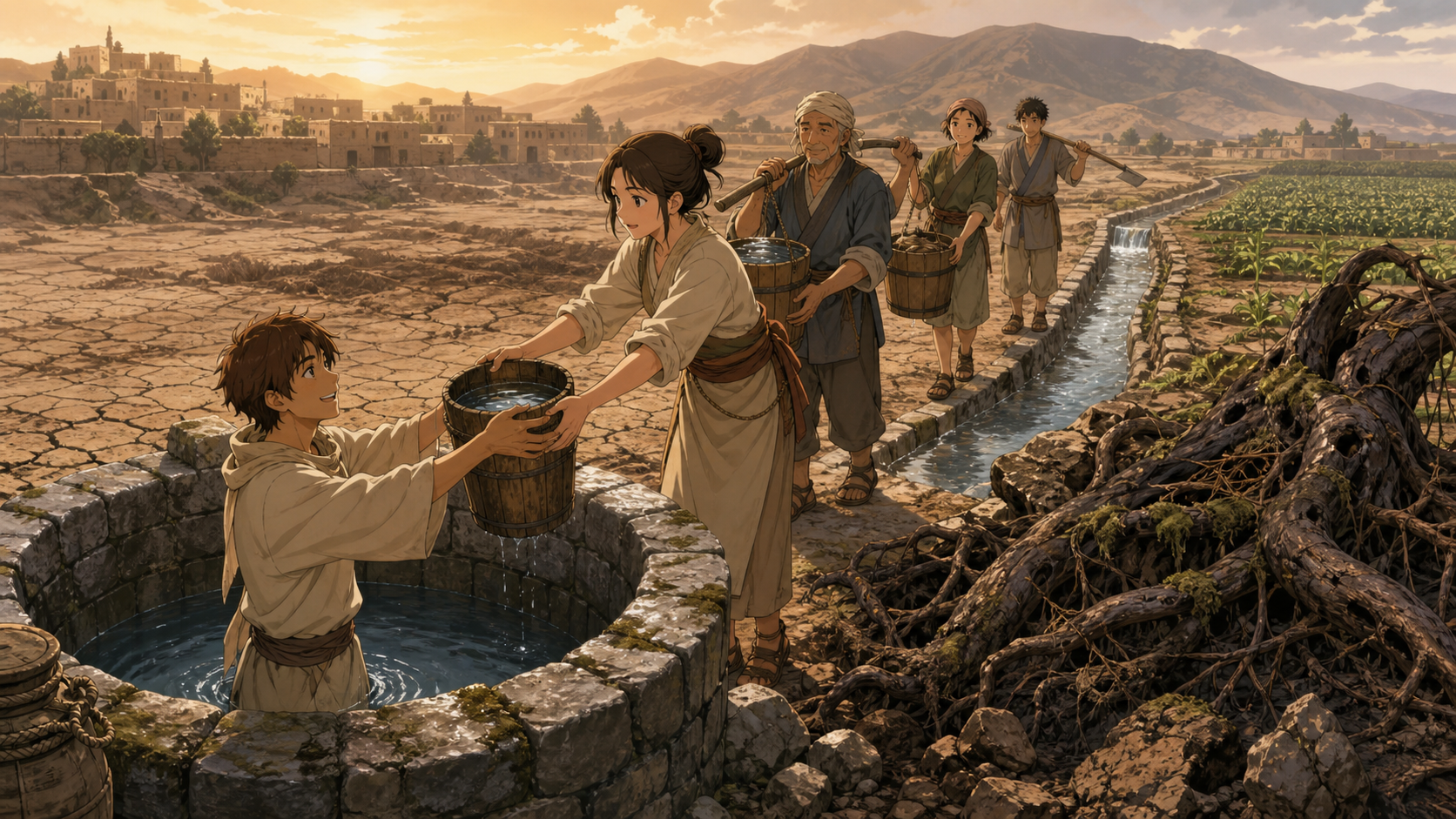
Ashura's Decision
People do not keep consuming poison because nobody warned them; change becomes possible when a community builds an alternative it can survive.
Bottom line
“Asura's Decision” understands that people do not keep consuming poison because nobody bothered to tell them poison is bad. Kanna's village knows the God Tree carries danger. The same sap making residents sick also fertilizes barren soil that once failed through annual drought and starvation. Asura arrives with a correct diagnosis, announces the threat, reveals his connection to Ninshu, and immediately loses the room. He earns trust only after refusing the false choice between destroying the tree now and abandoning everyone to hunger. Digging for clean water takes a year. Villagers join, learn Ninshu, and create the condition that lets them burn the contaminated roots without sacrificing their food supply. Indra solves his assigned village's matching problem alone and returns first. Asura returns late with people walking beside him. The episode clearly favors collaboration, but its strongest argument is more specific: safe change requires an alternative people can live on. Nobody owes a reformer applause for removing a deadly system when that system also supplies tomorrow's meal.
Episode 467 continues an anime-created trial
Episode 467 is titled “Asura's Decision.” The Japanese title is “Ashura no Ketsui.” The episode aired in Japan on July 7, 2016.
The ancient brothers are canonical, while this village, its illness, and the yearlong water project expand their history for the anime.
Chakra confirms the hidden source
Asura feels his chakra react beneath the village. The response connects the residents' illness to the remains of the God Tree.
His body becomes an investigative tool, not a complete answer.
Sap has entered the soil
God Tree residue enriches land that would otherwise be barren. Crops grow because the damaged root system continues releasing extraordinary energy.
Agricultural success conceals biological harm.
Food carries contamination home
People and animals eat produce grown in affected ground. Small exposure accumulates across years until residents become sick.
The danger travels through ordinary nourishment rather than a dramatic attack.
Illness is built into survival
Families cannot avoid exposure through a single personal choice when every harvest depends on the same soil. The problem belongs to infrastructure.
Individual discipline cannot purify a food system.
Taizo worries about recent exposure
He has eaten village food and reacts with alarm. Asura explains that he can address a small amount before long accumulation causes greater harm.
Privilege becomes visible through temporary access and quick departure.
Visitors can leave
Asura and Taizo have homes elsewhere, healing knowledge, and no lifelong dependence on the harvest. Residents face every consequence of whatever solution follows.
Outside certainty must yield to local risk.
The guarded cave suggests prior knowledge
The village elder restricted access to the roots before Asura arrived. Secrecy indicates that leadership already understands part of the danger.
Hidden knowledge has managed fear without ending exposure.
Kanna joins the confrontation
Asura and Taizo bring an affected villager when they question the elder. Kanna's presence keeps the inquiry connected to families living with the illness.
She is evidence, witness, and participant.
The elder remembers the drought
Before God Tree residue fertilized the area, yearly water shortages destroyed crops. Hunger killed residents in large numbers.
The poisoned oasis replaced an immediate catastrophe.
Starvation explains the bargain
Communities facing death do not choose between perfect health and contamination. They choose the danger that allows another season.
The elder's decision belongs to scarcity, not ignorance.
Secrecy protected a fragile settlement
Public knowledge might cause panic, abandonment, or outside interference without supplying water. Concealment preserved order at the cost of informed consent.
Survival does not erase that ethical debt.
Kanna accepts the inherited risk
She initially resigns herself to remaining and enduring the illness. Her response may look passive, but leaving land, family, graves, and food is not a simple option.
Attachment carries material constraints.
Asura tells the whole village
He makes the contamination public rather than preserving the elder's secret. Residents deserve knowledge about what enters their bodies.
Disclosure creates responsibility for what happens after fear arrives.
The messenger loses credibility
Villagers turn against Asura when they learn he comes from Hagoromo's Ninshu settlement. Their distrust predates his personal conduct.
An institution's reputation follows every representative.
Chakra has already harmed them
The God Tree made human life into fuel, and its remains continue poisoning descendants. A chakra teacher promising rescue can sound like another owner of dangerous power.
History shapes reception.
Correct facts do not create consent
Asura knows the source and can probably destroy the roots. The villagers still control whether an outsider removes what keeps their fields alive.
Expertise cannot substitute for permission.
Burning the tree would end fertility
Immediate destruction may stop new contamination while returning the region to drought and hunger. A technically successful intervention could kill people through a different route.
Health includes food and water.
Leaving the tree preserves slow harm
Doing nothing protects the next harvest but guarantees continued exposure, illness, and death. The existing arrangement is not a sustainable compromise.
Delay needs a purpose and limit.
Asura rejects the false choice
He decides to help without destroying the roots first. His answer is not permanent tolerance for poison.
He will build the alternative before removing the dependency.
Clean water becomes the necessary condition
A reliable well can support crops after the God Tree is gone. Water turns moral intention into a survivable transition plan.
The solution begins beneath the same ground holding the danger.
Asura accepts an unknown timeline
He admits the work may take years. The succession contest rewards a result, yet he refuses to make speed the village's highest priority.
Care changes his relationship to the deadline.
Kanna finds the first excavation
She discovers Asura and Taizo digging rather than preparing a destructive technique. Visible labor clarifies what his speech failed to communicate.
Trust returns through work people can inspect.
Taizo remains beside him
The friend once punished for clearing trees now helps with a project grounded in explanation and community need. His earlier mistake becomes practical education.
Loyalty matures into shared responsibility.
The villagers decide to join
Kanna rallies residents after learning the plan. Their participation changes Asura's project into a community project.
Consent becomes active authorship rather than reluctant permission.
Digging distributes knowledge
Every participant learns the soil, tools, water signs, and reasons for choosing particular locations. The solution does not remain locked inside Asura's technique.
Capacity stays after the visitor leaves.
Ninshu enters through cooperation
Asura teaches chakra practice while laboring with the village. The creed is no longer an outside demand attached to a warning.
Residents experience connection before accepting the name.
Teaching follows earned trust
He does not require conversion before offering help. Ninshu becomes useful within a relationship built through accountability and time.
Doctrine arrives after conduct.
A year refuses heroic pacing
The excavation continues across seasons rather than collapsing into one montage of effortless power. Duration distinguishes commitment from intervention tourism.
Asura lives with the consequences of his proposal.
Repeated failure tests the group
Dry attempts could have confirmed every fear about Asura's plan. Continuing requires residents to debate, adjust, and choose the work again.
Collective resolve is renewed, not assumed.
Asura needs everyone
His strength cannot locate and excavate a sustainable water source alone within a useful time. Dependence becomes an honest feature of leadership.
He succeeds by making room for other people's effort.
Kanna's mother gives the project urgency
The illness remains present while the well is dug. Long-term reform unfolds beside bodies that cannot wait comfortably.
Patience is necessary, but never emotionally neutral.
The graves prevent easy optimism
Past deaths remain proof that the village paid for every delayed solution. New cooperation does not retroactively justify secrecy.
Progress must remember who did not survive to see water.
Indra faces a matching problem
Hagoromo sent both brothers to villages harmed by the same God Tree legacy. Comparable starting conditions make their methods easier to examine.
The people and local histories are still not interchangeable.
Indra doubts collective agreement
He assumes villagers will not reach a decision together. Conflict and delay appear to him as evidence that shared authority cannot solve urgent harm.
Impatience strengthens unilateral rule.
He acts through personal power
Indra produces water and removes the dangerous tree without depending on the villagers' labor. The outcome addresses the stated material problem quickly.
Efficiency becomes his strongest evidence for command.
Fast relief has genuine value
People suffering contamination and drought benefit from an immediate safe resource. A slow process is not automatically kinder when illness continues during every delay.
The episode should not pretend speed lacks moral force.
A solution can create dependence on the solver
When one extraordinary person supplies the entire answer, residents may not gain the knowledge or organization required for future failure.
Delivery and durability are different measures.
Indra returns first
He completes the mission and reports home while Asura remains away. By ordinary contest rules, the older brother has done exactly what Hagoromo requested.
Waiting now changes the apparent criteria.
Hagoromo delays the decision
He refuses to select a successor until Asura returns. The delay protects the slower method from automatic defeat.
Indra can reasonably experience the changed timeline as special treatment.
The test lacked transparent standards
Hagoromo never said whether speed, community participation, permanence, safety, or obedience would matter most. He intends to judge character through results.
Unstated criteria invite resentment even when the final judgment has wisdom.
Black Zetsu meets the waiting heir
The manipulator uses Indra's completed mission and delayed recognition as another opening. He can frame patience for Asura as theft from Indra.
Institutional ambiguity becomes personal grievance.
A year changes Asura's arrival
He finally returns to the Land of Ancestors with villagers beside him. Their presence is not decoration for a victorious entrance.
They are evidence that the relationship continued beyond a task.
Clean water makes removal possible
The community eventually reaches a safe source. Only then can residents destroy the God Tree remains without returning to the conditions that caused mass starvation.
Sequence protects survival.
The village burns the roots
Removal becomes a collective choice supported by a viable alternative. Residents are not passive recipients watching Asura decide their future.
They end the dependency they once needed.
Kanna's mother can recover
Stopping further exposure gives healing a chance to hold. Her body connects the environmental project back to a specific household.
Infrastructure becomes intimate.
Gamamaru observed both missions
The toad sage supplies Hagoromo with information beyond each son's self-report. His account confirms process as well as outcome.
Even so, observation from afar cannot capture every resident's judgment.
Hagoromo reaches his decision
Asura's method demonstrates the creed Hagoromo wants preserved: strength created through bonds rather than imposed from above. The choice follows a political philosophy.
Leadership and doctrine become inseparable.
Asura's success is not purity
He began by announcing danger without a trusted plan and previously acted on Taizo's lie without verification. The year matters because he learns while staying.
Growth, not hidden perfection, qualifies him.
Indra's success is not failure
He solved water scarcity and contamination quickly. The weakness lies in ownership of the solution and contempt for collective deliberation, not an absence of results.
The distinction makes the coming resentment more credible.
Community labor is not free
Villagers spend a year digging while sick, farming, grieving, and supporting households. Celebrating cooperation should not romanticize the burden transferred onto them.
Shared work needs shared credit.
The episode argues for transition design
Removing a harmful system requires replacing the function that made people depend on that system. Clean water comes before fire.
That order is the chapter's most useful political lesson.
The Naruto parallel stays visible
Asura's persistence, improvised chakra sphere, and ability to gather supporters anticipate Naruto. Familiar echoes make the lineage legible.
They also risk shrinking an ancient community story into foreshadowing for a later hero.
Kanna prevents that shrinkage
Her trust, family stake, and decision to rally neighbors give the village an internal actor. Asura cannot claim the outcome without her.
Local leadership turns help into collective change.
The title names commitment
Asura's decision is not simply choosing mercy over force. He chooses to remain until a safe alternative exists, even if succession passes him by.
Duration makes the promise measurable.
The next episode will expose the cost
Hagoromo's choice may honor collaboration while humiliating the son who completed the stated assignment first. A wise principle delivered through an opaque contest can still wound.
Black Zetsu is waiting inside that procedural failure.
The village is not irrational for keeping the roots
Residents know people are sick. They also remember drought, failed crops, graves from starvation, and the sudden fertility that let families remain on their land. Poison is not their preferred future. It is the price attached to the only survival system available.
Calling that choice ignorance would let scarcity disappear from the moral judgment.
Disclosure creates duties for the person disclosing
Asura is right to break the elder’s secrecy because residents deserve to know what enters their bodies. Once he announces the danger, he becomes responsible for more than winning the argument.
Fear without a transition plan can destabilize a community while leaving the underlying dependency untouched. Truth needs resources, time, and a route people can actually use.
Kanna changes outside help into local action
She brings Asura into a household, connects his failed treatment to a shared illness, joins the investigation, and later persuades neighbors to dig. Her participation is not approval added after the expert decides everything.
Kanna translates evidence through relationships Asura does not possess. The project becomes legitimate because an affected resident helps author it.
A year measures the promise
Asura stays through dry holes, seasons, illness, and the possibility that Hagoromo will select Indra before he returns. Duration gives the villagers evidence that he will not remove the roots and leave them with applause instead of water.
Commitment becomes visible when the work continues after novelty, gratitude, and easy confidence have disappeared.
Indra’s speed remains morally serious
Immediate clean water matters when people are being poisoned. The episode would weaken itself if cooperation were automatically good and efficiency automatically cruel. Residents living with urgent illness do not owe anyone a beautiful yearlong process.
The concern is durability and ownership. If only Indra can reproduce the solution, relief remains attached to the exceptional person who delivered it.
Shared labor must not become romanticized suffering
The villagers dig while sick, farming, parenting, and remembering people already buried. Their labor proves authorship, but it also represents a burden created by ancient violence and carried by people who did not choose the succession test.
Asura deserves credit for staying. Kanna and her neighbors deserve credit for making the result possible.
Clean water comes before righteous fire
Burning the God Tree roots first would look decisive and return the village to the drought that made poison survivable. Building water first changes what residents are free to choose.
That order is the episode’s real definition of consent. A meaningful no to the roots exists only after saying no no longer means hunger.
Consent is not a signature collected beside an impossible choice. It depends on whether people can refuse without losing food, water, shelter, medicine, or belonging. The well changes the village’s answer because it changes the cost of answering. Once survival no longer depends on poisoned fertility, destroying the roots becomes a community decision instead of an outsider’s moral demand.
RaeRae’s verdict
“Ashura’s Decision” understands transition better than many stories about heroic reform. The contaminated roots are killing people, and they are also feeding people. Asura’s diagnosis is correct, but correctness does not grant authority over another community’s survival.
He earns trust by staying long enough to build an alternative with Kanna, Taizo, and the village. Indra delivers faster relief through superior power. Asura helps people own the conditions that make removal possible. The second method wins because the community remains capable after the hero leaves.
Final verdict
“Asura's Decision” gives the ancient succession arc its clearest social argument. The God Tree is not merely an evil object waiting for a hero to burn. Poisoned sap makes people sick, but the same contamination turned drought-stricken ground into an oasis after starvation killed countless residents. Asura initially brings facts without trust and learns that diagnosis does not grant authority. His better choice is to stay, dig, teach, listen, and help create clean water before asking anyone to surrender the only fertility they know. Indra's quick solution remains materially impressive, which makes Hagoromo's coming choice morally interesting instead of automatic. One son delivers relief through exceptional power. The other helps a community own the conditions of its survival. CVM's verdict belongs with the second method, while remembering that villagers supplied a year of labor and Kanna transformed an outsider's promise into local action.
RaeRae’s call
Nobody owes a reformer gratitude for destroying the system supplying tomorrow’s meal. The village can reject the poisonous roots only after clean water makes rejection survivable. Kanna turns outside knowledge into local action, residents contribute a year of labor, and Asura accepts a timeline he cannot control. Indra proves exceptional power can deliver relief quickly. Asura proves leadership should leave people with knowledge, capacity, and choices that remain after the exceptional person goes home.
Episode details and viewing routes
- Official episode reference: Naruto Official episode guide
- Licensed episode route: Crunchyroll licensed episode page
What I am carrying forward
Asura learned the God Tree roots poisoned residents while fertilizing soil that once failed through drought. The village rejected immediate destruction because losing the roots without replacement meant hunger.
Kanna rallied her neighbors, and Asura stayed for a year while they dug for clean water, learned Ninshu, and built the conditions for removing the contamination together. Indra returned earlier after solving his village’s problem alone. Episode 468 asks Hagoromo to judge those two models of leadership.