
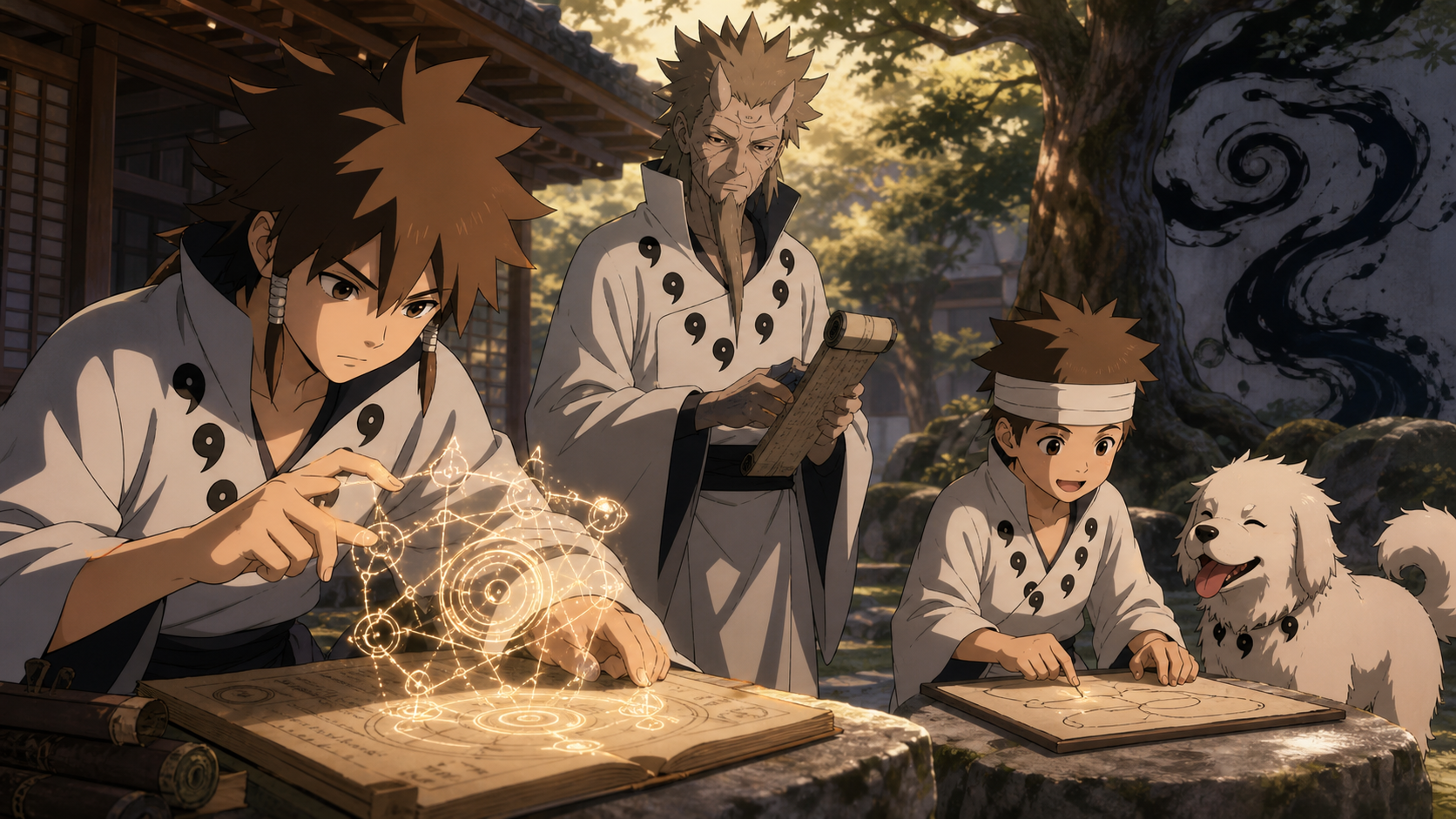
Ashura and Indra
Black Zetsu does not invent a cruel child; he enters the gap between Indra’s valid fear of chakra misuse and the safeguards his family never built.
Bottom line
“Asura and Indra” introduces the first person to turn Hagoromo's spiritual practice into a repeatable technique, then refuses to pretend invention arrives with its ethics already settled. Indra is brilliant, attentive, protective, and genuinely frightened by what shaped chakra could become. Black Zetsu does not manufacture a cruel boy from nothing. He finds a gifted child whose concern about misuse receives a philosophical answer instead of meaningful safeguards, then engineers grief around that open wound. Asura's failure matters too. His warmth draws friends close, but affection cannot replace preparation when a hunt becomes deadly. Shiro pays the price while both brothers learn the wrong lesson from the same attack. Asura sees the brother who saved him. Indra sees power awakened by loss. The episode's tragedy begins before hatred. A family praises talent, excuses avoidable danger, and leaves one grieving child alone with the stranger who arranged the funeral.
Episode 465 expands a brief family history
Episode 465 is titled “Asura and Indra.” The Japanese title is “Ashura to Indora.” The episode aired in Japan on June 16, 2016.
The brothers and their eventual conflict come from the manga, while most childhood events shown here are anime-original expansion.
Hagoromo's sons begin as companions
Indra and Asura study, fish, train, and spend ordinary time together. Their bond is not introduced as a rivalry waiting to happen.
The later feud hurts because closeness comes first.
The books reveal unequal aptitude
Indra moves easily through Hagoromo's written teachings. Asura struggles to stay awake and retain the same material.
Equal access does not produce equal performance, especially when instruction favors one kind of learner.
Indra fits the institution already built
The older brother reads quickly, concentrates alone, and turns abstract principles into systems. Ninshu's early school naturally recognizes those skills.
Praise follows the student who already speaks the institution's language.
Asura learns through participation
Asura understands people more readily than texts. His strength appears in friendship, persistence, and the willingness to keep trying beside others.
Those capacities are harder to score during a lesson.
Fishing turns difference into affection
Indra catches a large fish while Asura pulls up driftwood. The scene could humiliate the younger brother, but Indra transforms the wood into a fish and shares the joke.
Competence still feels generous here.
Transformation makes chakra practical
Indra uses shaped chakra to alter what sits in his hands. He has moved beyond exchanging spiritual energy for mutual understanding.
An idea becomes a tool with visible results.
Hand seals organize invention
Indra names the gestures seals and the resulting techniques jutsu. Naming matters because a private discovery can now be taught, repeated, corrected, and expanded.
He creates a technical vocabulary for the shinobi world.
Hagoromo witnesses a new branch of Ninshu
Indra demonstrates chakra manipulation before his father, brother, and other followers. The audience responds with admiration.
No one in the room can yet measure how far the discovery will travel.
Everyday usefulness accelerates adoption
Jutsu can support construction, food production, transport, protection, and countless domestic tasks. People embrace methods that reduce labor and solve immediate problems.
Utility spreads faster than doctrine.
Indra recognizes the danger himself
He worries that shaped chakra can injure, dominate, or kill. That concern proves he is not born believing power excuses harm.
The future antagonist begins with an ethical question.
Hagoromo answers with inevitability
His father argues that someone else would eventually have discovered the same practice. The claim may be historically sensible, but inevitability does not answer responsibility.
Discovery still needs rules, consent, and consequences.
A warning receives no structure
Hagoromo does not establish limits for training, protected knowledge, supervision, or repair after misuse. He trusts spiritual connection to guide technical power.
Indra leaves with concern acknowledged but unresolved.
Black Zetsu studies the opening
Kaguya's hidden will watches from outside the family circle. He sees talent, isolation, and an unanswered fear that can be redirected.
Manipulation begins with accurate observation.
The sparring match previews the imbalance
Indra handles chakra and combat with confidence. Asura struggles to reproduce even basic techniques.
Their difference becomes public performance rather than private study.
Clones make comparison unavoidable
Indra creates functioning copies while Asura's attempt fails. Every demonstration turns the older brother into a standard the younger one cannot reach alone.
Admiration and pressure grow together.
Futami predicts Indra's succession
Hagoromo's first follower believes Ninshu will be safe under Indra. The assessment follows visible mastery, discipline, and innovation.
Leadership appears to be the natural prize for excellence.
Succession talk changes childhood
Once adults identify a likely heir, every achievement carries political meaning. Indra is no longer simply learning beside his brother.
He is being measured as the future of a movement.
Asura remains surrounded by friends
The younger brother leaves formal practice to spend time with Taizo, Edashi, Gasuka, and their dog Shiro. His social ease supplies belonging that skill cannot yet provide.
Friendship becomes his classroom.
The damaged fields create a real problem
A wild boar has been destroying crops. The children decide to hunt the animal rather than bring the danger to experienced adults.
Their confidence outruns their preparation.
Friends mistake access for mastery
They assume Asura's Ninshu training will protect the group if trouble comes. Association with a powerful teacher becomes evidence of ability he has not demonstrated.
Reputation hides risk.
Asura agrees to the hunt
He wants to help and does not puncture his friends' confidence. Kindness without an honest assessment of capacity can place everyone in greater danger.
Good motives need boundaries.
Indra senses the watcher
The older brother has noticed a presence around him before their direct meeting. Black Zetsu uses secrecy to control when and how contact occurs.
Uncertainty keeps Indra attentive.
Black Zetsu speaks as a private teacher
He approaches beyond Hagoromo's supervision and frames hidden power as truth the father has failed to explain.
The manipulator offers exclusive knowledge where family communication left silence.
Loss becomes his proposed key
Black Zetsu tells Indra that losing someone he loves can awaken greater ocular power. Grief is presented as a mechanism rather than a wound deserving care.
The lesson makes attachment feel dangerous and useful at once.
Indra immediately fears for Asura
His response is concern for his brother, not hunger for power. The scene preserves the love Black Zetsu plans to exploit.
Protection sends Indra toward the trap.
The boar attack is not an accident
Black Zetsu arranges the danger around Asura's group. He does not merely advise a vulnerable child after tragedy.
He manufactures the conditions that make his advice appear prophetic.
Asura's training fails under pressure
When the boar charges, Asura cannot shape chakra reliably enough to stop the animal. Classroom frustration becomes immediate physical danger.
Effort has not yet become competence.
Shiro protects the children
The dog places his body between the boar and the group. His loyalty carries the cost created by their reckless hunt and Black Zetsu's intervention.
Shiro's death cannot be reduced to a power trigger.
The children confront consequence
Their plan promised adventure and crop protection. The attack leaves them terrified, injured, and grieving.
No adult praise can erase the life lost through preventable exposure.
Indra arrives as the rescuer
He reaches Asura before the boar can finish the attack and orders his brother clear. The gifted child performs the role everyone expected him to fill.
Protection and superiority become harder to separate.
Lightning ends the threat
Indra uses a concentrated lightning technique to kill the boar. His innovation proves decisive where Asura's practice failed.
Jutsu's first great moral contradiction becomes visible: lethal force saves lives.
The Sharingan awakens through grief
Fear for Asura and the sight of Shiro's death trigger Indra's eyes. Love produces power through pain.
Black Zetsu has converted a relationship into an experiment.
Asura sees a changed brother
He notices the new eyes while processing rescue and loss. Indra remains the person who came for him, but something private has opened between them.
The family bond survives without understanding what entered beside grief.
Black Zetsu validates his own prediction
Because the attack produced the awakening he described, his secret teaching now looks credible. Manufactured evidence is one of his strongest weapons.
Indra has reason to listen again.
Indra demands an explanation
He confronts the hidden figure rather than accepting the encounter passively. Suspicion remains active.
Black Zetsu answers with another invitation to use the eyes and discover truth alone.
Seeing becomes an ideology
The Sharingan promises perception beyond ordinary trust. Black Zetsu encourages Indra to treat private vision as more reliable than shared testimony.
Isolation begins to resemble insight.
Grief receives no communal ritual
The episode gives Shiro's death enormous narrative force but little sustained collective care. Indra returns to training while the children absorb the loss.
Unprocessed grief becomes available for doctrine.
Indra trains with new severity
His focus hardens after the awakening. Practice no longer looks like joyful invention shared with Asura.
Mastery becomes protection against helplessness and proof that private pain produced value.
Other students feel the change
Indra grows more distant and demanding during group instruction. A teacher's unresolved fear can become pressure placed on every learner nearby.
Excellence starts losing generosity.
Asura still admires him
The younger brother remembers rescue more clearly than the emerging coldness. Gratitude delays recognition of how their relationship is changing.
Love can preserve contact without supplying accurate diagnosis.
Hagoromo misses the engineered crisis
He sees his sons' abilities and temperaments but does not know Black Zetsu arranged the attack. Parenting without full information remains vulnerable to an expert manipulator.
Power offers no automatic access to a child's private life.
Talent becomes a lonely assignment
Everyone expects Indra to invent, master, protect, and eventually lead. Few people ask what those expectations cost after he has witnessed death.
The prodigy is praised where he needs accompaniment.
Asura is not morally complete
Warmth does not absolve his reckless choice to join the hunt without sufficient skill. The story's future preference for cooperation should not erase this failure.
Community must include accountability.
Indra is not yet a tyrant
He worries about harmful jutsu, loves his brother, rescues children, and challenges a suspicious stranger. Those choices matter.
Later cruelty will be a development, not an original essence.
Black Zetsu exploits systems, not destiny
He uses succession pressure, weak safeguards, secrecy, grief, and unequal recognition. None requires supernatural mind control.
The method works because ordinary vulnerabilities already surround the family.
Ninjutsu begins with mixed moral evidence
Transformation creates delight, practical techniques ease work, clones support training, and lightning saves Asura. The same framework makes violence easier to repeat.
The tool's history resists a clean verdict.
The episode questions meritocracy
Indra appears most qualified because the institution rewards his visible strengths. Asura's collaborative ability cannot be measured until a community problem demands time, trust, and shared labor.
Succession criteria shape the winner before any trial begins.
The brothers inherit different kinds of attention
Indra receives admiration, expectation, and predatory interest. Asura receives friendship, protection, and lowered expectations.
Neither arrangement gives both children honest challenge and dependable care.
Shiro deserves more than symbolism
The dog's death saves the children before Indra arrives. Treating Shiro only as fuel for the Sharingan repeats Black Zetsu's logic.
Loyalty has value beyond what grief unlocks in somebody else.
This chapter starts the cycle with a choice
Black Zetsu chooses to stage danger. The children choose an unsafe hunt. Indra chooses rescue, then increasingly private training.
History may repeat, but every repetition travels through decisions people could confront.
The Naruto and Sasuke parallel stays incomplete
Asura resembles Naruto's social persistence, while Indra anticipates Sasuke's talent and visual power. The comparison helps, but neither ancient brother should become a costume for his descendant.
Their specific family conditions deserve attention.
The next test will formalize the divide
Hagoromo must eventually select a successor. Episode 465 has already shown why a simple contest will carry emotional weight far beyond the assigned task.
Leadership, love, grief, and recognition now occupy the same family argument.
Indra asks the question the adults should keep asking
He does not celebrate jutsu as uncomplicated progress. He recognizes immediately that repeatable chakra techniques can injure people, concentrate authority, and travel farther than the spiritual relationships meant to guide them.
Hagoromo answers that discovery was inevitable. Maybe it was. Inevitability describes what may happen; it does not decide who teaches the technique, what limits surround it, or who repairs the harm after misuse.
Safeguards are part of invention
A responsible system would separate beginner practice from lethal applications, supervise experimentation, require consent, document risks, and create consequences for abuse. None of that appears because Ninshu assumes understanding will discipline power.
Indra leaves the conversation knowing his fear was heard and not knowing what anybody plans to do about it. Black Zetsu enters the distance between recognition and action.
Prodigy praise can become emotional abandonment
Adults admire Indra’s speed, precision, invention, and apparent fitness to inherit the movement. That praise gives him status while quietly assigning him responsibility for everyone’s future.
Competent children are often treated as if competence removes their need for accompaniment. After Shiro dies, Indra receives more power and more expectation when he needs grief witnessed without being converted into destiny.
Asura’s kindness does not make the hunt safe
His friends believe Ninshu training guarantees protection, and Asura does not correct them. Wanting to help the farms is generous. Entering a dangerous hunt without enough skill, adult support, or an exit plan exposes every child and Shiro to preventable harm.
Community is not a substitute for competence. Honest care includes naming what the group cannot safely do yet.
Shiro acts before either chosen brother
The dog does not know about succession, reincarnation, ocular evolution, or Black Zetsu’s plan. Shiro sees children in danger and places one vulnerable body between them and the boar.
That act deserves to remain a life-saving choice, not scenery around Indra’s awakening. When a story values the power produced by death more than the one who died, it begins speaking the manipulator’s language.
Black Zetsu manufactures credibility
He predicts that loss will unlock Indra’s eyes, then arranges the attack that produces loss. When the Sharingan appears, cruelty looks like secret wisdom because the experiment was rigged to confirm the lesson.
This is more effective than a simple lie. Indra has bodily evidence that the stranger understood something his father never explained. The evidence is real even though its conditions were engineered.
Private vision becomes a dangerous substitute for relationship
Black Zetsu tells Indra to use his eyes and discover truth alone. The invitation flatters the exact strength everyone praises while directing him away from shared testimony, correction, and care.
Seeing more does not guarantee interpreting well. Isolation can make perception feel pure because nobody remains close enough to challenge the meaning assigned to what was seen.
The family needs grief practice as much as chakra practice
Students repeat hand seals, compare clones, and measure technical control. Nobody appears to have a ritual for Shiro, a protected conversation for the frightened children, or a way to examine why the hunt happened.
Unprocessed loss does not vanish. It becomes available to ambition, shame, doctrine, and anyone willing to explain the pain first.
Care must arrive before manipulation does.
RaeRae’s verdict
“Ashura and Indra” works because the brothers are not born as moral labels. Indra is protective and ethically alert. Asura is warm and dangerously underprepared. Both love each other. The tragedy grows from how adults interpret their differences and what nobody builds around them.
Black Zetsu does not invent the vulnerabilities. Succession talk, prodigy pressure, inadequate safeguards, reckless confidence, and unattended grief already exist. He arranges the wound and offers the first convincing explanation. That is manipulation at its most frightening: not creating a new person, but teaching a hurt child to misunderstand the person he already was.
Final verdict
“Asura and Indra” works best when read as a story about neglected safeguards. Indra invents a powerful language for chakra and immediately asks the correct ethical question. Hagoromo gives him perspective, but no structure capable of governing the danger. Black Zetsu enters that gap, kills the family's dog through an engineered attack, and teaches Indra to read grief as proof of secret knowledge. The episode sometimes leans too heavily on familiar Naruto and Sasuke parallels, especially when natural genius and struggling warmth divide so neatly between the brothers. Shiro's death also deserves more emotional space than the plot grants. Still, the central warning lands. Evil does not always begin by persuading someone to hate. Sometimes evil arranges a preventable loss, predicts the wound, and waits for a frightened child to mistake accurate cruelty for wisdom.
RaeRae’s call
Indra’s fear about jutsu is not proof that he was always destined for tyranny. It is the correct question left without a practical answer. Hagoromo offers trust where the invention needs safeguards. Adults offer praise where the prodigy needs accompaniment. Asura offers heart where the hunt needs preparation. Shiro pays the cost, and Black Zetsu turns an engineered death into evidence. Preventing the cycle requires structures of care before a manipulator arrives, not blame after he succeeds.
Episode details and viewing routes
- Official episode reference: Naruto Official episode guide
- Licensed episode route: Crunchyroll licensed episode page
What I am carrying forward
Indra transformed Ninshu into repeatable jutsu and immediately questioned how shaped chakra could be governed. Hagoromo treated discovery as inevitable but built no visible safeguards around the danger.
Black Zetsu arranged the boar attack, Shiro died protecting Asura’s group, and Indra awakened the Sharingan while rescuing his brother. The manipulator’s prediction now looks credible because he manufactured its proof. Episode 466 sends Asura and Indra into a leadership trial carrying very different lessons from the same loss.