
RaeRae Reacts · One Piece Episode 145
The Sky Goes Dark at Noon
One Piece Episode 145 brings giant shadows, a stolen Jaya Eternal Pose, Ace on Buggy’s ship, and the protection carried by Whitebeard’s name.
The turtle turns the divers’ air hoses into tow cables
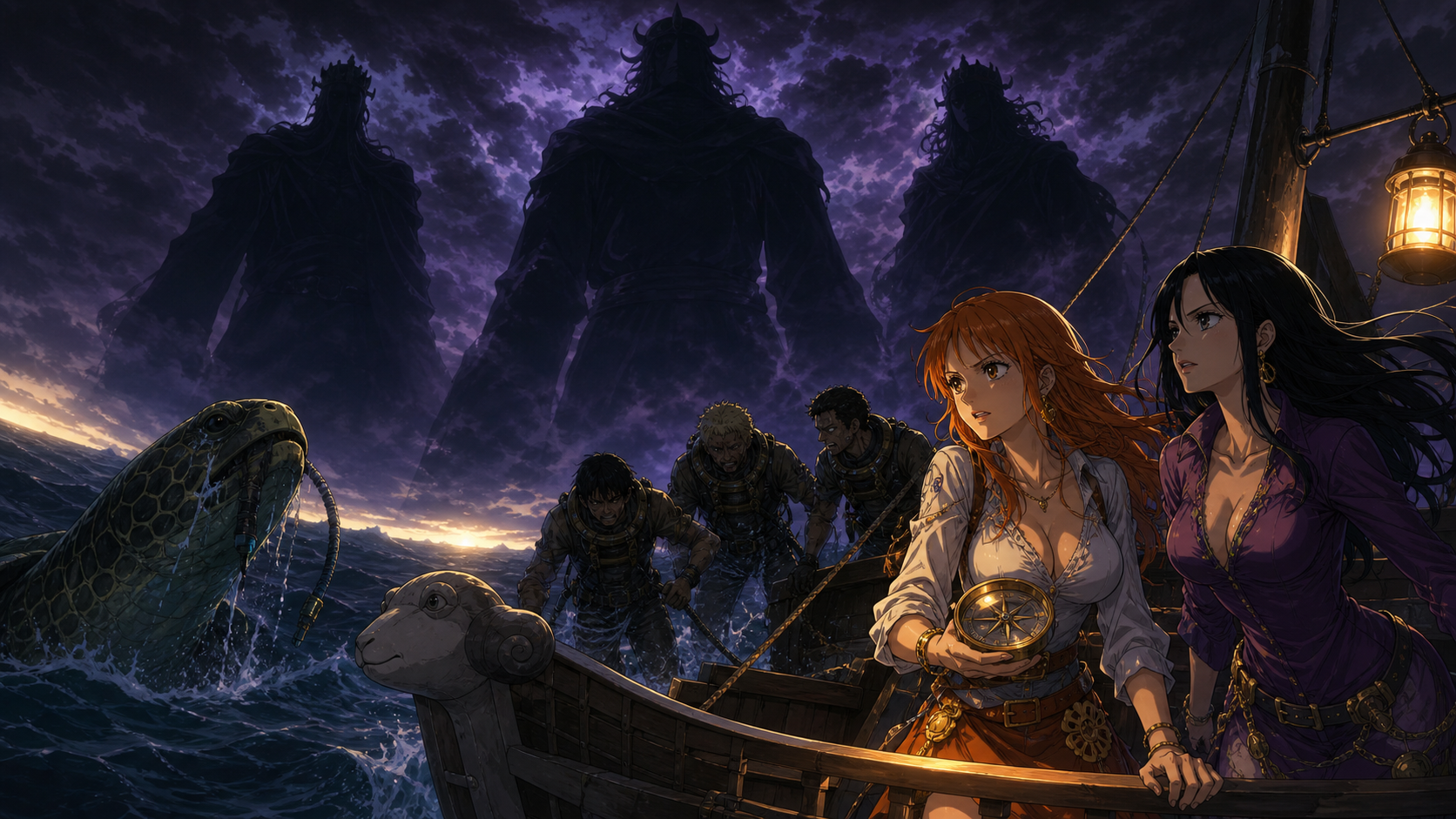
Episode 145 opens with the giant turtle holding the diving hoses while the Going Merry strains against the pull. Equipment meant to keep three people alive now threatens to drag the entire ship under.
Nami considers cutting the hoses because the vessel carries everyone else. The choice cannot wait for certainty, but severing the lines could abandon Luffy, Zoro, and Sanji inside the turtle or the wreck.
The deck team should secure a second line to the divers, reduce sail resistance, release nonessential load, and establish a final cut threshold based on hull angle and water intake.
Chopper needs emergency breathing support ready. Every person hauled from the water should receive assessment before argument, celebration, or another dive.
Robin reads the hose position as evidence of where the crew went
Robin follows the equipment rather than guessing from panic. The hoses disappearing into the turtle’s mouth support the fear that the divers and wreck were swallowed.
Evidence still has limits. A hose path does not prove every diver remains attached, alive, or inside the same space.
The surface team should check air flow, line tension, signals, bubbles, and whether any person responds. Multiple observations can guide rescue while avoiding a false claim of certainty.
Robin’s calm delivery matters because Nami must make a high-stakes decision. Useful information names both the strongest conclusion and the remaining uncertainty.
A decision log would help after the crisis. Someone should record when tension increased, when darkness began, which signals failed, and why Nami considered cutting the hoses. That record protects the crew from rewriting a frightening choice after everyone knows the outcome.
Sudden darkness changes the emergency without explaining the cause
Daylight vanishes while the ship remains under tension. Masira’s crew calls the darkness an omen and urges immediate retreat.
Fear may notice danger before analysis catches up, but superstition cannot define the response. The crews need to check cloud cover, wind, temperature, wave direction, and whether a large object blocks the sun.
Lanterns should come out before anyone loses footing. Lookouts need assigned sectors because darkness can hide debris, the turtle, or another vessel.
No one should shame the salvage crew for panic. Their local experience may include repeated patterns the Straw Hats have never seen, even when their explanation uses folklore.
The divers surface alive and still need medical care
Luffy appears unconscious before Zoro and Sanji reach the surface. Survival becomes visible, but the event still involved drowning risk, pressure, impact, and possible oxygen loss.
They should be lifted horizontally when possible, kept warm, and checked for breathing, confusion, chest pain, bleeding, and ear injury.
Luffy’s Devil Fruit makes every underwater delay especially dangerous. Future dives require a full-body tether and one person assigned solely to retrieval.
Zoro and Sanji may insist they can continue. Chopper should retain medical authority to stop activity when symptoms suggest delayed complications.
Masira boards the Merry because the salvage conflict never ended
Masira reaches the Straw Hats after the rescue and blocks immediate departure. He wants answers about the wreck, his claim, and whatever the divers removed.
Boarding without permission escalates risk, especially while injured people occupy the deck. The crew should create distance from weapons and keep the medical area protected.
Nami can state what they found, what disappeared with the turtle, and which evidence belongs to the lost St. Briss rather than either pirate crew.
Masira deserves credit for equipment and labor. Payment or shared records would resolve more than another fight over treasure nobody recovered.
The colossal shadows turn false night into a scale problem
Three gigantic silhouettes appear across the dark horizon, dwarfing any giant the crew knows. The shapes seem close enough to crush ships with one movement.
Apparent size depends on distance, light, cloud height, and projection. The crew lacks enough information to identify bodies, shadows, or another optical effect.
Nami should move toward open daylight while Robin records direction, duration, silhouette shape, and the location of the sun. Usopp can estimate angles against the mast.
The correct immediate response is escape, not certainty. Documentation can happen while the ship leaves the possible impact zone.
Nami orders retreat before curiosity becomes negligence
The sky event offers another clue about the world above, but the crew has injured divers, unstable equipment, and a giant turtle behind them.
Nami chooses distance. A navigator must sometimes leave evidence unexplained because the vessel and passengers cannot safely remain.
Luffy should follow without turning the retreat into a challenge to his courage. Leadership includes accepting specialist decisions during conditions outside personal expertise.
Once clear, they can log the position and decide whether a better-equipped return makes sense. Leaving now does not erase the discovery.
The wreck yielded battle damage but no route to the sky
Sanji reports that the St. Briss showed signs of violent damage, yet the underwater search produced no practical instructions for reaching Skypiea.
Battle damage raises new questions about whether the ship fell because of combat, structural failure, weather, or events in the sky ocean.
Robin should record weapon marks, burn patterns, breach direction, and which sections were missing before the turtle swallowed the site.
A failed search still narrows the problem. The route likely depends on knowledge held outside the wreck rather than one surviving chart.
Robin takes a Jaya Eternal Pose without consent
Robin reveals an Eternal Pose taken from Masira’s ship. The object gives the crew a reachable destination where local salvagers may know more about sky-falling wrecks.
Theft creates a real cost. Masira’s crew may depend on that pose for navigation and return, so taking the instrument could strand them.
Emergency need does not erase responsibility. Robin should confirm that Masira has another route, return or replace the pose when possible, and document why she took the object.
The crew gains direction through her foresight, but competence should not become a blanket excuse for removing safety equipment from another vessel.
Nami should also duplicate the bearing rather than let one stolen instrument become another single point of failure. A charted heading, estimated distance, and visible landmarks can preserve the route if the pose breaks or must be returned before departure.
Jaya is a temporary route with a time limit
The Eternal Pose points toward Jaya while Nami’s Log Pose remains locked upward. Staying too long may allow the Log Pose to reset and erase their direct magnetic connection to Skypiea.
Nami should record the current needle angle, estimate the reset window, and set a departure deadline before anyone enters port.
The crew needs specific questions: who has seen falling ships, who studies vertical currents, which weather patterns produce sudden darkness, and who can reinforce the Merry.
A port full of stories can consume days. Every lead should be ranked by evidence, access, and time required.
Buggy plans to convert Luffy’s growth into his own fame
Elsewhere, Buggy explains that he wants Luffy to build a larger reputation before a future defeat. The strategy treats another person’s accomplishments as a resource waiting for extraction.
Buggy values the story people will tell more than the actual work required to earn respect. He wants one victory to overwrite years of difference.
His crew should understand that delayed revenge still exposes them to risk without guaranteeing status. Luffy’s allies, strength, and influence may grow alongside the bounty.
Leadership built on reputation gambling asks subordinates to finance one man’s insecurity. A crew deserves objectives connected to survival, shared reward, and informed agreement.
Mohji and Cabaji search for Captain John’s treasure without a safety plan
Buggy’s people chase another treasure lead while the captain develops his long revenge narrative. The search reflects a crew scattered across promises of easy status.
Treasure hunting requires maps, ownership research, supplies, communication, and a return schedule. Wandering a dangerous island without those basics can turn greed into a missing-person emergency.
Buggy should account for every team and provide recovery support rather than assuming failure is personal incompetence.
Repeated treasure schemes also need transparent records. Crew members should know who owns findings, who pays expenses, and who carries medical or legal consequences.
Ace boards Buggy’s ship and falls asleep among enemies
Ace arrives on Buggy’s vessel, then abruptly falls asleep in front of armed pirates. His confidence and medical sleep pattern create a moment of extreme vulnerability.
Mohji suggests killing him while he cannot defend himself. The proposal treats unconsciousness as permission and ignores the consequences for every person aboard.
The crew should establish distance, remove immediate hazards, and wait for Ace to wake. They may ask him to leave without attacking a sleeping guest.
Ace also owes others basic caution. Entering an unfamiliar ship and losing consciousness can provoke panic, mistaken medical intervention, or violence.
Buggy refuses because Whitebeard protects his people
Buggy stops the attack after recognizing Ace’s connection to Whitebeard. He understands that harming one crewmate could bring a response too powerful for his entire organization.
Deterrence protects Ace in the moment, but safety depends on feared retaliation rather than a shared rule against killing unconscious people.
Buggy’s memory of Whitebeard gives him useful risk awareness. He should communicate the scale clearly without using fear to humiliate his crew.
The scene shows why reputation can function as collective protection. The same system can also create unequal safety, where people without a famous captain receive no restraint.
A better crew rule would forbid attacks on unconscious people regardless of affiliation. Whitebeard’s retaliation can reinforce the boundary, but the boundary should survive when the sleeping visitor has no emperor behind him.
Whitebeard’s reputation carries both care and coercive power
Buggy describes a captain who does not forgive harm against his family. That promise tells allies they will not be abandoned and warns outsiders that every attack has consequences.
Protection should still remain proportionate and evidence-based. Automatic retaliation can punish uninvolved crew members or turn a misunderstanding into war.
A powerful organization needs procedures for confirming facts, recovering injured people, negotiating release, and distinguishing individual wrongdoing from collective guilt.
Ace benefits from Whitebeard’s shield even while asleep. The ethical question is whether that power creates durable safety or merely expands the radius of fear.
Ace wakes and turns a threat assessment into a party
Ace wakes without treating Buggy’s crew as enemies and quickly joins their food and celebration. His ease lowers tension, but nobody addresses the earlier plan to kill him.
Hospitality can reset a meeting while leaving risk unexamined. Buggy should clarify boundaries, confirm Ace’s purpose, and make sure the crew understands that violence is off the table.
Ace should disclose enough about his destination and departure to avoid becoming an indefinite passenger. Shared food does not create unlimited access to supplies or navigation.
The party works because both sides choose connection over escalation. That choice deserves structure so the peace lasts after alcohol, hunger, or fear changes the mood.
The episode connects local navigation to global power
The Straw Hats flee shadows they cannot explain while Buggy avoids a fight he understands too well. Both groups act under incomplete information, but consequences shape their decisions.
Nami uses observable danger to order retreat. Buggy uses institutional memory to stop opportunistic violence. Neither choice requires total knowledge before action.
Robin’s Eternal Pose moves the local mystery toward Jaya, while Ace’s presence hints that the wider sea already contains conflicts larger than one island search.
Good judgment means recognizing which unknowns demand investigation and which risks demand immediate distance.
Both crews also reveal the value of institutional memory. Nami relies on navigation rules, Robin on historical patterns, and Buggy on direct knowledge of stronger pirates. Memory becomes useful when leaders convert remembered danger into clear action rather than myth, panic, or boasting.
Episode 145 knows a shadow can be evidence without being an answer
The giant figures do not need an instant explanation to matter. Their scale, timing, and connection to sudden darkness tell the crew that the sky above Jaya holds forces outside ordinary navigation.
The same episode refuses to make reputation empty. Whitebeard’s name changes behavior because people believe he will act for his crew, while Buggy’s planned reputation depends on a future shortcut.
RaeRae’s verdict: keep this one. Episode 145 turns fear into a test of judgment. Nami leaves before wonder kills the crew, Robin finds a practical lead but creates a debt, and Buggy accidentally demonstrates that real status protects people before applause arrives. The monsters on the horizon remain unexplained. The choices made beneath them reveal plenty.