
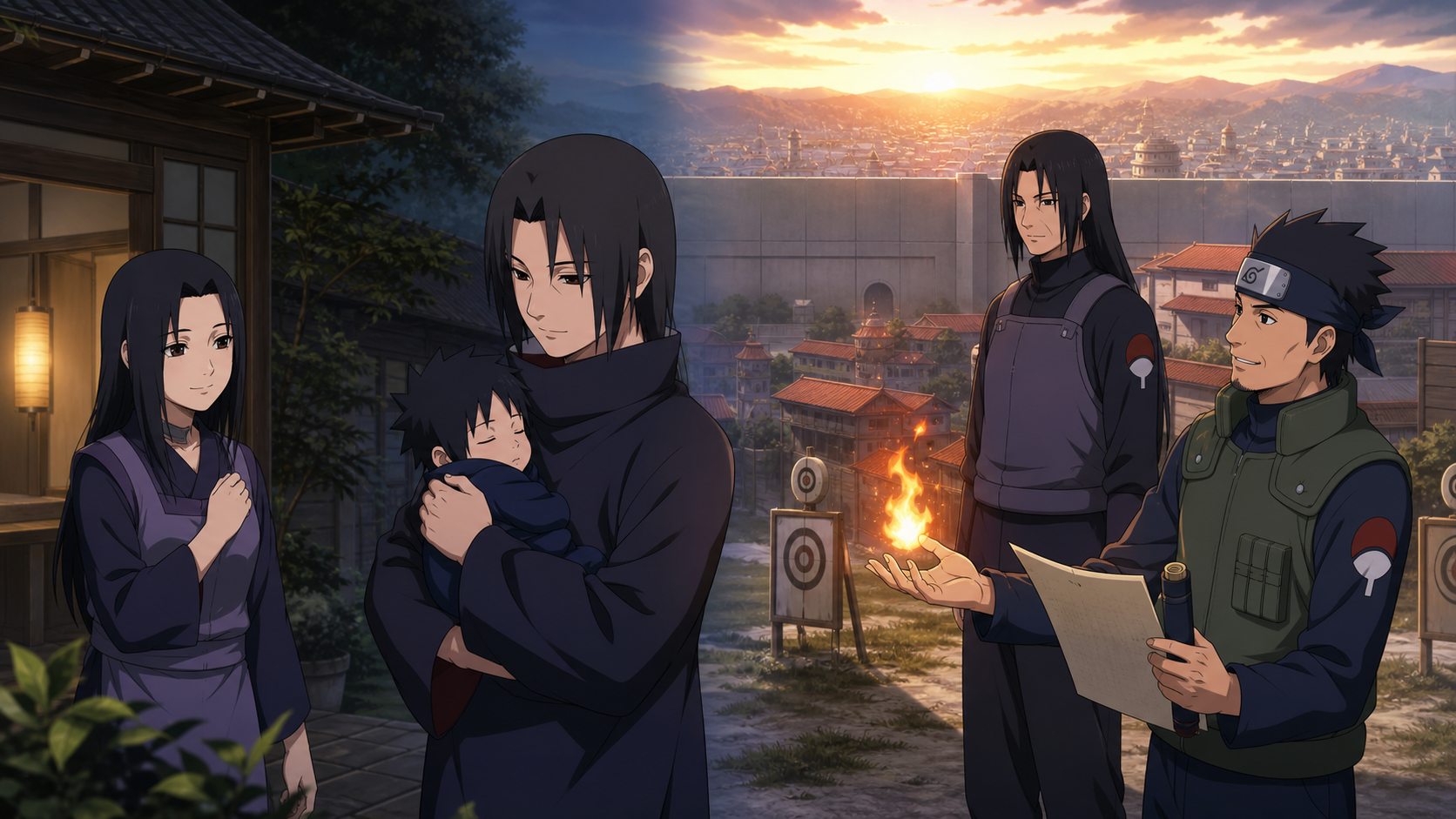
Itachi’s Story: Light and Darkness – The Genius
Every adult who calls Itachi a genius gains an excuse to ask more from him and notice less about what the traumatized child actually needs.
Bottom line
“The Genius” shows how Konoha turns one traumatized child into a useful symbol while pushing his family toward the village wall. Itachi protects baby Sasuke during the Nine-Tails attack, helps Izumi reach shelter, and watches adults rebuild Konoha around suspicion of the Uchiha. Then the Academy praises him for learning too fast, classmates punish him for making their own work look ordinary, and teachers treat isolation as evidence of exceptional promise. Yes, Itachi is brilliant. He masters the Great Fireball Technique almost immediately and uses a shadow clone before graduation. The title still carries a warning. Every adult who calls him a genius gains an excuse to ask more from him and notice less about what he needs. Talent becomes the respectable language used to hide neglect.
The Nine-Tails attack rewards the vigilance trauma created
Itachi notices danger, carries Sasuke, finds Izumi, and reaches shelter because he has already learned to scan the world for catastrophe. Those skills save lives. Their usefulness does not make the childhood conditions that produced them healthy.
This is how neglect becomes easy to praise. Adults see a calm child performing under pressure and congratulate the calm instead of asking why panic had to become familiar so early.
Relocation turns suspicion into daily geography
The Uchiha do not need a public conviction to understand what the village edge means. Distance from central Konoha controls movement, increases surveillance, and tells every child where officials believe the clan belongs.
Other families moving gives leadership administrative cover. Equal procedure can still produce unequal meaning when one group is already suspected because an unknown attacker used its bloodline power.
Izumi represents connection without extraction
She knows Itachi first as the boy who helped her survive, not as an asset, heir, rival, or impossible standard. Her gratitude asks nothing from his next performance. That makes the relationship unusual in his life.
The tragedy is not that Itachi lacks any path toward ordinary closeness. The path exists. Institutions keep offering faster, louder rewards for isolation, mastery, and usefulness.
Early graduation solves the school’s problem
Itachi is bored, ahead of the curriculum, and using a clone to satisfy attendance. Moving him forward is efficient for the Academy and appealing to a village that wants his talent available.
It does not solve grief, peer isolation, or the habit of dividing himself to meet institutional demands. The system removes the inconvenient child from class and calls acceleration support.
Shisui proves challenge and care can coexist
He does not ask Itachi to hide his ability so other people feel comfortable. He offers training difficult enough to matter while treating the younger boy as a person. Skill becomes a shared language instead of a transaction.
That bond undermines the excuse that genius inevitably produces loneliness. Itachi is not unreachable. He responds when somebody can meet his ability without consuming his childhood.
The episode also exposes how institutions turn peer conflict into evidence for acceleration. Classmates resent Itachi because rankings make one child’s success feel like everybody else’s failure. Teachers then read his distance from those classmates as another sign that he belongs above them. Nobody questions the structure producing the resentment. Itachi should not have to perform incompetence to earn friendship, and other children should not be told their value shrinks beside his ability. A healthier school would challenge him without converting every relationship into a ladder. Care would measure belonging as seriously as speed, accuracy, and future usefulness.
RaeRae’s verdict
“The Genius” never needs to pretend Itachi is ordinary. He is spectacularly gifted. The problem is that every institution treats exceptional ability as evidence that ordinary developmental needs no longer apply. Fugaku sees an heir. The Academy sees accelerated service. Classmates see a ranking that diminishes them. Konoha sees future utility.
Meanwhile, Itachi sees Sasuke, Izumi, Shisui, another funeral, a relocated clan, and the consequences of an attacker nobody identified. He learns that protection receives praise, training offers control, and institutional compliance can be supplied through a clone. The title is accurate. It is also the label that lets adults admire adaptation while ignoring the trauma being adapted to. Talent should widen a child’s choices. Here, it narrows the road toward adult responsibility.
Episode 452 follows the child after the cliff
Episode 452 is titled “Itachi's Story: Light and Darkness – The Genius.” The Japanese title is “Isai,” a term for exceptional or unusual talent. The episode aired in Japan on March 10, 2016.
The story moves from the birth of Sasuke through the Nine-Tails attack and into Itachi's Academy years.
Tobi watches Konoha before the attack
A masked man surveys the village and disappears. The audience knows the disaster about to follow has a human hand behind the beast.
Konoha will later direct suspicion toward the Uchiha clan while the actual attacker remains hidden.
Itachi senses the same ominous wind
The uneasy air from the previous episode becomes a warning. Itachi notices danger before anybody explains the threat.
His alertness keeps him alive, but constant alertness is already replacing the ease a child should have at home.
The Nine-Tails appears inside Konoha
Kurama tears through buildings and streets under Tobi's control. Families scramble for shelter while shinobi rush toward a threat larger than any ordinary defense.
For Itachi, another war has reached the place that adults called safe.
Baby Sasuke becomes Itachi's first priority
Itachi does not chase glory or move toward the front line. He holds Sasuke and focuses on keeping his brother alive.
The decision shows his clearest moral instinct: protect the person whose safety has been placed in his hands.
A child carries another child through disaster
The image can look heroic because Itachi remains composed. The practical truth is harsher. A young boy is responsible for an infant while a tailed beast destroys their village.
His success should never make that burden look reasonable.
Itachi finds Izumi during the attack
Izumi Uchiha is also caught in the chaos. Itachi helps her move toward safety rather than limiting his concern to his own household.
The moment gives his compassion a second direction beyond Sasuke.
He guides Izumi to a shelter
Itachi gets Izumi where civilians can survive the attack. His judgment is fast, practical, and centered on another person's immediate need.
Nobody has to order him to help.
Izumi sees the person beneath the prodigy
Before Academy rankings and clan expectations define him, Izumi experiences Itachi as the boy who made sure she lived. Gratitude begins from action rather than reputation.
That history will matter as Itachi becomes harder for most people to approach.
Konoha survives at a terrible cost
The village eventually subdues the Nine-Tails, but homes and lives have been destroyed. Minato and Kushina die while sealing Kurama into Naruto.
Victory leaves a newborn jinchuriki, an orphaned village, and a political question ready for exploitation.
Another funeral teaches the same lesson
Itachi attends a service for the people killed during the attack. He has already seen public mourning after the Third Shinobi World War.
The village keeps holding ceremonies for deaths that its systems fail to prevent.
Izumi thanks Itachi
She speaks to him after the attack and acknowledges his help. The exchange is simple, which makes the connection feel human.
Itachi rarely receives uncomplicated recognition that asks nothing from his talent.
Reconstruction becomes a political decision
Danzō helps oversee how Konoha will be rebuilt. Streets, compounds, and clan locations are not neutral pieces on a map.
Who receives the center and who gets pushed outward reveals how power reads the disaster.
The Uchiha are moved to the village edge
The clan receives a settlement farther from Konoha's center. Officials can describe the move as reconstruction, but distance also makes surveillance and exclusion easier.
Architecture begins doing political work before anybody announces a formal accusation.
Other clans are relocated too
The Uchiha cannot object as though they alone were moved. That administrative cover gives village leadership a defensible answer.
Equal language can conceal unequal purpose and effect.
Suspicion follows the Sharingan
Konoha leaders know that a Sharingan can control the Nine-Tails. They do not know which Uchiha actually caused the attack.
The village turns a possible mechanism into collective suspicion without public evidence against the clan.
Tobi's secrecy protects the wrong conclusion
The masked attacker leaves the Uchiha clan to carry blame for his crime. His absence creates space for fear to write a convenient story.
The family suffers for the power of an enemy they cannot identify.
The clan notices the insult
Uchiha adults understand what the new location means. Their anger does not arise from wounded pride alone.
Physical removal confirms that Konoha sees them as a population to contain.
Fugaku keeps his reaction controlled
As clan head, Fugaku must weigh public resistance against the risk of confirming every suspicion. Silence can preserve temporary stability while allowing resentment to deepen at home.
His children grow inside that pressure without control over the political bargain.
Itachi asks to see the new training grounds
He studies the changed settlement through a practical request. Training offers a way to understand where his family now lives and what the move has given them.
He notices details adults may prefer to leave unexplained.
Fugaku begins teaching Fire Release
Fugaku demonstrates the Great Fireball Technique, an Uchiha coming-of-age standard associated with clan skill and approval. The lesson carries more than combat value.
Success can become a rare route to his father's recognition.
Itachi masters the fireball immediately
He reproduces the technique with astonishing speed. The result confirms that his reputation for genius is based on real ability.
The episode does not need to diminish his talent to question what adults do with that talent.
Fugaku sees a remarkable heir
Itachi's performance gives Fugaku reason for pride. The clan has a child capable of carrying its name and perhaps its future demands.
Praise arrives tied to usefulness before emotional closeness can develop on its own.
Itachi notices Fugaku's unease
His father looks toward the buildings around the relocated settlement. Itachi reads discomfort even when Fugaku does not explain every political implication.
The child keeps learning to interpret silence because adults keep important truths inside silence.
The new compound is not simply a home
Nearby structures and the clan's distance from central Konoha make the area easier to observe. The Uchiha settlement carries the feeling of a boundary drawn around a suspect population.
Itachi's training ground sits inside a growing political cage.
Itachi and Izumi enter the Academy
The two children begin formal shinobi education together. Izumi offers one familiar connection in a setting designed to compare students.
The Academy quickly turns Itachi's difference into rank.
Basic lessons cannot hold his attention
He understands the material faster than the curriculum expects. Repetition feels empty because his prior training and natural ability place him far ahead.
Boredom becomes another form of distance from his peers.
Itachi rises to the top of the class
Tests and exercises confirm his superior performance. Teachers gain a clean measure for what the village already wants to believe about him.
The number at the top cannot measure grief, loneliness, or his obsession with death.
Classmates admire and resent him
Exceptional performance draws attention from students who want to know him and students who feel diminished beside him. Itachi has done nothing wrong by learning quickly.
The classroom still makes his achievement a problem other children must emotionally manage.
Ordinary friendship becomes harder
Peers rarely meet Itachi without the title of genius entering first. Curiosity, jealousy, and competition crowd out the chance to approach him as another child.
His reserve then looks like proof that he never wanted connection.
Itachi asks Fugaku for harder training
Academy material no longer challenges him, so he requests more advanced instruction at home. The decision makes practical sense.
Training also gives him a structured alternative to the social world he does not know how to enter.
Fugaku rewards advancement
The father-son relationship continues through technique and achievement. Each new skill confirms Itachi's value to the clan.
Emotional needs remain easier to ignore when progress looks impressive.
Upperclassmen target Itachi's group
Older students provoke trouble around Itachi and his classmates. Their aggression turns school hierarchy into a physical test.
The Academy teaches cooperation while allowing status resentment to spill into violence.
Itachi appears to take the hit
The confrontation seems to catch him, giving the older boys a moment of satisfaction. They believe they have pulled the celebrated student back down.
Their victory lasts only until the body disappears.
The target was a shadow clone
Itachi used a clone to manage the confrontation while preserving his real objective elsewhere. The technique reveals planning as much as raw chakra control.
He solves a social threat by dividing his presence rather than engaging as himself.
He attends class through a clone
Itachi can satisfy Academy attendance while spending time training beyond the school curriculum. The workaround is clever and a little ridiculous in the best way.
A child has already learned how to give an institution the version of himself required on paper.
Shisui offers advanced companionship
Shisui Uchiha can meet Itachi at a level most classmates cannot. Their training gives Itachi challenge, trust, and a relationship that does not depend on pretending to be less capable.
Shisui becomes the rare older figure who treats him as both gifted and human.
Training with Shisui feels different
Shisui pushes Itachi without reducing him to a clan asset. Skill becomes shared work rather than a performance for approval.
Their bond shows that demanding training and genuine care can exist together.
The teachers discover the clone
Academy staff recognize that Itachi has mastered the Shadow Clone Technique before graduation. The discovery confirms ability beyond the normal student standard.
Institutional attention grows immediately.
A forbidden technique becomes another credential
Shadow clones carry risks because chakra divides among the bodies. Itachi's use should raise questions about access, supervision, and why a child feels compelled to bypass school.
The adults mainly see proof that the prodigy label was correct.
The Academy considers early graduation
Once Itachi exceeds the curriculum, moving him ahead looks efficient. Konoha has a history of accelerating talented children when the village can use their skills.
Efficiency and care do not mean the same thing.
Advancement cannot return his childhood
Graduating early may remove boredom and place Itachi among stronger shinobi. The promotion also sends him faster toward missions, violence, and adult responsibility.
The system answers isolation by increasing the burden that created isolation.
Genius becomes a village resource
Teachers, clan leaders, and officials see rare capacity. Each institution imagines what Itachi could do for its own future.
Few people ask what constant usefulness will do to the boy.
Izumi remains evidence of another path
Her gratitude and shared Academy experience show that Itachi can form bonds outside duty. He is not born emotionally unreachable.
Connection exists, but the systems surrounding him keep rewarding distance more reliably.
Sasuke remains the center of home
Through political relocation and Academy pressure, Itachi continues orienting himself around his little brother. Sasuke represents family without rank, at least while he remains an infant.
Protecting Sasuke feels simpler than trusting the adults shaping both boys' lives.
Konoha praises the result of its own neglect
War exposure made Itachi study life and death. The Nine-Tails attack made vigilance useful. Clan suspicion made observation necessary. Isolation made training attractive.
The village then calls the finished pattern genius as though talent developed outside those pressures.
The title is accurate and incomplete
Itachi truly possesses unusual intelligence, chakra control, perception, and discipline. Denying those qualities would flatten the character.
Treating those qualities as his whole identity would repeat the mistake every adult makes.
Episode 452 makes achievement feel dangerous
Each success moves Itachi closer to adult power and farther from children his own age. His fireball, rankings, clone, and advanced training all look like victories.
Together, they create a route toward service before he has healed from what service already showed him.
The Uchiha crisis grows beneath school life
The family has been relocated, suspicion has hardened, and Fugaku sees the insult surrounding their new home. Academy praise cannot separate Itachi from that political reality.
Soon, his access to both village and clan will make him useful to people on opposite sides.
The Genius ends with a child moving too fast
Itachi outgrows the Academy curriculum because his ability is extraordinary. Konoha responds by preparing to accelerate him deeper into the shinobi system.
Episode 453 will show the pain hidden beneath that advancement as missions, loss, and the Sharingan push him toward responsibilities no child should carry.
RaeRae’s call
Itachi is a genius. That truth should increase adult responsibility, not cancel it. Konoha praises the vigilance war created, moves the Uchiha under suspicion, rewards a child for bypassing school, and accelerates him toward service. Izumi and Shisui show another path: connection that recognizes ability without turning ability into ownership. The failure is not that Itachi learns too quickly. It is that nearly every adult sees speed and decides he needs less childhood.
Episode details and viewing routes
- Official episode reference: Naruto Official episode guide
- Licensed episode route: Crunchyroll licensed episode page
What I am carrying forward
Itachi protected baby Sasuke and helped Izumi survive the Nine-Tails attack. Konoha then relocated the Uchiha to the village edge while suspicion centered on Sharingan control of Kurama.
Itachi mastered Fire Release, topped the Academy, trained with Shisui, and used a shadow clone to attend class while training elsewhere. The Academy considered early graduation. Episode 453, “The Pain of Living,” follows the missions, loss, and Sharingan awakening hidden beneath that advancement.