
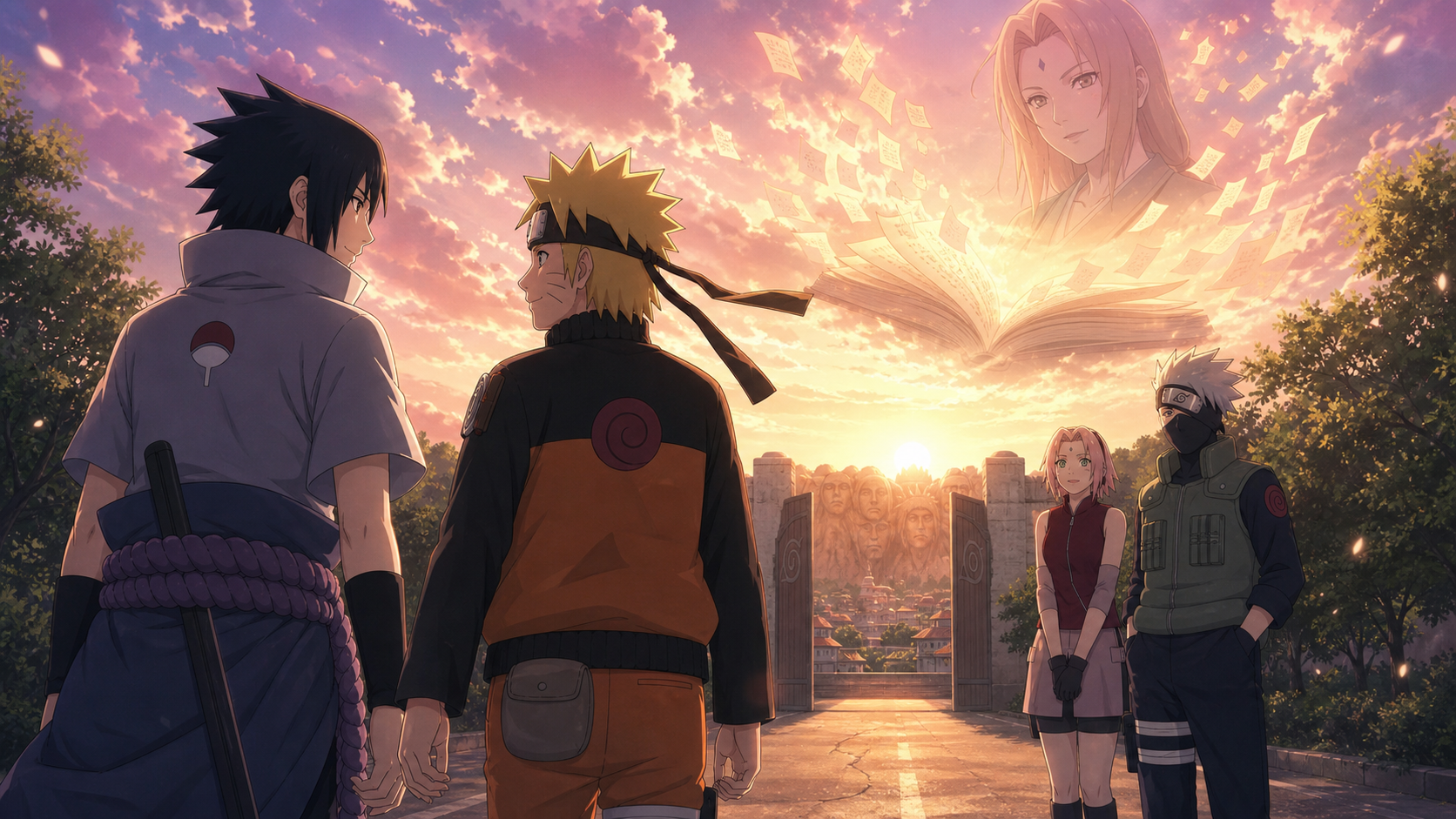
Rival
Naruto and Sasuke finally admit the jealousy beneath their hierarchy, but the reconciliation becomes bittersweet when the manuscript closes inside Tsunade’s larger prison.
Bottom line
“Rival” reveals that Sasuke never hated Naruto for being weak. He hated the moment Naruto stopped being safely beneath him. Fugaku and the Academy taught Sasuke to measure worth through rank, Itachi’s example, and the reputation of the Uchiha. Naruto ruined that system by rescuing a puppy when Sasuke froze, by acting before status gave him permission, and by growing stronger after Sasuke finally acknowledged him. Their final fight inside Jiraiya’s manuscript lets Sasuke say what three years of anger kept hidden: Naruto left him behind, and he was jealous. Naruto answers with his own jealousy and refuses to make friendship dependent on who wins. They return to Konoha together because rivalry finally becomes mutual recognition instead of a hierarchy. Then the manuscript closes, Dan wakes Tsunade inside another dream, and the real Tsunade remains trapped in Infinite Tsukuyomi. Jiraiya’s hopeful ending is moving precisely because the viewer can see the surrounding cage.
The puppy rescue breaks the ranking system
Sasuke can understand test scores, clan reputation, and formal technique. Naruto jumping into dangerous water for a living creature does not fit any of those measurements. The lowest-ranked student acts while the best student freezes.
Sasuke’s hesitation is not shameful. Turning that moment into proof that Naruto must remain beneath him is where shame becomes rivalry’s poison. Courage appears before authority gives permission.
Jealousy is information, not an excuse
Both boys finally admit wanting something the other possessed. Naruto envied Sasuke’s competence and recognition. Sasuke envied Naruto’s freedom to act, fail, recover, and keep belonging. Those feelings explain years of competition.
They do not excuse attacks, abandonment, humiliation, or coercion. Naming jealousy matters because accountability works better when the wound is visible and nobody has to pretend cruelty came from nowhere.
Kurama changes from resource to participant
The fox offers a name, explains the Tailed Beast Bomb, and helps Naruto use chakra without disappearing inside it. Instruction replaces the old bargain where power arrived only if Naruto surrendered control.
Naruto thanks Kurama. That exchange matters beside an arc filled with bodies used as vessels, puppets, seals, and weapons. Shared power begins when the source is recognized as somebody.
Sasuke’s return does not require ideological surrender
He can walk home with Naruto while keeping his argument about the shinobi world. Relationship becomes safer when disagreement no longer automatically means disappearance or a fight to the death.
Naruto also has to accept that friendship cannot be proven by forcing Sasuke into cheerful agreement. Proximity creates the chance for accountability. It does not settle politics on the road.
The dream frame changes the meaning of closure
Jiraiya’s manuscript gives Tsunade nearly everything she wants: Naruto’s future, Sasuke’s return, Dan, Nawaki, and Jiraiya himself alive enough to annoy her. The details sell comfort.
Then reality shows her bound to the tree. A healing fantasy becomes coercive when the person receiving it cannot consent, question it, or choose waking over the life it offers.
RaeRae’s verdict
“Rival” earns its reconciliation because Naruto and Sasuke finally stop pretending their conflict was only about strength. Each boy saw a quality in the other that made his own place feel unstable. Sasuke needed Naruto beneath him because Fugaku taught him relative position was love. Naruto needed Sasuke’s acknowledgment because loneliness made recognition feel like home.
The fight cannot erase what either caused, but the confession changes what repair can address. They return without declaring one winner, one owner, or one obedient friend. That hopeful ending is deliberately bittersweet. Jiraiya’s manuscript understands the bond, yet Infinite Tsukuyomi uses that understanding to hold Tsunade captive. A beautiful story can tell emotional truth and still become a cage when somebody else controls whether the reader may leave.
Episode 450 closes Jiraiya’s manuscript arc
Episode 450 is the final installment of the anime-original “Jiraiya Shinobi Handbook” story inside Tsunade’s Infinite Tsukuyomi dream. The Japanese title is “Raibaru,” meaning “Rival.” The episode aired in Japan on February 25, 2016.
The ending mixes a reconciliation fantasy with a return to the real war still waiting outside the dream.
Sasuke agrees to return but rejects the reset
After Sasori’s defeat, Sasuke accepts Konoha as his destination. He refuses to say that Team 7 can simply start over as friends.
Coming home and restoring trust are different decisions.
Sasuke keeps his political purpose
He says he intends to change the shinobi world through his own method. Return does not mean submission to the institutions that failed the Uchiha and enabled Danzō.
Konoha must face his criticism rather than use belonging to silence him.
Naruto keeps calling Sasuke a friend
Naruto will not allow Sasuke’s refusal to define the entire relationship. His loyalty has survived desertion, attack, and ideological distance.
That persistence can feel supportive or suffocating depending on which boy is speaking.
They return to Orochimaru’s old hideout
The final argument takes physical form at a place tied to Sasuke’s attempt to gain power outside Konoha. The abandoned lair holds the history of a mentorship built on possession.
Fighting there forces Sasuke to revisit why he left and what the path actually gave him.
Sasuke says his feelings did not change
One alliance battle has not erased years of resentment. Sasuke still wants to defeat Naruto and establish an independent direction.
His honesty prevents the reunion from becoming a performance for everyone else.
Naruto defines himself through the bond
When Sasuke asks what Naruto is, Naruto answers that he is a friend. Rank, prophecy, and bloodline do not enter the definition.
Naruto chooses relationship as identity even when the relationship offers no comfort.
Sasuke frames the fight as final proof
He says bringing Naruto down has occupied his thoughts for years. Victory appears capable of settling every comparison at once.
The standard remains impossible because defeating a person cannot erase what that person awakened in him.
Naruto accepts the challenge without accepting the premise
Naruto fights seriously but does not agree that losing will end their bond. Combat becomes a way to survive Sasuke’s refusal long enough for truth to surface.
His goal is not domination followed by obedience.
Fireball meets Fireball
The boys exchange a technique associated with Uchiha tradition. Naruto’s ability to answer Sasuke’s fire breaks the assumption that clan inheritance owns every expression of strength.
The mirrored attack begins the episode’s long review of rivalry.
Uchiha suspicion shaped Sasuke’s childhood
After the Nine-Tails incident, the clan lived under distrust and spatial isolation. Sasuke grew inside political pressure before he understood the policies creating that pressure.
Personal insecurity and collective grievance developed together.
Negotiation prevented the coup
Minato’s talks with Fugaku stopped volatile members from turning frustration into revolt. Peace came through sustained compromise rather than elimination.
The success changed Sasuke’s view of both the Hokage and Naruto.
Peace did not eliminate family comparison
The village avoided catastrophe, but Fugaku continued measuring Sasuke against Itachi. Political reform outside the home did not repair the hierarchy inside the home.
Sasuke still needed another target for the pressure.
Minato once asked Sasuke to be Naruto’s friend
At the Academy entrance ceremony, the Hokage introduced the children and proposed friendship. Fugaku answered that Sasuke would become Naruto’s rival.
An adult label preceded the boys’ own understanding of each other.
Fugaku turns relationship into competition
Calling Sasuke a rival may sound proud and harmless. For a child already compared to Itachi, the title creates another standard he must defend.
Friendship begins under the demand that Sasuke remain impressive.
Sasuke sees only the Hokage’s son
He initially evaluates Naruto through Minato’s rank. Naruto’s poor Academy performance makes the family status look undeserved.
Sasuke resents a child who seems free to fail without losing his place.
Academy rankings appear to settle the hierarchy
Sasuke finishes at the top while Naruto occupies the bottom. The result should satisfy the rivalry Fugaku predicted.
Instead, Sasuke feels annoyed because beating a loser offers no meaningful recognition.
Naruto cannot be a worthy rival while staying weak
Sasuke needs Naruto strong enough to validate victory but weak enough to preserve Sasuke’s superiority. No real person can remain inside that contradiction forever.
Rivalry becomes unstable the moment Naruto grows.
A puppy changes Sasuke’s understanding
The boys encounter a dog caught in dangerous river currents. Adults warn that attempting rescue could sweep another person away.
Status and technique suddenly matter less than willingness to act.
Sasuke freezes at the river
He sees the danger and cannot move. The top-ranked student discovers a situation that Academy success did not prepare him to enter.
His hesitation is human. Shame turns that hesitation into a private verdict.
Naruto jumps without calculation
Naruto enters the water and saves the animal. He does not pause to consider whether the rescue will improve his reputation.
His body moves because another living creature needs help.
Action reveals a strength rankings missed
Sasuke watches the lowest-ranked student do what he could not. The moment exposes courage as a capacity that cannot be read from exam results.
Naruto possesses something Sasuke values and cannot quantify.
Admiration first appears as anger
Sasuke says Naruto’s action made him furious. Admitting admiration would threaten the hierarchy protecting him from Fugaku’s comparisons.
Anger allows him to acknowledge Naruto without feeling smaller.
Minato’s negotiation deepens the change
When the Hokage peacefully prevents the Uchiha revolt, Sasuke revises his judgment of Naruto’s family. Minato shows strength through listening and political risk.
Naruto is no longer only the undeserving child of a powerful man.
Sasuke begins seeing a real rival
He recognizes that Naruto has qualities he lacks. Rivalry becomes reciprocal possibility rather than adult assignment.
That recognition could support friendship if superiority stopped being necessary.
Naruto remains outwardly foolish
Sasuke complains that Naruto keeps laughing, failing, and appearing unchanged. The visible foolishness makes later growth feel sudden.
Naruto’s work happened beneath a persona Sasuke dismissed.
Acknowledgment creates new fear
Once Sasuke admits Naruto matters, every gain Naruto makes can affect his identity. The rival becomes emotionally powerful.
Indifference was safer than attachment.
Naruto wanted to grow beside Sasuke
Naruto explains that he imagined shared training and mutual improvement. He did not understand his progress as abandonment.
The same growth carried opposite meanings to each boy.
Sasuke felt left behind
He says Naruto suddenly advanced and left him alone. The statement reveals loneliness beneath years of contempt.
Sasuke’s anger was never only about losing a contest. He believed the person he finally recognized had moved beyond him.
Comparison converts another’s growth into rejection
Naruto becoming stronger did not reduce Sasuke’s actual skill. A hierarchy-based identity makes relative position feel like belonging.
Falling behind feels identical to being abandoned.
Shadow clones make progress visible
Naruto multiplies across the battlefield and attacks with Rasengan. Techniques once dismissed as chaotic now display training and coordination.
Sasuke fights the evidence of the growth he feared.
Sasuke says desperation drove his training
He tried to keep up because Naruto’s improvement threatened the role he built for himself. Chidori development, the police mission, and Orochimaru’s curse all followed that pressure.
Hard work remains real even when the motive becomes destructive.
Naruto credits Sasuke too
Naruto says thinking of Sasuke as a rival helped him reach his own level. The influence was never one-directional.
Each boy became stronger partly because the other existed.
Mutual influence breaks the hierarchy
If Naruto owes growth to Sasuke and Sasuke owes growth to Naruto, neither can claim complete self-sufficiency. Rivalry becomes relational.
The admission makes superiority less important than continued challenge.
Sasuke still attacks to surpass him
Understanding does not immediately stop the fight. Sasuke activates greater ocular power and insists on bringing Naruto down.
Years of identity cannot dissolve through one accurate sentence.
Naruto combines Sage and tailed-beast power
He uses disciplined natural energy alongside the Nine-Tails chakra that once erased his control. Two formerly conflicting sources work together.
The combination represents growth through integration rather than rejection.
The fox gives Naruto a name
The Nine-Tails identifies himself as Kurama. Naming changes the relationship from boy and monster toward two subjects capable of cooperation.
Naruto thanks him rather than treating the chakra as an owned resource.
Kurama teaches the Tailed Beast Bomb
Naruto does not know the technique, so Kurama explains the connection to Rasengan. Instruction replaces the earlier temptation to surrender control.
The beast helps Naruto remain himself while accessing greater power.
Sasuke shapes black flame through Susanoo
Kagutsuchi and ocular power gather into his final assault. The technique carries clan inheritance, trauma, and years of lonely refinement.
Sasuke wants one collision to end the destiny he feels trapped inside.
Naruto refuses an ending based on destruction
He says he will stop Sasuke as a friend. The wording matters because victory alone would confirm Sasuke’s belief that relationships are hierarchies.
Naruto fights to preserve the person attacking him.
Their final attacks erase the battlefield
Tailed-beast power and Susanoo collide at full scale. Spectacle reaches the point where neither boy can maintain distance through technique.
The fight burns away every argument except the one neither wanted to say plainly.
Naruto repeats that Sasuke remains his friend
After the collision, Naruto refuses past and future tense. Sasuke has always been and will remain his friend.
The claim does not depend on behavior being harmless or acceptable.
A friend’s punch is allowed to hurt
Their exhausted exchange becomes almost ordinary. Naruto jokes that a punch from a friend should hurt.
Pain stops functioning as proof of hatred and becomes evidence that neither disappeared.
Sasuke admits Naruto was blinding
He describes Naruto’s ability to act in dangerous moments as radiant. The puppy rescue still defines what Sasuke envied most.
Naruto’s strength was never only chakra or technique.
Naruto admits his own jealousy
He was jealous of Sasuke too. The top student possessed competence and recognition Naruto desperately wanted.
Mutual envy exposes rivalry as two children each seeing in the other what they lacked.
Sasuke finally names the feeling
Once jealousy is spoken, the years of hostility lose their mystery. The emotion does not excuse cruelty, desertion, or attack.
Naming the wound makes accountability possible without pretending the wound was destiny.
They decide that mutual feeling is friendship
The boys accept that rivalry, admiration, jealousy, and concern can exist inside one bond. Friendship does not require emotional purity.
Recognition allows them to return without one submitting to the other.
Naruto becomes Hokage in Jiraiya’s ending
The manuscript’s narrator says the child of prophecy reaches the office and faces the future beside friends. Jiraiya resolves the story through connection rather than individual coronation.
Naruto becomes Hokage after learning how to keep rivalry from becoming abandonment.
Tsunade accuses Jiraiya of favoritism
She jokes that making Naruto Hokage reveals the author’s bias. The complaint lets affection hide inside teasing one last time.
Jiraiya’s hope for his student is obvious and unapologetic.
Jiraiya asks whether the ending works
Within Tsunade’s dream, the author appears close enough to discuss the book. She gives reluctant approval to Naruto and Sasuke’s conclusion.
The exchange offers Tsunade the conversation death denied her.
Dan wakes Tsunade from the reading dream
Tsunade opens her eyes and sees Dan. Jiraiya’s book is gone, and another desired life surrounds her.
Waking does not mean returning to reality.
Nawaki and Jiraiya remain alive nearby
The dream supplies Tsunade’s lost loved ones, including Jiraiya secretly sharing inappropriate material with Nawaki. Ordinary annoyance makes the fantasy feel lived-in.
Infinite Tsukuyomi builds captivity from details the captive wants to protect.
Tsunade says she is tired of dreaming
The line carries unintended truth. She believes one dream ended without recognizing the larger illusion holding her.
Awareness reaches the edge of the cage and stops.
The real Tsunade remains bound to the tree
Outside the fantasy, Infinite Tsukuyomi holds her and countless others. Her peaceful version of Dan, Nawaki, and Jiraiya is not a recovered life.
The manuscript’s hopeful ending exists inside coercive sleep.
Reality returns to Team 7’s war
The episode closes by reconnecting with Naruto, Sasuke, and Sakura facing the actual conflict beyond Tsunade’s dream. Teamwork remains necessary without Jiraiya’s tidy resolution.
The real bond must survive choices no manuscript can settle for them.
Episode 450 makes hope and illusion coexist
Jiraiya’s story understands something true about Naruto and Sasuke: rivalry hid mutual longing for recognition. Infinite Tsukuyomi uses that truth to keep Tsunade asleep.
A beautiful answer can still function as a prison when nobody is allowed to choose waking.
Rival ends the arc without ending the question
The manuscript lets Naruto and Sasuke speak, fight, reconcile, and walk home. Reality resumes before that comfort can become evidence.
The next episodes leave Jiraiya’s alternate book behind and return to the consequences of the real shinobi world.
RaeRae’s call
Naruto and Sasuke become friends when rivalry stops requiring a hierarchy. Mutual jealousy is not pretty, but it is honest enough to work with. Kurama joins that change by offering a name and knowledge instead of demanding Naruto disappear. The manuscript closes on reconciliation, then reality reveals Tsunade still imprisoned. Hope matters here. So does consent. A story cannot become a true home if the person inside it is forbidden to wake.
Episode details and viewing routes
- Official episode reference: Naruto Official episode guide
- Licensed episode route: Crunchyroll licensed episode page
What I am carrying forward
Naruto and Sasuke returned to Orochimaru’s former hideout and fought through the jealousy beneath their rivalry. Sasuke admitted Naruto’s growth made him feel abandoned. Naruto admitted he envied Sasuke too.
Kurama gave Naruto his name and helped him control tailed-beast power. Naruto and Sasuke returned to Konoha together inside Jiraiya’s ending. Tsunade then woke beside Dan, Nawaki, and Jiraiya while her real body remained trapped in Infinite Tsukuyomi. Episode 451 returns to the real war through Itachi’s story.