
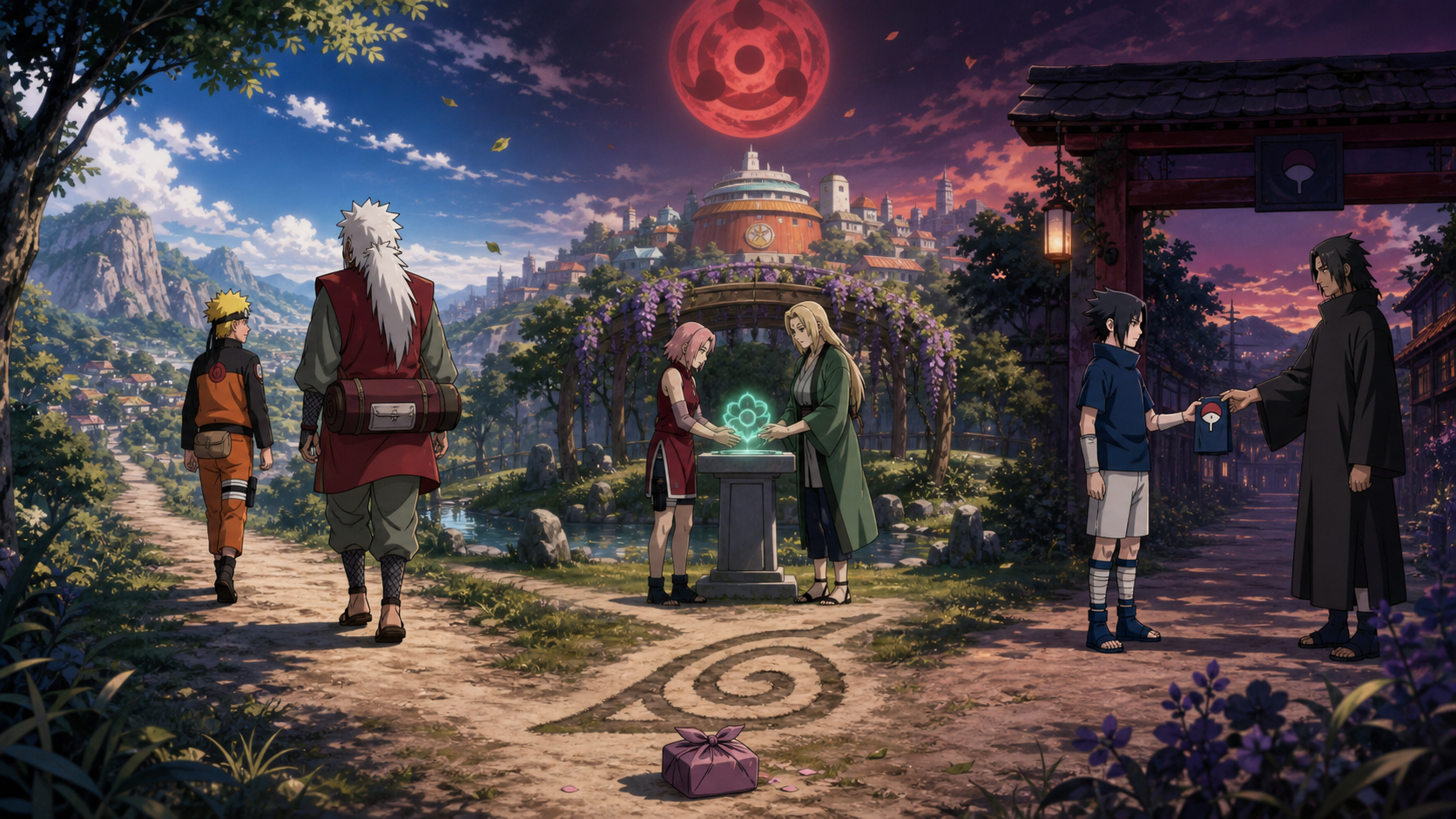
The Mutual Path
Team 7 grows stronger along three roads, but training sharpens ability without healing the different reasons Naruto, Sakura and Sasuke sought power.
Bottom line
“The Mutual Path” shows three teammates growing stronger for three very different reasons. Naruto leaves with Jiraiya carrying support from Minato, Kushina, Sakura, and Team 10. Sakura asks Tsunade to train her because she refuses to remain behind. Sasuke joins a long Uchiha mission after Fugaku dismisses his questions, praises Itachi’s judgment, and turns every achievement into another audition. Before those paths separate, Sasuke throws away food Sakura made for him and attacks Naruto with Chidori. Minato prevents the collision, but Sasuke studies the greater damage from Naruto’s Rasengan and converts fear into another competition. Three years of training sharpen all three members of Team 7. Training does not heal the reason each person sought power. Meanwhile, Danzō and Orochimaru reveal that Hizashi’s test was meant to eliminate Minato’s supporters. The adults praising peace in public are not the only adults designing Konoha’s future.
Episode 442 stays inside Jiraiya’s alternate story
Episode 442 continues the anime-original “Jiraiya Shinobi Handbook” manuscript inside Tsunade’s Infinite Tsukuyomi dream. The Japanese title is “Tagai no Michi,” meaning “The Mutual Path.” The episode aired in Japan on December 17, 2015.
The title sounds like shared direction. The episode spends most of its time showing Naruto, Sasuke, and Sakura moving apart.
Sasuke studies Chidori without satisfaction
Sasuke has learned Kakashi’s lightning technique, yet mastery brings no calm. He evaluates the Chidori through comparison rather than capability.
Naruto’s Big Ball Rasengan has already changed the standard in Sasuke’s mind.
He considers asking Fugaku for guidance
Sasuke wants advice from his father. The desire reveals that training is not only about surpassing Naruto.
He wants Fugaku to look closely enough to see the work and offer direction.
Fugaku says he is busy
Fugaku postpones the conversation. Political responsibilities may be real, but another dismissal reinforces a long pattern.
Sasuke learns that his questions can wait while Itachi’s work receives immediate attention.
Itachi invites Sasuke into the room
Itachi makes space for his younger brother during the family discussion. The invitation could become the recognition Sasuke has wanted.
Instead, the conversation repeatedly confirms that Fugaku trusts Itachi’s judgment more.
The Uchiha debate Minato’s reforms
Fugaku asks whether Minato genuinely intends to change the village’s treatment of the clan. Itachi reports that the Hokage appears sincere.
The alternate Konoha has avoided catastrophe, but reconciliation still requires evidence on both sides.
Itachi asks the clan to change too
Itachi argues that the Uchiha cannot demand every concession while remaining isolated. The clan must meet the village partway.
His position is politically careful. Mutual trust cannot be built as a one-sided performance.
Sasuke hears surrender in compromise
Sasuke reacts angrily to Itachi’s proposal. He sees a clan already mistreated by Konoha and questions why the injured party must change.
That objection contains truth. Calls for compromise often hide unequal responsibility.
Fugaku silences Sasuke’s objection
Before Sasuke can develop the argument, Fugaku cuts him off. He assumes Itachi reached the conclusion through serious thought.
Fugaku validates one son’s reasoning without granting the other son room to reason aloud.
Agreement becomes another comparison
Fugaku supports the search for common ground because Itachi recommends that path. Sasuke experiences the decision as proof that his own perspective has no weight.
The political debate becomes inseparable from a family hierarchy.
Itachi reports a long-term mission
Several Uchiha have been selected for an extended assignment away from Konoha. The mission offers service, danger, and standing within the clan.
Itachi’s participation again places him where family and village power intersect.
Fugaku supports Itachi’s departure
Fugaku trusts Itachi to accept the assignment. His confidence sounds effortless in a room where Sasuke must fight for every scrap of acknowledgment.
Sasuke wants the same certainty directed toward him.
Resentment enters Chidori training
Sasuke returns to practice carrying anger from the family meeting. Lightning becomes an outlet for emotions he cannot safely express at home.
The technique grows more dangerous as the reason behind each strike becomes less controlled.
Sakura brings Sasuke food
Sakura arrives with a meal while Sasuke trains. Her gesture offers care without demanding a performance first.
She sees exhaustion and responds to a physical need. Sasuke sees an interruption while shame is already burning.
Sasuke throws the food aside
He rejects Sakura’s care violently, scattering what she brought. The action is not a harmless sign of focus.
Sasuke passes humiliation downward because confronting Fugaku feels impossible.
Sakura becomes collateral damage
Sakura did not create the family comparison or Naruto’s progress. She receives the anger because she is present and emotionally available.
Pain may explain Sasuke’s behavior. Pain does not excuse making her smaller.
Naruto asks Sasuke to apologize
Naruto intervenes on Sakura’s behalf and demands an apology. His response is direct because the disrespect is visible.
He does not need to understand Sasuke’s entire history to know Sakura deserves better.
Sasuke turns correction into rivalry
Rather than apologize, Sasuke antagonizes Naruto. A simple request for accountability becomes another challenge to status.
Sasuke cannot admit fault without feeling as though Naruto has moved above him.
Sakura tries to stop the escalation
Sakura attempts to defuse the argument before techniques replace words. Neither boy listens enough to recognize the danger.
She is pushed into managing a conflict created by Sasuke’s cruelty and Naruto’s refusal to let that cruelty pass.
Naruto and Sasuke begin fighting
The rivalry becomes physical. Their new techniques turn an emotional dispute into a potentially lethal encounter.
Training designed for protection now serves wounded pride.
Chidori carries Sasuke’s demand to be seen
Sasuke’s lightning concentrates into a forward strike. Every lesson from Kakashi is present, but the target has changed.
He attacks the person whose growth makes Fugaku’s neglect feel unbearable.
Rasengan answers the challenge
Naruto forms the Rasengan rather than retreating. He wants to stop Sasuke and defend his own worth.
The response also accepts Sasuke’s framing: strength will decide an argument that began with an apology owed to Sakura.
Minato interrupts the collision
Minato arrives before Chidori and Rasengan meet. His intervention prevents anger from becoming irreversible harm.
Adult supervision enters at the last possible moment, after Sakura’s warnings failed to reach either teammate.
The interruption reveals unequal destruction
The techniques strike separate targets, allowing Sasuke to compare the resulting damage. Naruto’s Rasengan leaves the greater impact.
Sasuke does not read the evidence as one technique behaving differently from another. He reads a verdict on himself.
Naruto’s progress confirms Sasuke’s fear
Sasuke realizes that Naruto has moved farther ahead than he believed. Recognition from the other genin now feels backed by physical proof.
Fear of being surpassed hardens into determination to separate and train elsewhere.
Minato sees anger beneath the rivalry
The Hokage is taken aback by Sasuke’s intensity. This was not an ordinary sparring match between competitive teammates.
The danger did not begin with technique. Chidori and Rasengan exposed a wound already shaping Sasuke’s decisions.
A mutual path can still move apart
Naruto and Sasuke want strength, recognition, and control over their futures. Those shared desires do not guarantee shared methods.
Parallel ambition can become separation when every gain must create a loser.
Sasuke joins the Uchiha mission
Sasuke chooses the extended clan assignment. Leaving Konoha offers distance from Naruto and a new arena for proving himself.
The choice remains inside village structures, yet emotionally resembles an escape from home.
Shisui questions Sasuke’s resolve
Shisui points out that the other participants outrank Sasuke. The mission will place him among shinobi with more experience and standing.
His question tests whether Sasuke wants growth or merely a prestigious stage.
Sasuke accepts the hierarchy as a challenge
Sasuke explains his determination and enters the mission anyway. He would rather risk being the weakest member than remain close to Naruto’s visible progress.
Distance promises a clean measurement, even though Sasuke’s emotional standard will keep moving.
Naruto prepares to leave with Jiraiya
Naruto begins his own long training journey. Jiraiya offers experience with seals, combat, and the wider shinobi world.
The departure follows Naruto’s dangerous four-tailed transformation, making control a necessary part of every future lesson.
Naruto receives a full farewell
Kushina, Minato, Sakura, and Team 10 gather to see Naruto and Jiraiya off. The crowd makes Naruto’s support visible.
He leaves home knowing people expect his return and care about the person returning, not only the strength acquired.
Support does not make Naruto’s work effortless
Naruto still has to train, fail, persist, and confront the Nine-Tails chakra. Love cannot perform those tasks for him.
Support changes the emotional cost of failure. Naruto does not have to earn his place before trying again.
Sakura refuses to remain the spectator
With Naruto and Sasuke leaving on separate paths, Sakura confronts her position within Team 7. Waiting for their return would preserve the same imbalance.
She asks Tsunade for training because she wants the ability to stand beside them.
Tsunade becomes Sakura’s chosen teacher
Sakura seeks medical knowledge, chakra control, combat strength, and the discipline behind the Strength of a Hundred Technique.
Her path grows from deliberate selection rather than family pressure or rivalry alone.
Team 7 separates into three apprenticeships
Naruto trains with Jiraiya. Sasuke trains with Shisui and the Uchiha mission group. Sakura trains with Tsunade.
Their shared team identity survives only as memory while each student learns from a different adult world.
Danzō meets Orochimaru in secret
Away from farewells and public negotiations, Danzō and Orochimaru discuss the failed operation involving Hizashi.
The conversation reveals that political sabotage sat beneath the moral test.
Hizashi’s grievance was a weapon
Danzō and Orochimaru expected the crisis to remove many shinobi loyal to Minato. Hizashi’s anger supplied a believable cause and vulnerable partner.
The men did not care whether his question about Konoha deserved an answer. They cared how many opponents his pain could eliminate.
The failed purge exposes another Konoha
Minato negotiates openly with the Uchiha while Danzō works through covert violence. Both claim concern for the village’s future.
One path builds trust through promises. The other manufactures disorder to justify control.
Danzō offers Orochimaru a future vessel
Their arrangement includes selecting a body for Orochimaru. A human life becomes payment inside a political alliance.
That detail strips away any claim that their plan serves ordinary villagers.
Three years pass through disciplined change
The manuscript moves across a long training interval. Naruto, Sasuke, and Sakura transform through repeated work rather than a single breakthrough.
The time jump shows results while leaving the original motives alive beneath those results.
Naruto learns senjutsu with Jiraiya
Naruto develops Sage training alongside his other techniques. Senjutsu requires awareness, balance, and stillness unlike the frenzy of uncontrolled Nine-Tails chakra.
His path increasingly rewards cooperation with power rather than surrender to power.
Sasuke develops Chidori under Shisui
Sasuke sharpens the lightning technique during the Uchiha mission. Shisui becomes a demanding benchmark and direct mentor.
Progress earns Sasuke real standing, though his desire to surpass Naruto and Itachi remains unresolved.
Sakura pursues the Strength of a Hundred
Tsunade teaches Sakura the control and accumulation needed for the forehead seal. The work takes patience beyond ordinary combat practice.
Sakura builds power that can heal others and alter a battlefield without copying either teammate.
Fugaku finally receives reports of Sasuke’s excellence
When the mission group returns, Fugaku learns that Sasuke has become second only to Shisui. External reports make the achievement impossible to dismiss.
Sasuke has acquired the proof he once believed would secure recognition.
Sasuke promises to surpass Itachi
Even after ranking near Shisui, Sasuke names Itachi as the next target. Achievement has not ended comparison.
Fugaku’s hierarchy still governs the meaning of success.
Fugaku promotes Sasuke into the police force
Fugaku grants Sasuke a position in the Konoha Military Police Force and challenges him to support bold claims with action.
The promotion offers responsibility, but approval remains conditional and competitive.
Sasuke remembers the day he left
He walks away angry, recalling the separation from Naruto and Team 7. Three years have increased strength without resolving the original humiliation.
The path outward has curved back toward the same emotional conflict.
The episode gives Sakura a path of her own
Naruto and Sasuke dominate the rivalry, but Sakura refuses to exist only between them. Her apprenticeship turns concern into professional capacity.
Her progress should not be treated as a supporting detail in the boys’ story.
Mutual growth requires more than equal power
All three teammates become formidable. Equality in combat does not automatically restore trust, apology, or emotional safety.
Power can prepare them for reunion. Honest accountability must make reunion worth having.
Agreement becomes another ranking inside Sasuke
Fugaku supports Itachi’s mission and treats his judgment as mature, while Sasuke’s challenge is dismissed. The political outcome becomes proof of sibling hierarchy.
Sasuke no longer hears only a policy dispute. He hears that Itachi belongs among decision-makers and he remains the child outside the door.
Naruto’s demand for an apology is not ownership
He sees Sakura being mistreated and names the behavior. That intervention protects a teammate, but it should not turn her into a prize between rival boys.
Sakura tries to stop the escalation because the conflict now threatens her body and both friendships, giving her standing beyond who wins.
Minato interrupts before technique becomes verdict
Chidori and Rasengan are about to convert emotional comparison into irreversible injury. The adult stops contact rather than waiting for damage to teach the lesson.
Good supervision does not romanticize a near-fatal clash as necessary growth. It changes conditions before children pay the full cost.
Sakura chooses an apprenticeship instead of accepting a role
She refuses to remain the person who brings food, watches rivalry, and waits for rescue. Asking Tsunade for training redirects frustration into medical knowledge, strength, and disciplined control.
Her path is not an imitation of either boy. It is a decision about the teammate and shinobi she intends to become.
Naruto leaves with a support network
Family, teacher, friends, and village relationships mark his departure. That security does not perform senjutsu or endure training for him.
It lets difficulty occur without every setback becoming evidence that he was abandoned, which protects learning from the panic Sasuke carries into mastery.
Sasuke accepts an institution built around inherited status
The police force offers recognition, rank, clan identity, and reports Fugaku can value. It also channels Sasuke’s need for approval into a hierarchy already tied to Uchiha separation.
Institutional reward can stabilize performance while deepening the wound that makes reward feel necessary.
Danzō and Orochimaru reveal the hidden curriculum
While Team 7 trains openly, powerful adults negotiate bodies, vessels, and political control in secret. Children are told growth means discipline while institutions plan how to use that growth.
The contrast keeps apprenticeship from becoming a neutral coming-of-age ritual. Every teacher operates inside a contested system.
Three years measure practice, not healing
Naruto learns senjutsu, Sakura pursues the Strength of a Hundred, and Sasuke sharpens Chidori. Their abilities change because they work.
The reasons beneath that work remain unequal. Training can improve control without repairing family comparison, political exploitation, or the emotional damage that power temporarily disguises.
Mutual paths require the freedom to return differently
Team 7 separates without a guarantee that growth will preserve the same relationships. Each member must be allowed to change goals, boundaries, and understanding.
A shared future cannot require everyone to become equally powerful or resume old roles without accounting for what happened during the distance.
RaeRae’s verdict
“The Mutual Path” is strongest when it gives Sakura a road she chooses rather than treating her as emotional scenery between Chidori and Rasengan. She seeks Tsunade because she wants knowledge, strength, and the authority to act. Naruto leaves with Jiraiya inside a support network that makes struggle survivable. Sasuke accepts Shisui’s training and Fugaku’s police path because technique and rank offer measurements where paternal care remains uncertain.
Those roads are mutual only because they begin from the same fracture and continue affecting one another. They are not emotionally equal. Minato interrupts the boys before rivalry becomes bodily catastrophe. Nobody interrupts the quieter system teaching Sasuke to translate love into superiority. Meanwhile, Danzō and Orochimaru plan around children as political resources. Three years of training will sharpen everyone. The real question is whether stronger bodies can return without repeating the institutions that taught them why power felt necessary.
Episode 442 ends with rivalry institutionalized
Sasuke’s private need for recognition now carries a police rank, clan standing, and advanced Chidori. Naruto and Sakura have changed along their own routes.
Episode 443, “The Difference in Power,” must reveal what happens when those separately built identities meet again.
RaeRae’s call
Team 7 does not walk one road in three costumes. Naruto leaves with visible support and a teacher willing to travel beside him. Sakura chooses Tsunade and refuses the spectator role the rivalry keeps assigning her. Sasuke enters a police hierarchy that turns skill into the approval Fugaku rarely gives directly. All three work hard. Only one path consistently converts emotional scarcity into institutional reward. The episode understands that training improves ability faster than it heals motive. A future will require more than matching strength. It will require consent, accountability, changed roles, and the freedom to return without pretending the separation affected everyone equally.
Episode details and viewing routes
- Official episode reference: Naruto Official episode guide
- Licensed episode route: Crunchyroll licensed episode page
What I am carrying forward
After Minato stopped Naruto’s Rasengan and Sasuke’s Chidori from colliding, Team 7 separated into three apprenticeships. Naruto traveled with Jiraiya, Sakura asked Tsunade for medical and strength training, and Sasuke trained under Shisui while accepting a future in the Uchiha police force.
Three years passed. Naruto developed senjutsu, Sakura pursued the Strength of a Hundred, and Sasuke sharpened Chidori while promising to surpass Itachi. Danzō secretly offered Orochimaru a future vessel. Episode 443, “The Difference in Power,” tests what the three paths produced.