
RaeRae Reacts · One Piece Episode 139
Ruluka’s Rainbow Mist Tax
One Piece Episode 139 brings the Straw Hats to Ruluka, where predatory taxes, Henzo’s public research, an unmanned galleon, and the Rainbow Mist collide.
Rapanui’s fleet begins with friendly fire
Episode 139 opens under pursuit by nine Marine ships commanded by Rapanui Pasqua. His coin-based Finger Bomb can destroy pirate vessels, but a sneeze redirects the attack into another Marine ship and breaks formation.
A weapon whose accuracy depends on breath, posture, and uninterrupted concentration needs a protected firing protocol. Rapanui should confirm the line of fire, friendly positions, range, backstop, and abort conditions before release.
Command must treat friendly fire as an incident requiring rescue, medical response, evidence preservation, and review. Embarrassment cannot justify continuing pursuit while injured sailors remain on a damaged vessel.
Weapons training should include interruption drills because sneezing, sudden waves, shouted warnings, and equipment failure are predictable possibilities at sea. Rapanui needs a safe direction for a canceled shot and an officer empowered to stop firing when friendly ships cross that corridor.
Nami uses the broken formation instead of chasing revenge
Nami recognizes the opening and orders the Merry ahead. Her priority is escape, not punishing the fleet for the dangerous shot.
A navigator making an emergency break needs current, wind, sail condition, visibility, and the crew’s physical capacity. The fastest course may still become unsafe near an unfamiliar island or harbor.
Leaving reduces immediate conflict, though the crew should document ship names and damage from a distance. Evidence may matter if Marines later misrepresent who caused the collision.
Nami should also confirm that every crewmate is aboard before using the gap. A clean tactical escape becomes a rescue crisis if someone was left on a scouting boat, tangled in rigging, or injured during the first volley.
Ruluka charges admission before offering safety
The Straw Hats reach Ruluka Island and encounter a collector demanding harbor or landing taxes. The demand arrives before any explanation of services, rates, authority, exemptions, or appeal.
Ports may charge for docks, inspections, waste removal, rescue capacity, and maintenance. Legitimate fees should be published, applied consistently, receipted, and connected to real public benefit.
A collector should not block emergency refuge without assessing danger. A vessel escaping pursuit may need temporary safe harbor even when payment remains disputed.
Visitors should receive a written schedule in a language they understand, along with the collector’s name and a receipt number. Seizing a vessel or threatening passengers over an unfamiliar fee should require review by someone independent from the collection squad.
Wetton’s tax system reaches ordinary survival
Mayor Wetton imposes taxes on nearly every activity, from eating and drinking to market purchases. Residents rush meals and hide unfinished goods because collection is designed around fear.
Taxation becomes abusive when rules are unpredictable, enforcement is humiliating, and revenue serves rulers rather than residents. People need clear rates, notice, receipts, appeals, hardship protections, and independent review.
Food taxes can hit poor families hardest. Essential meals, water, medicine, and shelter require exemptions or progressive treatment so public revenue does not create hunger.
Residents also need to see where money goes. Public budgets, procurement records, audits, and conflict disclosures would show whether Wetton funds sanitation and safety or diverts revenue toward his mansion, armed collectors, and projects that strengthen his rule.
Luffy ignores the collector and runs over Sanji too
Sanji steps forward when a collector shouts at Nami, but Luffy charges through the confrontation in search of food and knocks both men aside.
Defending a crewmate does not require escalating every insult into violence. Sanji should ask for authority and terms while Nami decides whether she wants intervention.
Luffy’s hunger explains his focus but does not excuse striking allies or officials. The crew needs a rule for who speaks during port disputes so urgency does not become chaos.
Henzo’s research lives under public suspicion
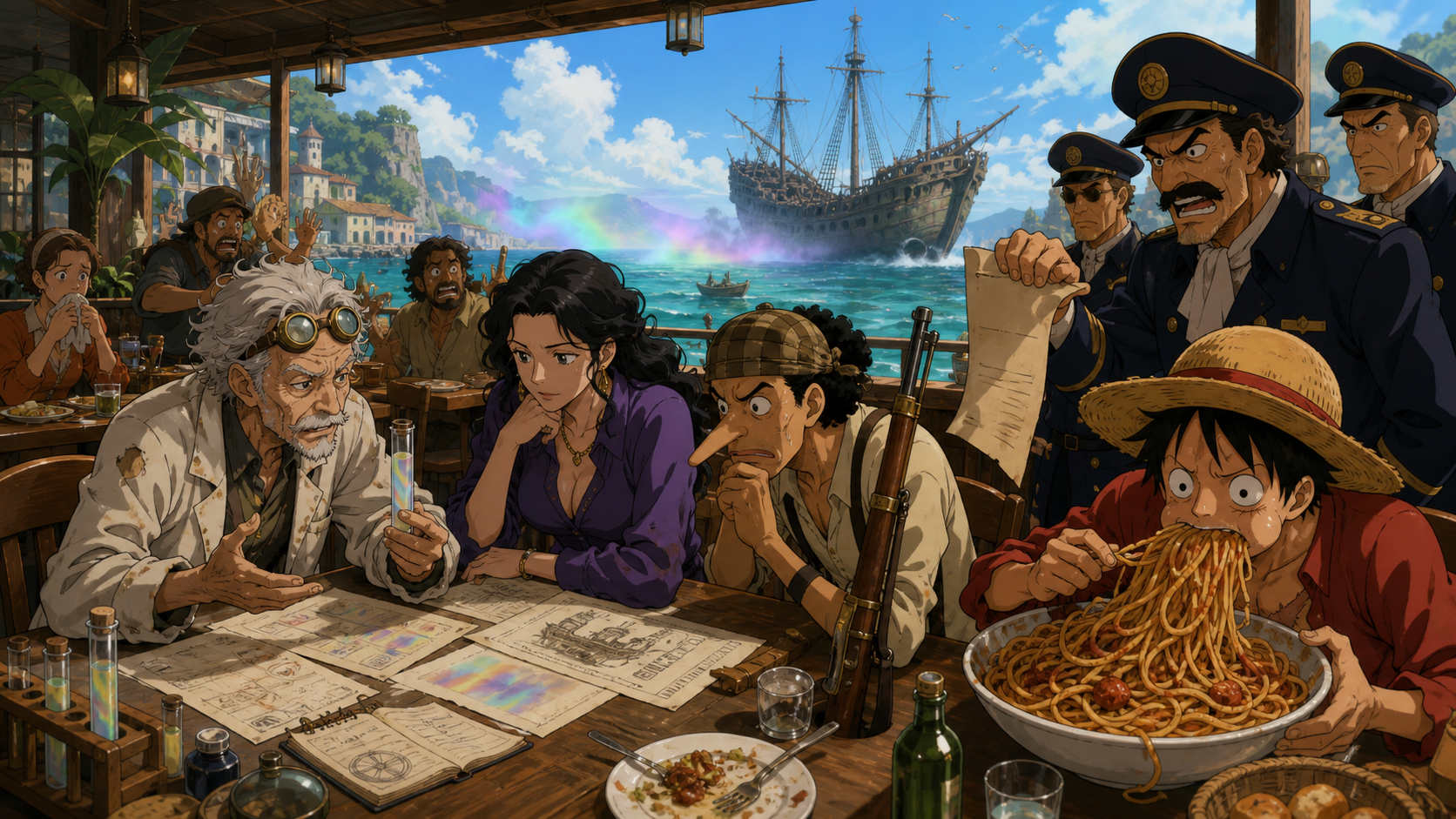
Robin, Usopp, and Luffy meet elderly scientist Henzo, who has spent decades researching the Rainbow Mist. Restaurant patrons accuse him of wasting tax money while Wetton’s collectors protect the project.
Publicly funded research should disclose goals, budget, methods, risks, milestones, and oversight without exposing sensitive personal data. Residents deserve to know whether the work benefits them or merely gives the mayor another excuse to collect.
Henzo’s long commitment may be sincere while the funding structure remains coercive. Good science cannot cleanse abusive taxation.
Independent ethics and safety review could separate Henzo’s research needs from Wetton’s political control. Grants should pay for defined equipment and staff, with unused money returned or reauthorized. Henzo should not depend on personal loyalty to the mayor for every experiment.
Robin brings an independent source to the conversation
Robin shows Henzo a book from Alabasta that discusses the Rainbow Mist. Her evidence confirms that the phenomenon exists beyond local rumor and that other observers have recorded related claims.
A scientist should compare editions, authorship, dates, translations, maps, and cited observations before treating a book as proof. Legends can contain useful leads without functioning as measurements.
Robin’s contribution models respectful expertise. She does not seize control of Henzo’s research; she adds a source and asks what he knows.
The restaurant tax punishes unfinished consumption
Collectors enter the restaurant, and patrons hurry to finish food and drink before inspection. One customer pays because liquor remains unfinished.
A rule that changes price based on the contents of a glass invites arbitrary enforcement and dangerous behavior. People may consume alcohol too quickly, hide waste, or avoid ordering food they need.
Inspectors should never pressure rapid drinking. Public-health risk outweighs revenue, and penalties need written criteria rather than a collector’s performance at the table.
Restaurant owners face coercion too. They may lose customers, absorb unpaid assessments, or become informants to keep a license. A fair system would separate food safety inspection from revenue intimidation and let businesses challenge charges without risking closure.
Usopp pays for Luffy’s spaghetti without consenting first
Collectors spot Luffy eating a mountain of spaghetti and charge an eating tax that Usopp ends up paying. The person with available money absorbs the cost created by someone else’s appetite.
Crew finances need authorization rules, spending limits, emergency reserves, and a record of shared debts. Usopp can choose to help, but payment under threat is not a voluntary gift.
Luffy should repay the amount or accept a transparent crew decision about communal meals. Friendship does not turn another person’s wallet into public property.
The Dynamo Squad weaponizes tax collection
Sanji, Nami, and Chopper encounter armored collectors using electrically charged suits. Equipment designed for enforcement turns a civil fee dispute into a serious bodily threat.
Collection staff should not use electric force to compel payment for ordinary goods. Any defensive equipment needs certification, training, medical limits, incident reporting, and proportional-use rules.
Wetton’s government benefits from fear, so the suits are not a rogue misunderstanding. The system converts revenue workers into an occupying force.
Electric armor around a market creates additional risk for people with heart conditions, children, wet pavement, metal stalls, and anyone carrying conductive tools. Emergency services should know how to disconnect power without shocking the person who needs rescue.
Sanji tests the armor twice before changing tactics
Sanji kicks the electric armor and receives a shock, then tries again before recognizing that direct contact favors the collectors. Persistence without new information increases injury.
After the first shock, the group should create distance, check Sanji for burns or irregular heartbeat, identify power sources, and seek a non-contact escape. Nami and Chopper need cover rather than a demonstration.
Changing tactics is not cowardice. Adaptation protects the people a fighter claims to defend.
Running away exposes the suits’ tethered weakness
Sanji retreats, and the Dynamo Squad’s wired armor catches or pulls against its own connections. The escape reveals that intimidating equipment can contain a structural limit.
He uses movement rather than greater force, reducing the chance of burns and collateral damage. Nami and Chopper gain time to leave the market.
The squad’s supervisors should suspend the equipment after failure. Tethers around crowds can trip residents, overturn stalls, and entangle children or animals.
An unmanned galleon demands quarantine before curiosity
Residents shout when the old galleon Talielisin drifts into harbor without a visible crew. Henzo immediately races toward the vessel.
An abandoned ship may carry disease, unstable cargo, fire, flooding, bodies, weapons, or structural collapse. Harbor officials should establish distance, inspect from a safe craft, and record the vessel’s condition before boarding.
Henzo’s personal connection to the mist may compromise judgment. Another qualified person should evaluate whether the ship is safe enough to enter.
The harbor should also search for survivors in the water, inspect lifeboat stations, and notify nearby ports. An empty deck does not prove everyone disappeared at once. People may be injured below, stranded on another island, or separated during evacuation.
Henzo’s H-1 craft needs more than a successful launch
Henzo approaches in his experimental H-1 while the crew follows. A research craft designed around the Rainbow Mist must survive ordinary sea conditions before facing an unknown phenomenon.
Inspection should cover flotation, propulsion, steering, emergency power, communications, protective equipment, navigation instruments, and retrieval plans. Every passenger needs a briefing and a way to refuse.
Experimental status increases documentation duties. Near misses and component failures belong in a log, not in Henzo’s private memory.
A rescue team should remain outside the expected hazard boundary with tow lines, medical equipment, and a time for declaring the expedition overdue. Henzo cannot serve as lead scientist, pilot, safety officer, and only witness without creating avoidable blind spots.
The galleon offers evidence from a missing history
Henzo and the pirates explore Talielisin while trying to understand how an empty vessel reached Ruluka. Weathering, cargo, rigging, logs, personal effects, and biological growth could reveal origin and elapsed time.
Explorers should photograph objects in place, avoid disturbing remains, mark hazards, and preserve chain of custody. Looting would destroy both evidence and possible family property.
Robin’s archaeological discipline becomes essential because the ship may belong to people whose disappearance shaped the island’s history.
If names or identifying objects are found, Henzo should contact surviving families or local authorities rather than announce a discovery for personal credit. Human loss must remain more important than the prestige of solving the Rainbow Mist legend.
The Rainbow Mist appears before informed consent exists
Henzo’s instruments detect the phenomenon, and a spectral fog forms offshore. He has waited decades for this moment, so urgency overwhelms discussion.
Unknown atmospheric conditions may disrupt visibility, navigation, breathing, instruments, time perception, or communication. A responsible expedition needs remote sampling, tethered probes, defined exposure limits, and an abort threshold.
The crew has not agreed to enter. Scientific importance cannot erase the right of passengers to understand risks and choose.
Henzo should explain what past accounts claim about missing ships, altered time, navigation failure, and possible treasure. He must distinguish observation from legend so excitement does not hide uncertainty. Each person needs a real chance to stay ashore.
Henzo commandeers the Going Merry for his life’s work
Henzo tries to take the Merry into the Rainbow Mist while the crew resists. His research goal is profound, but the ship remains their home and shared property.
Emergency scientific opportunity does not authorize vessel theft. Henzo should present evidence, request help, name the likely duration, and explain how he plans to return.
The crew’s emotional investment in adventure does not create blanket consent for every unknown hazard. Luffy’s enthusiasm cannot speak for Robin, Usopp, or anyone separated on shore.
Using the Merry also risks the crew’s food, charts, medicine, weapons, and personal belongings. A separate research craft, tether, or staged approach would keep one experiment from destroying every resource needed for recovery.
Episode 139 makes curiosity answer to public harm
Ruluka places two systems side by side. Wetton extracts money from every daily action, while Henzo channels that revenue into a private search he believes may recover lost history. Both claim importance. Neither has earned transparent consent.
The Rainbow Mist deserves study, and residents deserve freedom from predatory taxation. Scientific wonder cannot require silence about how funds were collected or whose vessel carries the risk.
RaeRae’s verdict: keep this one. Episode 139 turns a colorful mystery into a civic-accountability problem before the fog ever closes. Robin brings evidence, Nami notices power, Sanji learns to retreat, and Henzo shows how a sincere life’s work can still cross a boundary. Curiosity becomes worthy of trust only when researchers tell the truth, respect ownership, and let everyone aboard decide whether the unknown is worth entering.