
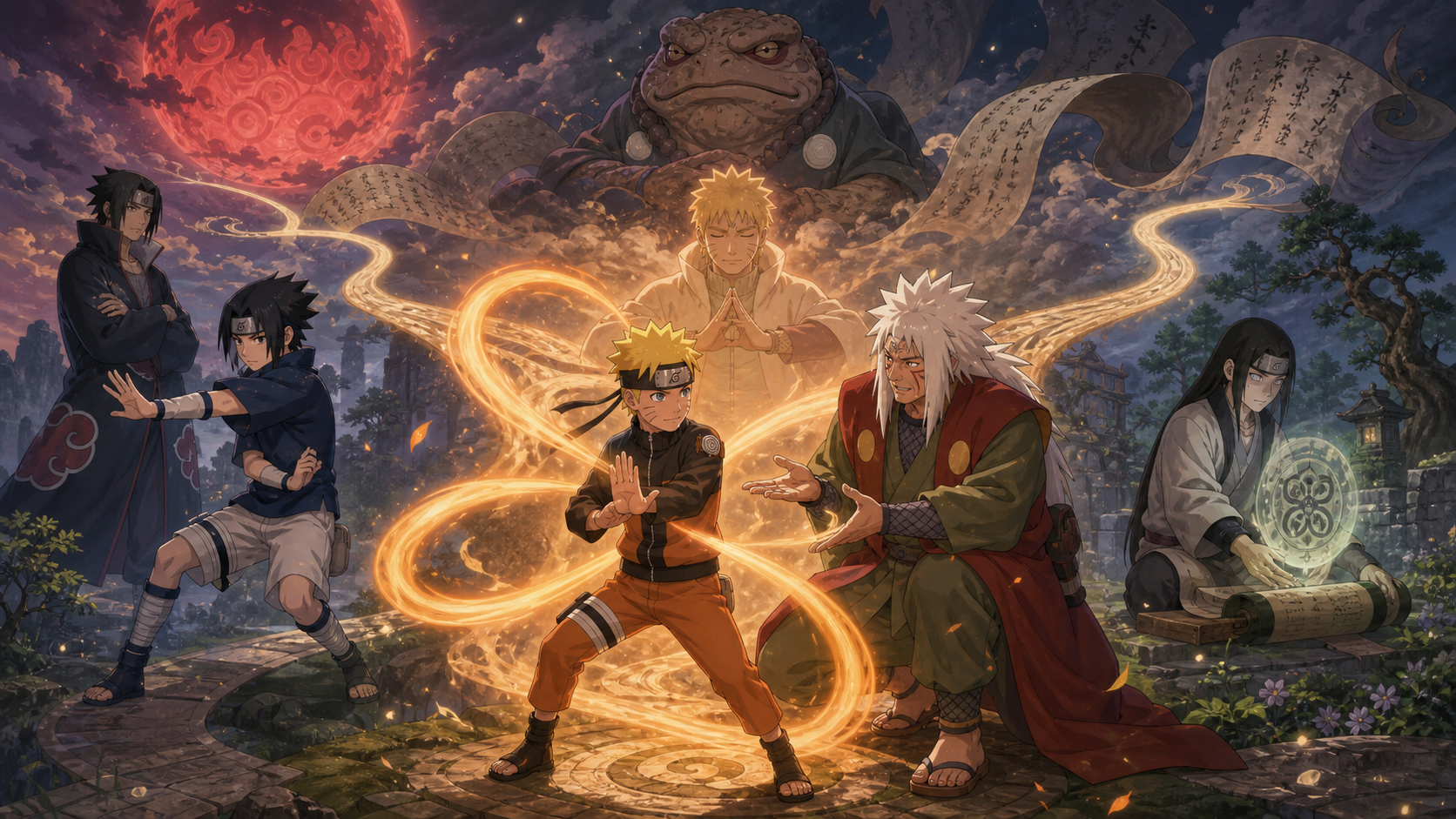
The Child of Prophecy
Prediction cannot make Naruto worthy; Jiraiya’s guidance, Minato’s trust and Naruto’s disciplined choice to protect people must do that work.
Bottom line
“The Child of Prophecy” refuses to let prophecy excuse anybody’s choices. Jiraiya loosens Naruto’s seal because he believes his student may be the child who can change the shinobi world. That decision releases a four-tailed Naruto who cannot recognize teacher, friend, or mission. Jiraiya must contain the disaster he helped create. Naruto finally returns through a memory of training with Minato, then chooses to use that recovered control to protect the rookies. The episode’s strongest evidence does not come from a prediction. Naruto proves himself through learned discipline and a decision to help people. Meanwhile, Sasuke fights beneath the weight of Fugaku’s comparison to Itachi, and Neji names the masked judge as his father, Hizashi. Parents and teachers can guide children toward freedom or build the cage around them. Prophecy here is a warning about that responsibility, not a guarantee of greatness.
Episode 439 remains inside Tsunade’s dream
Episode 439 continues the anime-original “Jiraiya Shinobi Handbook” story within Tsunade’s Infinite Tsukuyomi dream. The Japanese title is “Yogen no Ko,” meaning “The Child of Prophecy.” The episode aired in Japan on November 26, 2015.
These events do not revise the main Naruto timeline. Tsunade is reading Jiraiya’s imagined version of familiar lives, with relationships and history rearranged around a manuscript.
Tsunade’s candle reaches its end
The candle beside Tsunade burns out while she reads. Shizune replaces the light and worries that Tsunade is pushing herself too hard.
That small action measures how long Tsunade has surrendered to the book. Night has continued around her even while the dream makes time feel suspended.
Shizune cannot pull her away
Shizune offers practical care, but Tsunade returns to the pages. Food, rest, and conversation struggle against the emotional gravity of Jiraiya’s voice.
The manuscript gives Tsunade one more impossible night with someone she lost. Of course stopping feels harder than fatigue.
Jiraiya finds Naruto in a strange inner space
Naruto remains trapped away from the rookies and unable to move freely. Jiraiya reaches him in a space shaped by seals, chakra, and the dream manuscript’s unstable logic.
His arrival offers Naruto a teacher, but also introduces the episode’s most dangerous choice.
Jiraiya remembers the Great Toad Sage
Before acting, Jiraiya recalls the Great Toad Sage’s prediction. One of his students will bring a great revolution to the shinobi world.
The prophecy never promises that revolution will be kind. Jiraiya’s guidance may lead the student toward salvation or destruction.
The prediction places responsibility on the teacher
Calling Naruto the child of prophecy can sound like praise. The actual warning points at Jiraiya.
His teaching choices matter because extraordinary power magnifies every lesson, absence, shortcut, and mistake. A gifted student does not make a mentor less accountable.
Jiraiya chooses risk for Naruto
Jiraiya does not merely observe a destined event. He touches the seal and creates new access.
That distinction matters. Prophecy may shape his expectation, but his hand still makes the decision. Belief cannot absorb responsibility for the result.
The Nine-Tails chakra floods out
The loosened seal gives Naruto more power than he can govern. Red chakra consumes his shape as the fourth tail forms.
The power Naruto wanted for his friends erases the part of him capable of recognizing why he wanted power at all.
Four tails mark a catastrophic threshold
Naruto’s earlier transformations allowed fragments of intention to survive. The four-tailed state operates differently.
His body becomes a weapon driven by rage and pain. Strength increases while judgment disappears.
Naruto destroys Jiraiya’s suppressing tag
Jiraiya tries to use a chakra-suppressing seal against the transformation. Four-tailed Naruto destroys the tag before control can be restored.
The failure exposes the weakness in Jiraiya’s plan. He opened a door without securing a dependable way to close that door.
The student no longer recognizes the teacher
Four-tailed Naruto attacks Jiraiya as an obstacle. Their bond cannot reach a mind buried beneath the chakra.
Love and trust remain real, but neither functions as an emergency restraint when Naruto loses himself.
Jiraiya must survive his own decision
The battle is not proof that Naruto betrayed Jiraiya. Jiraiya deliberately released a force Naruto could not yet control.
He now carries two duties: survive the attack and prevent Naruto from hurting anyone else.
Mentorship includes containment
A teacher who encourages dangerous growth must prepare for failure. Inspiration alone is not supervision.
Jiraiya’s willingness to fight Naruto shows commitment, yet the need for that fight also records his miscalculation.
The swamp finally immobilizes Naruto
Jiraiya uses an earth-based swamp technique to trap the transformed Naruto. Raw violence cannot move freely once the ground itself swallows momentum.
The technique buys time rather than solving Naruto’s internal struggle. Restraint protects the world outside him while the real decision remains inside.
Sasuke fights beneath another father’s judgment
Elsewhere, Sasuke battles Sasori’s puppets while remembering Fugaku’s expectations. His father measures him against Itachi.
The comparison turns family recognition into a competition Sasuke can never finish. Even success arrives under somebody else’s name.
Itachi becomes the standard in Sasuke’s head
Sasuke does not need Itachi physically present for the comparison to hurt. Fugaku’s voice has already installed the hierarchy.
Every difficult fight can become another private trial about whether Sasuke deserves to stand beside his brother.
Praise can become a cage
Adults often imagine comparison will motivate a talented child. Repeated comparison can also teach that affection has a ranking system.
Sasuke’s drive gains intensity while losing peace. Achievement becomes a plea for recognition.
Sasori’s puppets multiply that pressure
The puppet assault surrounds Sasuke with enemies that do not tire, hesitate, or care about his family history.
He must solve the immediate battlefield while old insecurity demands a flawless performance. The emotional burden is invisible to everyone beside him.
The rookies remain under observation
The masked man continues watching the genin factions. Neji remains beside him, forced to witness friends struggle inside a test he did not choose.
Their debate has moved beyond rules versus comrades. Neji now studies the person who claimed authority to arrange the crisis.
The masked man treats pain as evidence
He wants the rookies’ behavior under pressure to prove something about Konoha and the Hyūga system.
Manufactured danger can reveal choices, but the examiner also shapes those choices. He cannot pretend his own coercion sits outside the result.
Neji watches the judge more closely
Neji’s Byakugan gives him exceptional sight, yet recognition here depends on more than anatomy. Speech, priorities, and emotional familiarity begin pointing toward a personal truth.
The test is no longer only about the rookies. The masked man is revealing himself with every judgment.
Naruto hears Minato through memory
Inside the struggle, Naruto remembers learning the Rasengan from Minato. The remembered lesson gives him a pattern of focus stronger than the surrounding rage.
Minato does not magically remove the Nine-Tails chakra. Training gives Naruto something disciplined to reach for.
The Rasengan lesson becomes an anchor
Rasengan training demanded concentration, rotation, power, and containment at once. Those skills answer the exact crisis consuming Naruto.
The memory matters because Naruto practiced. Sentiment connects him to Minato, but repetition makes the connection usable.
Naruto regains control through learned discipline
Naruto suppresses the transformation and returns to himself. The scene does not prove that prophecy selected the right child.
Naruto recovers because instruction became habit and because he chooses to follow that habit while drowning in power.
Minato’s guidance contrasts with Jiraiya’s gamble
Jiraiya gives Naruto access to more chakra before control is secure. Minato’s remembered lesson teaches control through deliberate stages.
Both adults believe in Naruto. Belief becomes helpful only when paired with a method Naruto can safely carry forward.
Naruto does not stay trapped in shame
After losing control, Naruto could freeze around the damage he nearly caused. He instead accepts Jiraiya’s direction and returns to the rescue.
Accountability requires remembering the failure without allowing shame to become another prison.
Jiraiya sends Naruto back to the others
Once Naruto is stable, Jiraiya withdraws and directs him toward the battle. The teacher stops being the center of the episode.
Naruto must now demonstrate what restored control means through action among his peers.
Shadow clones spread Naruto’s protection
Naruto reaches the rookies and uses shadow clones against Sasori’s puppet force. The technique turns one recovered fighter into support across a crowded field.
Unlike the four-tailed form, every clone serves Naruto’s chosen purpose. Multiplication no longer means uncontrolled destruction.
The Rasengan carries training into the present
Naruto attacks with the Rasengan he remembered learning from Minato. A lesson from his father becomes immediate help for comrades.
The move connects inheritance to choice. Naruto honors the teacher by deciding what the power protects.
Naruto forces Sasori to retreat
The combination of clones, Rasengan pressure, and the rookies’ resistance breaks Sasori’s advantage. Sasori and Hiruko pull away rather than finishing the fight.
The retreat does not erase the poison, kidnappings, or unanswered conspiracy. Naruto creates breathing room, not a complete victory.
The rookies see a comrade rather than a prophecy
The genin praise Naruto because he arrived, fought beside them, and changed the battlefield. They do not need the Great Toad Sage’s title.
Their trust rests on witnessed behavior. That foundation is more durable than a legend Naruto never asked to carry.
Shared danger repairs the faction split
The rookies had argued over reporting to Konoha or rescuing captured team leaders. Naruto’s arrival helps them move past a debate designed to divide them.
No speech settles every principle. Coordinated action reminds them that disagreement does not require abandonment.
They choose to search for the kidnapped jōnin
With Sasori driven back, the group turns toward the missing team leaders. The rescue becomes a shared mission rather than one faction’s demand.
Their choice still contains risk. Unity means accepting that risk together and planning around one another’s strengths.
Naruto earns leadership without claiming command
Naruto does not arrive with rank over the others. He changes the group by restoring possibility when exhaustion and argument have narrowed their options.
Leadership here grows from service. He makes cooperation easier, then joins the work.
The episode sets prophecy against evidence
Jiraiya’s memory says a student may transform the world. Naruto’s behavior shows the smaller decisions that could make such change possible.
He controls power, returns to friends, and helps former opponents act as one group. Those choices matter even without a foretold future.
Neji asks whether the test succeeded
After watching the rookies reunite, Neji asks the masked man whether he obtained the answer he wanted.
The question reverses their positions. Neji now evaluates the examiner instead of merely submitting to his lecture.
Neji names Hizashi
Neji calls the masked man “father,” identifying him as Hizashi. The revelation turns a political experiment into a family confrontation.
The man judging whether Konoha’s children can escape old rules is the father whose death shaped Neji’s anger toward those rules.
Recognition breaks the mask’s authority
A concealed face allowed Hizashi to speak as though he were an impartial observer. Neji’s recognition removes that protection.
Every claim about sacrifice, freedom, and the Hyūga now carries the history between father and son.
The caged bird question becomes personal
Hizashi’s life and death sit at the center of the branch family’s burden. Neji has spent years interpreting that loss through resentment, fatalism, and later understanding.
The next exchange must address more than clan policy. Neji needs to know why his father placed him inside another test.
Parents shape the futures they predict
Fugaku compares Sasuke to Itachi. Minato’s patient training helps Naruto recover control. Hizashi tests Neji from behind a mask. Jiraiya risks Naruto’s body under the influence of prophecy.
The episode links these adults through consequence. Children carry what teachers and parents repeat, withhold, and demand.
The title belongs to a choice, not a crown
Naruto may be the child Jiraiya associates with prophecy, but the episode never gives him a ceremonial victory. He becomes a monster, regains control, and returns to work.
That sequence keeps the title honest. A future hero is not someone guaranteed to remain right. He is someone responsible for finding his way back and choosing people again.
Prophecy places responsibility on the teacher first
The Great Toad Sage tells Jiraiya that a student may transform the world, which means Jiraiya must decide how to teach without knowing which child or outcome fulfills the vision.
Prediction does not authorize reckless experiments. Uncertainty should make mentorship more careful about methods, consent, and consequences.
Jiraiya’s faith becomes dangerous without containment
He believes Naruto can master the Nine-Tails and loosens access to prove it. When four tails emerge, the student loses recognition and the teacher becomes a target.
Believing in potential is not the same as building the conditions that let a child reach it without destroying himself or others.
The suppressing tag represents a safety system
Naruto tears it away after transformation, showing that one tool cannot carry the whole burden of control. A safeguard needs backup plans, monitoring, distance, and people ready to intervene.
Mentorship fails when confidence in the learner becomes an excuse to underdesign the emergency response.
Minato’s lesson works because Naruto practiced it
The remembered Rasengan instruction gives Naruto a sequence his body already knows: gather, rotate, contain, and focus. Memory becomes usable through repetition.
Love supplies the reason to reach back. Training supplies the path. Neither sentiment nor destiny alone could restore control inside the flood.
Recovery does not erase the harm of transformation
Naruto returns to himself, but Jiraiya still faced lethal danger and the surrounding space absorbed uncontrolled force. Regaining control is the beginning of accountability.
He must remember what happened, accept limits, and change how the next attempt is supervised instead of treating survival as proof the gamble worked.
Sasuke fights an invisible family ranking
Sasori’s puppets are the immediate enemies, yet Fugaku’s comparison to Itachi makes every struggle feel like evidence about Sasuke’s worth. Praise has taught him to hear hierarchy.
The battlefield becomes harder because failure threatens belonging inside his own mind, even when his father is nowhere nearby.
Sakura’s expertise survives the story’s underestimation
Poison and puppet weapons make medical knowledge essential to the group’s survival. She reads injuries and treatment needs while fighters measure visible force.
Tsunade’s objection to Jiraiya’s version of Sakura matters because the manuscript keeps depending on capabilities it does not consistently honor.
The rookies recognize service rather than a title
Naruto returns with clones, distributes protection, pressures Sasori, and makes cooperation possible again. Nobody needs to know a prophecy to value what he does.
Leadership grows from reducing other people’s danger, not from announcing that a future has already selected him for importance.
Neji turns observation back on the examiner
After being forced to watch, he asks whether the test produced the answer Hizashi wanted. The captive begins evaluating the person who claimed authority to judge everyone else.
Naming his father removes the mask’s false neutrality and restores family history to every political accusation.
A child of prophecy must remain allowed to fail
If every mistake becomes evidence against destiny, Naruto loses the ordinary freedom to learn. If every success confirms destiny, collaborators disappear from the record.
The title becomes humane only when prophecy describes responsibility around Naruto rather than a crown that makes his choices inevitable.
RaeRae’s verdict
“The Child of Prophecy” works when Naruto earns the title through return rather than revelation. Jiraiya takes an unacceptable risk with access to the Nine-Tails, Naruto loses control, and Minato’s practiced lesson gives him a route back. The rookies trust Naruto because he rejoins their work, spreads protection through clones, and helps former opponents choose a shared rescue. That evidence matters more than the Great Toad Sage’s prediction.
The episode also understands that adults manufacture the futures they claim merely to foresee. Fugaku installs Itachi as the ranking inside Sasuke’s head. Jiraiya lets prophecy encourage a dangerous gamble. Hizashi builds a test around Neji’s wound and calls observation neutral. Minato’s training is different because it gives Naruto a method he can carry and adapt. A worthy teacher does not demand that a child prove the prediction. The teacher builds safety, practice, and room for refusal so the child can remain a person while deciding what power should protect.
Episode 439 leaves two reckonings open
The kidnapped jōnin still need rescue, and Neji has just confronted the identity beneath the mask. Neither conflict closes when Sasori retreats.
“The Child of Prophecy” ends at the point where public mission and private family history collide. Episode 440, “The Caged Bird,” must answer what Hizashi wanted Neji to see.
RaeRae’s call
Prophecy never makes Naruto worthy. Jiraiya’s guidance, Minato’s practiced method, the rookies’ trust, and Naruto’s decision to return after losing control do that work. The four-tailed eruption proves belief without adequate containment can endanger both student and teacher. Sasuke shows another form of adult prediction, carrying Fugaku’s comparison to Itachi into every fight. Neji finally names Hizashi and forces the masked examiner back inside the family history he tried to judge from above. Children do not simply fulfill adult expectations. They survive, revise, and choose futures adults failed to design safely.
Episode details and viewing routes
- Official episode reference: Naruto Official episode guide
- Licensed episode route: Crunchyroll licensed episode page
What I am carrying forward
Naruto lost control after Jiraiya loosened access to the Nine-Tails, reached four tails, destroyed the suppressing tag, and attacked his teacher. A remembered Rasengan lesson from Minato helped him regain control. He returned to the rookies, used shadow clones and Rasengan pressure against Sasori’s puppets, and helped reunite the teams around rescuing their kidnapped jōnin.
Neji identified the masked examiner as his father, Hizashi. The rescue mission and the Hyūga family reckoning remain unresolved. Episode 440, “The Caged Bird,” continues both conflicts.