
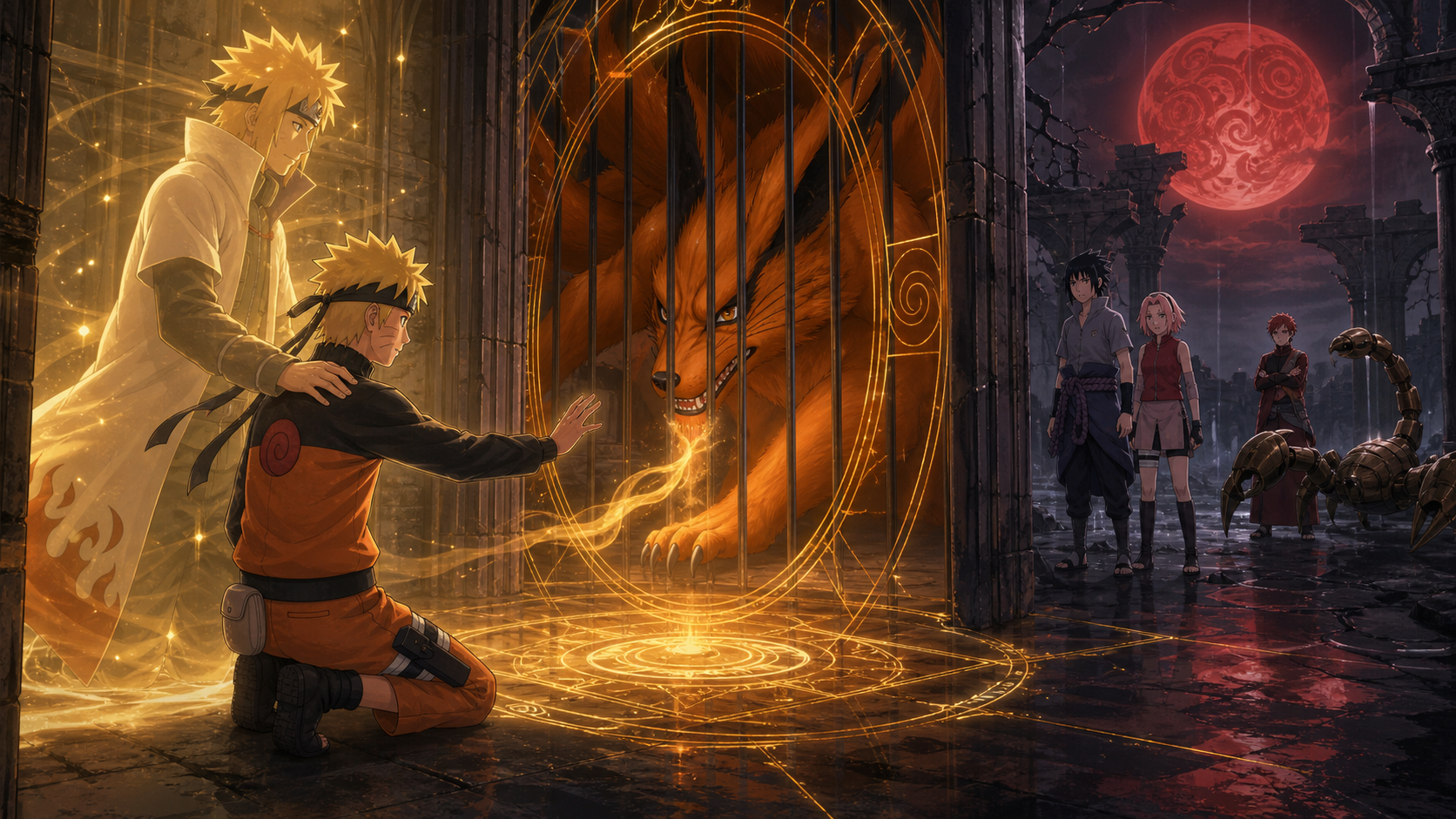
The Sealed Power
Kurama offers the strength Naruto needs, but opening the seal asks him to trust Minato’s judgment without surrendering his own limits.
Bottom line
“The Sealed Power” asks Naruto to trust the reason Minato sealed Kurama inside him without pretending the seal created a healthy relationship. Naruto is immobilized while his friends face Sasori and the wider trap. Kurama offers enough chakra to break his restraints, but only if Naruto opens access he may not control. The choice echoes the political test around Neji. The masked man identifies a real Konoha injustice, then asks Neji to hand over judgment so one angry leader can force reform. Team Jiraiya reports that the Leaf rookies returned for endangered children, proving the younger generation can revise mission priorities. The masked man orders more surveillance anyway. Power, grievance, and trust all need limits. A seal can protect someone or imprison someone. A leader becomes dangerous when he insists only his hand should hold the key.
Episode 437 returns to Naruto’s seal
Episode 437 continues the anime-original “Jiraiya Shinobi Handbook” arc inside Tsunade’s Infinite Tsukuyomi dream. “The Sealed Power” aired in Japan on November 12, 2015.
The episode places Naruto’s relationship with the Nine-Tails beside Neji’s relationship with the Hyūga system. Both boys carry power controlled through seals adults chose for them.
Shizune notices Tsunade has not eaten
Outside the manuscript’s inner story, Shizune approaches Tsunade because she has spent the day reading instead of eating. Dream Tsunade explains that she cannot put Jiraiya’s novel down.
The domestic interruption makes the captivity look gentle. Infinite Tsukuyomi has built a world where Shizune cares for her and Jiraiya’s voice remains available through pages.
Reading becomes the dream’s restraint
Tsunade does not experience chains or paralysis inside her fantasy. She keeps turning pages by choice.
That willing attention is exactly what makes the illusion effective. Madara does not need to frighten her when grief can hold her more comfortably.
Team Jiraiya reports to the masked man
Yahiko, Konan, and Nagato tell the masked figure what happened underground. Konoha’s rookies first left to prioritize the assigned mission, then returned for the children.
The report gives the observer a real answer to his ethical test. The young shinobi did not blindly obey or blindly charge. They reassessed and cooperated.
The rookies chose lives after thinking
Shikamaru’s team initially refused a dangerous descent. Later, Chōji protected Konan and the children while Shikamaru restrained a creature.
That sequence matters. Their care survived tactical thought, and their tactical thought made care more useful.
Team Jiraiya recognizes the difference
Yahiko’s group had expected Konoha shinobi to treat rules as absolute. The rescue complicates that belief.
The younger generation can inherit an institution without repeating every institutional failure.
The masked man refuses to end the test
Instead of accepting the report as sufficient, the masked figure orders Team Jiraiya to keep watching. His suspicion has become resistant to evidence.
A test stops being fair when the examiner moves the passing line after receiving an answer he dislikes.
Continued surveillance reveals his investment
The masked man does not merely want to know how Konoha’s rookies behave. He wants their behavior to prove his indictment.
That desire makes him a poor judge. He has built an operation around a conclusion and treats contrary evidence as a reason for another round.
He wants Konoha to change first
The stranger argues that transforming a powerful village such as Konoha will influence other hidden villages. The theory has strategic logic. Major institutions can normalize reform or cruelty across the system.
The unanswered question is who gets to define the reform and how much coercion becomes acceptable while forcing that example.
Neji is offered a place in the campaign
The masked man directs his argument toward Neji because the Hyūga branch system harmed his family directly. Neji could become a credible symbol for resistance against Konoha’s internal hierarchy.
Recruiting the injured person does not automatically make the movement accountable to that person.
The grievance remains legitimate
Hizashi died under conditions produced by Kumo’s kidnapping attempt, war pressure, Konoha’s political calculations, and the Hyūga branch system. The Caged Bird Seal still enforces main-family authority over branch bodies.
Neji has every reason to demand change. Rejecting the masked man cannot mean defending the status quo.
The method remains coercive
The stranger abducted jōnin, isolated children, manipulated the rookies, and brought Neji into a controlled vision while hiding his identity.
Someone who condemns forced obedience should not build a recruitment process around captivity and selective evidence.
Naruto cannot move
Elsewhere, Naruto finds himself physically restrained or unable to act while his friends remain in danger. His earlier confidence disappears when willpower cannot move his body.
Helplessness attacks the identity he has been building. He wants to be the person who reaches others, and now he cannot reach the next step.
He interprets paralysis as personal failure
Naruto blames his lack of strength. He rarely distinguishes between an impossible condition and a moral failure to overcome that condition.
That habit creates persistence, but the same habit makes him treat every limit as shame.
Kurama speaks from behind the seal
The Nine-Tails offers chakra and encourages Naruto to open the seal. Kurama has his own reason to want greater access.
Their interests overlap because Naruto needs power and Kurama wants freedom. Overlap does not establish trust.
Kurama knows the restraint can be broken
The beast recognizes that enough chakra could release Naruto’s blocked points or overwhelm the technique holding him. The solution carries a control problem.
Power can free his body while endangering everybody nearby if the chakra exceeds his ability to direct the transformation.
Naruto asks to try anyway
Naruto refuses to accept that loss of control is guaranteed. He argues that nobody will know the result without an attempt.
That answer sounds brave and reckless because both descriptions fit. His friends’ danger makes caution feel like surrender.
The seal was never a neutral gift
Minato placed the Nine-Tails inside his child under catastrophic circumstances. The decision gave Konoha a jinchūriki, preserved power, and assigned Naruto a burden he could not consent to carry.
Parental love shaped the choice. Military necessity shaped the same choice.
Naruto remembers questioning Minato
Alternate Naruto had the chance waking Naruto never received during childhood: he could ask his living father why the Nine-Tails was sealed inside him.
That conversation does not remove the burden. Direct explanation gives the child a route to challenge the adult responsible.
Minato believed in future protection
Minato explains that he trusted Naruto to use the power when something important needed protection. The seal carried hope rather than only containment.
Belief can become a genuine source of strength. Belief can also romanticize a dangerous inheritance adults chose for a child.
The father’s faith is not technical control
Minato believing Naruto will master the chakra does not teach Naruto how to master the chakra during this crisis. Confidence is not a training program.
Naruto still has to negotiate with Kurama, understand the seal, regulate the flow, and accept responsibility for the result.
Kurama offers a dangerous shortcut
Opening access could save friends faster than waiting for another rescue. The shortcut bypasses the slow relationship work required for stable partnership.
Kurama’s offer tests whether urgency can make Naruto confuse shared need with earned trust.
Sasuke faces Sasori
Sasuke encounters Sasori during the scattered mission. The puppet master provides a threat built around hidden weapons, poison, distance, and bodies treated as tools.
Sasuke’s speed and visual ability help, but one concealed strike can change the fight.
Poison makes power time-sensitive
Sasuke is poisoned. The injury creates a deadline that strength alone cannot solve.
Poison attacks the body after the visible exchange ends. Winning the next clash means little if the toxin keeps working.
Sakura’s medical role becomes essential
Sasuke’s condition increases the need for Sakura and coordinated retreat. A team cannot treat medical expertise as secondary until somebody collapses.
The mission’s scattered structure makes reaching treatment harder.
Sasori embodies controlled bodies
Sasori turns human bodies into puppets and hides his own living core inside constructed forms. His technique fits an episode about seals, restraints, and institutional ownership.
Every conflict asks who controls the body carrying power.
Jiraiya investigates Orochimaru’s network
Jiraiya’s parallel work leads toward one of Orochimaru’s compounds or hideouts. The discovery suggests the missing-shinobi operation connects with a broader hidden network.
Adults are gathering structural information while the rookies survive immediate tests. Both levels matter.
Orochimaru remains a threat in the kinder timeline
Minato and Kushina survived. The Uchiha stayed intact. Orochimaru’s experiments and appetite for forbidden power still exist.
Alternate history prevents specific tragedies without deleting every person who benefits from weak oversight and vulnerable bodies.
The masked man and Orochimaru share a contradiction
Both claim access to change ordinary shinobi society cannot achieve. Both use hidden facilities, selected bodies, and controlled information.
Different goals do not erase similarities in method.
Neji has to separate power from liberation
The masked man offers a route to attack the institution that caged Neji’s family. Joining could provide leverage unavailable inside the Hyūga hierarchy.
Liberation led by another secretive authority can become a replacement cage.
Naruto has to separate power from partnership
Kurama offers what Naruto urgently needs. Accepting chakra may be necessary. Treating necessity as friendship would be premature.
Partnership requires both sides to speak, set limits, and accept consequences beyond the immediate emergency.
The episode parallels two keys
Neji is offered political power through the masked man. Naruto is offered physical power through Kurama. Each offer promises a way past helplessness.
Each source also wants something from the person receiving the offer.
Team Jiraiya becomes evidence against despair
Yahiko, Konan, and Nagato see Konoha rookies return for children. Their report proves institutional culture is not perfectly inherited.
Young people can make different choices when given room to think and cooperate.
The masked man treats hope as insufficient
He orders continued observation because one rescue does not reform a village. That caution is understandable. One good choice cannot dismantle the branch seal or rewrite mission law.
His error is refusing to recognize the choice as evidence of capacity for reform.
Structural change needs more than good individuals
The rookies helping children does not free the Hyūga branch family or repair Hizashi’s death. Personal compassion cannot substitute for policy, authority, and accountability.
The episode needs both truths: the young generation can change, and institutions will not change automatically because those children grow up kind.
Minato’s Konoha remains unfinished
This timeline gave Minato years as Hokage and prevented the Uchiha massacre. The Hyūga system still exists, and the masked man still finds enough grievance to organize a test.
Better leadership improves outcomes without completing justice.
Tsunade reads a debate she knows personally
Tsunade inherited a village with old laws, clan autonomy, war debts, and children carrying powers adults assigned. As Hokage, she often relied on individual courage because structural repair moved slowly.
Jiraiya’s fictional story asks whether faith in the next generation can excuse the present generation from changing institutions now.
The Nine-Tails is not yet Kurama to Naruto
The relationship in this alternate story remains hostile and transactional. Using the name Kurama too casually inside Naruto’s immediate perspective would imply trust the arc has not earned.
The audience knows the beast’s identity and later relationship. This Naruto still faces the Nine-Tails behind a seal.
The episode uses memory as authorization
Naruto recalls Minato’s faith and draws permission to risk the sealed power. The memory helps him act when fear and paralysis are winning.
Parental faith should support judgment rather than replace judgment. Naruto remains responsible for how he opens the door.
Sasuke’s poison keeps the crisis grounded
While Naruto wrestles with inherited power and Neji hears political arguments, Sasuke’s body is losing a practical medical fight. Philosophy does not pause poison.
The episode needs the team to turn decisions into rescue before time runs out.
Where the episode is strongest
The parallel between Naruto and Neji works. Both are offered power by someone behind a barrier. Both sources identify a real need. Neither offer comes without self-interest.
Team Jiraiya’s report gives the argument a behavioral test instead of leaving every claim at the level of speeches.
Where the episode is weaker
The story spreads attention across Tsunade, Shizune, Team Jiraiya, the masked man, Neji, Naruto, Kurama, Sasuke, Sasori, and Jiraiya’s investigation. Several threads receive only enough time to set up the next episode.
The result feels transitional even when the themes connect.
Minato’s belief cannot substitute for Naruto’s consent
He sealed power into his infant son because he believed Naruto could protect the village later. That faith may be loving, but the child could not agree to the burden.
Naruto inherits both possibility and risk. Respecting his father does not require pretending the decision belonged equally to them.
The seal contains a relationship nobody has built yet
At this point Naruto does not know the Nine-Tails as Kurama or understand the history behind its rage. Their connection is containment before it becomes partnership.
Opening the seal under pressure would increase access faster than trust, which is precisely why the offered shortcut deserves suspicion.
Kurama speaks to the need Naruto cannot hide
Paralysis makes Naruto feel useless while friends face danger beyond him. The fox offers power at the moment that shame makes refusal hardest.
A true offer permits time, limits, questions, and withdrawal. An offer built around emergency can become coercion even when the power would help.
Naruto’s limits are information, not humiliation
Being unable to move does not make him morally responsible for every event outside the seal. His body is reporting a condition that needs understanding.
Forcing more chakra through the problem may restore action, but action without control can transfer the danger directly to the teammates he wants to save.
Sakura changes the meaning of Sasori’s poison
Sasuke’s strength cannot make contamination irrelevant. Poison creates a medical clock, requires identification, and turns treatment knowledge into part of the battle plan.
Sakura is not valuable only after somebody is injured. Her expertise changes which risks the team can survive before the first strike lands.
Sasori turns bodies into obedient technique
His puppetry makes control visible through strings, preserved corpses, hidden weapons, and poison. The enemy’s art removes choice while retaining useful function.
That image belongs beside Naruto’s seal and Neji’s recruitment because all three plots ask who gets to direct power housed in another body.
Neji is offered freedom with somebody else holding the map
The masked man recognizes Hyūga oppression and promises a campaign against Konoha, but he still controls information, movement, timing, and membership.
Liberation cannot require Neji to exchange one inherited authority for a masked authority that treats his grievance as recruitment material.
Team Jiraiya demonstrates revision without surrender
Yahiko, Konan, and Nagato reassess the Konoha rookies after seeing them return for endangered children. They change judgment because behavior changed the evidence.
That is stronger than demanding instant trust. Hope becomes credible when people can revise conclusions while keeping their own questions and boundaries.
Trust needs a way to survive refusal
If Naruto says no to more chakra, Kurama’s response reveals whether the offer respected him. If Neji declines recruitment, the masked man’s response reveals whether liberation ever included Neji’s judgment.
Power relationships become trustworthy when refusal does not trigger punishment, abandonment, or renewed captivity. That standard matters more than whether the proposed goal sounds noble. A protector who only supports agreement is still controlling the person whose freedom supposedly justifies the plan. Consent becomes real when a no can remain safely spoken.
RaeRae’s verdict
“The Sealed Power” understands that inherited power can be faith, weapon, burden, and cage at the same time. Minato believed Naruto could protect something precious with the Nine-Tails’ chakra. That love does not make the sealing fair or control easy. Naruto still has to decide how much access to give a captive beast whose goals only partly match his own.
The masked man makes a similar offer to Neji through politics. He knows where Konoha failed and wants Neji’s pain to authorize his method. Team Jiraiya’s report should have complicated his certainty. Instead, he orders more surveillance. That decision tells me more about him than the mask: he wants proof that only force can change the village, so evidence of voluntary change becomes inconvenient.
RaeRae’s call
Sealed power is never only a larger chakra supply. Minato placed a future inside Naruto before Naruto could consent, and paternal faith does not remove that fact. Kurama offers access when paralysis and shame make refusal difficult, before either side has built the relationship that could make power shared. Outside, Sasori’s poison proves strength still depends on Sakura’s medical knowledge and time. Neji faces the same structural question through politics: will liberation give him agency, or merely replace the authority directing his body? Naruto and Neji both need power that can be questioned, limited, and refused. Anything less repeats containment under a kinder name.
Episode details and viewing routes
- Official episode reference: Naruto Official episode guide
- Licensed episode route: Crunchyroll licensed episode page
What I am carrying forward
Team Jiraiya reported that Konoha’s rookies initially prioritized the mission but returned to save Ashitaba and Komichi. The masked man ordered continued surveillance rather than ending the test. He argued that changing Konoha could influence the wider shinobi world and continued pressuring Neji through the village’s treatment of the Hyūga branch family.
Naruto remained immobilized and regretted his weakness. The Nine-Tails offered chakra if Naruto opened the seal despite the risk of losing control. Naruto remembered Minato explaining that he sealed the power because he believed his son would use the chakra to protect something important. Sasuke faced Sasori and suffered poisoning. Episode 438 forces the rookies to choose between reporting under the rules and rescuing their captured comrades.