
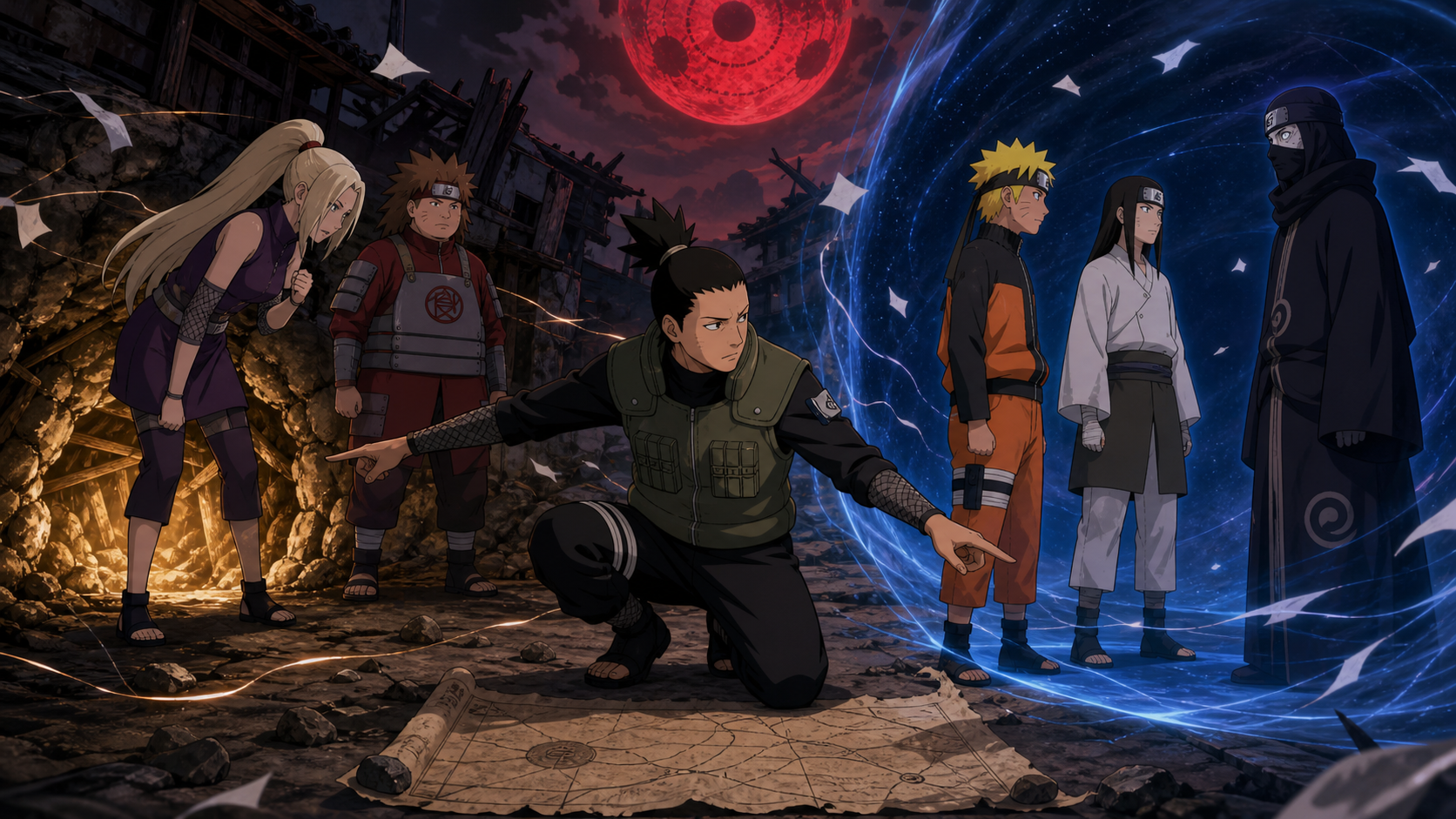
Order of Priority
Rules keep panic from multiplying casualties, but leadership fails when restraint becomes permission to treat endangered people as scenery.
Bottom line
“Order of Priority” refuses to let “mission first” sound clean when two children are under collapsed ground. Team Jiraiya goes after them. Ino and Chōji want to help. Shikamaru holds his team back because the captured jōnin, Minato’s orders, and a possible trap still matter. Elsewhere, Naruto and Neji hear a hidden voice accuse Konoha of valuing rules above comrades. The voice then drags them into another space, where a masked person carries a Byakugan. Every part of the episode pressures the same wound in shinobi culture: rules exist because panic kills people, but institutions often use those rules to make abandoning people sound professional. Shikamaru’s restraint is defensible. His responsibility does not end with restraint. A leader has to find the path that protects the mission without treating civilians as acceptable scenery.
Episode 435 asks what comes first
Episode 435 continues the anime-original “Jiraiya Shinobi Handbook” story inside Tsunade’s Infinite Tsukuyomi dream. The Japanese title is “Yūsen Jun’i,” meaning “Order of Priority.” The episode aired in Japan on October 22, 2015.
The title names a practical leadership problem rather than a philosophical decoration. Several duties become urgent at once, and no team has enough people or information to satisfy all of them.
The children remain underground
Ashitaba and Komichi fell when the fight damaged the village ground. The collapse opened access to tunnels or a buried space beneath the settlement.
Their danger is immediate. They did not join a shinobi operation or accept mission risk. Adults and armed groups brought that risk into their home.
Team Jiraiya descends first
Yahiko, Konan, and Nagato go after the children. Their decision provides the clearest evidence so far about the values behind their name.
They stop the confrontation and address the harm nearest to them. Whatever larger test or plan exists, civilians cannot wait for that plan to become convenient.
Their rescue does not erase responsibility
Nagato’s power contributed to the collapse. Diving after the children is necessary, but rescue does not cancel the danger created during the fight.
Team Jiraiya accepts the consequence instead of using intent as an excuse. That response matters more than claiming the damage was accidental.
Ino wants to follow
Ino sees children fall and responds with urgency. Her instinct is not foolish sentiment. Additional rescuers could matter underground.
She also lacks information about the tunnel stability, enemy purpose, and whether following Team Jiraiya would place more people inside a prepared trap.
Chōji shares the impulse
Chōji wants to help Ino and the children. His compassion often becomes visible before strategy. He notices who is hungry, hurt, excluded, or afraid.
That strength can push him toward danger because leaving somebody behind feels worse than facing an unknown threat.
Shikamaru stops both teammates
Shikamaru tells Ino and Chōji not to enter the sinkhole. He does not have the luxury of reacting only as a friend or decent person. He is making a command decision for the remaining team.
His refusal looks cruel because viewers can see the children’s danger. Leadership often becomes visible through the action everybody else resents.
Minato’s order still controls the mission
The young teams were told to report discoveries rather than attempt impulsive rescues. Their jōnin leaders have vanished, confirming that the enemy designed the area to capture experienced shinobi and scatter students.
Shikamaru has evidence that following a target underground may multiply the casualties.
The original mission has not disappeared
Kakashi and other senior shinobi remain captive. Hidan, Kakuzu, Team Jiraiya, and an unknown coordinator have all appeared around the search.
Saving two children cannot make those obligations vanish. The real problem is resource allocation under pressure.
A priority list is not a moral ranking
Placing one task first does not mean the people in another task matter less. Priority measures timing, available capability, and consequence.
Shikamaru’s challenge is communicating that distinction before restraint hardens into abandonment.
Team Jiraiya already covers the rescue
Yahiko’s group is moving toward the children. Sending Ino and Chōji into the same hole may duplicate effort while weakening Konoha’s ability to continue the larger search.
That fact supports Shikamaru’s choice. Trusting recent opponents with civilian lives remains emotionally difficult, but their actions have supplied relevant evidence.
Trust has to begin before certainty
Konoha does not know Team Jiraiya’s complete purpose. Waiting for perfect certainty would make cooperation impossible in an emergency.
Shikamaru can treat their rescue behavior as provisional evidence without declaring them allies.
The village becomes a test site
The conflict has moved through a civilian settlement and underground passages. Somebody appears to be observing how the Konoha teams respond to competing duties.
The children’s danger may have become part of that test, whether planned or caused by the fight. Using civilians to measure ethics would make the test itself unethical.
Team Kakashi reaches the settlement
Naruto, Sasuke, and Sakura arrive near the village disturbance while trying to regroup and locate Kakashi. Their mission now overlaps with Shikamaru’s team and Team Jiraiya’s confrontation.
The broader field finally begins reconnecting, but the enemy has already split attention across several crises.
Team Guy also arrives
Neji, Lee, and Tenten reach the area without Guy. They carry direct evidence of the underground abduction method and the loss of another jōnin leader.
Neji’s brief detection of underground chakra remains one of Konoha’s strongest clues.
Naruto and Neji come together
Naruto and Neji represent two different relationships with rules and destiny. Naruto resists any system that declares a person fixed. Neji grew up under a clan seal that turned family hierarchy into bodily control.
Placing them together makes the hidden voice’s accusation about Konoha more pointed.
A mysterious voice interrupts them
An unseen speaker addresses Naruto and Neji. The voice condemns Konoha shinobi for following rules while comrades suffer.
The claim targets a real contradiction in village history. Sakumo Hatake’s fate already placed that wound inside the arc.
The voice uses moral truth as leverage
Konoha has punished people for choosing comrades over missions. Branch Hyūga members carry rules written into their bodies. Naruto has watched institutions call abandonment necessary.
A speaker can use accurate criticism while pursuing manipulation. Truth in the accusation does not prove trustworthiness of the accuser.
Sakumo’s story hangs over the episode
Kakashi previously told Team 7 that Sakumo saved comrades, failed a mission, suffered public disgrace, and died by suicide. His story demonstrates what “mission first” can become when a village refuses moral context.
Shikamaru’s choice now risks resembling the same culture, even though his tactical reasons are stronger than public shame or rigid doctrine.
Naruto rejects abandonment by instinct
Naruto’s history makes him hostile to any rule that asks him to leave somebody behind. He knows how institutional logic can turn a person into an acceptable loss.
That instinct protects his moral center. The same instinct can make him easy to lure with a visible captive.
Neji understands rules carved into flesh
Neji grew up inside the Hyūga branch system. The Caged Bird Seal enforces obedience, restricts the Byakugan after death, and protects the main family through branch-family sacrifice.
When the voice criticizes Konoha rules, Neji has personal evidence that the village tolerates cruelty inside respected clans.
The speaker invites them away
The voice offers access to another space or altered dimension. Following separates Naruto and Neji from the teams they just found.
The move repeats the enemy’s broader method: isolate selected people, then control what information they receive.
Curiosity becomes another capture route
Naruto wants answers about the missing jōnin and the accusation. Neji’s eyes may help him evaluate the hidden threat. Both have reasons to continue.
Those reasons do not make the route safe. The speaker has designed the invitation around their deepest objections to Konoha.
They wake in a strange location
Naruto and Neji regain awareness somewhere unfamiliar. The shift confirms that the voice controlled the transition.
Their physical separation from allies gives the masked person time to shape the conversation without interruption.
A masked figure meets them
The person conceals identity behind a mask. Hidden identity makes every moral accusation harder to evaluate because the speaker asks for trust without offering accountability.
The figure wants Naruto and Neji to judge Konoha while withholding the personal stake behind the judgment.
Neji recognizes a Byakugan
Neji detects that the masked person possesses a Byakugan. That is the episode’s strongest identity clue.
The eye connects the stranger to the Hyūga bloodline or to some form of acquisition involving that bloodline. The episode does not yet verify which explanation applies.
The Byakugan changes the accusation
A Hyūga connection gives the speaker potential firsthand knowledge of branch-family rules, sacrifice, and institutional silence.
The critique may come from someone harmed by the same system that shaped Neji. That possibility makes dismissal harder and manipulation easier.
A stolen eye remains possible
Naruto’s world contains transplanted dōjutsu, stolen bodies, and experiments. Possessing a Byakugan does not automatically prove clan identity.
Neji can confirm the eye. He cannot confirm the biography behind the mask.
The masked person chooses Naruto and Neji carefully
Naruto challenges institutional abandonment. Neji embodies the consequences of clan hierarchy. Both can be pushed through stories about rules harming comrades.
The selection feels deliberate rather than accidental. The speaker wants an audience already prepared to find Konoha guilty.
Shikamaru and Naruto occupy opposite pressures
Shikamaru holds people back because a leader must manage limited resources. Naruto follows the critic because abandoning people feels morally intolerable.
Neither position is sufficient alone. Pure obedience can preserve cruelty. Pure impulse can feed traps and create more victims.
The shinobi system manufactures these impossible choices
Villages train children to treat mission completion, secrecy, comrades, clients, civilians, and national survival as simultaneous absolutes. Then leaders blame the individual when those duties collide.
Episode 435 makes the collision visible instead of pretending one slogan can solve every case.
The children expose the limits of mission language
Ashitaba and Komichi are not part of Konoha’s original assignment. A narrow reading could classify their rescue as outside scope.
Any ethical mission system has to account for foreseeable civilian harm created by the mission itself. Otherwise efficiency becomes permission to leave damage behind.
Team Jiraiya acts before debating
Yahiko’s group does not hold a seminar about priorities. They descend because the children are falling now.
That action earns moral credibility while raising tactical questions. A fast rescue can still create another trap.
Shikamaru thinks before acting
Shikamaru protects the remaining team from a blind descent. His caution earns tactical credibility while raising moral questions.
The strongest solution needs Team Jiraiya’s urgency and Shikamaru’s analysis in the same plan.
The episode delays that cooperation
Both sides possess part of the answer but remain separated by suspicion and incomplete information. The plot stretches conflict because nobody trusts the other enough to share priorities.
That delay resembles the larger shinobi world, where villages often duplicate danger rather than exchange intelligence.
Tsunade reads her own leadership burden
As Hokage, Tsunade has ordered missions, protected civilians, deployed children, and faced crises where every available choice carried deaths.
Jiraiya’s fictional dilemma gives her a reader’s distance from decisions she knows too well.
The dream keeps Jiraiya’s moral question alive
Jiraiya believed shinobi needed an answer to hatred beyond retaliation and obedience. His students, Naruto, and Konoha’s rookies now test different versions of that belief.
The manuscript lets Tsunade hear him ask again what a shinobi owes another person.
The episode advances through argument more than combat
Most of the important movement comes from choices: descend, stay, regroup, follow the voice, accept the invitation, reveal the eye.
That emphasis suits the title. Priority becomes visible through direction rather than speeches about values.
The masked reveal is effective but incomplete
The Byakugan gives the cliffhanger a specific connection to Neji. The mask prevents the episode from turning that connection into certainty.
The next installment must earn the mystery through history and motive, not merely another surprise face.
Triage is not a declaration of human worth
Choosing which danger receives movement first does not mean the other lives matter less. It means time, information, terrain, and available teams cannot satisfy every need simultaneously.
Leadership becomes cruel when it hides behind priority language, but it also becomes reckless when urgency refuses any sequence at all.
Ino keeps the trapped children emotionally present
Her insistence prevents the mission order from turning civilians into background noise. She names the people whose danger could disappear inside tactical abstraction.
Even when Shikamaru stops her, that pressure improves the decision by forcing him to explain why another rescue team changes what their own team should do.
Chōji makes friendship part of the calculation
He understands Ino’s impulse and the pain of standing still while somebody may be buried. His support ensures she does not face command as an isolated dissenter.
A good team needs members who can challenge the leader without being treated as disloyal for feeling the human cost first.
Shikamaru must account for the rescue already underway
Team Jiraiya has descended, which means additional bodies could help or could create congestion, instability, and more people needing extraction. He cannot decide as though nobody responded.
Trusting another team’s action is uncomfortable, especially across faction suspicion, but coordination begins when every group stops duplicating movement blindly.
Orders remain provisional when conditions change
Minato’s restriction was designed for a search involving missing veterans and unknown methods. New children, collapsed ground, hostile actors, and separated leaders alter the mission.
Following command responsibly requires asking whether its purpose still survives the facts, not worshipping the original sentence after reality moves.
Naruto hears the moral truth inside the trap
The mysterious voice condemns systems that sacrifice people for rules, and Naruto recognizes a wound his own village created. That truth makes the invitation persuasive.
Manipulation often works through accurate criticism. A speaker can name institutional harm correctly while still using the listener’s compassion to isolate and capture them.
Neji knows rules can be written onto skin
The Hyūga branch seal turned hierarchy into bodily control, so he cannot dismiss accusations about shinobi institutions as abstract rhetoric. His experience makes him a deliberate target.
The masked figure’s Byakugan deepens the claim by suggesting another life shaped, stolen, or discarded through the clan’s ocular politics.
Naruto and Neji need each other’s suspicion
Naruto moves toward anyone who describes abandonment because he refuses to repeat it. Neji is more alert to inherited systems, hidden costs, and the possibility that familiar moral language conceals control.
Together, compassion and structural memory could test the speaker. Separated from their teams, both strengths become easier to redirect.
Team Jiraiya and Shikamaru represent incomplete virtues
Yahiko, Konan, and Nagato act before deliberation can excuse abandonment. Shikamaru pauses before emotion multiplies casualties. Neither method is sufficient everywhere.
The real answer would connect Team Jiraiya’s urgency to Shikamaru’s coordination instead of forcing rescue and planning to compete for moral legitimacy.
Tsunade recognizes the burden hidden in the title
As Hokage, she repeatedly decides which mission, patient, village, or threat receives limited resources first. Reading the dispute through Jiraiya’s story makes leadership personal.
Infinite Tsukuyomi offers no relief from that burden because her dream keeps asking whether authority can remain humane under scarcity.
Delay must leave an accountable record
If leaders choose not to move, they still owe the endangered people a reason, a monitoring plan, and a point when the decision will be reconsidered.
Otherwise caution becomes invisible abandonment performed with calmer language. Shikamaru’s restraint matters because he continues thinking, not because waiting is automatically wise.
Rescue must include the rescuers’ survival
Rushing underground may feel morally pure, but creating additional casualties reduces the village’s capacity to help anyone. That consequence belongs in the decision without becoming an excuse for indifference.
Care is durable when it protects both the person in danger and the people asked to reach them safely.
RaeRae’s verdict
“Order of Priority” works because every major choice contains a defensible reason and a real moral danger. Team Jiraiya goes after the children but may deepen a trap. Shikamaru protects his team but risks treating civilians as somebody else’s problem. Naruto and Neji pursue evidence but allow a hidden speaker to isolate them.
The episode understands that rules and compassion need each other. Rules should preserve judgment under panic. Compassion should stop rules from converting people into acceptable losses. The masked Byakugan user attacks the gap between those principles, and Konoha has supplied enough history to make the attack credible.
RaeRae’s call
An order of priority is not a ranking of whose life matters. Ino keeps the trapped children visible. Chōji keeps dissent from becoming lonely. Shikamaru accounts for the rescue already underway and the danger of sending more bodies into unstable ground. Team Jiraiya supplies urgency, while he supplies sequence. Naruto and Neji then meet a speaker who uses a true indictment of shinobi rules as a capture route. Naruto understands abandonment. Neji carries hierarchy in his skin. Their compassion and experience make them appropriate listeners, but also vulnerable targets. Accountable leadership must revise orders when conditions change and explain every delay to the people carrying its cost.
Episode details and viewing routes
- Official episode reference: Naruto Official episode guide
- Licensed episode route: Crunchyroll licensed episode page
What I am carrying forward
Team Jiraiya descended into the underground area to rescue Ashitaba and Komichi after the children fell during the village fight. Ino and Chōji wanted to follow, but Shikamaru stopped them and continued weighing the original mission against the immediate rescue.
Naruto’s and Neji’s groups reunited elsewhere in the settlement. A mysterious voice condemned Konoha shinobi for placing rules above comrades and drew Naruto and Neji into another space. They woke before a masked person. Neji determined that the stranger possessed a Byakugan. Episode 436 continues that confrontation and the history behind the accusation.