
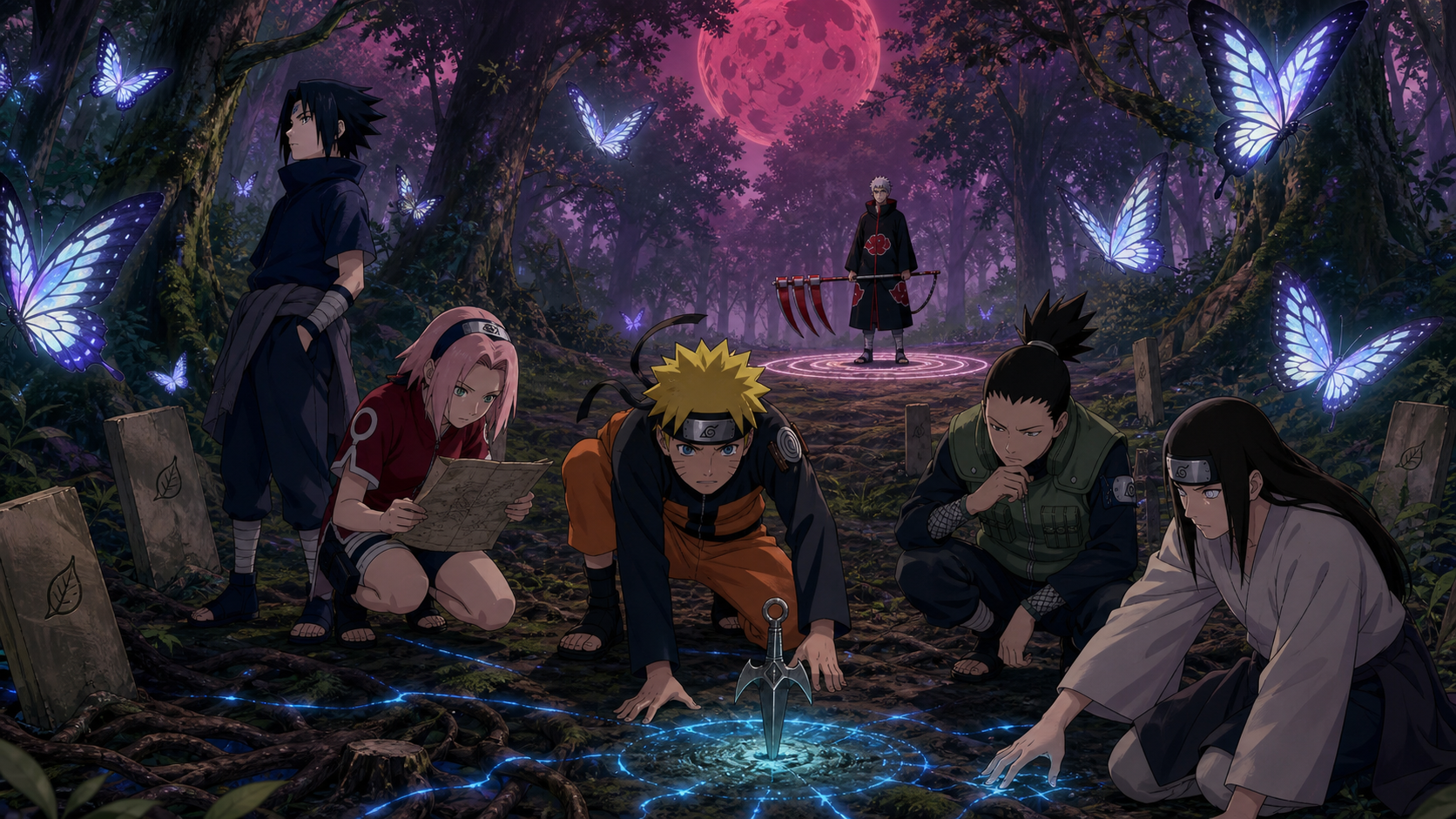
The Search Mission
Minato orders the young teams to report before rescuing anyone, but Naruto still mistakes solitary danger for proof that he belongs beside them.
Bottom line
“The Search Mission” tests whether Konoha’s new generation can follow an order designed to keep bravery from becoming another disappearance. Veteran shinobi are vanishing. A wounded survivor remembers only Ageha butterflies. Minato sends four young teams to investigate and tells them to report any discovery before attempting a rescue. That condition is not cowardice. The enemy is targeting experience, erasing jōnin through an underground chakra route, and leaving almost no evidence. Naruto still charges ahead when Hidan appears, loses blood, and becomes trapped in a curse that punishes his body from a distance. The alternate world gave him living parents and the Hokage’s protection. A mission can still reach the stubborn weakness no family can remove: Naruto believes accepting danger alone proves he deserves to stand beside everybody else.
Episode 433 continues Jiraiya’s manuscript
Tsunade remains trapped inside Infinite Tsukuyomi and continues reading the fictional “Jiraiya Shinobi Handbook.” Episode 433, “The Search Mission,” aired in Japan on October 8, 2015.
The episode belongs entirely to the anime-original alternate history. Minato’s survival, the intact Uchiha clan, and this missing-shinobi case are parts of the novel inside Tsunade’s dream rather than additions to manga canon.
The wounded shinobi provides one clue
The man found near Konoha cannot deliver a useful report. His surviving memory centers on Ageha butterflies. That fragment gives the village an image without a confirmed enemy, location, or method.
A responsible investigation has to treat his memory as a lead rather than an answer. Butterflies may mark a place, lure, technique, or person.
Missing veterans change the threat level
The disappearances involve experienced shinobi. These are not academy students wandering off course. Somebody can remove people trained to notice traps, resist capture, and report danger.
Shikamaru recognizes the pattern early. The enemy is selecting capability, which means every senior rescuer may also become the next target.
Minato questions the survivor
As Hokage, Minato takes the limited testimony seriously. He does not dismiss the survivor because the account sounds strange, and he does not pretend one damaged memory supports a complete theory.
That restraint fits the episode’s central problem. Konoha needs action without false confidence.
Tsunade receives the case information
Minato shares the situation with Tsunade inside Jiraiya’s fictional world. Her medical knowledge and experience give the village another senior perspective.
The dream lets Tsunade participate in a Konoha where Minato carries the Hokage office. She can advise without holding every final responsibility herself.
Four rookie squads receive the mission
Konoha deploys multiple young teams to search for the missing shinobi. Team 7 joins the operation alongside the other familiar rookie formations.
Sending several squads increases coverage and creates mutual support. The choice also places less experienced shinobi in danger because senior fighters have become the enemy’s preferred targets.
The jōnin leaders carry Flying Thunder God kunai
The team leaders receive marked kunai connected to Minato’s Flying Thunder God technique. The tools provide an emergency route for location and intervention.
Minato does not send children into uncertainty with a motivational speech and hope. He builds a retrieval mechanism around the mission.
Minato gives one firm restriction
If a squad finds a missing comrade, the young shinobi must report to Konoha rather than launch an immediate rescue. The order anticipates the emotional pressure of seeing somebody in danger.
Rescue instinct can be noble and still feed a trap. Minato asks them to bring information home so the village can respond with enough force and context.
Naruto hears caution as doubt
Naruto struggles with instructions that place waiting between discovery and action. He wants to prove that he belongs on serious missions despite his “loser” reputation.
That insecurity makes restraint feel like another person questioning his value. The mission needs him to understand that discipline is part of courage.
Shikamaru studies the selection pattern
Shikamaru notices that the missing people are seasoned fighters. His analysis changes the search from a general disappearance case into a targeted operation.
The observation should affect behavior immediately. Experienced leaders cannot assume rank protects them. The rookie teams may survive precisely because the enemy considers them less valuable.
The episode values intelligence before combat
No one can defeat a technique they have not identified. Tracks, survivor memory, chakra traces, timing, and target selection matter more than an early display of force.
The search gives sensory and analytical shinobi a central role. That balance suits an ensemble mission better than making Team 7 solve every problem through power.
Ageha butterflies become a lure
The glowing butterflies draw attention because they match the survivor’s final word. Following them seems logical, but the match may be exactly what the enemy expects.
Beautiful evidence can still lead people into danger. A clue that arrives too neatly deserves more suspicion, not less.
Naruto moves before the group understands
Naruto reacts to the butterflies with his usual speed and impatience. He wants the clue to become a route and the route to become a rescue.
His impulse keeps missions moving when fear would freeze somebody else. The same impulse can separate him from the people able to see the trap.
The forest hides movement underground
The enemy uses the earth beneath the search area rather than approaching across open ground. Veteran shinobi disappear downward before teammates can establish a conventional fight.
The method attacks the group’s assumptions. Eyes scan trees and paths while danger moves below their feet.
A jōnin leader vanishes
One of the senior leaders is pulled beneath the surface. The marked kunai remains behind as evidence of how quickly the removal happened.
The emergency tool cannot help if the person carrying the tool loses contact before using or preserving the intended signal. Preparation reduces risk without making a mission safe.
The remaining teams face the same method
The abductions continue against leaders who should be the strongest protection available to each squad. Every disappearance leaves younger shinobi with less guidance and more pressure.
The enemy is dismantling command rather than fighting whole teams at once.
Might Guy becomes another target
Guy disappears through the underground technique. His physical speed and combat power cannot answer an attack that denies him a visible opponent.
The moment proves Shikamaru’s warning. Experience has become the selection criterion rather than a defense.
Neji senses the chakra flow
Before Guy vanishes, Neji detects chakra moving beneath the ground. The trace disappears after the abduction.
That brief detection gives the young teams their first meaningful information about method. The enemy can hide the path quickly, but the technique is not completely invisible.
The Byakugan has a practical job
Neji’s vision matters because the search extends beyond surfaces. He does not solve the entire mystery in one glance. He catches a temporary chakra route that others cannot see.
The limitation keeps his ability useful without turning the Byakugan into an automatic answer machine.
The leaders’ disappearance changes authority
Young shinobi must decide whether to preserve Minato’s instructions after the adults who carried those instructions vanish. Following orders becomes harder when no senior voice stands nearby.
That transition tests whether discipline belongs to the team or only to the commander.
Naruto becomes separated from safety
Naruto’s forward movement exposes him to a direct enemy encounter. The mission shifts from investigation to survival before Konoha has enough information to organize the rescue Minato required.
The trap works by making urgent people feel one step behind.
Hidan enters the alternate story
Hidan confronts Naruto. His presence introduces an Akatsuki threat even though this alternate history has changed several major political outcomes.
The manuscript preserves dangerous personalities and organizations rather than building a peaceful world around Naruto’s surviving parents.
Hidan needs only a small wound
Hidan injures Naruto and obtains his blood. The amount looks minor beside a normal shinobi battle. For Hidan’s ritual, blood is access.
That mechanic punishes any fighter who treats a scratch as meaningless. Durability cannot protect Naruto once the curse connects their bodies.
The ritual changes distance into control
Hidan uses Naruto’s blood to establish his curse and injures himself to harm Naruto. The enemy can attack the target through his own body after creating the link.
Naruto’s usual willingness to absorb punishment becomes dangerous. Hidan turns that tolerance against him without needing to win every physical exchange.
Naruto meets an enemy who rewards recklessness
Charging Hidan provides exactly what the ritual requires: proximity, contact, and blood. Naruto’s courage does not become useless, but courage without information helps the enemy complete his setup.
The fight makes Minato’s earlier caution look less like parental anxiety and more like accurate mission planning.
Kurama does not automatically solve the curse
Naruto carries enormous chakra and already accessed Kurama’s power in the previous episode. Hidan’s technique works through a specific condition rather than a simple power comparison.
More chakra cannot replace understanding the ritual circle, blood requirement, and link. The episode keeps tactics relevant inside an alternate world full of inherited power.
The enemy network appears coordinated
Underground abductions remove leaders while Hidan catches Naruto away from the larger formation. These threats may involve different fighters, but the timing creates pressure across the search area.
Konoha has walked into an operation designed to scatter attention and prevent a unified response.
The missing jōnin may be bait
Minato’s no-rescue order anticipates a possibility the episode keeps strengthening. Captured veterans can draw their students deeper into prepared terrain.
The emotional bond between teacher and team becomes part of the enemy’s weapon.
The alternate world preserves Akatsuki danger
Minato and Kushina surviving changed Naruto’s family. Uchiha negotiation changed Sasuke’s home. Neither change erased every violent movement beyond Konoha.
Jiraiya’s fictional world argues that better choices can prevent specific catastrophes without ending human greed, ideology, or organized cruelty.
Minato cannot protect Naruto from every choice
Minato equips the leaders, gives careful orders, and commands the village. Naruto can still outrun that protection and enter a curse.
Parenthood reduces abandonment. Parenthood does not create remote control over a child’s judgment.
Naruto’s need to prove himself remains
Canon Naruto chased recognition because villagers denied his worth. Alternate Naruto receives family love but still lives beneath Minato’s legend and Sasuke’s talent.
The source of insecurity changes. The behavior remains familiar because comparison can wound even inside a loving home.
Sasuke’s rivalry has a different foundation
Sasuke is not pursuing revenge for a murdered clan in this story. His rivalry with Naruto grows within family expectations and visible competition.
That difference should shape how he responds when Naruto takes reckless risks. Frustration can come from friendship and pride rather than fear of losing another bond after massacre.
The ensemble has more responsibility than usual
Shikamaru’s analysis and Neji’s detection provide the mission’s clearest advances. Naruto supplies urgency and becomes the immediate victim of Hidan’s technique.
The distribution is healthy for an arc built around the rookie generation. Intelligence, vision, and force solve different parts of the same problem.
The mystery stays appropriately incomplete
Episode 433 does not identify the full purpose behind the abductions or explain every enemy relationship. The young shinobi know the target pattern and underground method, while the audience sees a dangerous confrontation with Hidan.
That amount of uncertainty supports the next episode. Adding a confident villain theory now would overstate the evidence.
The title describes work rather than destiny
“The Search Mission” is plain and functional. The episode follows clues, team deployment, command rules, and the consequences of losing formation.
The lack of a grand title suits a chapter where basic field discipline matters more than prophecy.
Tsunade keeps reading because the stakes feel familiar
The manuscript places young shinobi under orders, removes experienced leaders, and forces children to decide how much danger they can carry. Tsunade has spent her Hokage years making versions of that decision.
Her dream lets Jiraiya write the burden while she watches from the reader’s side.
The episode’s strongest idea is command loss
Pulling jōnin underground creates more than a rescue problem. The technique strips each team of the person expected to decide, protect, and report.
Young shinobi must either reproduce the mission structure themselves or become isolated targets.
The pacing keeps the investigation thin
The episode moves quickly from briefing to clues, disappearances, and Hidan’s ritual. Some teams receive little room to establish their search methods before the leaders vanish.
More observation would have made the abductions feel earned rather than scheduled. The strongest beats still communicate the enemy’s design.
Minato’s restriction is a rescue plan, not rejection
Reporting before engagement keeps the Hokage informed, preserves a transport route, and prevents young teams from disappearing into the same system that took the veterans.
Naruto hears the order through old insecurity. A parent’s caution feels like doubt because public stigma has already taught him to expect exclusion.
Four teams make the search an information network
Tracking, sensory vision, tactical planning, medical support, insects, animals, and combat skill are distributed across the rookies. No single prodigy holds the complete answer.
The mission becomes credible when these specialties communicate. Splitting bodies across terrain only works if discoveries return to the group.
Shikamaru treats selection as evidence
He asks why these teams were chosen, what the missing shinobi share, and how a pattern might reveal the enemy’s objective. That questioning is mission work, not delay.
Intelligence begins before the first footprint. Leadership means examining the assignment itself instead of assuming authority already understood everything.
Neji gives buried danger a visible shape
The Byakugan traces chakra underground after ordinary sight fails. His observation turns a vague disappearance into a route the group can study and potentially counter.
Neji’s contribution is not decorative certainty. He must interpret motion, depth, and intent while allies decide how much risk the information supports.
The jōnin disappear because experience is not immunity
Flying Thunder God kunai offer emergency access, yet leaders can still be separated before the signal produces rescue. The enemy attacks coordination rather than simply overpowering everyone.
Once the adults vanish, younger shinobi inherit decisions without receiving equivalent information, authority, or emotional preparation.
Naruto confuses movement with proof of worth
He advances before the lure is understood because arriving first feels like evidence that he deserves the mission. The instinct is understandable and dangerous.
Courage becomes useful only when it remains connected to teammates who can read traps, provide care, communicate findings, and retrieve him after failure.
Hidan weaponizes the smallest breach
He does not need to dominate Naruto’s full strength. A drop of blood creates the ritual link, turning distance into control and Naruto’s body into an attack surface.
The matchup punishes the fantasy that resilience makes injury irrelevant. One wound can carry consequences raw power cannot simply outlast.
Parental love cannot replace Naruto’s judgment
Minato and Kushina give him a home, but they cannot make every choice from inside his body. Protection must eventually coexist with risk he chooses badly.
The alternate childhood is honest when it lets secure attachment reduce abandonment without turning Naruto into an obedient or effortless child.
Command loss changes who carries the consequences
When Kakashi, Guy, Kurenai, and Asuma disappear, the younger teams do not become miniature jōnin by default. They inherit incomplete maps, frightened teammates, competing priorities, and the knowledge that every decision may strand another person.
That burden should change how we read Naruto’s charge. He is not the only child proving courage. Sakura, Sasuke, Shikamaru, Neji, Hinata, Kiba, Shino, Chōji, Ino, Lee, and Tenten must hold the search together while authority vanishes around them. Their restraint is action too. A mission remains collective when the loudest person separates, because everyone left behind still has to interpret evidence, protect bodies, and choose the next safe movement together.
RaeRae’s verdict
“The Search Mission” works because Minato’s warning is specific and the enemy proves why that warning mattered. Report first. Do not let love for a missing teacher turn another team into evidence. Shikamaru sees the target pattern, Neji catches the underground chakra, and Naruto demonstrates the cost of moving before knowledge catches up.
Hidan is a sharp opponent for this version of Naruto. The Hokage’s son has more social protection than canon Naruto, but the same willingness to wager his body. Hidan turns one small wound into ownership from a distance. The episode ends with the search no longer asking where the missing shinobi went. The urgent question is whether the rookies can stop the enemy from deciding who disappears next.
RaeRae’s call
The search mission works when it stops treating Naruto’s forward motion as the only form of courage. Minato creates a reporting rule because veterans are already missing. Shikamaru studies the assignment. Neji maps buried chakra. Four teams bring different senses, tools, and responsibilities into one information network. Naruto still runs ahead because caution touches the old fear that other people do not believe he belongs. Hidan turns that insecurity into an opening, needing only one wound to control a much stronger opponent at distance. Loving parents changed Naruto’s foundation. They did not eliminate the judgment he must learn with teammates who deserve to survive his mistakes.
Episode details and viewing routes
- Official episode reference: Naruto Official episode guide
- Licensed episode route: Crunchyroll licensed episode page
What I am carrying forward
Minato investigated a wounded shinobi whose only clear clue involved Ageha butterflies. He sent four young Konoha teams to search for missing veteran shinobi and ordered them to report any discovery before attempting a rescue. Shikamaru identified that the disappearances targeted experienced fighters.
An underground chakra technique pulled jōnin leaders beneath the earth, leaving marked Flying Thunder God kunai behind. Neji detected the chakra flow shortly before Guy disappeared, but the trace vanished. Naruto encountered Hidan, who wounded him, obtained his blood, and activated a curse that transferred self-inflicted injuries to Naruto. Episode 434 reveals more about the force behind the mission.