
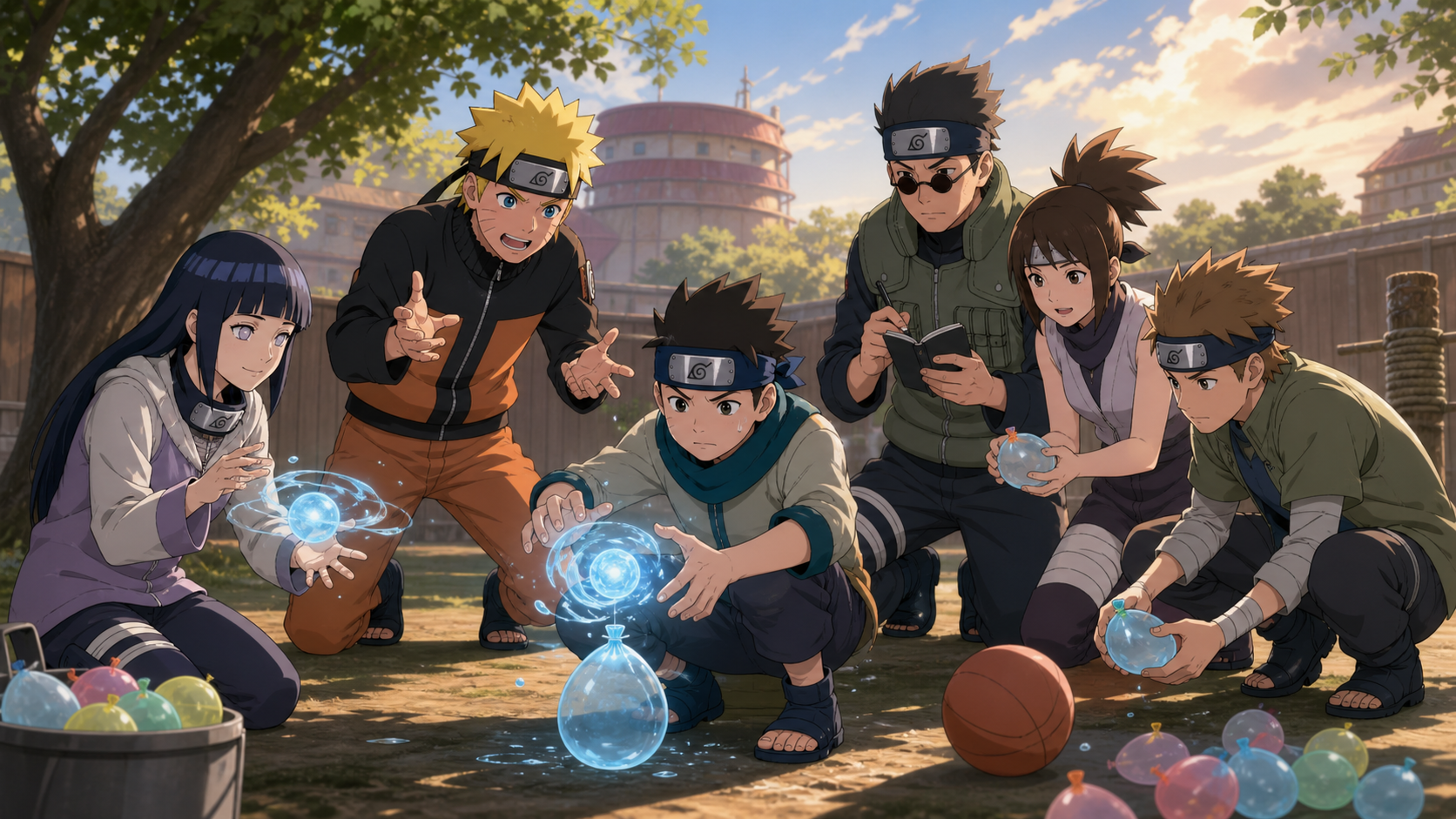
The One Who Will Inherit
Naruto knows the Rasengan but cannot yet explain it clearly, so Konohamaru inherits creativity, stubbornness and unfinished work rather than finished greatness.
Bottom line
“The Ones Who Will Inherit” steps away from Six Paths power to show inheritance at its least polished. Naruto has just returned from two and a half years with Jiraiya when Konohamaru asks him for a new technique. Naruto agrees to teach the Rasengan, but his explanations are gestures, sound effects, and demonstrations that assume the student can feel what the teacher means. Konohamaru cannot. He asks Kiba, Chōji, Hinata, Moegi, Udon, Ebisu, and even the logic of Sexy Technique to help translate rotation and power into something his own body can perform. The comedy is broad, but the educational problem is real: knowing a technique does not automatically mean knowing how to teach the technique. Naruto inherited the Rasengan through Jiraiya’s improvised instruction. Konohamaru inherits Naruto’s creativity, stubbornness, and terrible vocabulary along with the jutsu. The episode ends before mastery. He has burst the water balloon and begun wrestling with the rubber ball while Naruto leaves again on the mission that may lead to Sasuke. Inheritance is not a handoff of finished greatness. Inheritance is unfinished work placed in somebody else’s hands.
Episode 422 pauses the war chronology
Episode 421 ended with Naruto returning in Six Paths Sage Mode and attacking Madara. Episode 422 does not continue that battlefield moment.
The directory should identify the flashback interruption clearly.
This episode is anime-original
The two-part Konohamaru training story is not adapted from a manga chapter. The episode fills in how Naruto began teaching him the Rasengan.
Continuity expansion should not be mislabeled as manga canon.
The flashback begins before Shippuden’s first mission
Naruto has returned from traveling with Jiraiya but has not yet completed the Kazekage Rescue Mission. Konohamaru is still an Academy student under Ebisu’s guidance.
The placement explains everyone’s age and skill level.
Konohamaru cleans Naruto’s apartment
He prepares the empty room before Naruto returns to Konoha. The work shows affection expressed through maintenance rather than a greeting speech.
Care begins before the person arrives.
The clean apartment creates a continuity tension
Earlier Shippuden material presents Naruto’s neglected room differently after the long absence. Episode 422’s cleaning scene does not align perfectly with that visual history.
The final React can note the inconsistency without inventing a repair.
Naruto returns in his new black-and-orange jacket
The clothing marks the time skip and the beginning of his older design. Konohamaru immediately compares the returning shinobi with the brother figure he remembers.
Visual change raises expectations of new ability.
Team Ebisu meets Naruto with Sakura
Konohamaru, Moegi, Udon, and Ebisu reconnect with someone whose departure shaped their own training period. Sakura also sees the result of Naruto’s journey.
The welcome joins several generations of Konoha students.
Konohamaru demonstrates an improved Sexy Technique
He wants proof that he has not remained still while Naruto trained elsewhere. The technique is familiar, comedic, and easy for Naruto to recognize.
Students often begin with the skill that already earns a response.
Naruto answers with a more elaborate variation
His competitive instinct turns the reunion into escalation. The joke shows that time with Jiraiya has not replaced every immature habit.
Growth can be uneven.
Sakura stops the exchange physically
She reacts to Naruto’s sexualized demonstration with immediate anger. The familiar gag reestablishes their dynamic but also interrupts any careful assessment of what he learned.
Comedy substitutes impact for conversation.
Naruto stores his old jacket
Back at the apartment, he places the Part I clothing into a drawer rather than discarding the jacket. The action preserves a previous self while making room for the new one.
Change does not require erasure.
Konohamaru asks for a new jutsu
He treats Naruto as a teacher because their relationship has always mixed rivalry with admiration. The request gives Naruto authority he once sought from older shinobi.
Recognition arrives through responsibility.
Konohamaru initially expects another Sexy Technique
Naruto’s reputation makes the misunderstanding plausible. When Naruto speaks about an advanced technique, Konohamaru imagines escalation in the wrong category.
Shared history can obstruct clear instruction.
Naruto chooses the Rasengan
The technique came from Minato, passed through Jiraiya, and became Naruto’s signature. Teaching Konohamaru extends a line that the student does not fully know.
Inheritance enters through practical training.
Naruto demonstrates the finished sphere
The rotating chakra in his palm gives Konohamaru a visible target. The demonstration proves the result without explaining the internal process.
Seeing mastery is not the same as understanding construction.
The Rasengan requires shape transformation
The user must rotate chakra, increase its power, and contain the force in a stable sphere. No hand seals organize the technique for the learner.
Control has to happen directly in the hand.
Naruto begins with a water balloon
The first stage teaches rotation. Chakra must move the water in several directions until turbulence bursts the balloon.
The training tool makes invisible movement observable.
Naruto explains through sound effects
His instruction resembles Jiraiya’s own improvised language but becomes even less precise through Naruto’s memory and style. Konohamaru receives enthusiasm without a usable model.
Expert performance can conceal instructional gaps.
Konohamaru cannot understand rotation
He knows the balloon must burst but not how to create interacting chakra currents. Repetition without a mental model produces frustration.
Effort needs feedback.
Naruto leaves for the Kazekage rescue
Akatsuki kidnaps Gaara, and Naruto departs for Sunagakure before he can supervise the first stage. The emergency takes priority over a training schedule.
Teaching becomes interrupted inheritance.
Gaara’s rescue situates the timeline exactly
The mission is Shippuden’s opening major arc, before Naruto learns about Sasori’s spy and the Tenchi Bridge assignment. Konohamaru trains during Naruto’s absences between those events.
The episode fills gaps inside known chronology.
Konohamaru continues without the teacher
He does not wait for Naruto to return before trying to solve the problem. Independent work is necessary because the lesson arrived incomplete.
Absence forces translation.
Moegi and Udon become training partners
They watch attempts, search for explanations, and accompany Konohamaru through increasingly strange experiments. Their presence keeps the project from becoming solitary obsession.
Peers supply continuity when the mentor leaves.
Konohamaru asks Kiba for help
Kiba understands vigorous chakra use and spinning motion through his own techniques, but that knowledge does not map cleanly onto a palm-sized sphere.
Related experience is not automatic pedagogy.
Chōji offers another physical perspective
His expansion techniques use chakra through the body differently from the Rasengan’s contained rotation. The advice cannot solve Konohamaru’s specific control problem.
Power systems share vocabulary without sharing mechanics.
Hinata brings precise chakra control
Gentle Fist requires exact chakra release from tenketsu and exceptional visual understanding through the Byakugan. Even that expertise does not directly reproduce Naruto’s training insight for Konohamaru.
Precision still needs the right analogy.
Asking several people is a strength
Konohamaru does not treat confusion as shame. He gathers multiple explanations and tests what each can contribute.
Learning becomes collaborative investigation.
Team Ebisu returns to their instructor
Ebisu is the adult officially responsible for the students, yet Konohamaru approaches him through the language of Naruto’s techniques and interests. The result becomes another misunderstanding.
Existing mentorship and aspirational mentorship overlap awkwardly.
The team takes Ebisu’s magazines
They assume material connected to adult attraction might improve Konohamaru’s Sexy Technique and somehow unlock Naruto’s lesson. The gag extends the wrong initial category.
Research without a clear question gathers noise.
Konohamaru creates a spinning-girl transformation
He combines Sexy Technique with a figure rotating a hula hoop. The visual gives him a concrete way to imagine several motions occurring around a center.
Comedy becomes a usable spatial model.
The analogy finally changes his chakra motion
Konohamaru stops copying Naruto’s sounds and builds rotation through an image that makes sense to him. The student translates the principle into personal cognition.
Learning happens when instruction becomes owned.
Konohamaru bursts the water balloon
The result confirms that he can generate the chaotic rotational movement required by the first stage. The method looks different from Naruto’s path but reaches the same mechanical goal.
Successful adaptation is not incorrect imitation.
Naruto returns and checks the result
He recognizes that Konohamaru has completed the rotation stage even though the explanation and imagery differ. A teacher has to evaluate function rather than demand identical thought.
The student’s route expands the lesson.
Naruto introduces the rubber ball
The second stage focuses on power. A rubber ball resists internal pressure more strongly than the water balloon.
Rotation alone can no longer complete the task.
Naruto’s explanation remains vague
He again relies on forceful noises and bodily intuition. Konohamaru immediately realizes that the next assignment comes without a clear procedure.
Success in stage one has not transformed Naruto into an expert teacher.
Konohamaru seeks Ebisu’s help again
Moegi and Udon accompany him to the park, where Ebisu is speaking with Iruka. The students turn the request into another Sexy Technique experiment.
The search for power returns to performance.
Three transformations compete for Ebisu’s reaction
The children ask him to judge which transformed girl is most attractive. The scene uses his established vulnerability to sexualized techniques as a crude measurement device.
The joke is character continuity, not Rasengan mechanics by itself.
Konohamaru studies sudden release
He transforms into a girl who first conceals and then reveals her chest, sending Ebisu into an exaggerated nosebleed. The change from restraint to burst gives Konohamaru another physical analogy.
Power becomes pressure released from containment.
The episode ends during second-stage training
Konohamaru has not formed a complete Rasengan. He returns to the rubber ball with a new idea and continued determination.
Mastery belongs to the next episode.
Episode 423 completes the training story
“Naruto’s Rival” follows the final containment stage and connects the finished Rasengan to Konohamaru’s confrontation with the Naraka Path during Pain’s assault.
The two episodes should link directly.
The title refers to more than a jutsu
Konohamaru inherits Naruto’s technique, improvised learning style, refusal to quit, and desire to become Hokage. Some parts deserve preservation, while others need improvement.
Inheritance includes editing.
Naruto occupies Jiraiya’s old position
He demonstrates, assigns physical stages, leaves on dangerous work, and expects the student to discover part of the solution. Naruto repeats a teaching structure he once experienced.
Students often reproduce the methods used on them.
Naruto is a skilled learner before becoming a skilled teacher
He can perform the Rasengan under combat pressure and adapt the technique through clones. Explaining internal control to another person requires a different competence.
Mastery has more than one direction.
Konohamaru’s misunderstandings are not lack of intelligence
Naruto gives incomplete explanations, changes context rapidly, and leaves mid-process. Konohamaru’s strange analogies are attempts to make missing concepts concrete.
Creative repair is evidence of thought.
Moegi and Udon should retain credit
They accompany searches, test ideas, and sustain the training during Naruto’s missions. The finished technique will carry a team’s patience even when Konohamaru performs the Rasengan alone.
Peer support belongs inside the inheritance.
Ebisu remains more than the target of a joke
He taught Konohamaru fundamentals and helped move him away from relying only on his family name. The episode uses his comic weakness but should not erase his longer mentorship.
Several teachers shape the student.
The interruption after Episode 421 is deliberately low-scale
Six Paths seals and Night Guy give way to balloons, rubber balls, dirty apartments, and confused children. The contrast shows how legendary techniques begin as ordinary practice.
Scale changes without abandoning the inheritance theme.
The final React should not insert the autograph story
The central Episode 422 material concerns Naruto’s return and Konohamaru’s Rasengan stages. Any autograph framing belongs only where direct episode evidence supports that framing.
Titles and summaries must follow the actual broadcast.
The final React should flag the apartment discrepancy carefully
Konohamaru cleans the room here, while earlier Shippuden presentation suggests prolonged neglect. The safest editorial treatment is an anime-original continuity wrinkle.
No elaborate fan theory is required.
Japanese performance requires direct listening
Claims about Konohamaru’s excitement, Naruto’s confidence, Sakura’s anger, Ebisu’s embarrassment, or Moegi and Udon’s patience require lawful scene-level Japanese listening.
No invented vocal analysis belongs in publication.
Knowing a technique is not the same as knowing how to teach it
Naruto can form the Rasengan because he learned through unusual sensory shortcuts, repetition, and Jiraiya’s guidance. Translating that experience into instructions for another person requires a different skill.
His sound effects are not proof that Konohamaru is slow. They reveal where Naruto’s explanation still depends on private intuition.
Konohamaru treats confusion as a research problem
He does not wait for Naruto to return with better words. He asks Kiba, Chōji, Hinata, Ebisu, Moegi, and Udon for perspectives that describe movement, force, and control differently.
Seeking multiple explanations is disciplined learning. It reduces dependence on one admired teacher.
Moegi and Udon are collaborators, not an audience
They participate in experiments, interpret failed explanations, maintain the training process, and help Konohamaru keep working after Naruto leaves for Gaara’s rescue.
The breakthrough belongs to the team’s shared inquiry. Friendship is practical infrastructure, not applause around the named inheritor.
Hinata supplies precision Naruto cannot yet articulate
Her chakra-control background offers another language for rotation and release. She does not need to become the Rasengan’s primary teacher for her explanation to alter the process.
Specialists strengthen learning when they can contribute one exact piece without owning the whole technique.
Ebisu remains responsible beneath the comedy
The magazine jokes make him an easy target, but he is still Team Ebisu’s assigned instructor. He understands Konohamaru’s habits, safety, stamina, and foundational control better than a visiting mentor can.
Good teaching should integrate Naruto’s gift with structured supervision rather than leaving children to reverse-engineer dangerous training alone.
The transformation analogy is embarrassing and effective
Konohamaru uses imagery that finally makes rotational motion legible to his own brain. The source can be ridiculous while the learning mechanism remains real.
Education works when a student can translate abstract instruction into a model they can test. Dignity does not require pretending every useful analogy sounds noble.
Naruto inherits Jiraiya’s responsibility imperfectly
Offering the Rasengan shows trust and a desire to pass knowledge forward. Leaving for Gaara is also the correct emergency priority.
The tension is not that Naruto fails by departing. It is that mentorship needs continuity, safety plans, and other adults who can carry instruction during absence.
Inheritance should expand authorship
Konohamaru does not become Naruto by learning Naruto’s technique. His questions, analogies, teammates, body, and future applications will change how the knowledge lives.
A healthy lineage preserves credit while allowing the next practitioner to understand, adapt, and eventually teach in a voice that belongs to them.
RaeRae’s verdict
“The Ones Who Will Inherit” is strongest when the crude comedy is read alongside a serious teaching failure. Naruto knows the Rasengan so well that the technique feels bodily and obvious. Konohamaru receives noises where he needs mechanics. The student’s spinning transformation and absurd experiments are funny because they are also doing real conceptual work. He builds rotation from an image he understands and pressure from a sudden release he can imagine. The route is messy, but the water balloon bursts.
That messiness belongs after Hagoromo’s grand inheritance speech. Six Paths power arrives through ancient chakra and complementary seals. The Rasengan arrives through an older boy who cannot explain himself, two classmates willing to keep looking, an instructor with an embarrassing weakness, and a student stubborn enough to translate all of them. Konohamaru does not inherit Naruto by becoming a copy. He inherits a problem, changes the language, and keeps training after the teacher leaves. That is a more useful model of legacy than perfect transmission.
RaeRae’s call
Konohamaru inherits more than a finished sphere. He inherits a problem Naruto cannot yet explain cleanly, then builds a learning network around it. Moegi and Udon keep the practice alive. Kiba, Chōji, Hinata, and Ebisu offer different pieces of movement, force, control, and release. Naruto remains the mentor who trusted him with the Rasengan, but admiration does not require pretending Naruto is already a polished teacher. Konohamaru’s misunderstandings are evidence about the instruction, not evidence that he lacks intelligence. Inheritance becomes real when knowledge survives absence, gains new language, credits every collaborator, and gives the next person enough authorship to carry it forward differently.
Episode details and viewing routes
- Official episode reference: Naruto Official episode guide
- Licensed episode route: Crunchyroll licensed episode page
The Rasengan does not arrive as an object passed cleanly from one genius to another. It becomes messy group work. Naruto demonstrates what he can do. Konohamaru admits what he cannot understand. Moegi and Udon stay through the failed attempts. Other shinobi lend language from their own disciplines. Ebisu remains the adult who should help connect risk to foundation. The spinning transformation joke finally gives Konohamaru a model his body can use. None of that reduces the technique. It makes learning honest. The heir is not the person who copies most faithfully. The heir is the person who understands enough to adapt, credits the people who helped, and becomes capable of teaching the next student without pretending confusion is weakness.
What I am carrying forward
Shortly after Naruto returned from training with Jiraiya, Konohamaru asked him to teach a new jutsu. Naruto chose the Rasengan and began with the water-balloon rotation stage, but his vague explanations left Konohamaru searching for help from friends and instructors. A spinning Sexy Technique transformation gave Konohamaru a workable image for rotation, and he burst the balloon while Naruto was away rescuing Gaara.
Naruto then assigned the rubber-ball power stage before leaving on the mission connected to Sasori’s spy and Sasuke. Konohamaru used another exaggerated transformation to imagine pressure and sudden release, then returned to training. Episode 422 ends before he forms the complete Rasengan. Episode 423 continues the final stage and the technique’s eventual use during Pain’s invasion.