
RaeRae Reacts · One Piece Episode 134
Usopp’s Giant Firework
One Piece Episode 134 brings Usopp to Fireworks Island for a giant-shell lesson about grief, explosive safety, inherited craft, and Kodama’s future.
Fireworks Island treats memory as public infrastructure
Episode 134 brings the Straw Hats to an island preparing for a fireworks festival with four hundred years of history. The celebration belongs to the whole community, but one mountain family carries the technical knowledge behind every display.
A tradition that depends on two or three people remains vulnerable. Illness, death, migration, missing records, or damaged equipment can erase centuries of practice within one generation.
The island should support apprenticeships, archives, inspections, and safe storage instead of treating the family as an endless private resource. Community pride needs community investment.
Usopp notices the gunpowder supply because ammunition matters to him. His practical goal pulls him toward a craft that soon forces him to think beyond his own weapons.
Odama recognizes an amateur before Usopp finishes bragging
Usopp climbs the mountain and asks master pyrotechnist Odama for gunpowder. The old man rejects him quickly, especially on the busiest day of the year.
Odama’s suspicion makes sense. Gunpowder is not a casual favor, and a stranger who exaggerates expertise creates a serious risk. Suppliers should verify training, intended use, quantity, storage, and transport before releasing explosive material.
Usopp shows one of his homemade fireworks as proof. Odama sees the difference between enthusiasm and professional control.
The rejection also challenges Usopp’s usual strategy. A confident story cannot replace measurements, testing records, or safe construction when an explosion may injure bystanders.
Kodama sees potential inside unfinished work
Kodama examines Usopp’s small firework and offers encouragement. She calls the piece unfinished because a firework becomes complete only after a safe launch and visible bloom.
Her definition joins design with outcome. A shell that looks impressive on a bench has not proved ignition timing, lift, burst pattern, debris control, or safe fallout.
Testing should still happen in stages. Nobody should jump from a workshop object straight to a crowded festival. Small controlled trials, distance calculations, weather checks, and documented failures protect both maker and audience.
Kodama gives Usopp respect without pretending his work already meets professional standards. That balance lets a learner stay motivated while remaining honest about risk.
Helping with chores becomes a real apprenticeship
Odama sends Usopp to help Kodama complete festival preparations. The tasks may look minor, but carrying materials, checking fuses, organizing shells, and maintaining clean work zones reveal how the workshop operates.
Explosive craft depends on routine discipline. Powder contamination, static, moisture, mislabeled components, loose tools, and open flame can turn a small shortcut into mass injury.
Kodama explains the family process while Usopp contributes strength and problem solving. Their exchange works because neither person owns every useful skill.
A safe apprenticeship should also provide protective clothing, emergency exits, separation distances, inventory logs, and an adult who can stop work. Curiosity needs boundaries before curiosity meets ignition.
The giant shell carries a fatal history
Usopp sees the enormous 200-gauge shell and imagines a spectacular launch. Kodama reveals that a similar attempt one year earlier killed both of her parents after faulty equipment caused an accident.
The shell is therefore not only a family dream. The shell is evidence from a fatal incident. Moving, modifying, or launching related equipment without a full investigation risks repeating the same failure.
The workshop should preserve records about design, materials, launcher condition, weather, ignition method, crew positions, and emergency response. Grief cannot substitute for engineering analysis.
Kodama deserves truthful information about what happened. Adults sometimes hide details to protect a child, but secrecy can leave survivors blaming themselves or chasing the same danger without understanding the cause.
Rain becomes a safety system rather than bad luck
Rain threatens the festival, and Kodama worries that the display may be canceled. Odama continues preparation while waiting for conditions to change.
Weather decisions should follow written thresholds rather than hope. Wind direction, wind speed, rainfall, lightning, visibility, humidity, and ground conditions all affect launch safety and fallout.
Cancellation protects workers and spectators even when disappointment costs money. A centuries-old tradition can survive one postponed night. A preventable death changes a family and community permanently.
The island needs clear announcements, evacuation routes, shelter, and refund or rescheduling plans. Public pressure should never force pyrotechnists to override their own safety call.
Kodama plans to carry the entire risk alone
Kodama tells Usopp that the launch team will position the giant shell, but she intends to ignite the charge alone so nobody else faces danger. Her plan mistakes solitary exposure for responsibility.
A child should not become the human shield for an unsafe design. Removing other workers does not make the shell safe. The response should eliminate hazards through engineering, distance, remote ignition, barriers, and verified equipment.
Kodama’s willingness grows from grief and loyalty. She wants to complete her parents’ dream and protect everyone around her. Those motives make the plan understandable, not acceptable.
Adults must interrupt self-sacrifice when trauma dresses danger as duty.
A family tradition cannot demand a child’s body
The lost 200-gauge technique represents status, identity, and unfinished family work. Kodama believes reviving the shell will prove she belongs in the lineage.
Her worth does not depend on reproducing the most dangerous achievement immediately. She can preserve recipes, study old equipment, master smaller shells, document failures, and build toward certification over years.
Tradition should serve living people. Living people should never become fuel for tradition.
The community also needs to stop romanticizing hereditary obligation. Kodama may choose pyrotechnics, change the craft, share the knowledge, or leave. Love for her parents does not remove those options.
Odama’s refusal is grief speaking through authority
Odama discovers Kodama’s plan and forbids the launch. His fear comes from losing his child and fearing the loss of his granddaughter.
The boundary is correct, though prohibition alone leaves Kodama feeling that he rejected her competence and her parents’ dream. A fuller conversation should name the accident, the unresolved technical problem, and a safe path toward future mastery.
Odama also needs support. Bereaved caregivers often carry responsibility, anger, and fear while protecting younger survivors. Community grief services should not begin and end at a festival memorial.
Authority works better when a young person understands both the limit and the route beyond the limit.
Running away exposes the cost of an unexplained no
Kodama leaves after Odama stops the launch. Her departure shows that control without connection can push risk outside adult supervision.
Someone should locate her promptly, confirm safety, and approach without threats. A grieving child near explosives, cliffs, and a crowded festival should never disappear without a coordinated search.
Odama can maintain the no while listening to what the launch represents. Validation does not mean permission.
The festival team also needs access controls so emotional conflict cannot lead anyone to move a giant shell secretly. Inventory, keys, signatures, and two-person authorization protect families from impulsive decisions.
Usopp studies the tower instead of forcing the shell
Usopp notices that the old tower has stood for centuries and suspects the structure once served the giant-shell tradition. His mechanical curiosity becomes useful because he asks what the existing system was designed to do.
Historic equipment still requires inspection. Age can weaken timber, rope, fasteners, foundations, and alignment. Original purpose does not prove current load capacity.
Usopp shares his idea with Odama rather than acting alone. That choice separates responsible problem solving from the bravado he showed at arrival.
A qualified team should calculate load, test the pulley system without explosive material, establish exclusion zones, and confirm the launch tube before moving the shell.
The cemetery conversation gives grief a different future
Usopp finds Kodama at her parents’ graves. He tells her that their deepest dream was not a single giant explosion. Their dream was Kodama’s life and her future as a master craftsperson.
The message matters because grief can freeze one unfinished task into a command. Survivors may believe completion will repay the dead or repair the past.
Usopp does not tell Kodama to abandon pyrotechnics. He separates long-term mastery from a dangerous deadline.
That distinction protects agency. She can honor her parents through learning, patience, teaching, and safer innovation rather than reenacting the condition that killed them.
Usopp stops lying when a child needs the truth
Usopp often uses exaggeration to manage fear or gain status. With Kodama, he gives a plain answer about danger, loss, and what her parents likely wanted.
His honesty lands because he understands dreams that look impossible and fear that feels embarrassing. He does not need to pretend expertise in grief.
Responsible adults must avoid claiming certainty about what dead parents would say. Usopp frames the point around a reasonable priority: loving caregivers want their child alive.
The scene shows his best courage. Courage here means refusing the dramatic launch plan even though a huge explosion would make him look impressive.
The pulley system turns invention toward harm reduction
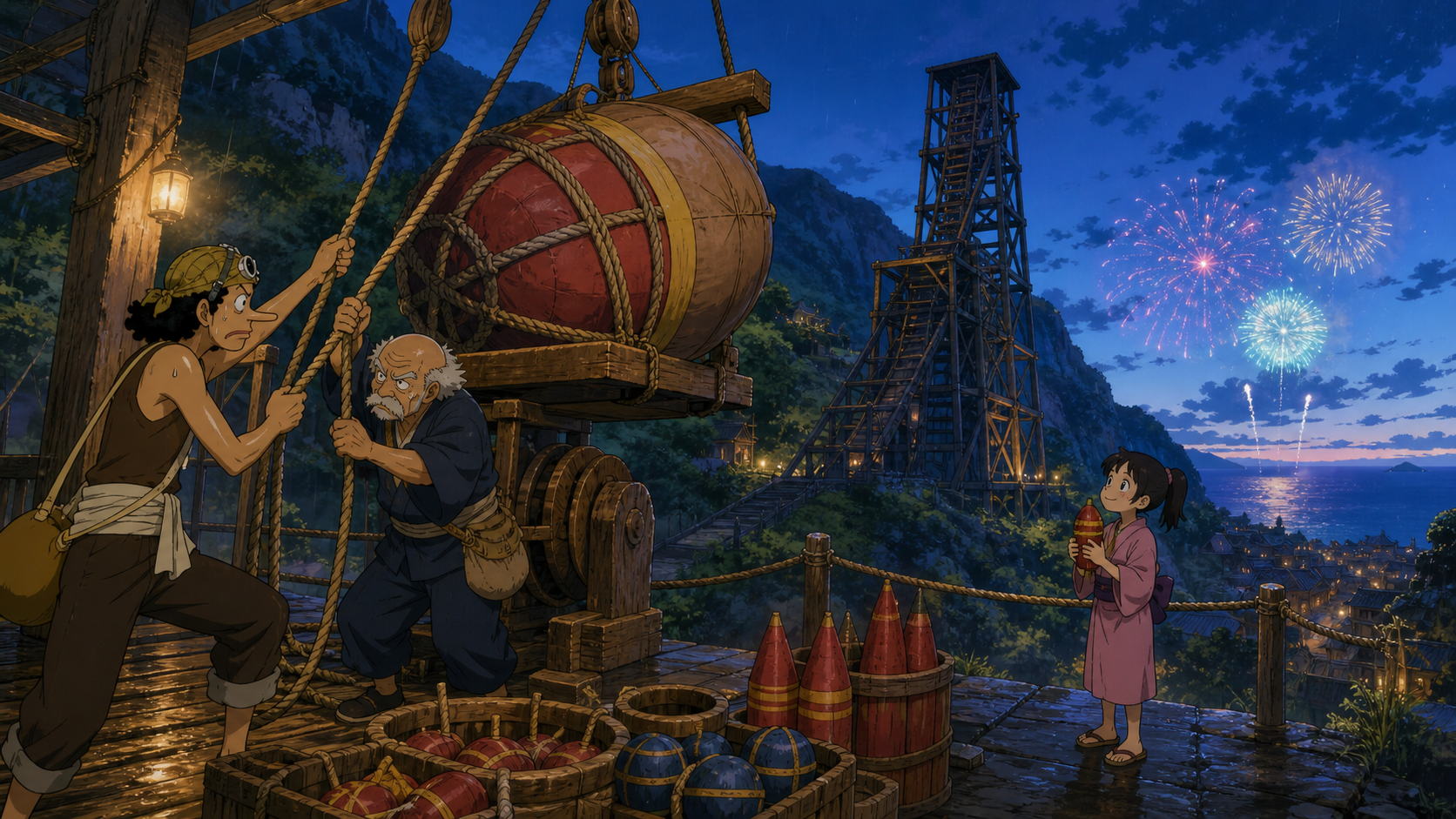
Usopp and Odama use a pulley arrangement to move the giant shell toward the historic launch platform. Mechanical advantage reduces uncontrolled lifting and lets trained adults manage the load.
The design still needs redundant supports, rated rope, controlled communication, and a cleared route. Nobody should stand beneath a suspended explosive shell.
Kodama remains away from the hazardous operation, which is essential. Observation from a protected zone can become part of training without turning her into the test subject.
Usopp’s engineering finally serves a system larger than one clever trick. He combines old infrastructure, present knowledge, and a safer division of responsibility.
The festival needs audience protections beyond spectacle
When the weather clears, the regular display begins over the island. Spectators receive beauty without seeing the months of preparation and risk control behind every bloom.
Launch zones require distance from homes, boats, animals, dry vegetation, and medical facilities. Fire crews, first aid, crowd control, and debris cleanup should be ready before ignition.
People with sensory sensitivities, trauma, respiratory conditions, or animals need advance notice and quieter viewing options. Celebration should not require everyone to absorb the same noise and smoke.
Environmental review matters too. Paper, chemicals, ash, and unexploded material must not remain in water or farmland after applause ends.
Finishing a firework means accepting accountability
Usopp launches his own smaller piece during the festival and finally lets the work face the sky. Kodama’s earlier challenge returns with greater meaning.
A maker cannot control every result, but a maker owns preparation, testing, site choice, warnings, and response when something fails.
Public success should be documented rather than converted into confidence alone. Usopp can record construction, fuse timing, lift, burst, wind, and debris so the next design improves.
Calling a piece finished should never mean forgetting the evidence after the color fades.
The giant bloom belongs to adults carrying adult risk
Odama lights the restored launch system after the regular display, and the 200-gauge shell creates the enormous finale Kodama hoped to see.
The emotional payoff works because Kodama does not have to gamble her life to witness the family tradition. Trained adults assume responsibility and use the discovered infrastructure.
One successful launch does not prove every technical problem is solved. The team should inspect the tower, document the result, review near misses, and decide whether another launch is justified.
Kodama gains inspiration without being told to repeat the feat tomorrow. Her next step should be education, supervised practice, and time.
Episode 134 lets Usopp earn the gunpowder
Odama eventually agrees to share gunpowder after seeing Usopp’s judgment and skill. The exchange now rests on demonstrated responsibility rather than loud claims.
Odama should still control quantity, packaging, transport, and instructions. Respect does not eliminate material risk.
Usopp leaves with something more valuable than ammunition. He learns that invention reaches maturity when cleverness protects somebody else.
The crew should store the powder in a dry, secured compartment away from heat, cooking flame, medical supplies, and sleeping areas. Usopp should label every container, track quantities, inspect packaging after rough weather, and tell the others how to respond to smoke or damage. Odama’s gift becomes part of ship safety the moment the material crosses the Merry’s rail.
RaeRae’s verdict: keep this one. Episode 134 gives Usopp a rare, grounded victory, refuses to make a grieving child prove love through self-sacrifice, and turns a spectacular explosion into a story about safety, inheritance, and a future that stays alive.