
The Yamanaka Clan: Secret Ninjutsu
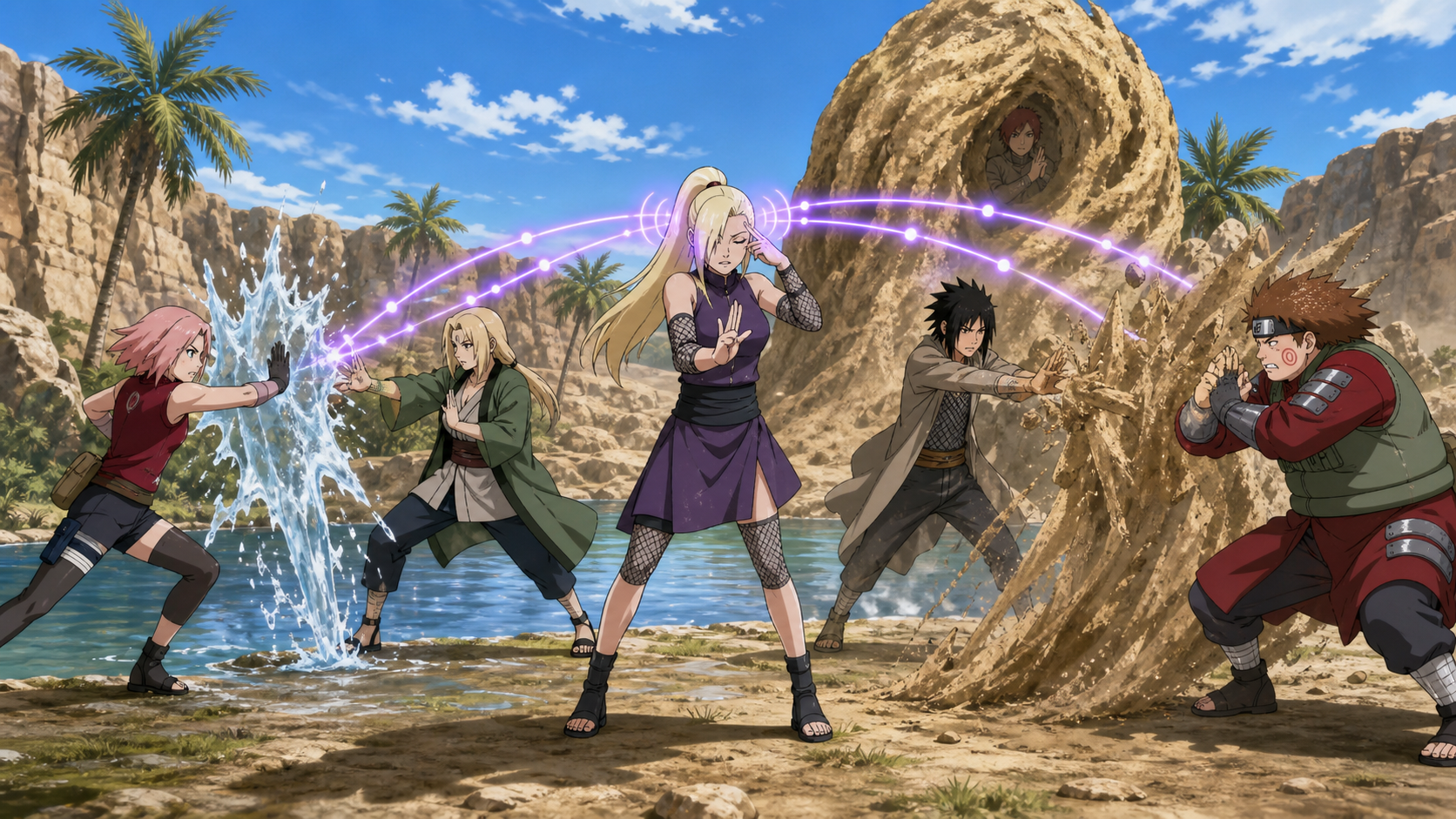
Ino wins the information fight by linking Sakura and Chōji, then using medical chakra control to make the inherited Yamanaka network fast enough to matter.
Bottom line
“The Yamanaka Clan: Secret Ninjutsu” proves that Ino’s medical training was never time stolen from her inheritance. Shishio blocks ordinary sensory perception and hides his team inside a sand formation. Ameno’s medical water techniques pressure Sakura, while Kōji’s sandstone power keeps Chōji occupied. Ino cannot aim Mind Transfer at targets she cannot locate, so she changes the job. Mind Transmission links Sakura and Chōji, lets each teammate share what the other sees, and turns two isolated fights into one information network. The first relay is too slow. Ino draws on the precise chakra control Tsunade demanded, increases transmission speed, and begins sending thoughts directly enough for Sakura and Chōji to counter blind-side attacks. Her detour becomes the missing part of the Yamanaka system. The Leaf trio wins without taking the Sand team’s scroll or exploiting their injuries. Ino and Ameno treat opposing candidates, both teams acknowledge the result, and water from the oasis is shared. Ino’s place is not behind a stronger fighter. She is the connection that lets strong fighters stop being blind.
The oasis is now urgent
Sakura, Ino, and Chōji have only water extracted from the giant scorpion. The oasis offers a safer supply for the remaining exam.
Survival pressure gives the next confrontation immediate stakes.
Ameno’s team controls the approach
Ameno, Shishio, and Kōji intercept the Leaf trio before the water. They use position and scarcity to negotiate from strength.
Terrain can become leverage without formal ownership.
Ameno offers a clear bargain
The Leaf team can hand over its scroll in exchange for access to the oasis and medical care. Her terms avoid an unnecessary fight while still advancing Sand qualification.
Courtesy does not make the demand neutral.
Sakura’s team rejects the offer
They do not recognize the Sand team’s claim over shared water. Surrendering a scroll would also erase the progress already made through the desert.
Refusal protects both principle and exam position.
Ino takes the first offensive action
She throws kunai before the Sand formation is fully understood. The attack tries to regain tempo but exposes her to a prepared counter.
Initiative without information can become vulnerability.
Shishio summons sand lions
His constructs strike Ino and knock her down. The Sand team immediately separates the Leaf trio’s information specialist from Sakura and Chōji.
Target selection reveals an understanding of team structure.
Sakura faces Ameno
The two medical kunoichi become direct opponents. Ameno shows that her healing discipline includes techniques designed for frontline pressure.
Medical specialization does not mean passive positioning.
Ameno uses Medical Water Release offensively
Water takes forms such as a scorpion and jellyfish, turning treatment knowledge into controlled attacks. The same chakra discipline supports harm and care.
Technique ethics depend on purpose and target.
Sakura answers with strength and control
Her close-range power can break through created forms, but Ameno’s fluid attacks complicate direct impact. Sakura must read movement rather than rely on one decisive punch.
Power remains strongest when guided by timing.
Chōji faces Kōji
Both fighters specialize in force and expanded striking capacity. Their pairing prevents either from freely supporting teammates.
Matched roles create deliberate isolation.
Kōji uses Sandstone Fist
Hardened sand lets him meet Chōji’s expanded limbs with comparable mass and resistance. The desert supplies his armor and weapon.
Local material becomes a force multiplier.
Chōji cannot simply overpower him
Expansion changes scale but does not guarantee superiority against a prepared power specialist. Chōji needs coordination rather than another larger swing.
Equal strength shifts value toward information.
Shishio spreads chakra through the ground
His formation uses the battlefield itself as a sensory and concealment system. Once established, the technique changes how every combatant can be found.
Control of the ground becomes control of perception.
Hot Sand Camouflage hides the Sand team
The technique removes clear visual targets and masks movement within heated desert conditions. Sakura and Chōji begin receiving attacks from unseen angles.
The enemy weaponizes what the environment already does.
Noise disrupts additional tracking
The blinding sand formation does more than hide bodies. Interference makes ordinary detection unreliable and prevents clean orientation.
Several damaged senses create compounding confusion.
Ino’s sensory perception is blocked
Her recent progress cannot pierce Shishio’s prepared field directly. The episode lets the new skill fail under a specific counter.
Growth remains credible when conditions matter.
Mind Transfer cannot start without a target
Ino needs enough positional certainty to project consciousness safely. Launching blindly risks missing and leaving her body helpless.
The clan’s famous technique depends on prior information.
Ino changes from control to communication
Rather than forcing Mind Transfer, she activates Mind Transmission and contacts Sakura and Chōji. The decision reframes her role around the information still available.
Adaptation begins by abandoning the wrong objective.
The episode remains anime-original
This Sand team, the concealment formation, and Ino’s exam breakthrough belong to adaptation-only material. The final React must label that continuity status.
Character insight does not need false manga authority.
Mind Transmission connects several people
Ino can speak inside both teammates’ minds without alerting the enemy. The link creates a private tactical channel across separated fights.
Communication becomes invisible infrastructure.
Ino identifies the attack pattern
Shishio’s team strikes from blind sides. One Leaf fighter may see an opponent approaching the other even when the intended target cannot.
The concealment is strong but not omnidirectional.
Sakura can see threats aimed at Chōji
Her angle contains information Chōji lacks. Passing that observation quickly enough could let him defend before impact.
Separate viewpoints become useful only after connection.
Chōji can return the same protection
His position reveals attacks entering Sakura’s blind side. The system does not make one teammate the permanent observer.
Mutual coverage keeps the network balanced.
Ino’s first relay is too slow
She receives one teammate’s thought and then forwards the warning. By the time the message reaches its destination, the attack is already close.
Correct information can still fail through latency.
Speed becomes the real training problem
Ino no longer needs greater range or a stronger takeover. She needs faster, cleaner transfer between minds under active pressure.
The battlefield defines a precise development target.
Ino remembers Inoichi’s warning
Mind Transmission has levels shaped by range, number of participants, speed, and intensity. Increasing those variables carelessly can injure or kill the user.
Communication power carries physical cost.
The clan technique conveys more than words
At high mastery, thoughts, intent, and emotional urgency can move through the link. Teammates receive the meaning behind a warning rather than a slow verbal description.
Shared feeling can shorten reaction time.
Ino regrets avoiding clan training
Under pressure, every skipped session feels like proof that she chose badly. The regret threatens to turn useful reflection into paralysis.
Guilt does not improve transmission speed.
Tsunade’s correction returns to her
Medical training repeatedly demanded delicate chakra control. The criticism that once felt separate from Yamanaka work now describes the exact battlefield need.
Two disciplines meet at a technical seam.
Medical control becomes clan control
Ino applies the precision learned through healing to the mental link. She does not switch identities; she uses one education to raise the level of another.
Integration becomes observable action.
Ino sends Sakura’s perception to Chōji
The link begins carrying visual or immediate thought content rather than a paraphrased warning. Chōji receives the attack line through Sakura’s awareness.
Information moves closer to its source.
She then reverses the path
Chōji’s viewpoint reaches Sakura, allowing her to answer a threat outside her own vision. The network becomes bidirectional.
One successful relay is not enough for a formation.
The first direct transfer still costs time
Ino has to concentrate and refine the connection while attacks continue. Progress appears as reduced delay rather than instant mastery.
Incremental gains keep the breakthrough grounded.
Sakura and Chōji trust the link
They act on information entering their minds without stopping to verify every message. That confidence comes from years of knowing Ino, not only the new technique.
Trust converts data into movement.
Ino raises the transmission level
She pushes scope and speed while remaining aware of the danger Inoichi described. The choice is risky because standing still would let both teammates be worn down.
Leadership sometimes means accepting measured strain.
Shared intent counters the blind-side pattern
Sakura and Chōji begin responding before the concealed attackers complete their strikes. Shishio’s formation still hides bodies, but no longer isolates perception.
The Leaf team defeats concealment through distributed sight.
Sakura lands the counter
With timely warning, she can place her strength where Ameno’s technique cannot absorb or evade the impact. Information unlocks the power already present.
Ino’s contribution appears inside Sakura’s hit.
Chōji breaks Kōji’s rhythm
The same network lets him anticipate sandstone attacks and answer with expansion at the correct angle. Comparable force stops being a stalemate.
Timing separates equal weights.
Shishio’s field loses strategic value
Concealment remains active, but the formation no longer guarantees surprise. Maintaining the technique cannot repair a compromised attack pattern.
A countermeasure can neutralize advantage without dispelling the jutsu.
Ino’s thoughts join the final exchange
She stops functioning as a switchboard outside the action. Her own intent moves through the network and helps coordinate the finish.
The connector is also a participant.
Team Ameno is defeated
Sakura, Ino, and Chōji overcome a deliberately matched formation through communication rather than individual escalation. The result belongs to all three.
Team structure defeats role-by-role isolation.
Ino still has medical responsibility
Victory leaves injured candidates on both sides. She transitions from high-risk transmission work back to treatment despite fatigue.
Combat success does not end duty of care.
Ameno treats the Leaf team
Her earlier ethics remain consistent after defeat. She uses medical skill for people who were enemies moments earlier.
Professional identity survives competitive loss.
Ino treats the Sand team
She answers with the same standard, demonstrating that medical training is not merely a personal advantage. Care becomes reciprocal.
Their specialties create respect after conflict.
The Leaf team does not take the scroll
Sakura, Ino, and Chōji already have what they need or choose not to exploit the defeated team. Their victory is not converted into unnecessary humiliation.
Restraint can be evidence of Chūnin judgment.
Ameno allows access to the water
The oasis becomes shared rather than held as bargaining territory. Immediate survival matters more than preserving the opening demand.
Resources can outgrow the fight that surrounded them.
Both teams want a future rematch
Neither side treats the outcome as a final ranking of their abilities. A controlled third-exam match would offer a cleaner contest.
Respect keeps competition alive without repeating the ambush.
Ino claims Tsunade’s apprenticeship
She wants recognition as someone shaped by medical training, even though Sakura remains the senior and more advanced student. The claim is about discipline rather than equal status.
Belonging does not require identical achievement.
Ino also claims Yamanaka inheritance
Mind Transmission provides the decisive answer, and medical chakra control strengthens the clan technique. Neither identity has to erase the other.
The episode title names a return made on Ino’s terms.
Inoichi’s teaching gains new meaning
His warnings about range, speed, participants, and emotional transmission stop sounding like abstract family lectures. Every variable becomes visible in the fight.
Context turns inherited rules into chosen knowledge.
The team has two medical ninja for a reason
Sakura’s frontline role exposes her to injury, while Ino’s mental techniques expose her to chakra strain. Each can stabilize the other when one specialty becomes dangerous.
Overlap creates resilience rather than redundancy.
Chōji is essential to the network
His sight, power, and trust provide half of the shared-perception system. The episode does not reduce him to a body Ino and Sakura direct.
Every node produces information and action.
Shikamaru’s absence changes the solution
Without the usual strategist, Ino has to build a live coordination system herself. She cannot wait for an external plan to connect the team.
Temporary absence reveals leadership capacity.
The final React should explain latency
The important escalation is not vague emotional power. Ino shortens the delay between one teammate perceiving danger and the other responding.
Specific mechanics make her growth legible.
Japanese performance requires direct evidence
Any claims about Ino’s strain, Sakura’s trust, Chōji’s resolve, Ameno’s courtesy, or Inoichi’s gravity require lawful scene-level Japanese listening.
No invented delivery notes belong in publication.
Blocked targeting reveals a different form of leadership
Hot Sand Camouflage denies Ino the visible target her Mind Transfer expects. She could keep forcing a familiar technique or wait for Sakura and Chōji to solve isolated fights.
Instead, she changes the problem. If she cannot control the hidden opponent, she can connect the teammates who must respond.
Communication becomes battlefield infrastructure
Mind Transmission is not flavor layered over Sakura and Chōji’s attacks. It creates a shared warning system across separated engagements and reduces the Sand team’s advantage.
Ino becomes the network through which observation reaches action. Her contribution is structural even when another fist creates the visible impact.
Latency is the first honest limit
Ino’s early relay takes too long because information passes through deliberate steps. A warning that arrives after impact may be accurate and still operationally useless.
She improves by refining chakra control, shortening transfer, and anticipating the next exchange. Speed matters because communication has a deadline.
Shared perception requires consent and trust
Sakura and Chōji allow Ino to relay sensory information through their minds while attacks arrive from concealment. That access is intimate and potentially disorienting.
The technique works because teammates trust the purpose and act on the signal. Outside immediate danger, boundaries should define what can be shared and when the connection ends.
Medical training strengthens the clan technique
Tsunade’s precision work gives Ino another way to understand delicate chakra control. The lesson does not pull her away from Yamanaka practice; it improves transmission speed and stability.
Training crosses disciplines when the student recognizes underlying principles. Integration creates a result neither path produced alone.
Sakura and Chōji are participants, not endpoints
Ino cannot manufacture their counters by herself. Sakura must interpret the transferred warning, Chōji must trust information arriving through an unusual route, and both must adjust timing.
The network succeeds through reciprocal action. Calling it solely Ino’s victory would erase the people who make communication meaningful.
Chōji gives the absent formation a new shape
Shikamaru is not present to organize the familiar Ino-Shika-Chō sequence. Chōji still brings force, timing, emotional trust, and knowledge of how Ino communicates under pressure.
The team does not become incomplete because one member is elsewhere. It adapts its relationships to the people actually in the field.
Medical ethics survive the result
After Team Ameno loses, both medical ninja treat people across the competitive line. Winning does not make untreated injury acceptable, and accepting care does not erase the fight.
The decision protects future participation while showing why distributed medical skill matters. Care remains part of mission judgment after combat ends.
RaeRae’s verdict
“The Yamanaka Clan: Secret Ninjutsu” gives Ino a battlefield problem that only her mixed training can solve. Shishio blocks sensory perception, so conventional Mind Transfer loses its target. Sakura and Chōji can each see attacks entering the other’s blind side, but warnings arrive too slowly. Mind Transmission turns those disconnected viewpoints into a team-wide field of awareness.
The breakthrough works because Tsunade’s lessons improve Inoichi’s system. Delicate chakra control reduces transmission delay and lets Ino move thought more directly between Sakura and Chōji. The episode does not claim that a few minutes erase years of skipped training. Ino strains, needs repeated attempts, and still has room to improve. The victory establishes direction, not completion. Treating the opposing team afterward makes the integration even clearer. Ino is a Yamanaka who can connect minds and a medical kunoichi who chooses what to do with that connection after the fighting stops.
RaeRae’s call
Ino wins this episode when she stops treating Mind Transfer as the only proof that she belongs to the Yamanaka clan. Concealment blocks control, so she builds communication. Sakura’s perception reaches Chōji, Chōji’s awareness reaches Sakura, and both fighters turn a hidden attack pattern into a shared counter. The first relay is too slow, which makes the improvement meaningful. Medical chakra control does not replace inheritance; it strengthens it. Sakura and Chōji remain full participants rather than weapons Ino activates. The result is not a compromise between two identities. It is an authored discipline where care, sensing, consent, speed, and clan knowledge finally work together.
Episode details and viewing routes
- Official episode reference: Naruto Official episode guide
- Licensed episode route: Crunchyroll licensed episode page
The satisfying detail is that Ino does not become useful by disappearing into the link. Her judgment remains clear in every transfer. She identifies the pattern, chooses needed information, watches the delay, and changes transmission. Sakura and Chōji do not lose agency when they accept help. They gain access to each other’s danger and decide how to respond. That is what makes the technique communal rather than controlling. Ino’s place is not behind the people who land the hits. She is the reason two isolated battles become one coordinated field.
What I am carrying forward
Ameno, Shishio, and Kōji challenged Sakura, Ino, and Chōji near the oasis. Shishio’s sand formation concealed the Sand team and blocked Ino’s ordinary sensory perception, while Ameno fought Sakura with medical water techniques and Kōji matched Chōji’s power.
Ino used Mind Transmission to share Sakura and Chōji’s perceptions, then applied medical chakra control to increase the speed and precision of the link. The Leaf trio countered the blind-side attack pattern and won. Ino and Ameno treated the opposing teams, water was shared, and both groups parted with respect. Episode 408 introduces Saya’s puppet-based mind technique and pushes Ino, Sakura, and Chōji into another exhausting fight.