
RaeRae Reacts · One Piece Episode 130
Nico Robin Joins the Crew
One Piece Episode 130 closes Alabasta with rebuilding, Pell’s survival, the truth about Pluton, and Nico Robin’s dangerous arrival aboard the Merry.
Hina shows what the Cage-Cage power means
Episode 130 opens with Hina using the Cage-Cage Fruit against Bon Clay’s crew. Her body becomes a moving arrest mechanism, and contact turns escape into confinement.
The power fits her role almost too perfectly. Hina does not merely carry state authority. She can physically produce detention wherever she stands.
Bon Clay’s people pay the price for the diversion that let the Merry reach Vivi. Their capture should remain part of the Alabasta record, not disappear because the emotional farewell already landed.
Capture is not the same as accountability
Hina can restrain suspects. That ability does not answer whether detention is fair, how prisoners will be treated, or whose story becomes the official report.
Bon Clay’s crew aided wanted pirates, but they also helped the people who stopped Crocodile. A lawful process should document both facts, provide medical care, identify every prisoner, and protect access to counsel and outside contact.
Power that makes arrest easy needs stronger oversight, not weaker oversight. Convenience should never become proof of guilt.
Alabasta starts rebuilding before every wound closes
The episode moves across a country beginning to recover. People return to work, communities reconnect, and public energy replaces the paralysis Crocodile created.
Reconstruction cannot mean restoring the exact conditions that allowed Baroque Works to thrive. Water governance, regional representation, emergency communication, military accountability, and public records all need repair.
Visible activity brings hope, but leaders should publish who receives aid, which districts wait, and how decisions are challenged. A busy capital can still hide neglected communities.
Rebuilding also needs a labor standard. Contractors should not exploit displaced people through unsafe work, withheld pay, or promises of food instead of wages. Women and disabled residents need access to planning meetings and paid roles, not ceremonial thanks after men make every decision.
Regional recovery councils can publish damage maps, water schedules, clinic capacity, housing lists, and spending reports. Transparency will not remove every conflict. Transparency gives citizens facts before another manipulator turns frustration into a weapon.
Survival stories belong to the whole country
Camus, Barbarossa, and Rasa appear alive as the epilogue checks on people beyond the palace.
Those confirmations matter because war stories often narrow around famous fighters. Alabasta survived through workers, travelers, local defenders, animals, families, and people whose names never reached the royal tomb.
A national memorial should hold both the dead and the living. Survivors need more than applause. They need treatment, housing, income support, and permission to tell complicated stories about what happened.
Pell’s survival changes the meaning of the bomb flight
Pell is alive. Relief hits immediately because Vivi does not have to carry another loss.
His return does not make the bomb harmless or erase the choice he made. Survival means the story must now address medical recovery, trauma, duty, and the pressure to become a permanent symbol.
Pell should not be pushed back into service before healing. A country grateful for sacrifice can prove gratitude through care rather than demanding another sacrifice.
His survival will also affect public memory. Officials may want a clean miracle story, while Pell may remember terror, pain, confusion, and anger. He owns the right to describe the event in his own time. A national symbol is still a patient with privacy.
Vivi deserves care around the reunion too. Relief can sit beside guilt for believing someone died, fear of another loss, and anger about the conditions that made the flight necessary. Happy news does not cancel trauma.
The Merry carries a stranger out of Alabasta
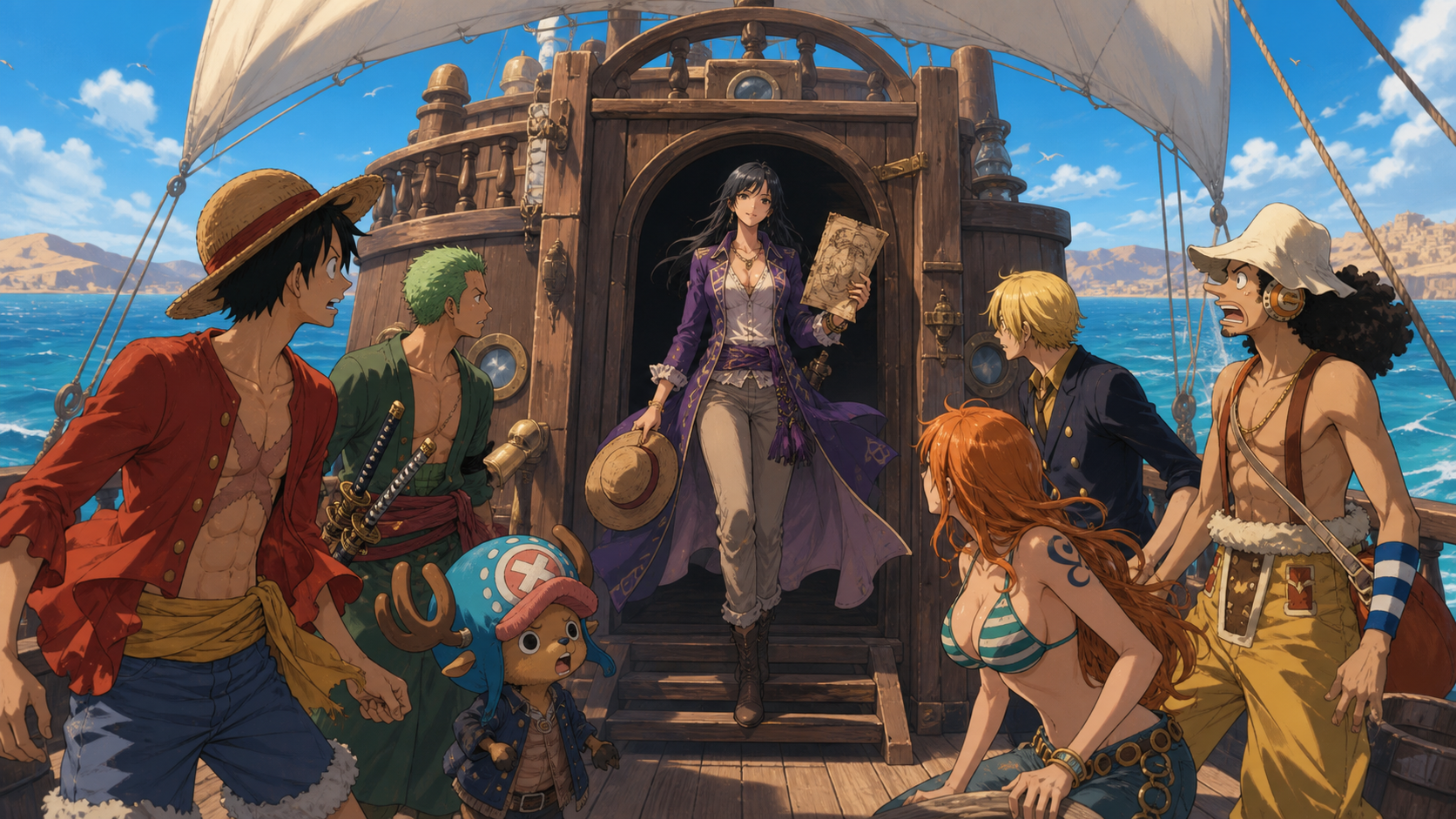
After the crew clears the coast, Miss All Sunday emerges from the cabin. The woman who worked beside Crocodile has already crossed their boundary and occupied their home.
The reveal is funny because everyone reacts at once. The safety issue remains real. She boarded without permission, knows the ship’s layout, possesses a dangerous ability, and has not explained her intentions.
Nami, Zoro, Usopp, Sanji, Chopper, and Luffy deserve a complete conversation before anyone calls the matter settled.
Robin arrives carrying dangerous knowledge
The archaeologist brings more than a mysterious smile. She can read Poneglyphs, understands Crocodile’s obsession, and knows what the royal tomb actually contained.
Knowledge made her useful to Baroque Works and dangerous to the World Government. Neither role tells the crew whether she can be trusted.
Her information should be treated carefully. Access needs consent, sources need verification, and nobody should pressure her to reveal history simply because the crew gave her passage.
The Poneglyph really described Pluton
Robin reveals that the stone recorded information about the ancient weapon Pluton. She lied to Crocodile in the tomb.
That lie protected Alabasta and possibly the wider world from a man who wanted mass destruction. Deception served harm prevention in a situation where honest disclosure would have enabled atrocity.
The choice still carries consequences. Cobra heard one account, Crocodile heard another, and Robin alone controls the translation. Trust requires explaining the decision without surrendering knowledge to people who may misuse the weapon.
Cobra also deserves to know why the translation changed without receiving technical details about Pluton. A protected account could confirm that Robin prevented immediate harm and that Crocodile never obtained the information he sought. Accountability does not require publishing a blueprint.
Withholding a weapon is not the same as owning one
Robin’s ability to read the inscription gives her power over access. That power does not make Pluton hers.
No individual, pirate crew, monarchy, or government should decide the fate of a catastrophic weapon through private possession. The safest response begins with limiting access and refusing reproduction.
Any future discussion needs people directly threatened by the weapon, not only scholars and military leaders. Secrecy may prevent immediate harm, but permanent unaccountable secrecy creates another danger.
Luffy saved Robin against her stated wish
Robin tells Luffy that she wanted to die in the collapsing tomb and that his rescue created responsibility.
The scene plays lightly, but the underlying pain is severe. A person who has survived persecution, exploitation, and isolation may experience rescue as another loss of control.
Luffy was right to prevent an immediate death. Saving a life does not create ownership over that life. The next step should offer safety, time, medical care, and choices without demanding gratitude.
Take responsibility cannot become emotional debt
Robin’s phrase turns Luffy’s rescue back toward him. He changed the outcome, so she asks for a place to continue living.
The crew can offer passage without accepting unlimited obligation. Boundaries should cover violence, theft, access to private spaces, watch schedules, information sharing, and how anyone can leave.
Mutual responsibility works better than debt. Luffy owes her respect after overriding the immediate wish to die. Robin owes the crew honesty about risks she brings aboard.
The crew deserves a collective decision
Luffy may captain the Merry, but the ship is home to everyone. Adding a former enemy changes every person’s safety.
Zoro’s suspicion is reasonable. Nami’s questions are reasonable. Usopp’s fear is reasonable. Sanji’s enthusiasm cannot substitute for consent. Chopper needs truthful medical history where care is involved.
A healthy crew can let the captain make urgent calls while still holding a real discussion afterward. Loyalty should not silence disagreement.
They also need an exit process. Robin should know where the next safe port lies, which supplies she may use, and what conduct would end the arrangement. The crew should know whether anyone is tracking her, what names she has used, and which enemies may follow.
Consent can develop over time. A temporary passenger agreement gives everyone room to observe, ask questions, and change position without turning the first conversation into a permanent verdict.
Robin understands people faster than they understand her
Robin has survived by reading rooms, locating desire, and adapting before anyone can corner her.
That skill helps her disarm the Straw Hats, but charm should not rush trust. Gifts, jokes, useful information, and flattering attention can create warmth without answering hard questions.
The crew should judge patterns over time: Does she respect boundaries? Does she share risk? Does she protect weaker members? Does she tell the truth when truth costs something?
A seventh member changes the crew’s knowledge
Robin brings archaeology, languages, political history, intelligence work, and a view of the world that none of the others possess.
Those skills expand the journey beyond navigation and combat. The crew can now encounter ruins and records as evidence rather than scenery.
Her presence also attracts government attention. Every island, harbor, and ally may face consequences. The crew needs threat planning alongside excitement.
Robin’s scholarship creates another responsibility: preservation. Rubbings, notes, translations, and artifacts need protection from water, fire, theft, and careless handling. Usopp can help build storage. Nami can map discovery locations without exposing sensitive sites. Shared systems reduce the chance that one person’s injury destroys irreplaceable knowledge.
The crew should also resist treating Robin as a walking answer key. Research takes time, uncertainty, comparison, and revision. She deserves permission to say that evidence is incomplete.
Alabasta closes while a larger history opens
Episode 130 finishes the desert story by showing recovery, survival, capture, and departure. The final reveal immediately opens another question.
Crocodile wanted Pluton as a shortcut to power. Robin wants the truth behind history. Those goals touched the same stone but point toward different futures.
The Straw Hats leave one political conspiracy and sail into a historical one. Alabasta becomes proof that buried knowledge can shape living people.
Production makes the epilogue feel like a new premiere
Yoshiyuki Suga’s script moves from Hina’s power and captured allies through rebuilding, survivor confirmations, Pell’s return, Robin’s emergence, the Pluton truth, and her demand for passage.
Yoko Ikeda’s direction lets the country breathe before placing danger inside the crew’s safest space. The bright deck and dark cabin doorway do half the storytelling.
Takayuki Shimura’s animation direction gives Robin stillness while everyone else erupts. Miyuki Sato and Michiyo Kawasaki contrast Alabasta’s warm recovery with blue open water, ending one world while another begins.
What Episode 130 changes
Hina demonstrates the Cage-Cage Fruit against Bon Clay’s crew.
Alabasta begins rebuilding, and the story confirms that Camus, Barbarossa, Rasa, and Pell survived.
Miss All Sunday emerges from the Going Merry’s cabin after secretly boarding the ship.
Robin reveals that the Poneglyph contained information about Pluton and that she lied to Crocodile.
She tells Luffy to accept responsibility for saving her and positions herself as the crew’s seventh member.
Episode details
Japanese title: 危険な香り!七人目はニコ・ロビン!
English title: A Dangerous Scent! The Seventh Member Is Nico Robin
Japanese broadcast: October 27, 2002
Saga: Alabasta
Material: Manga-canon adaptation
Script: Yoshiyuki Suga
Episode direction: Yoko Ikeda
Animation direction: Takayuki Shimura
Art: Miyuki Sato and Michiyo Kawasaki
The official One Piece guide confirms Hina’s power, Alabasta’s reconstruction, the named survivors, Pell’s survival, Miss All Sunday emerging aboard the Merry, the Pluton inscription, and Robin’s lie to Crocodile. The detention, medical, governance, catastrophic-weapon, consent, collective-decision, trauma, labor, and trust analysis is RaeRae’s reading of those events.
Final verdict
Episode 130 earns a 9.5 out of 10. Alabasta gets a real epilogue, Pell gets another life, Bon Clay’s crew remains visible, and the Merry gets the most dangerous surprise passenger imaginable.
Robin is not redeemed because she smiles on deck. She is alive, brilliant, hunted, morally complicated, and asking for a chance. Luffy accepts people before institutions finish labeling them, but the rest of the crew still deserves boundaries and answers.
Pell’s return and Robin’s arrival mirror each other in a strange way. Both people emerge after the story treated death as likely. One returns home to heal. One leaves the only structure she knew and asks strangers for a future. Survival creates work for both.
The episode also refuses to lock Alabasta inside tragedy. Markets reopen, survivors reappear, and communities begin choosing what comes next. Recovery remains unfinished, but unfinished does not mean hopeless.
The sea carries that unfinished hope into the next chapter.
The arc ends by changing the question. Crocodile asked who could control Pluton. Robin asks who can uncover the truth. The Straw Hats have no idea how much history just walked out of their cabin, which makes the next voyage impossible to resist.