
The Chunin Exams Begin!
Registration turns absence into a staffing decision for Sakura, Ino and Choji while an invitation gives Kakashi a dangerous route into the Rain.
Bottom line
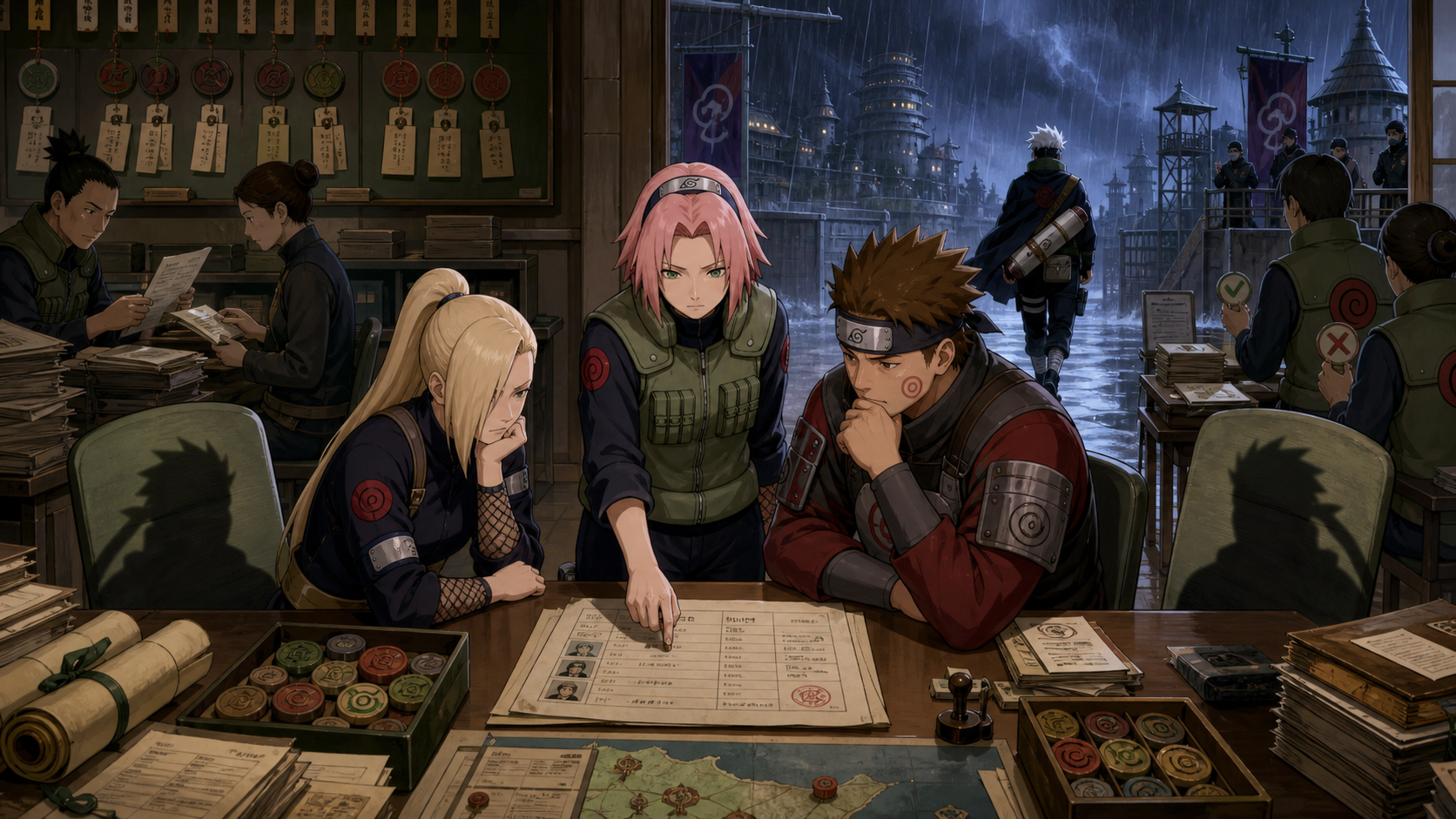
“The Chunin Exams Begin!” is really about vacancies. Naruto and Sasuke are gone, Shikamaru already holds chūnin rank, and the old three-person formations no longer fit the exam rules. Ino and Chōji ask Sakura to fill Shikamaru’s place. Sakura refuses at first because joining as somebody’s substitute can feel like proof that Team 7 has vanished. Meanwhile, Tsunade sends invitations across villages while Kakashi carries one into Amegakure, a place Konoha barely understands and Akatsuki already influences. Mist, Cloud, and Stone decline. Waterfall and Grass accept. Every response reveals trust, intelligence gaps, and self-interest around an event advertised as youth promotion. The episode works because administration becomes character pressure. A registration rule forces Sakura to face grief. A diplomatic invitation sends Kakashi into uncertainty. A tournament roster gives hidden villages access to Gaara. The paperwork is not filler around the story. The paperwork is how military institutions turn personal loss into staffing and political opportunity.
Roster compliance also decides whose grief receives time and whose grief becomes an administrative problem. Sakura must answer the form before Team 7 has any emotional resolution.
Konoha begins formal preparation
The joint exam moves from proposal into schedules, invitations, team registration, security, and travel. Tsunade needs several departments working before any written question appears.
Institutional stories become believable when somebody handles logistics.
The exam is still anime-original
Episode 395 continues the adaptation-only account of Naruto’s training absence. The material expands the ensemble and village politics without becoming unseen manga history.
Every directory label should preserve that boundary.
Invitations double as intelligence work
Asking another village to participate reveals diplomatic posture, available teams, trust in Suna and Konoha, and willingness to expose young shinobi abroad.
A response can say more than the written answer.
Tsunade assigns Kakashi to Amegakure
Konoha lacks reliable information about the Rain’s internal condition. Delivering the invitation gives Kakashi a legitimate reason to observe the village.
Diplomacy provides cover for reconnaissance.
The Rain is not a neutral destination
Years of war turned Amegakure into a battleground for larger nations, and Pain’s rule remains concealed from outsiders. Akatsuki connections make every official interaction dangerous.
Konoha’s ignorance reflects how little great villages notice smaller countries after using their land.
Kakashi’s assignment fits his skill set
He can read security patterns, notice inconsistencies, protect himself, and leave without announcing every suspicion. His history in ANBU and field command supports the mission.
Competence matters because a polite invitation can become an interrogation trap.
Espionage complicates the alliance language
Konoha presents the exam as cooperation while collecting information through the delivery. The caution is understandable, yet the method shows why hidden villages struggle to trust one another.
Security and sincerity keep sharing the same envelope.
Mist declines participation
Refusal may reflect internal priorities, distrust, travel risk, or reluctance to support a Suna-Konoha event. The episode does not need to invent a private motive beyond available evidence.
Absence is still a political signal.
Cloud also declines
Kumogakure has its own military interests and history with Konoha, including the Hyūga Affair. Participation would expose candidates and imply support for the hosts.
Old grievances remain beneath routine diplomacy.
Stone declines as well
Iwagakure’s rivalry with Konoha and investment in independent strength make caution plausible. A joint exam can look like alliance-building by competing powers.
Neutrality on paper may protect strategic distance.
Waterfall accepts
Takigakure’s participation brings a smaller village into an event dominated by larger powers. The decision creates opportunity and exposure at the same time.
Fū’s presence will make jinchūriki security especially important.
Grass accepts too
Kusagakure candidates add another regional perspective and another source of uncertainty. Smaller villages may seek recognition, information, or stronger ties through participation.
The exam offers visibility that ordinary missions rarely provide.
Participation is not proof of friendship
Villages can accept because the event serves their interests. Competitors may gather intelligence while leaders perform cooperation.
Diplomacy often works before affection exists.
Gaara’s jinchūriki status raises the stakes
Hosting concentrates foreign teams near a leader Akatsuki wants to capture. Security must distinguish ordinary rivalry from assassination or abduction.
Tournament rules cannot contain an enemy who never registered.
Fū creates another hidden target
The Seven-Tails jinchūriki enters the same broader environment. Her village’s decision exposes a young host to attention that may exceed the exam’s stated purpose.
Adults keep placing jinchūriki inside public military structures and calling the arrangement opportunity.
Young candidates receive incomplete information
They know the rules, destination, and promotion stakes. They do not receive the full intelligence picture surrounding Akatsuki or attacks on Gaara.
Consent to compete differs from consent to enter a covert security operation.
Team registration exposes Konoha’s vacancies
The exam expects three-person cells. Naruto and Sasuke are absent, while Shikamaru has already advanced beyond the candidate pool.
Administrative sameness collides with lives that changed.
Sakura no longer has a complete Team 7
Sasuke defected, Naruto left to train, and Kakashi receives separate missions. The team name survives while daily structure has broken apart.
A blank roster can make grief bureaucratically visible.
Ino and Chōji also lack their third member
Shikamaru’s promotion creates a practical problem for Team Asuma. His success leaves friends behind without intending abandonment.
Advancement changes group dynamics even when affection remains stable.
They ask Sakura to join
The invitation solves both vacancies and brings a medical trainee into a team with established coordination. Tactically, the combination has real potential.
Emotionally, the offer asks three people to admit their original teams no longer fit the form.
Sakura refuses at first
Her response can look stubborn because the exam offers advancement. The refusal also protects a Team 7 identity she has already watched fracture.
People do not process loss according to registration deadlines.
She does not want pity
Joining because everybody else lacks a third member may feel like being placed wherever a slot remains. Sakura wants her growing skill recognized as more than convenient availability.
Belonging feels different when the invitation names value.
The offer is not necessarily pity
Ino and Chōji know Sakura’s discipline and potential. Their team needs somebody capable, and history gives Ino real knowledge of Sakura’s strengths and insecurities.
Practical need and genuine respect can coexist.
Ino carries a complicated friendship
She once supported Sakura, later became a rival, and continued caring beneath competition. Asking Sakura to join reopens intimacy without erasing their sharp edges.
Friendship between girls deserves more than a shared crush storyline.
Chōji understands loyalty under change
He values the Ino-Shika-Chō bond and may fear that a temporary replacement dishonors the formation. Asking Sakura shows flexibility rather than disloyalty.
A relationship can remain real while a task requires adaptation.
Shikamaru’s absence becomes leadership evidence
He cannot enter as a candidate because he already passed the institutional gate. His new rank places him closer to administration and evaluation.
Promotion separates him from friends before giving him power to support them differently.
A substitute can become a teammate
The word replacement suggests one person occupying somebody else’s identity. A temporary exam cell works better when the members build a new agreement around current abilities.
Sakura does not need to become Shikamaru.
Medical training changes Sakura’s role
Under Tsunade, she is developing precision, diagnostic knowledge, chakra control, and responsibility for other bodies. Those abilities could transform Team Asuma’s endurance.
Her value should be named through skill rather than emotional encouragement alone.
Passing would not repair Team 7
Chūnin rank cannot bring Sasuke back or complete Naruto’s training. Sakura may hesitate because the exam offers a measurable achievement beside an unresolved personal failure.
Progress often feels disloyal during grief.
Refusing forever would freeze her around absence
Honoring Team 7 does not require avoiding every new partnership. Sakura’s future cannot depend entirely on when two boys return.
Agency grows when memory stops controlling every available choice.
The exam forces lateral trust
Candidates have trained mostly inside familiar cells. Changed rosters require them to explain techniques, timing, boundaries, and expectations to someone new.
Leadership appears through adaptation before the official test begins.
The villages are also forming a temporary team
Konoha and Suna host, smaller villages participate, and larger rivals decline. The diplomatic structure mirrors the candidate problem at a larger scale.
Everyone must decide whether cooperation threatens identity.
Amegakure’s response deserves suspicion
Pain’s hidden control and Akatsuki interests mean participation could supply intelligence or access. Kakashi cannot assume an official seal reflects transparent government.
Authoritarian systems often preserve familiar paperwork.
The episode uses preparation as tension
No arena battle is needed when invitations move through hostile territory, teams cannot register, and hidden actors read the same schedule. Planning creates multiple points of failure.
The quiet episode works through consequences attached to ordinary tasks.
Registration exposes who controls access
Candidates cannot simply declare readiness and appear at the test. Jōnin recommendations, village approval, team rules, travel permission, and diplomatic acceptance determine who receives the opportunity.
Promotion is presented as individual merit after institutions select the field. That gate can protect inexperienced genin, but the gate also allows favoritism, political convenience, and incomplete intelligence to shape supposedly fair competition.
The title promises a start that has not fully arrived
Formal competition follows in Episode 396, with Shikamaru administering the written test. Episode 395 begins the institutional and emotional process rather than the first scored round.
The distinction matters for accurate directory summaries.
The arc can deepen secondary characters
Naruto’s absence allows Sakura, Ino, Chōji, Neji, Gaara, Fū, and others to carry decisions. Long franchises need space where supporting people act without waiting for the lead.
Screen time should develop their motives rather than simply praise Naruto.
The arc can also over-credit Naruto
The framing calls him Konoha’s hope and uses his memory to organize everyone’s growth. Inspiration is established, but every training session and difficult choice belongs to the person doing the work.
Respecting influence requires respecting independence.
Japanese performance analysis remains bounded
The final publication should verify cast and staff credits. Claims about Sakura’s refusal, Ino’s invitation, Tsunade’s authority, Kakashi’s caution, or Gaara’s resolve require lawful direct listening.
Generic vocal description would only imitate observation.
A three-person rule turns grief into administration
Team 7 lacks Sasuke and Naruto. Team 10 lacks Shikamaru for a different reason. Registration reduces those histories to a roster requirement that must be solved before a deadline.
Rules need clarity, but institutions should recognize what vacancies mean emotionally. Filling a space is not the same as replacing a person or pretending the old team remains unchanged.
Sakura controls what joining means
Ino and Chōji can make a sincere offer, and Sakura can still worry that they see her as a convenient extra or someone needing rescue. Her interpretation deserves conversation rather than ridicule.
Consent improves when the team names roles, expectations, risks, and reasons directly. Nobody should be pushed into gratitude because an invitation appears generous from outside.
Ino’s offer carries rivalry and real care
She and Sakura have competed, fought, protected one another, and built identities partly through comparison. Asking Sakura to join brings all that history into a practical decision.
The offer becomes stronger when Ino can value Sakura’s medical skill and judgment without turning the moment into another contest over who needs whom more.
Chōji is not a neutral third person
He has his own bond with Shikamaru, loyalty to Ino, combat strengths, doubts, and recent experiences of loss. A new arrangement affects how he moves and who he trusts under pressure.
Team consent belongs to all three participants. Quiet agreement should not be assumed merely because Chōji often avoids escalating conflict.
Shikamaru’s promotion changed Team 10’s labor
His Chūnin status creates responsibilities beyond the original unit and proves rank can redistribute a teammate before injury or betrayal does. The vacancy is institutional, not personal abandonment.
That distinction may make a temporary roster easier to discuss, but it still requires the remaining members to rebuild communication patterns without their usual strategist.
Sakura brings medical expertise and different risk
Her training under Tsunade can stabilize teammates and change how the group plans endurance. It may also cause evaluators to treat her as support who should absorb everyone else’s injuries.
A medic on a three-person team still needs protection, offensive agency, rest, and authority to stop reckless behavior before care becomes endless cleanup.
A substitute relationship can become real
Temporary formation does not make the connection fake. Sakura, Ino, and Chōji can learn one another’s timing, disagree, solve problems, and build trust that exists outside their original teams.
The key is refusing replacement language. New bonds add to old ones; they do not erase Sasuke, Naruto, Shikamaru, or the histories attached to those absences.
Invitations are diplomacy with a reconnaissance layer
Kakashi carries an official offer and observes routes, leadership signals, security, and political mood. Amegakure will reasonably assume the visitor is doing more than delivering paper.
Calling the mission friendship would be dishonest. Diplomatic contact often includes intelligence work, which makes boundaries, cover stories, and risk to local civilians part of the ethical file.
The Rain has reasons to distrust every great village
Amegakure became a battlefield for larger powers, producing displacement, orphanhood, militarization, and leaders shaped by intervention. Konoha cannot approach as if suspicion proves Rain hostility.
Kakashi enters with village authority backed by that history. Competence includes understanding what his forehead protector represents to people who paid for wars they did not start.
Declining the exam is a political choice, not cowardice
Mist, Cloud, and Stone may distrust the host, protect intelligence, avoid exposing young shinobi, or reject the timing. Participation would also carry risks specific to their governments.
A joint event only demonstrates consent if refusal remains legitimate. Treating absence as disloyalty would turn diplomacy into pressure disguised as invitation.
Acceptance does not prove alliance intimacy
Grass and Waterfall may see training value, visibility, information access, or strategic advantage. Their candidates can cooperate while leaders continue guarding separate interests.
That complexity is normal. Durable relations grow through repeated transactions and honest negotiation, not one cheerful attendance list presented as proof everyone trusts one another.
Fū’s presence raises a hidden consent problem
As Chōmei’s jinchūriki, she enters an event where Akatsuki targets are already known. Leaders may value her strength while withholding how much danger her status attracts.
She deserves accurate risk information and a voice in security decisions. Protection cannot mean using her as bait or confining her without explanation.
Gaara’s visibility creates a second target
The host Kazekage is also a jinchūriki whose capture would damage diplomacy, village security, and a living relationship with Shukaku. The exam gathers vulnerabilities in one public frame.
Security planning must protect candidates without treating Gaara and Fū as objects whose primary value is keeping tailed-beast power away from enemies.
The title begins before the first test
Team negotiation, travel decisions, intelligence missions, invitations, refusals, and security preparation are already part of the exam’s real structure. Leadership is being tested before candidates enter a room.
That is useful if evaluators acknowledge the labor. Otherwise the institution rewards only visible performance and ignores who built the conditions that made the event possible.
The arc should let secondary characters own consequences
Naruto’s absence creates space, not a vacuum requiring every action to reference him. Sakura, Ino, Chōji, Gaara, Fū, Kakashi, and visiting teams have motives unrelated to his eventual reaction.
The story earns its detour when those characters make choices that remain meaningful after the main war narrative returns.
Registration should record accommodations, injuries, and role constraints before the test begins. A candidate recovering from trauma, carrying medical duties, or entering with a formed team should not be judged as if every participant arrived with preparation. Equal rules can preserve unequal disadvantage. Fair evaluation adjusts for conditions without lowering the leadership standard or exposing medical information to spectators.
RaeRae’s verdict
“The Chunin Exams Begin!” makes missing people shape the story without letting absence stop the village. Team 7 cannot register. Team Asuma lacks Shikamaru. Ino and Chōji offer Sakura a practical new formation, and her refusal reveals how deeply a roster can touch grief and identity. The most useful next step is not pretending their old teams never mattered. They need to build a temporary unit that names what each person contributes now.
The village diplomacy carries the same problem. Konoha and Suna want cooperation, Mist, Cloud, and Stone decline, and smaller villages enter for their own reasons. Kakashi delivers an invitation to a Rain Village Konoha barely understands. Akatsuki and the threat against Gaara turn every list of participants into a security document. Episode 395 earns its slower pace by showing that exams begin long before the first question. Somebody chooses the rules, invites the witnesses, hides the intelligence, and decides which children absorb the risk.
RaeRae’s call
The Chūnin Exams begin long before anybody answers a written question. Sakura, Ino, and Chōji have to decide whether a roster solution can become an honest team. Kakashi has to deliver diplomacy while recognizing that Amegakure sees a spy for a great village with blood in its history. Other villages have the right to refuse. Fū and Gaara deserve informed protection as people, not secured tailed-beast containers. Preparation is leadership work, and this arc succeeds only if every character owns that work instead of becoming proof that Naruto inspired the room while absent.
Episode details and viewing routes
- Official episode reference: Naruto Official episode guide
- Licensed episode route: Crunchyroll licensed episode page
What I am carrying forward
Konoha prepared invitations and candidate rosters for the joint Chūnin Exam. Kakashi traveled toward Amegakure with an intelligence-gathering purpose, while Mist, Cloud, and Stone declined and Waterfall and Grass accepted.
Sakura lacked Naruto and Sasuke, while Ino and Chōji lacked the already-promoted Shikamaru. They invited Sakura to form a temporary three-person team, but she initially refused. Episode 396 begins the written round under Shikamaru’s supervision.