
A True Ending
Madara forces an ending through capture, but Kurama, Gyuki and Gaara preserve tiny routes that keep relationship alive after raw power is taken.
Bottom line
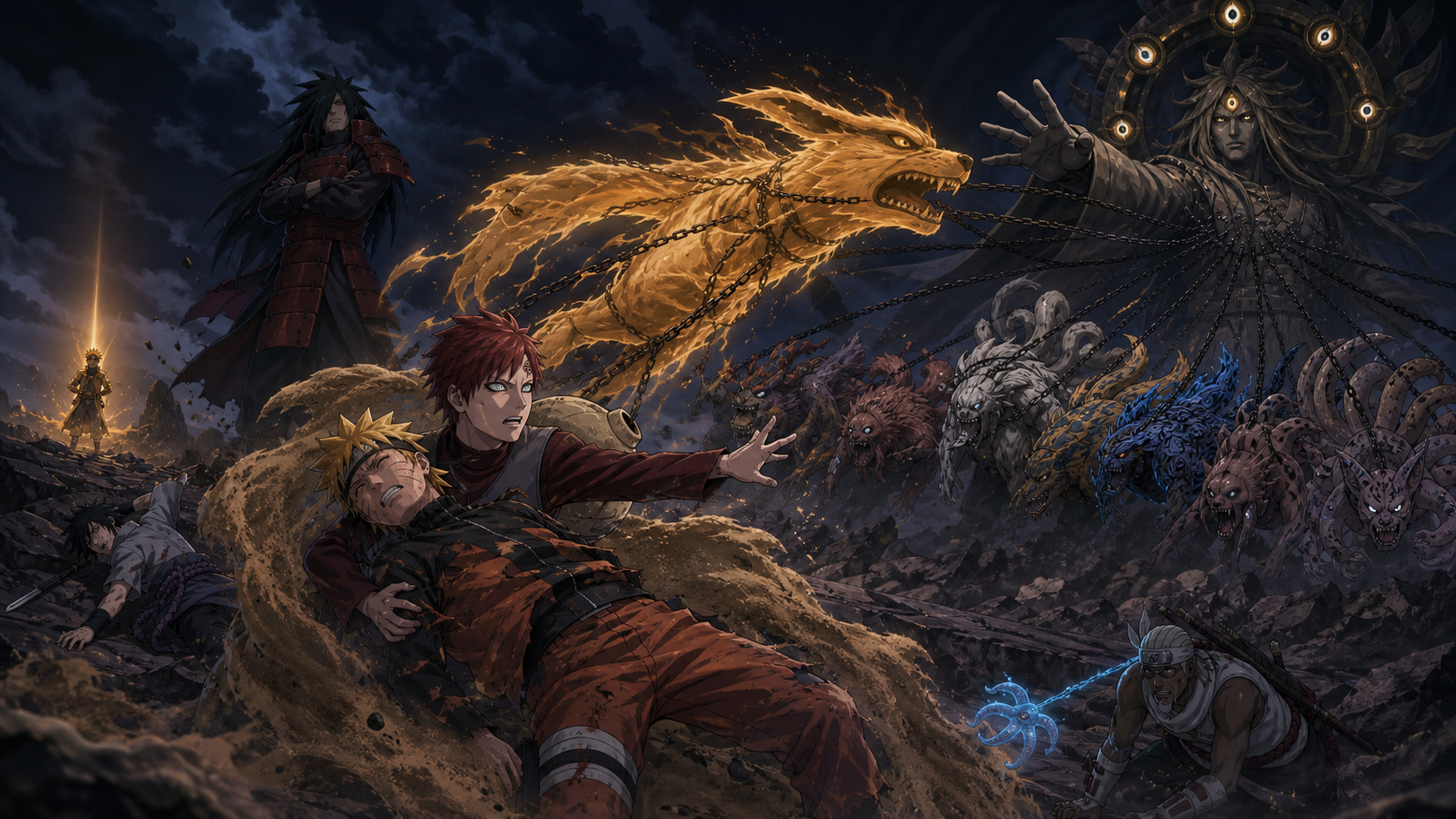
“A True Ending” gives Madara the victory he thinks proves his entire worldview. He drags all nine tailed beasts into the Demonic Statue, tears Kurama from Naruto, stops Sasuke’s attack, and drives Sasuke’s own sword through his body. The two boys carrying the alliance’s future collapse at nearly the same moment. Madara calls domination reality because nobody on the field can currently overpower him. That conclusion is his oldest mistake. Power can force an ending without making the ending true. Kurama uses the final seconds before extraction to give Gaara a survival route for Naruto. Gyūki leaves Bee a fragment. Gaara catches the person who once saved him and runs toward Minato. Those choices are small beside Madara’s chains, but they preserve relationship after he captures raw power. The episode hurts because Naruto and Kurama’s earned partnership is ripped apart by the same weapon logic the series has spent years criticizing. The cliffhanger does not ask whether Madara won the exchange. He did. The question is whether people reduced to resources can still create another future from whatever he failed to notice.
Madara’s chains keep tightening
The Demonic Statue pulls every tailed beast toward captivity despite their combined resistance. Nine separate bodies are treated as pieces returning to a container.
The visual turns political domination into a physical drag.
The beasts fight for their own freedom
Their resistance is not a service performed for the alliance. Capture threatens their identities, bodies, and ability to choose any future relationship with humans.
Self-defense remains central even when human lives also depend on them.
The alliance cannot break the Outer Path control
Shinobi and beasts have spent enormous power defeating Obito. Madara arrives with the exact eye and statue designed to reverse that achievement.
Preparation allows one man to exploit collective exhaustion.
Shukaku is pulled back toward confinement
His new cooperation with Gaara barely begins before Madara’s chains seize him. Freedom arrives long enough for one voluntary act.
That act still distinguishes partnership from imprisonment.
Gaara cannot save him through sand alone
The Kazekage’s control is formidable, but the statue operates through a power system built specifically for tailed-beast capture. Personal growth does not guarantee tactical victory.
Failure under overwhelming force does not make the attempt meaningless.
Gyūki prepares for survival
The Eight-Tails understands extraction mechanics and leaves Bee a route to remain alive through separated chakra. The response shows experience under repeated capture attempts.
Survival knowledge becomes resistance passed between partners.
Bee’s life depends on cooperation
His relationship with Gyūki developed beyond the village’s weapon assignment. The beast acts to preserve the host rather than merely protecting a container.
Reciprocity changes what jinchūriki survival can mean.
Kurama recognizes Naruto’s immediate danger
Extraction from a jinchūriki normally causes death. Kurama cannot simply overpower Madara’s chains, so he uses remaining time to communicate a plan.
Strategic care replaces impossible physical rescue.
He gives Gaara a route
Kurama tells Gaara that Minato carries the other half of the Nine-Tails and may be able to transfer that chakra into Naruto. The instruction is concise because every second matters.
Knowledge becomes the last protection Kurama can provide before separation.
Gaara is the right person to receive the message
He understands tailed-beast extraction, has survived the process through outside intervention, and can move Naruto quickly across the battlefield. His history becomes operational expertise.
The former victim is trusted with another jinchūriki’s life.
Naruto once crossed a desert to save Gaara
During the Kazekage Rescue, he refused to treat Gaara’s capture and death as a distant political problem. That commitment helped return Gaara to his village.
Episode 393 gives Gaara the chance to carry the debt forward without reducing friendship to repayment.
Kurama’s extraction tears apart an earned bond
Naruto began as an infant used to contain the Nine-Tails. Hostility slowly became negotiation, recognition, shared names, and mutual combat.
Madara treats all of that history as chakra inventory.
Captivity ignores relationship
The statue does not care whether a host and beast hate each other, tolerate each other, or become partners. Every connection disappears beneath the same chain.
Weapon systems flatten moral difference for administrative convenience.
Naruto cannot hold on forever
His resistance fails against the Rinnegan and statue. The loss is not caused by weak resolve or insufficient belief.
Some defeats come from an opponent having overwhelming control over the mechanism.
Kurama enters the statue
The final capture completes Madara’s immediate collection of the tailed beasts. The entity Naruto learned to call by name is sealed beside the others.
Madara gains components while the audience sees people disappear.
Naruto loses consciousness
The physical consequence begins immediately. Without Kurama, his body starts failing and his heartbeat weakens.
The series returns jinchūriki politics to the body of the child used at birth.
Hero status offers no biological exemption
Naruto has saved villages, defeated enemies, changed alliances, and carried thousands of people through the war. Extraction still kills a jinchūriki.
Narrative importance does not make the mechanism gentle.
Gaara catches him
The image reverses their earliest confrontation. Gaara once tried to kill people to prove existence, while Naruto fought to protect friends.
Now Gaara physically holds Naruto’s life inside a rescue attempt.
The rescue begins before grief can settle
There is no time for speeches about Kurama, fear over Naruto’s condition, or debate about odds. Gaara moves toward the one known source of compatible chakra.
Urgency turns friendship into logistics.
Sakura’s medical skill will still be necessary
Chakra transfer may address the extraction, but Naruto’s failing circulation and body require active care. Emotional stakes do not replace medical mechanics.
Competence should remain visible beside devotion.
Minato carries both hope and complication
He sealed Kurama into his infant son and retained the Yin half through the Reaper Death Seal. The same father who created Naruto’s jinchūriki condition may hold the route to survival.
Repair returns through the site of an earlier decision.
Madara treats the capture as confirmation
All nine beasts now sit inside the statue, and the strongest opposing jinchūriki lies dying. He reads the battlefield as proof that resistance was childish delay.
Winning power does not prove an argument about human nature.
The Kage are exhausted
They survived Madara’s earlier assault, healing, travel, and renewed combat. Leadership remains present while bodies reach practical limits.
The war has consumed the reserves of every generation.
Sasuke looks for an opening
He refuses to wait while Madara consolidates control. His attack carries tactical urgency and the familiar belief that decisive individual action can cut through a larger system.
Speed matters, but Madara expects opposition.
Madara stops him easily
The gap between Sasuke’s recent growth and Madara’s revived power becomes brutally clear. The attack never develops into a balanced duel.
The scene denies the comfort of rival symmetry.
Sasuke’s own sword becomes the weapon
Madara takes control of the blade and drives the consequence back into its owner. The visual fits his entire strategy: seize another person’s tool, reverse direction, claim the result.
Appropriation becomes combat style.
He aims for fatal finality
Madara does not need Sasuke persuaded, recruited, or publicly defeated. The younger Uchiha becomes another obstacle to remove.
Shared clan identity carries no protective value.
Uchiha solidarity was never his principle
Madara speaks through clan grievance and inherited conflict, yet he uses Obito, manipulates Sasuke’s history, and impales the remaining young Uchiha when convenient.
The clan functions as justification, not community.
Sasuke falls as Naruto fades
The parallel collapse places both central rivals at the edge of death. Their different paths converge through Madara’s refusal to allow any competing future.
The war’s next stage cannot rely on ordinary stamina or current power alone.
Their deaths would affect different networks
Naruto’s loss would strike the alliance, tailed beasts, villages, mentors, and friends built across the series. Sasuke’s loss would close an Uchiha history that remains unresolved with Team 7 and Konoha.
Two bodies carry consequences beyond protagonist status.
“True ending” belongs to the victor’s fantasy
Madara believes overwhelming force reveals reality’s final form. The title sounds absolute because the battlefield currently supports his claim.
Truth requires more than the ability to silence disagreement.
Forced endings are politically familiar
Empires, clans, and military systems often describe conquered conditions as natural order. The language turns a temporary balance of power into destiny.
Madara weaponizes inevitability after manufacturing the crisis.
Small survival plans challenge inevitability
Kurama’s message, Gyūki’s fragment, Gaara’s movement, and the allies reaching toward both boys do not look equal to Madara’s spectacle. They preserve options.
History changes because somebody protects an option the ruler missed.
The episode makes power scaling feel almost hostile
The alliance needed extended coordination to defeat Obito. Madara reverses the tailed-beast victory, captures all nine, and destroys both leads with startling speed.
Escalation risks making earlier labor feel disposable.
Consequence keeps the escalation grounded
Naruto’s pulse weakens. Gaara carries him. Sasuke bleeds around his own sword. The beasts vanish behind the statue.
Bodies give the power display an actual cost.
The alliance has to survive leader dependency
Naruto became the shared chakra link and emotional center for thousands of shinobi. Sasuke supplied another rare answer to Obito and Madara. Losing both exposes how much the coalition concentrated hope around exceptional individuals.
The next response must come from medics, transport teams, former enemies, teachers, summoned allies, and people who cannot wait for either boy to stand up first.
The direction uses parallel crisis
Cutting between extraction, rescue, Madara’s control, and Sasuke’s attack prevents any one character from owning the catastrophe. Multiple failures happen inside the same strategic collapse.
The audience cannot settle into one solution.
Japanese performance needs direct verification
The publication record should include verified Japanese cast and staff credits. Claims about Kurama’s urgency, Gaara’s focus, Madara’s contempt, Naruto’s weakening, or Sasuke’s shock require lawful scene-level listening.
Specific observation must precede performance judgment.
The next episode does not continue immediately
Episode 394 begins an anime-original Chūnin Exam flashback set before Naruto’s return from training. The broadcast sequence suspends two near-death cliffhangers for an extended side story.
Directory copy should warn viewers about the continuity break without insulting fans who value the added material.
Madara calls capture an ending because he controls the frame
Once the beasts enter the statue and both young rivals fall, he treats the outcome as settled. His definition of finality depends on nobody else retaining meaningful action.
That is the flaw. A battlefield contains medics, carriers, witnesses, partners, fragments of chakra, unfinished instructions, and people whose importance Madara never bothered to measure.
Kurama plans while losing the body connection
Extraction is violent, lethal, and designed to erase his partnership with Naruto. Kurama still uses the remaining moments to identify a possible survival route and communicate it through Gaara.
The act belongs to Kurama’s judgment. He is not simply leaving Naruto a convenient power reserve before disappearing into the plot.
Gaara receives the message through earned trust
He understands jinchūriki extraction in his own body and knows what Naruto risked to bring him home. Kurama chooses someone with relevant experience, mobility, authority, and a relationship strong enough to act immediately.
That is not destiny. It is emergency planning built from prior care that neither participant knew would later become infrastructure.
Rescue begins with catching a falling person
Gaara cannot reverse extraction in the sky. He can keep Naruto from striking the ground, preserve time, and move him toward people with the next necessary skill.
Small actions matter because survival is a chain. Fandom loves the miracle at the end and too easily forgets the hands that prevented death before the miracle existed.
Sakura’s medicine remains essential after tailed-beast strategy
Kurama may know what chakra Naruto needs, and Gaara may know where to carry him. Sakura still has to assess his failing body, support circulation, maintain oxygen, and keep him alive during transport.
Information does not replace care. Power does not replace care. The rescue works only when strategic knowledge and trained medical labor meet.
Gyūki protects Bee through a different route
He understands that full extraction can kill a host and preserves a means for Bee to remain alive. Their relationship contains years of coordination that Madara’s chains cannot fully anticipate.
The details differ from Naruto and Kurama because these are not interchangeable jinchūriki units. Each partnership has its own history, capacity, injuries, and survival decisions.
The beasts lose this battle without losing personhood
Madara’s chains overpower them and force them into the statue. Defeat does not prove they needed owners, nor does it transform capture into rightful custody.
They remain nine beings under coercion. The alliance’s later strategy must begin from rescue and consent rather than treating their imprisoned chakra as another weapon to seize.
Naruto’s collapse exposes the cost of village design
His life is endangered because adults sealed a sentient being into an infant and made their biological survival interdependent. The partnership later grew into something genuine inside that imposed structure.
Madara exploits the structure’s lethal seam. Konoha cannot celebrate the bond while avoiding responsibility for the original architecture that made extraction a death sentence.
Sasuke’s crisis follows another form of isolation
He searches for an individual opening against Madara and receives overwhelming force in return. His skill, eyes, and ambition cannot replace coordination or make him exempt from bodily vulnerability.
The fall is not cosmic punishment for arrogance. It is evidence that private power remains limited against an opponent who built advantages across bodies and generations.
Madara uses Sasuke’s sword to make ownership visible
He takes the younger man’s weapon and turns it back into his body. The act condenses Madara’s larger pattern: whatever exists near him becomes material for his objective.
Uchiha identity offers Sasuke no protection because Madara values clan continuity only when it serves his preferred historical role.
Naruto and Sasuke do not fall into identical networks
Naruto is carried by Gaara toward Sakura and Minato through instructions Kurama preserved. Sasuke lies within a different web of teammates, teachers, enemies, and unresolved family history.
Parallel editing creates shared dread, but responsible analysis keeps the rescue conditions separate instead of turning both boys into one symbolic chosen pair.
The alliance needs plans that survive leader loss
Too many battlefield functions have gathered around Naruto’s chakra and Sasuke’s offensive power. Their collapse risks turning thousands of capable fighters into witnesses waiting for the narrative to restart.
Command, communication, medicine, evacuation, and defense must remain distributed. A coalition is strongest when no single body can become its only operating system.
Madara mistakes fear for surrender
The Kage are exhausted, the beasts are captured, and the two central fighters appear mortally wounded. Despair is rational under those conditions.
Despair does not automatically produce consent to Madara’s answer. People can fear defeat, mourn losses, retreat, rescue, and continue refusing the person who calls coercion peace.
A true ending requires more than stopping motion
Madara can immobilize bodies and interrupt plans. He cannot settle what the captured beasts want, what survivors remember, what medics attempt, or how institutions later describe the war.
Finality is not his private declaration. An ending becomes socially real through consequences, testimony, burial, repair, and the choices that remain after the strongest man leaves the frame.
The remaining hope is deliberately unglamorous
A fragment saved, a body caught, a message delivered, a medic working, and a carrier moving toward the right person are not giant attacks. They are what the episode leaves alive.
That scale fits the RaeRae editorial line. Hope is credible when it has tasks, limits, people, and no guarantee that effort will be rewarded on schedule.
Sasuke’s survival will require its chain, and the people connected to him deserve names rather than becoming emergency scenery. Karin’s sensory and healing abilities, Orochimaru’s knowledge, Kabuto’s choices, and Team 7’s unfinished bonds all matter differently. A rescue can bring Sasuke back to life without settling what he intends to do with that life afterward.
RaeRae’s verdict
“A True Ending” is vicious because Madara does not merely beat Naruto and Sasuke. He converts every relationship around them back into property. Kurama becomes chakra in the statue. Sasuke’s sword becomes Madara’s weapon. Obito’s body remains contested. The tailed beasts lose freedom together after finally fighting as a coalition.
The episode preserves hope through practical care rather than a motivational speech. Kurama gives Gaara a plan. Gyūki prepares Bee’s survival. Gaara catches Naruto and runs. Those choices do not make Madara’s victory smaller. They expose the flaw in his idea of a true ending. He can capture bodies, redirect tools, and stop hearts. He cannot guarantee that every connection has been accounted for. Somebody is still carrying somebody else toward help.
RaeRae’s call
Madara thinks he has created a true ending because he captured the beasts and put Naruto and Sasuke on the ground. What he missed is the survival infrastructure built by relationships he calls weakness. Kurama leaves instructions. Gyūki protects Bee. Gaara catches Naruto. Sakura can keep a failing body alive. None of those actions guarantees victory, and none needs to be glamorous. Forced endings depend on everyone else becoming still. This episode leaves too many people moving, thinking, carrying, resisting, and refusing for Madara’s final sentence to hold.
Episode details and viewing routes
- Official episode reference: Naruto Official episode guide
- Licensed episode route: Crunchyroll licensed episode page
What I am carrying forward
Madara completed the capture of all nine tailed beasts inside the Demonic Statue. Kurama’s extraction caused Naruto to lose consciousness as his heartbeat weakened, while Gaara began carrying him toward Minato and the Yin half of the Nine-Tails.
Sasuke attacked Madara and was stopped, then impaled with his own sword. Both Naruto and Sasuke now face death. Episode 394 leaves the battlefield for the anime-original second Chūnin Exam story set during Naruto’s training absence.