
Pursuing Hope
Naruto’s history reaches the alliance as permission to act, but hope becomes useful only when thousands of people bring their own grief, skill and choice to the fight.
Bottom line
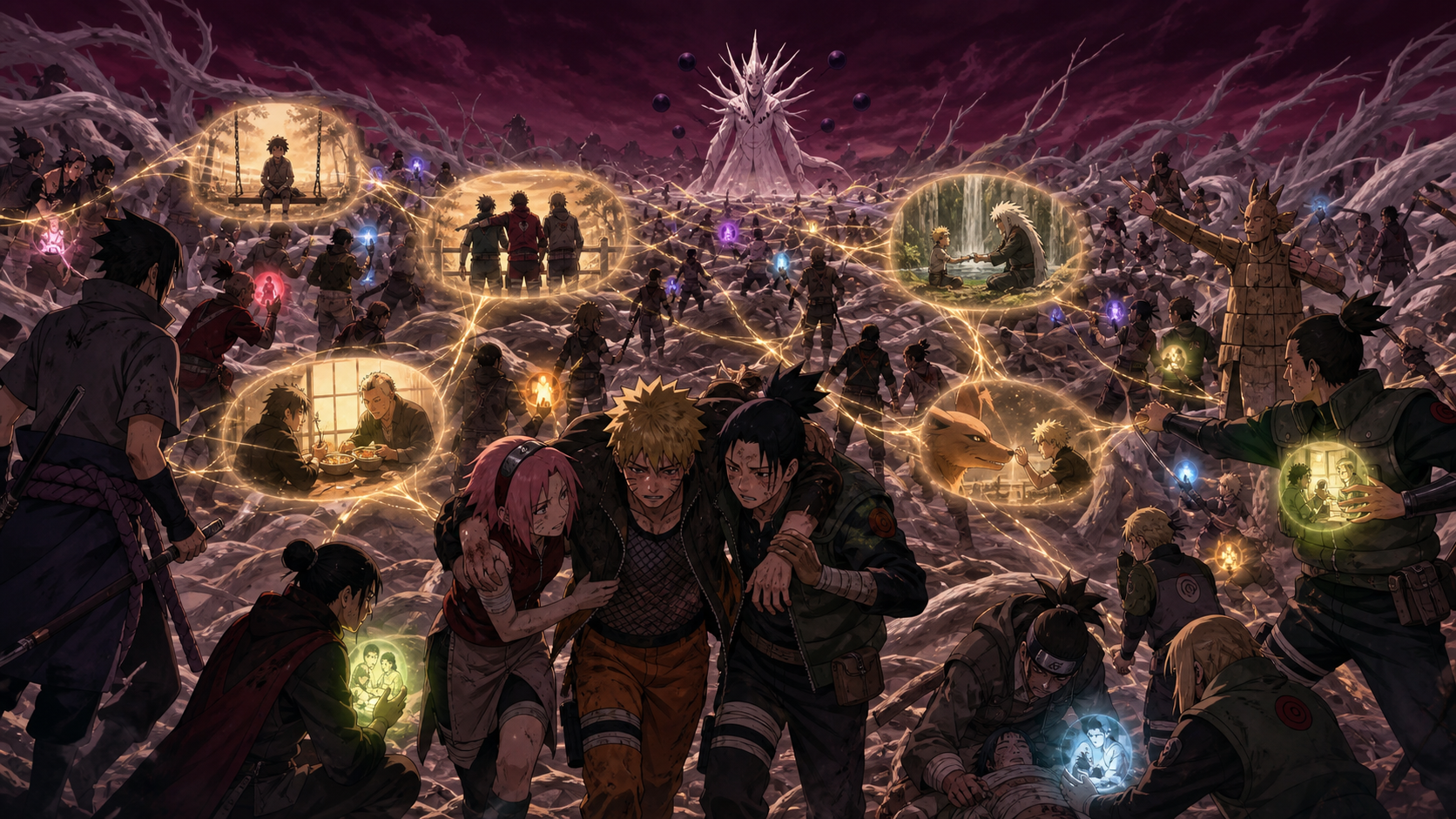
“Pursuing Hope” works when the Allied Shinobi Forces stop treating Naruto as the person who will save everyone and start treating his example as permission to act. Hashirama’s clone explains the shrinking deadline, Obito’s defenses, and the need for coordinated senjutsu support. Fighters across the alliance remember encounters with Naruto, but those memories should not turn thousands of people into extensions of one boy’s importance. Naruto affected them because he listened, challenged orders, kept promises, admitted fear, and needed help. Each shinobi still brings personal grief, village history, training, and reasons for choosing the real world. Hope becomes useful when hope produces movement: roots are cut, injured people are protected, units communicate, and ordinary fighters join the route toward Obito. The episode’s strongest claim is not that Naruto gives everyone a dream. Naruto helps them remember that their own dreams still require their bodies and choices.
Hashirama’s clone brings the plan to the field
The First Hokage cannot leave Madara without consequence, so a wood clone communicates directly with the alliance. Leadership reaches the people who must act rather than waiting for a central broadcast system that no longer exists.
Redundant communication becomes survival infrastructure.
The deadline is stated plainly
The Divine Tree’s flower may soon enable the Infinite Tsukuyomi. Fighters need the remaining time and the conditions for stopping the plan.
Truth supports judgment even when truth is frightening.
Obito’s defenses require specific power
Ordinary ninjutsu can be canceled by Yin–Yang Release. Senjutsu has caused damage, which gives natural-energy users a central offensive role.
Other shinobi remain necessary for delivery, protection, rescue, and restraint.
Information reduces helplessness
The alliance has watched legendary attacks disappear and comrades die without understanding why. A known vulnerability turns fear into a set of tactical questions.
Knowledge cannot restore casualties, but knowledge can prevent repetition.
Hashirama asks for coordinated action
No single unit can cut every root, protect every medic, reach Obito, and stop the flower. The plan depends on many specialties moving toward a shared purpose.
Coalition strength comes from organized difference.
Naruto remains exhausted
His renewed Sage and Tailed Beast power does not erase earlier depletion. He has distributed chakra, maintained protection, supported mass teleportation, and carried repeated emotional shocks.
Hope should not be measured by pretending his body feels fresh.
Sasuke’s presence changes the front
He cuts roots and prepares Susanoo power beside Naruto. The alliance gains a dangerous fighter whose motives remain partly private.
Useful cooperation now can coexist with justified caution later.
The two rivals create visible momentum
Naruto and Sasuke advancing together gives nearby units a clear direction. Their scale opens routes ordinary fighters cannot create alone.
Visible leadership matters most when the route stays open for others.
The alliance remembers Naruto through specific encounters
People recall missions, arguments, battles, rescues, and moments when Naruto refused the role assigned to him. The memories carry behavior rather than generic inspiration.
Specific evidence keeps hope human.
Iruka’s recognition began with personhood
He saw the lonely child beneath Konoha’s fear of Kurama and chose to protect him. Naruto’s later confidence grew from being known by one adult without becoming a resource.
Recognition was practical care before public praise.
Team 7 remembers shared work and damage
Sakura and Kakashi know Naruto’s persistence through missions, failure, injury, and the long pursuit of Sasuke. Their bond includes frustration and unequal emotional labor.
Care becomes honest when criticism remains possible.
Hinata remembers choosing movement
Naruto’s example mattered because he kept acting after embarrassment and rejection. Hinata translated that observation into her own training and decisions.
He did not manufacture courage inside her. She practiced courage herself.
Gaara remembers another jinchūriki path
Naruto challenged his belief that pain justified isolation and murder. Gaara then chose relationships, public responsibility, and difficult reform inside Sunagakure.
The changed life belongs to Gaara’s continued choices.
Killer Bee supplied expertise Naruto lacked
Naruto did not reach partnership with Kurama through determination alone. Bee taught from lived jinchūriki experience and demonstrated cooperation with Gyuki.
Mentorship moved across village lines.
Kurama’s change remains Kurama’s decision
Naruto listened, fought, shared names, and challenged the beast’s hatred. Kurama evaluated those actions and chose partnership.
The tailed beast is not a trophy proving Naruto’s goodness.
Former enemies remember being heard
Nagato and others encountered Naruto after causing devastating harm. He challenged their conclusions without pretending their suffering was imaginary.
Listening created a choice while accountability remained necessary.
Not every conversion should become a formula
Naruto cannot speak one perfect sentence and ethically resolve every violent person. Circumstances, willingness, power, and ongoing danger differ.
Relationship is work, not a guaranteed technique.
Ordinary shinobi carry private reasons
Some fight for children, teammates, villages, unfinished reforms, or a chance to go home. Others may simply refuse to be absorbed by a tree.
No one needs a grand speech to justify wanting to live.
Hope can be modest
Reaching the next position, freeing one trapped person, protecting a medic, or surviving another minute may be enough. The word does not have to mean certainty about final victory.
Small objectives keep overwhelmed people moving.
The roots remain an immediate labor problem
Fighters must cut, evade, report, and map a spreading extraction network. Every severed route can free bodies and reduce the tree’s access.
Work on the ground supports the attack above.
Rescue teams need protection
Reaching drained shinobi exposes medics and carriers to the same roots. Combat units have to secure corridors and watch for movement below.
Care requires defensive infrastructure.
Sensors turn chaos into shared information
They can identify chakra loss, root movement, enemy concentration, and gaps in formation. Communicators must move those findings faster than panic spreads.
Observation connects local survival to alliance strategy.
Clan techniques become coalition tools
Abilities inherited through families now serve people from other villages and bloodlines. Shadow, mind, sensory, medical, sealing, and physical techniques cross older boundaries.
Tradition gains value when tradition protects beyond the clan.
The alliance does not erase village history
Stone, Mist, Sand, Cloud, and Leaf shinobi carry wars, exploitation, and distrust into the same formation. Cooperation under attack cannot settle those histories automatically.
Postwar peace will need truth beyond battlefield camaraderie.
Shared danger creates a temporary public
Fighters make decisions as members of something larger than individual villages. They receive common information and accept mutual obligations.
That experience can become a foundation if institutions preserve equal voice later.
Naruto’s network models distributed power
He and Kurama share chakra outward so recipients gain protection and capacity. The energy does not force identical movement or erase personal judgment.
Support strengthens difference.
The Divine Tree models extraction
Roots take chakra inward and leave recipients unable to act. The system centralizes power while removing people from the future.
Both are networks, but only one permits reciprocity.
Obito sees numbers as proof of futility
He expects casualties, fear, and the countdown to break collective purpose. His worldview treats every failed rescue as evidence that bonds were false.
No real coalition can satisfy a standard of perfect protection.
The alliance rejects the perfection test
People continue despite knowing some comrades are already dead and others may not be saved. Continuing does not make those deaths acceptable.
Action protects remaining lives without balancing a ledger.
Grief travels with the advance
Shikamaru remains weak, Neji is dead, headquarters is gone, and countless families have new absences. The counterattack does not pause mourning or complete mourning.
Hope is allowed to limp.
Naruto becomes a reference point, not an owner
His history helps people recognize persistence and connection. He does not own their courage, dreams, or future political choices.
Influence should expand agency rather than absorb credit.
Leadership means making room behind the front
Naruto and Sasuke can open a path through roots and enemy force. Other units need enough room to bring their own work forward.
The strongest fighters should create access, not a spectator line.
Sakura’s network keeps the movement possible
Katsuyu and medical teams stabilize people while combat units reorganize. Without care, the advance would consume injured bodies as another resource.
Sustainable offense includes treatment and evacuation.
The Kage join rather than replace the force
Their arrival brings power and political authority. The alliance has already developed local coordination during their absence.
Effective leadership integrates the working system instead of reclaiming every decision.
Hashirama’s dream receives a field test
Shinobi from rival villages now protect one another against an imposed world. The cooperation realizes part of his founding hope on a scale Konoha alone never achieved.
The tailed-beast exploitation inside his old model still needs correction.
Sasuke watches acknowledgment form around Naruto
People move with Naruto because they know his conduct and have seen him serve. The response demonstrates what public recognition looks like before the Hokage title.
Sasuke’s own leadership claim lacks that shared history of trust.
Rivalry can push without humiliating
Sasuke’s challenge helped Naruto stand, but the alliance’s response gives the renewed action support. Competition is one input among many.
A healthy system cannot depend on shame as fuel.
Hope requires permission to report failure
Units must be able to say a route is blocked, a patient is gone, or a technique failed. False optimism would poison the information network.
Honest limits make collective action safer.
The advance belongs to many bodies
The frame may center Naruto, but movement comes from thousands of decisions to rise, cut, carry, heal, communicate, and follow a shared route.
Scale should restore individual contribution rather than blur each person’s work.
Obito’s isolation becomes tactically weaker
He holds greater individual power, yet he must manage attacks from different roles and directions. Centralized control creates enormous force and limited perspective.
Distributed groups can adapt faster when communication holds.
Pursuit acknowledges uncertainty
The title does not promise that hope is already possessed. People chase a possible future while evidence remains frightening.
Movement comes before assurance.
The real-world dream includes disagreement
If the alliance wins, members will still argue about borders, weapons, leadership, history, and justice. That friction is not proof of failure.
Consent requires room for conflict without forced unconsciousness.
Memory is context, not a command
The chakra connection brings Naruto’s history close enough for other fighters to feel pieces of it. That intimacy can explain why he keeps reaching for people, but it does not order everyone to copy his conclusions.
Each person still decides what the memories mean. Shared feeling becomes ethical only when interpretation remains open.
Iruka’s choice interrupts institutional cruelty
Konoha had adults, rules, schools, and a Hokage, yet a child still grew up carrying public contempt for a disaster he did not cause. Iruka changed Naruto’s life by refusing that inherited judgment.
One teacher’s care mattered enormously. The village should also have built protections that did not leave an orphan waiting for one good adult to notice.
Hinata’s courage was practiced before it was witnessed
Naruto inspired her, but Hinata trained through clan humiliation, family pressure, fear, and repeated failure. Her growth cannot be filed under his achievements simply because his persistence gave her language for her own.
Influence is not ownership. She carried the risk inside her body and made the decisions that changed her path.
Gaara’s reform took more than one conversation
Naruto broke through his certainty that isolation and violence were the only truths available to a jinchūriki. Gaara then had to choose differently, build relationships, earn public trust, and govern a village that once treated him as a weapon.
The encounter opened a door. Gaara performed the long political and personal labor after walking through it.
The alliance is not one giant friendship circle
These villages have invaded, exploited, assassinated, manipulated, and armed themselves against one another. Standing together under the Divine Tree does not settle who harmed whom or how repair should work after survival.
Hope can begin on shared ground without demanding instant forgiveness. Honest coalition leaves room for records, accountability, restitution, and difficult postwar arguments.
Unnamed shinobi deserve narrative weight
Most fighters in the advance will never receive a flashback or a dramatic close-up. They still bring families, grudges, skills, promises, and private reasons for refusing Obito’s dream.
Their movement matters beyond making Naruto look influential. A coalition exists because ordinary participants repeatedly choose work that famous leaders cannot do alone.
Hope cannot become compulsory positivity
Some fighters are terrified, grieving, angry, or unsure the plan will work. Those reactions match the battlefield. Nobody needs to perform cheerfulness before earning a place in the advance.
Useful hope can sound like a warning, a bitter joke, a medical instruction, or one exhausted person saying they can manage the next ten steps.
Every specialty changes what pursuit means
A sensor pursues hope by mapping danger. A medic does it by keeping a damaged body alive. A barrier team protects movement. A carrier evacuates someone. An attacker clears roots. A communicator prevents separate units from becoming isolated.
The episode gets stronger when victory is measured through that whole ecology rather than one finishing technique.
Naruto must be allowed to receive support
His identity has been built around making himself impossible to abandon, then becoming the person who refuses to abandon anyone else. That history can turn help into something he gives more easily than he accepts.
The alliance moving with him challenges that pattern. Reciprocity means Naruto is not the only person permitted to carry people through fear.
Sasuke’s cooperation remains a live question
He fights beside Naruto and creates real openings, but recent help does not erase the choices that brought him here or guarantee what he wants from the Hokage title. Trust can grow without becoming amnesia.
The alliance can use his strength now while preserving its right to judge his conduct, motives, and future claims later.
Kurama’s participation changes the public image
The same chakra once treated as a village curse now protects a multinational force. That reversal should not become proof that Konoha was wise to imprison Kurama in a child.
It proves Kurama can choose solidarity despite exploitation. Gratitude belongs to him, and accountability belongs to the institutions that denied his personhood.
The counterattack needs honest casualty information
Hope will fail operationally if commanders hide losses to preserve morale. Units need to know which routes are gone, which medics are overwhelmed, which formations broke, and where roots are still feeding.
Truth may hurt. False confidence kills. A coalition that can report failure without punishment adapts faster than one performing certainty for its leaders.
Obito mistakes pain for a universal conclusion
He suffered devastating loss and learned to distrust reality, but he turns his response into a law everyone must obey. Other people’s memories threaten him because grief did not lead all of them to the same answer.
Difference is the evidence his perfect dream cannot tolerate. Living people remain unpredictable, which is exactly why consent matters.
Pursuit leaves room for unfinished people
Nobody in this alliance has completed healing, political reform, reconciliation, or self-understanding. Naruto himself is exhausted, grieving, angry, and still capable of causing harm through stubbornness.
They do not need to become flawless before defending reality. An imperfect future remains valuable because it allows revision, apology, growth, refusal, and choices that have not been made yet.
The episode’s hope is collective but not identical
Hashirama wants cooperation, Naruto wants bonds, Gaara wants a changed village, Hinata wants to stand by her convictions, Shikamaru wants to support a future Hokage, and countless others want simpler things.
The alliance works when those different desires overlap long enough to stop forced unconsciousness. Unity does not require one dream wearing thousands of faces.
Hope also needs room for the people who cannot advance. Staying with an injured friend, holding a defensive line, repairing equipment, or admitting that panic has taken over can protect the coalition. Contribution is not measured only by distance traveled toward Obito or proximity to Naruto today.
RaeRae’s verdict
“Pursuing Hope” could easily become a long advertisement for Naruto’s specialness. The better reading gives the alliance its agency back. People remember him because his choices affected their choices, not because every life exists to validate his destiny. Gaara changed his own government. Hinata built her own courage. Kurama chose partnership. Medics, sensors, clan teams, summons, Kage, and ordinary fighters perform work Naruto cannot perform for them.
Hope becomes credible when the episode attaches hope to tasks. Cut roots. Protect rescue routes. Share intelligence. Keep injured people alive. Build the senjutsu attack around everyone else’s capacity. Naruto provides a visible direction, but the alliance moves because thousands decide the real world still belongs to them. Obito offers a perfect dream with no disagreement. They pursue an imperfect future where their own decisions remain possible.
RaeRae’s call
Naruto does not hand the alliance one approved dream. His memories remind people that they have survived isolation, failed institutions, grief, rivalry, and their own worst conclusions before. Then they bring their own reasons and skills forward. That distinction saves the episode from hero worship. Hope is not Naruto standing while everyone watches. Hope is thousands of people cutting, carrying, healing, warning, shielding, and choosing an imperfect reality where their futures still belong to them.
Episode details and viewing routes
- Official episode reference: Naruto Official episode guide
- Licensed episode route: Crunchyroll licensed episode page
What I am carrying forward
Hashirama’s clone communicated the Divine Tree deadline, Obito’s ninjutsu-canceling defense, and the need to organize around senjutsu. Fighters across the alliance remembered specific encounters that helped them choose action despite exhaustion and grief.
The coalition began advancing through roots, protecting support routes, and bringing many specialties toward the fight rather than waiting for Naruto alone. Episode 384 turns inward toward Obito as Naruto’s visible network of comrades forces him to confront the abandoned version of his own Hokage dream.