
RaeRae Reacts · One Piece Episode 122
Water Luffy Lands a Hit
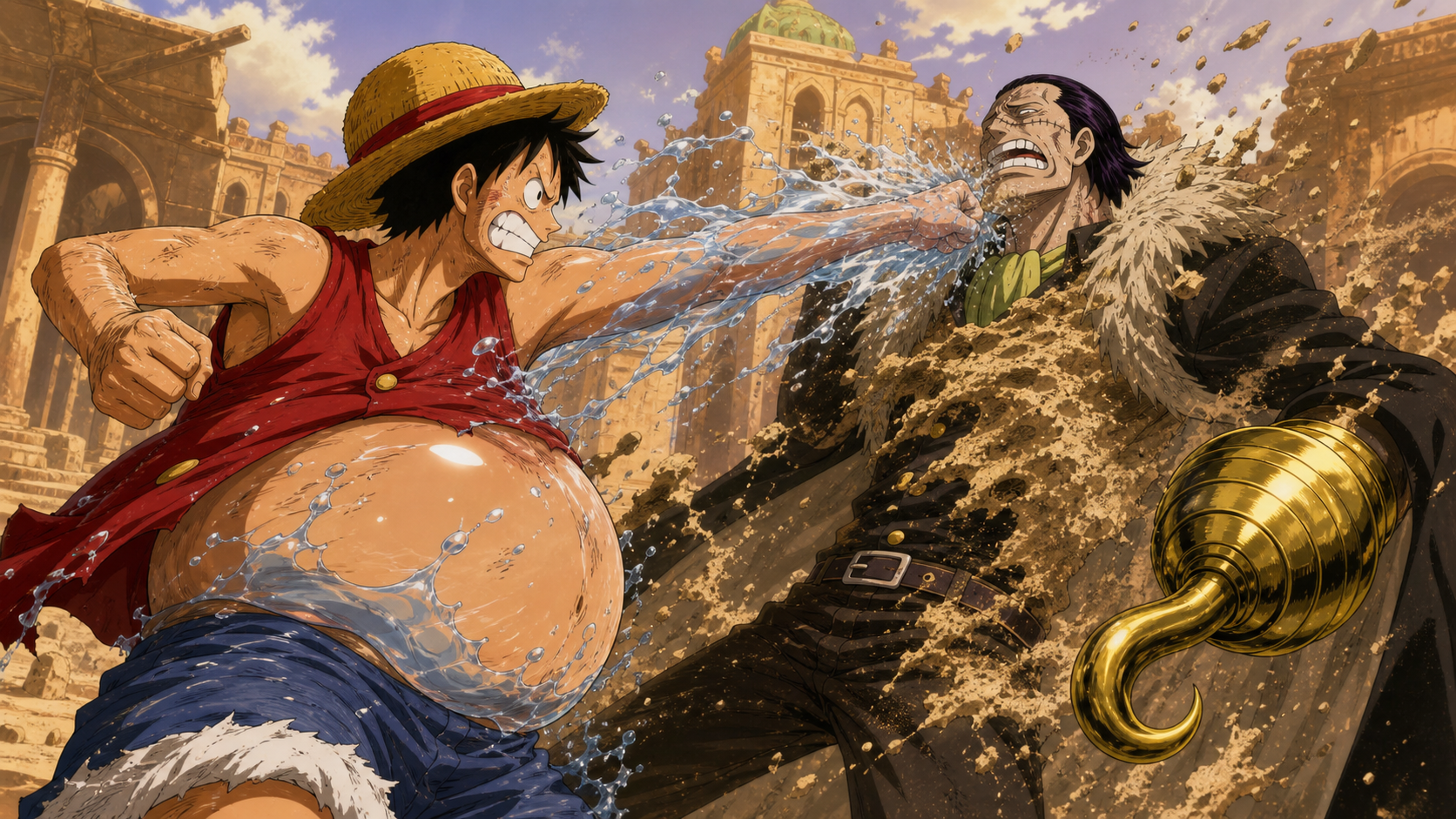
One Piece Episode 122 gives Luffy a water-based answer to Crocodile while Vivi’s team races to find the hidden cannon.
Quick reaction
One Piece Episode 122 gives Luffy a rematch, a barrel of water, and exactly enough confidence to turn a terrifying Logia problem into a deeply unserious science experiment. Crocodile can become sand, so Luffy brings the one substance that makes loose sand clump. The solution sounds obvious after somebody says the answer aloud. Finding that answer while a Warlord is trying to drain every drop from your body deserves more credit.
The palace team learns that a cannon will strike the plaza in ten minutes and splits up to search for the gunner. Beneath the city, Miss All Sunday forces Cobra to lead her toward Alabasta’s poneglyph while Tashigi arrives with Marines and correctly identifies the wanted pirate in front of her.
RaeRae’s bottom line: Water Luffy is hilarious, but the joke works because tactical learning finally gives Luffy a fair chance to hit Crocodile.
Ten minutes turns rescue into command work
Vivi tells Zoro, Nami, Usopp, Sanji, Chopper, and Pell that the cannon will fire on the palace plaza in ten minutes. The warning changes the shape of every remaining task. Nobody has time for a complete search, a long debate, or a perfect map.
The group needs sectors, elevation priorities, and a method for reporting cleared locations. Rooftops, towers, domes, walls, and any structure with a clean line toward the plaza deserve immediate attention. Rechecking the same roof while another tower remains untouched wastes the only resource nobody can replace.
Vivi also has to communicate the blast radius. Finding the weapon matters, but moving thousands of people away from the target may save lives if the search fails. Search and evacuation should happen together, even when the civil war makes coordinated movement almost impossible.
The crew separates without becoming disconnected
The Straw Hats have just reunited, yet the cannon threat requires another separation. This split feels different from earlier fragmentation because everyone now shares one objective, one deadline, and one source of information.
Good division of labor does not mean every person runs in a random direction. Pell can search from the air. Sanji and Zoro can cover difficult routes quickly. Nami can reason about distance and sight lines. Chopper can identify people who need medical help while moving through the city. Usopp understands projectile placement and firing angles better than most fighters around him.
Vivi remains the mission lead because she knows Alubarna, the palace, and the political stakes. The crew supports her plan instead of treating local knowledge as optional background.
Pell has the best view and the hardest burden
Pell’s falcon form offers the widest search field, but altitude does not automatically produce certainty. Dust reduces visibility, buildings create blind spots, and the gunner may use camouflage or an enclosed firing position.
Aerial reconnaissance works best when the observer receives defined questions. Pell should look for unusual roof access, ammunition movement, disturbed stone, protected platforms, and lines aimed directly at the crowded plaza. A cannon large enough to cause the promised destruction needs space, support, and a firing corridor.
Pell also carries emotional pressure because Vivi’s warning concerns his country and the people he swore to protect. Duty can sharpen focus, but duty can also push a protector toward reckless choices. The search team needs his information as much as his courage.
Luffy built a rematch around evidence
Luffy did not return to Crocodile with a motivational speech and the same failed attack plan. He returned with water because his earlier encounter produced evidence. Crocodile’s sand body loses perfect dispersal when wet.
That observation turns the rematch from stubborn repetition into adaptation. Luffy still relies on speed, durability, and instinct, but those strengths now serve a specific countermeasure. Every splash creates a brief window where a punch can connect.
The lesson has limits. Water does not erase Crocodile’s experience, hook, poison, reach, or ability to dehydrate living bodies. A weakness creates access, not safety. Luffy must control the supply and protect the barrel while surviving long enough to use both.
Water Luffy makes tactical planning look ridiculous
Luffy stores a huge amount of water inside his body and becomes round enough to resemble a walking canteen. The visual gag arrives during a lethal confrontation, and the tonal collision feels completely natural for One Piece.
The comedy does not cancel the plan. His body can transport water without leaving the entire supply in one fragile container. A mouthful can become a projectile, a splash, or emergency hydration. The absurd shape makes the tactic visible before any explanation arrives.
Crocodile’s disgust also matters. He expects fear, grandeur, and recognition of his status. Luffy answers with a swollen stomach and practical experimentation. Mockery strips away some of the ceremony Crocodile uses to frame domination as inevitability.
The body gag still carries physical risk
Carrying too much water can restrict movement, disrupt balance, and make impact harder to absorb. Luffy treats his rubber body as storage, but unusual capacity does not remove tactical cost.
The plan also depends on keeping the water clean enough to use and preventing Crocodile from draining the supply through contact or sand. Funny does not mean consequence-free.
Crocodile turns the first splash into sand
Luffy drenches Crocodile, expecting the water to settle the problem. Crocodile converts the attack into sand before the tactic can hold him. The response proves that knowing a weakness and applying a weakness are separate skills.
Luffy needs timing. Water must reach Crocodile at the same moment an attack lands or before Crocodile can disperse and reshape. Throwing a large volume from a predictable angle gives an experienced opponent time to counter.
Crocodile’s defense also reveals control. His fruit does more than make his body intangible. He manipulates surrounding moisture, sand, and terrain fast enough to neutralize resources. The rematch becomes a contest over sequence rather than raw volume.
A wet fist finally makes contact
When Luffy coats his attack with water, Crocodile can no longer let the strike pass harmlessly through dispersed sand. The impact lands, and the entire power relationship changes for one second.
Physical contact matters beyond damage. Crocodile has built his authority around untouchability. Citizens cannot expose him, soldiers cannot reach him, and most fighters cannot hit him. One wet punch proves that his protection has conditions.
Luffy still needs repetition without becoming predictable. He must ration water, vary angles, and avoid letting triumph after the first hit become an opening for the hook. Discovery earns a chance. Discipline decides whether that chance survives.
The rematch is a verification problem
Luffy tests a hypothesis under pressure: moisture makes Crocodile tangible. Each successful strike should confirm what amount, timing, and coverage work. Each failure should narrow the next attempt rather than trigger blind frustration.
This is field science with terrible safety controls. The independent variable is water placement. The outcome is whether Crocodile’s body receives force instead of dispersing. The confounding variable is a furious pirate trying to kill the researcher.
RaeRae respects the methodology while requesting a laboratory without poison hooks, collapsing ruins, or national emergencies.
Crocodile still controls the battlefield
One landed blow does not make Luffy the favorite. Crocodile understands the palace terrain, knows the cannon deadline, and has agents carrying out parallel parts of his plan.
He can attack from range, create blades and storms from sand, drain moisture through contact, and force Luffy to protect both body and water supply. Luffy needs to close distance without offering an easy grip.
Crocodile also has no reason to fight fairly. Delaying Luffy may be enough because the cannon and civil war continue without direct supervision. The clock rewards the villain even when the duel pauses.
Miss All Sunday moves beneath the visible war
While armies fight above, Miss All Sunday takes Cobra toward the poneglyph. Her objective sits underneath the conflict, both geographically and politically.
Crocodile wants Pluton, but Robin wants access to historical writing that almost nobody can read. Their alliance overlaps without becoming identical. Cobra understands that leading her to the text may expose knowledge protected by the royal family.
Coercion shapes every step. A captive guide cannot provide meaningful consent, and the presence of buried history does not justify violence against the person responsible for guarding the site.
Cobra faces an archival security crisis
Cobra carries knowledge about the royal tomb, its routes, and the poneglyph’s location. Under normal conditions, restricting that access protects the kingdom. Under threat, the same secrecy concentrates risk in one person.
A secure archive needs layered safeguards: limited route knowledge, physical barriers, independent witnesses, and procedures for coercion. Alabasta’s system appears to depend heavily on royal custody, leaving Cobra with an impossible choice when enemies control his movement.
The episode treats historical knowledge as power because access can reshape military ambition. Records are not passive stones when governments and pirates believe those records point toward weapons.
Robin’s goal remains distinct from Crocodile’s
Robin cooperates with Baroque Works, yet her attention stays fixed on the poneglyph and the history written there. Crocodile wants a weapon. Robin wants an answer.
Different motives do not erase participation in harm. She has helped an organization destabilize Alabasta, and intellectual curiosity cannot clean that record. At the same time, understanding her motive prevents a shallow reading where every member of the organization wants the same prize.
The distinction creates tension because Robin may withhold, reinterpret, or reject information that serves Crocodile. An alliance built on concealed priorities carries a fracture inside the contract.
Tashigi arrives with legal authority and incomplete context
Tashigi sees Miss All Sunday and tells the Marines that Robin is a wanted pirate. The identification is accurate, but the surrounding situation exceeds a simple arrest encounter.
Cobra is under coercion, the city is collapsing into civil war, a cannon threatens the plaza, and Crocodile’s organization has infiltrated public institutions. Marines entering that environment need to distinguish immediate threats, protect the captive, preserve evidence, and avoid blocking rescue routes.
Tashigi’s strength is her refusal to ignore a recognized suspect. Her challenge is converting recognition into action that helps Alabasta instead of merely satisfying a warrant.
The Marines need a civilian-protection priority
Arrest authority should not outrank an imminent mass-casualty threat. The cannon deadline and the crowded plaza require urgent coordination with local defenders, even if jurisdiction feels messy.
Marines can provide search teams, perimeter control, medical support, and secure communication. They can also document Baroque Works infiltration and prevent suspects from disappearing in the dust.
Protecting civilians does not mean abandoning accountability. The strongest response preserves life first, evidence second, and custody as soon as both can happen safely.
Three crises now compete for attention
Episode 122 runs three operations at once. Luffy fights Crocodile. Vivi’s allies search for the cannon. Cobra is forced toward the poneglyph while Tashigi closes in.
Every operation affects the others. Defeating Crocodile may disrupt command but will not automatically stop a timed weapon. Finding the cannon may save the plaza but will not protect the historical site. Arresting Robin may interrupt the tomb mission but will not end the civil war.
No single heroic victory can replace coordination across all three fronts. The structure keeps the episode tense because progress in one location does not pause danger elsewhere.
Production choices balance comedy and threat
Michiru Shimada’s script places the Water Luffy gag beside a countdown, a coerced king, and a buried historical secret without losing the stakes.
Kenji Yokoyama and Junichi Fujise direct the rematch around clear cause and effect: water is prepared, Crocodile counters, Luffy adjusts, and a wet strike connects.
Takeo Ide’s animation direction gives the swollen body gag readable weight while keeping punches, sand movement, and Crocodile’s reactions sharp. Miyuki Sato and Toshiaki Marumori connect palace ruins, desert air, and underground routes as parts of one besieged capital.
What Episode 122 changes
Vivi’s group begins a ten-minute search for the hidden cannon aimed at the palace plaza.
Luffy uses water to challenge Crocodile’s sand intangibility and lands a meaningful hit during their second duel.
Miss All Sunday forces Cobra toward the poneglyph while Tashigi identifies Robin as a wanted pirate to the Marines.
The Alabasta crisis divides into a duel, a bomb search, and a struggle over buried history.
Episode details
Japanese title: 砂ワニと水ルフィ!決闘第2ラウンド
English title: Sand Crocodile and Water Luffy! The Second Round of the Duel
Japanese broadcast: August 18, 2002
Saga: Alabasta
Material: Manga-canon adaptation
Script: Michiru Shimada
Episode direction: Kenji Yokoyama and Junichi Fujise
Animation direction: Takeo Ide
Art: Miyuki Sato and Toshiaki Marumori
The official One Piece guide confirms Vivi warning the group about the ten-minute cannon deadline, Luffy using water against Crocodile, Crocodile turning a large splash into sand, Miss All Sunday forcing Cobra toward the poneglyph, and Tashigi identifying Robin to the Marines. The emergency planning, archival security, legal response, bodily risk, labor, verification, and accountability analysis is RaeRae’s reading of those events.
Final verdict
Episode 122 earns a 9.5 out of 10. Water Luffy delivers one of the saga’s best combinations of comedy and tactical payoff because the ridiculous visual solves a real combat problem.
Luffy learns from defeat, returns with evidence, and changes his method. The crew accepts Vivi’s deadline and divides the search according to available strengths. Robin and Cobra move toward a historical truth that Crocodile wants to turn into military power.
The episode never lets one clever punch become a complete answer. A cannon still points at the plaza. Two armies still fight. A king remains captive. Marines have arrived with law but not yet with the full picture. Luffy has found a way to touch Crocodile. Everyone else now has ten minutes to touch the systems Crocodile built around him.