
The Divine Tree
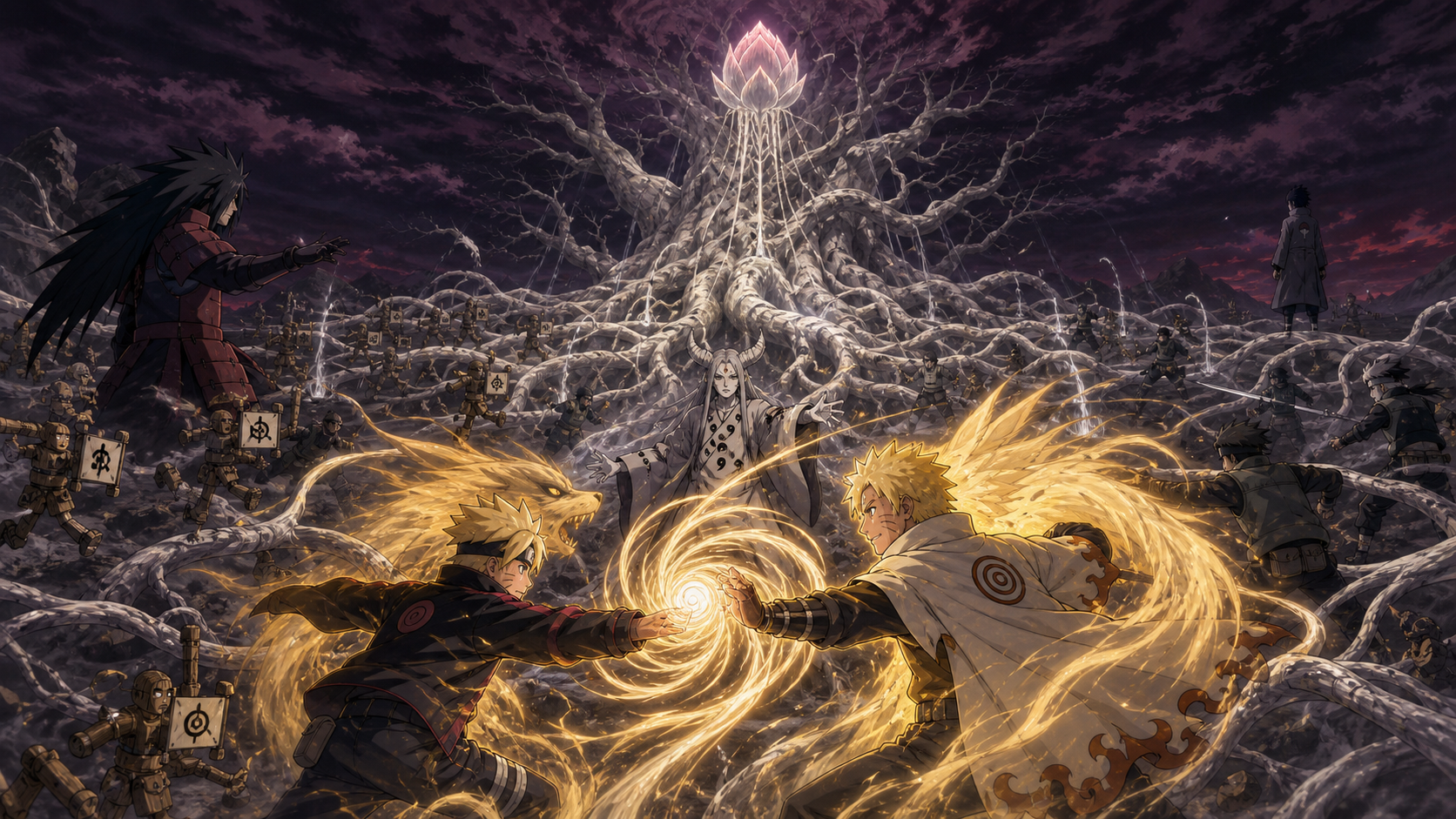
Father and son finally fight together while the Divine Tree strips the word sacred from a system designed to drain every living person into one ruler’s dream.
Bottom line
“The Divine Tree” turns the world’s oldest sacred story into a mass extraction system. Naruto and Minato link their Kurama halves and finally fight as father and son. Their shared form gives Naruto support without replacing the people who raised him. Hashirama sends wood clones across the alliance with a plan, while Madara refuses to pause his private duel long enough to help stop Obito. Then the Ten-Tails changes again. Obito summons the Divine Tree, and its roots hunt living shinobi, drain their chakra, and leave bodies behind. Madara explains that the tree once bore the chakra fruit and that the Infinite Tsukuyomi will bloom through the flower above them. The name “divine” does not make the process holy. The tree treats every person as stored energy for one ruler’s dream.
Minato’s Kurama half speaks to him
The chakra sealed inside Minato is not merely reserve power waiting for a command. This half of Kurama observes Minato’s guilt and pushes him to act beside Naruto.
The tailed beast becomes a participant in the father-son connection.
Minato has been watching Naruto lead
He sees his son share chakra, identify senjutsu as Obito’s weakness, protect the alliance, and refuse psychological surrender. Naruto is no longer the infant from the sealing night.
Fatherhood has to meet the person who grew in his absence.
Pride cannot claim sole credit
Minato gave Naruto life and made consequential sealing choices. Iruka, Team 7, Jiraiya, Tsunade, Killer Bee, Kurama, and many others helped Naruto survive and mature.
The child’s community deserves recognition alongside lineage.
Naruto refuses to spend the battle on apology
He tells Minato that Kushina’s chakra imprint already conveyed their feelings and history. The answer keeps Naruto focused on people still in immediate danger.
Deferral under fire does not equal a full family reckoning.
Kushina remains present in the relationship
Naruto’s knowledge of his birth and sealing came through his mother as well as his father. Her testimony prevents Minato from becoming the only narrator of that night.
The family story requires her voice.
Minato can participate in Naruto’s present without replacing the mother whose account helped Naruto understand the past. Their brief battlefield partnership becomes healthier when lineage is treated as one relationship among many, not a late claim of ownership over the adult Naruto became.
Minato enters Tailed Beast Mode
His half of Kurama provides a chakra form comparable to Naruto’s. The transformation gives him speed, reach, and power suited to Obito’s new scale.
The form also proves that cooperation with Kurama is not exclusive to one host.
Two halves create tactical compatibility
Naruto and Minato can coordinate chakra arms, movement, and attacks through related energy. Their connection allows rapid understanding during a fight with little room for explanation.
Shared power becomes a communication channel.
Father and son attack together
The image delivers a family moment through work rather than a pause for sentiment. They protect the alliance side by side after years of separation.
The satisfaction comes with the knowledge that ordinary days together remain impossible.
Tobirama remains part of the combination
Flying Raijin marks and positioning still create access against Obito. The father-son image does not eliminate the Second Hokage’s analytical and spatial support.
Emotional focus should not erase technical collaborators.
Obito defends against the linked assault
He shapes chakra arms and black material to block or redirect pressure. Senjutsu can damage him, but landing enough natural-energy force remains difficult.
A vulnerability is useful only when delivery survives adaptation.
The alliance needs a plan beyond the front four
Naruto, Minato, Tobirama, and Sasuke cannot sustain the entire battle while thousands wait. Every unit needs a role suited to the new information.
Distributed action reduces the cost of one missed attack.
Hashirama cannot leave Madara freely
His original body remains occupied by the reanimated rival who wants their private contest. The wider war needs Hashirama’s knowledge even while Madara refuses cooperation.
One man’s obsession traps strategic capacity.
Wood clones carry Hashirama’s message
He sends copies across the field to explain the plan directly to different units. The method spreads leadership without forcing everyone through one damaged command center.
Decentralized communication keeps the alliance moving.
A clone can deliver intent, not local judgment
Hashirama provides objectives and key information. Fighters still need to adapt the plan to terrain, injuries, and Obito’s responses.
Distributed authority works when local people can think.
Madara refuses a temporary truce
Hashirama asks him to help address the Ten-Tails host before resuming their fight. Madara prioritizes his own plan and desired confrontation.
Private rivalry becomes public obstruction.
Madara treats the war as a stage
Thousands of lives matter to him mainly as conditions around the Infinite Tsukuyomi and his contest with Hashirama. He has already reduced the world to an audience for a solution he chose.
Power without reciprocal stake makes empathy optional.
Obito changes the battlefield again
The Ten-Tails host calls forth a massive tree whose roots spread across the ground. The threat no longer stays concentrated inside his body.
Control expands into the environment.
The roots hunt living chakra
They move toward shinobi, wrap bodies, and drain energy rapidly. Fighters become targets because they are alive and contain chakra.
The attack makes existence itself the selection criterion.
Chakra extraction becomes visible at scale
Akatsuki extracted tailed beasts from individual jinchūriki in controlled locations. The Divine Tree performs a related theft across a battlefield with no ritual distance.
Mass automation makes the old violence faster.
Drained bodies restore the human cost
The roots leave people collapsed while the tree grows. No abstract explanation about world peace can hide the exchange.
Obito’s dream is fertilized by lives he refuses to ask.
Medics face an unfamiliar emergency
Physical wounds may not be the only problem when chakra is removed almost completely. Medical teams need to distinguish depletion, organ failure, root trauma, and ongoing contact.
Care begins with freeing patients from the extraction system.
Katsuyu’s network becomes a warning system
Her divided bodies can relay root movement, casualty locations, and requests for help across scattered units. Communication may save people before treatment becomes possible.
Medical infrastructure also carries intelligence.
Fighters must protect one another from the ground
The roots create attacks from below and across familiar paths. Units need lookout patterns, cutting teams, evacuation routes, and constant movement.
Individual speed cannot protect everyone at once.
The tree’s sacred name creates moral danger
Calling a weapon divine can discourage ordinary judgment. Religious or mythic language may make coercion sound inevitable, ancient, or beyond politics.
The bodies under the roots remain the clearest evidence.
Madara explains the chakra fruit history
The tree once absorbed energy and produced a fruit associated with extraordinary power. Human chakra history is tied to someone taking what the tree concentrated.
Origin stories can explain a system without granting rightful ownership.
The world is treated as a reservoir
Obito and Madara view people, tailed beasts, and natural energy as inputs for the Infinite Tsukuyomi. Individual lives become temporary storage before central collection.
Extraction is the economic model beneath the dream.
The flower creates a deadline
Once the tree blooms and reflects the eye upon the moon, the Infinite Tsukuyomi can trap the world. The alliance now faces both immediate root casualties and a timed global threat.
Strategy must protect people while interrupting the larger mechanism.
A countdown can produce bad sacrifice logic
Leaders may be tempted to treat current casualties as acceptable if an attack reaches the flower faster. People in the roots are not disposable delays.
Urgency requires triage and rescue alongside offense.
Obito presents extraction as peace
He claims the dream will end suffering by replacing reality. The tree reveals the coercion required before anyone receives that supposed comfort.
Peace that begins by emptying bodies is conquest.
Consent remains the missing foundation
No alliance member, civilian, tailed beast, or child agreed to surrender chakra and consciousness for Obito’s preferred world. The plan assumes one traumatized man can decide for everyone.
Beautiful outcomes cannot repair absent consent.
Naruto’s chakra network offers the opposite model
Naruto and Kurama shared power with allies to increase their ability to act. The Divine Tree takes power to remove their ability to resist.
One network distributes agency. The other centralizes agency.
Minato’s transportation also depended on connection
The mass rescue worked because linked chakra let many people move together. No recipient had to disappear into Naruto’s mind or surrender future choice.
Coordination can preserve individuality.
Obito copies relationship without reciprocity
The roots connect bodies to one central organism, but the flow travels in one direction. Victims provide energy and receive no voice.
Connection without mutuality is capture.
Madara’s information deserves scrutiny
He understands the tablet, the tree, and the plan through sources shaped by hidden access and manipulation. His confidence does not prove the history is complete.
Secret knowledge should be treated as interested evidence.
Hashirama hears a corruption of his dream
He wanted a village where children could live. Madara now supports a tree that consumes living people to create compulsory peace.
Their shared wish has split over whether people retain the right to choose reality.
The alliance sees friends disappear quickly
Root attacks turn nearby comrades into casualties before long speeches or heroic rescues can arrive. The speed creates fear and survivor guilt.
Units need permission to retreat, cut contact, and prioritize reachable people.
Naruto cannot extend himself everywhere
His chakra has protected thousands before, but the tree drains at a scale designed to exploit the whole battlefield. Trying to personally rescue every person could collapse the network.
Leadership requires choosing scalable actions without pretending every loss is controllable.
Sasuke watches the institution-sized problem
His Hokage ambition now faces a crisis no single officeholder can solve. Protecting Konoha means coordinating medics, sensors, clans, summons, tailed beasts, and other villages.
Authority is less important than building systems that let people act.
The title challenges easy spirituality
Trees can symbolize life, ancestry, and connection. This tree feeds by stripping life and connection from others.
Symbolic beauty should not override material behavior.
Survival now requires two simultaneous campaigns
Attack teams must stop Obito and prevent the flower from reaching the moon. Rescue teams must cut roots, recover drained shinobi, maintain medical routes, and keep panic from scattering the alliance into easier targets.
Treating rescue as a distraction from victory would hand the Divine Tree the very lives the alliance exists to defend.
The Divine Tree exposes the dream’s business model
Madara has spent years selling the Infinite Tsukuyomi as relief from grief, conflict, and disappointment. The roots finally show the invoice. Every promised private paradise depends on extracting chakra from people who never agreed to become raw material.
That matters because villains love discussing outcomes while hiding the labor and bodies required to produce them. Once the mechanism is visible, the sales pitch collapses. This is not mercy with unfortunate side effects. The theft is the operating system.
Kurama’s two halves are not matching batteries
Minato and Naruto can coordinate because both Kurama halves think, observe, and decide. Reducing them to compatible chakra supplies repeats the same objectification that created the jinchūriki system in the first place.
Father and son look magnificent together, yes. The moment becomes better when we also recognize two tailed-beast selves choosing cooperation inside a war built from generations of human entitlement to their bodies.
Minato’s pride needs room for the missing years
Watching Naruto lead gives Minato a glimpse of the person his son became, but admiration cannot replace knowledge. He does not know every lonely apartment evening, humiliating classroom moment, reckless joke, hard lesson, or ordinary friendship that made this teenager.
The reunion works because Minato follows Naruto’s lead instead of demanding instant emotional access. Love is present. So is the enormous blank space created by death, secrecy, and a village that failed its orphan.
Naruto keeps Kushina in the room
When Naruto tells Minato that Kushina already conveyed their story, he protects her place as a witness. Minato does not get to become the sole authority on a night carried in Kushina’s body and paid for with her life.
That small correction keeps the father-son scene from swallowing the mother. Naruto’s understanding belongs to both parents, Kurama’s memory, and his own judgment about what their choices meant for him.
Hashirama treats information like shared infrastructure
His wood clones do more than repeat orders. They move knowledge past damaged command routes and place it near the people who must act. The structure acknowledges that one voice cannot reach an alliance spread across a collapsing battlefield.
Good leadership is not hoarding the answer until everyone looks toward the founder. It is getting usable information into many hands quickly enough for local judgment to matter.
The roots turn surveillance into physical capture
They search the field for chakra, identify living targets, and close around bodies faster than most victims can understand the threat. The system does not need to know anyone’s name, history, or consent. It only needs to detect something valuable.
That impersonality makes the violence more frightening, not less. No individual hatred is required when extraction has been automated.
Medical care cannot begin after the fighting ends
Katsuyu, medics, sensors, and mobile teams need to function while roots are still moving. Waiting for the heroes to defeat Obito would abandon people whose chakra is disappearing in seconds.
The episode makes rescue part of strategy. Cutting a root, marking a safe corridor, relaying a casualty, and protecting a healer are war-changing actions even when none produces the final blow.
The alliance needs permission to survive imperfectly
A shinobi culture trained to glorify holding position can turn a root attack into mass suicide. Retreating three steps, abandoning equipment, calling for help, or choosing a reachable comrade over an impossible rescue should not be treated as cowardice.
Obito benefits whenever people confuse sacrifice with worth. The alliance needs discipline, but it also needs leaders who refuse to spend bodies merely to preserve an image of bravery.
Naruto’s network and Obito’s network are moral opposites
Both move chakra across many bodies, which makes the comparison unavoidable. Naruto and Kurama give power outward so allies can keep acting. Obito takes power inward until victims cannot act at all.
A network is not automatically communal because it connects people. Direction, consent, control, and the ability to leave determine whether connection becomes solidarity or captivity.
Sasuke’s Hokage claim meets its real test
The Divine Tree cannot be defeated by a title, a bloodline, or one spectacular technique. The crisis demands medical logistics, sensor intelligence, evacuation, coordinated offense, and trust across villages that recently treated one another as enemies.
If Sasuke wants authority, this is the scale of responsibility attached to it. Protecting Konoha means valuing systems and people he cannot personally command into safety.
The flower’s countdown does not cancel the casualties
The approaching bloom creates a global deadline, but urgency can become an excuse to ignore whoever is already trapped. A victory that saves an abstract future while knowingly discarding reachable people repeats the enemy’s arithmetic.
Stopping the Infinite Tsukuyomi and rescuing the drained are not rival missions. They are the same defense of human agency operating at different distances.
The episode refuses a clean father-son celebration
Naruto and Minato finally share power in battle, and the image earns its emotional charge. Then the ground opens into mass death. The story will not allow private fulfillment to seal the family inside a sentimental bubble.
Their bond matters because they use it for other people. A reunion becomes leadership when its energy travels outward instead of asking the battlefield to pause and admire it.
Peace cannot require unconsciousness
Obito insists that a dream world will end pain, but a person prevented from choosing, changing, refusing, or waking is not at peace. They have been removed from public life and placed inside somebody else’s solution.
Real peace is noisy because living people disagree. It needs repair, boundaries, care, accountability, and institutions capable of surviving conflict without erasing the participants.
RaeRae’s verdict
“The Divine Tree” makes the Infinite Tsukuyomi’s price impossible to romanticize. Obito does not open a gentle doorway into chosen dreams. He grows a system that hunts bodies, steals chakra, and turns human life into fuel for a flower meant to remove everyone’s agency. The sacred name only makes the violence more revealing.
Naruto and Minato offer a direct counterexample before the roots rise. Their Kurama halves connect, Tobirama supports their positioning, Hashirama distributes a plan through clones, and the alliance retains local judgment. That network adds capacity without swallowing identity. The Divine Tree also connects everyone, but only so power can flow toward one imposed reality. Same language of unity, completely different ethics.
RaeRae’s call
The Divine Tree is not sacred because Madara knows its mythology. It is an extraction machine that turns living people into fuel for a compulsory dream. Naruto, Minato, both Kurama halves, Tobirama, Hashirama, medics, and the alliance answer with a different kind of connection: power shared outward, information distributed, and people left able to choose. That is the line. Cooperation expands agency. Obito’s peace consumes it.
Episode details and viewing routes
- Official episode reference: Naruto Official episode guide
- Licensed episode route: Crunchyroll licensed episode page
What I am carrying forward
Minato’s half of Kurama helped him enter Tailed Beast Mode and fight beside Naruto. Hashirama distributed a coordinated plan through wood clones while Madara refused a temporary truce.
Obito summoned the Divine Tree, whose roots began hunting shinobi and draining their chakra. Madara explained the chakra-fruit history and the flower’s role in casting the Infinite Tsukuyomi. Episode 382 follows the alliance responding to mass extraction and the deadline created by the tree’s approaching bloom.