
RaeRae Reacts · One Piece Episode 121
A Hero Descends
One Piece Episode 121 brings Luffy back on Pell to rescue Vivi while Baroque Works infiltrators restart the civil war under dust cover.
Quick reaction
One Piece Episode 121 refuses to let one white flag fix a war designed to restart itself. Koza lies wounded and still forces out the order not to fight. A sudden dust whirlwind removes visibility. Baroque Works infiltrators embedded on both sides fire at one another, and every shot looks like proof that the enemy broke the ceasefire.
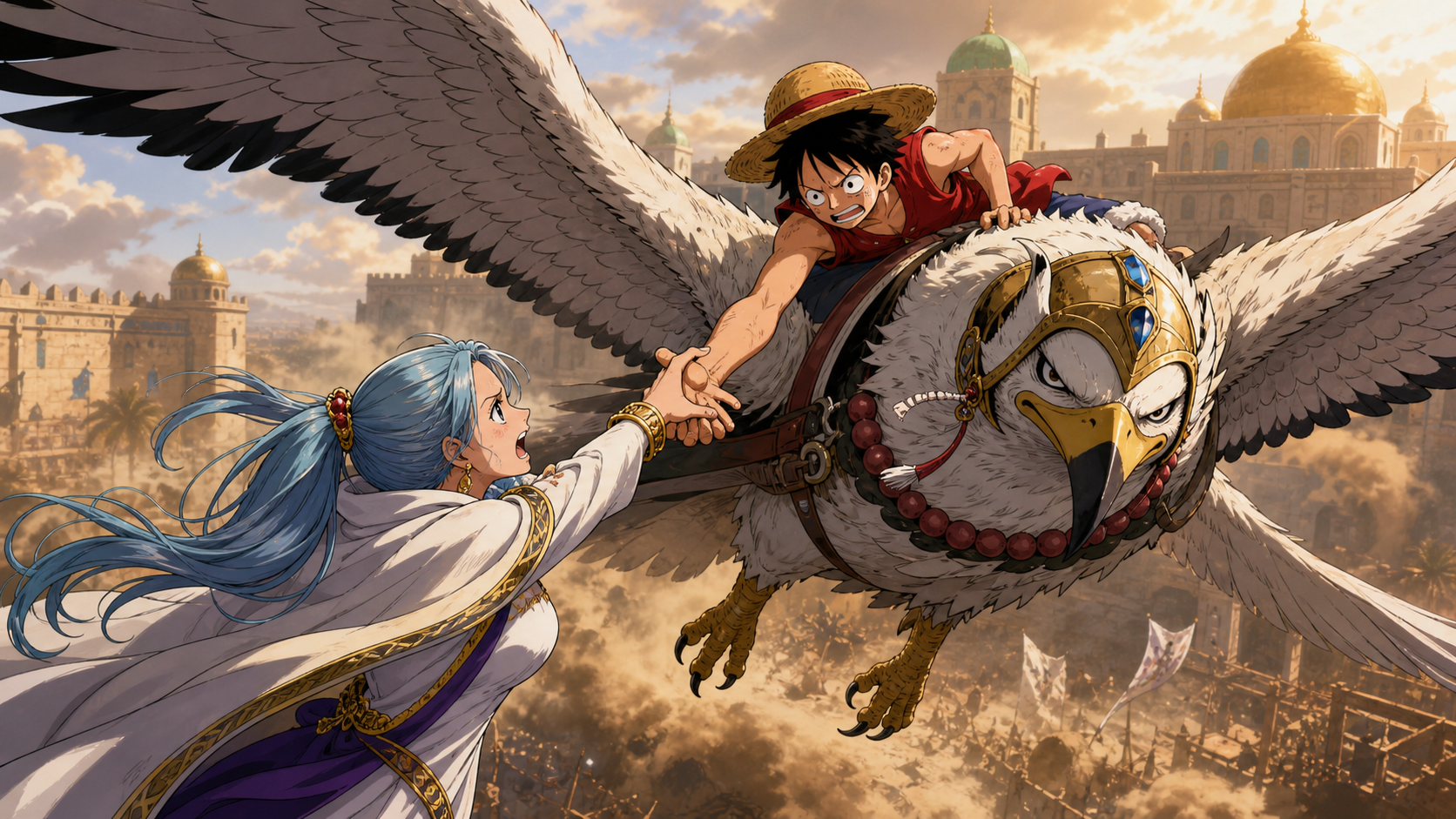
Vivi keeps trying to reach the crowd. Crocodile throws her from the palace. Luffy arrives on Pell, catches her, and lands where the Straw Hats reunite.
RaeRae’s bottom line: the rescue matters because Luffy returns Vivi to the work, not because he replaces her.
Koza keeps leading after the shot
Koza’s wound attacks both his body and his ability to communicate. He still tells the rebels not to fight.
The effort confirms that the ceasefire was genuine and that the royal uniform of the shooter did not change his conclusion.
His voice may not travel far, but nearby witnesses can repeat the message.
Medical care remains urgent because leadership does not make blood loss optional.
People close to Koza need to separate two responsibilities that can happen together. One person should apply pressure and monitor breathing while another repeats his words to rebel officers. Moving him without coordination could worsen the wound, yet leaving him exposed makes another attack easier. The message should survive even if his voice cannot. Witnesses can confirm the exact order and prevent later agents from inventing a different final statement.
The dust whirlwind destroys shared visibility
A dust whirlwind turns the plaza into an information vacuum. Fighters cannot see flags, leaders, uniforms, or the origin of gunfire clearly.
Low visibility increases fear and shortens the time available to verify movement.
Anyone firing inside the dust can create sound and muzzle flashes without providing a reliable target identity.
Baroque Works uses the environment to make disciplined restraint feel unsafe.
Dust also erases the visual evidence created in Episode 120. Raised white flags, lowered rifles, Vivi’s gestures, and Koza’s central position no longer anchor interpretation. The crowd falls back on sound, memory, and fear. Crocodile’s organization does not need to control every fighter. The organization only needs enough hidden shooters to make thousands believe restraint has become suicidal.
Infiltrators manufacture mutual betrayal
Agents embedded in both armies shoot at one another, creating apparent violations from both sides.
The tactic removes the possibility that one group can simply point to the other as the sole aggressor.
Each army receives immediate sensory evidence that looks more trustworthy than Koza’s distant explanation.
Crocodile’s plan makes retaliation feel like self-defense even though the first shots belong to his organization.
This is why identifying the “first shot” may not be enough after a complex battle resumes. Infiltrators can stage sequences from several positions, and frightened soldiers may respond before anyone records the order. Accountability needs a broader pattern: who benefited, who entered units without verifiable history, which weapons match recovered rounds, and which commands were transmitted before visibility failed.
A ceasefire needs authenticated communication
Flags and trusted leaders opened the pause, but dust and gunfire expose the weakness of single-channel signals.
Both armies need repeated visual, audible, and messenger-based confirmation that the stop order remains active.
Units should know which signal overrides local confusion and who can authenticate that signal.
Redundancy is not bureaucracy when sabotage is designed to remove one source at a time.
Signals also need a rhythm that cannot be easily copied by one infiltrator. Repeated horn patterns, flag positions, messenger phrases, and visible confirmation from several commanders could create stronger authentication. No method is perfect inside a compromised army, but layered verification raises the cost of deception. Crocodile’s plan thrives on isolated cues because isolated cues can be forged cheaply.
Vivi’s voice cannot overcome battlefield physics
Vivi knows the truth and has moral authority, but the plaza is loud, crowded, dusty, and full of weapons.
Her inability to be heard is not a failure of sincerity.
Communication requires amplification, position, repeated messengers, and people able to translate words into commands.
The episode refuses the fantasy that the correct speech automatically reaches everyone who needs the message.
Vivi’s persistence remains essential because failed delivery does not make the content wrong. She changes position, seeks allies, and continues communicating through whatever channel remains. Leadership here is not volume alone. Leadership means recognizing that the audience cannot receive the message and redesigning the route without blaming the audience for conditions Crocodile engineered.
Crocodile targets persistence
Vivi has survived capture, political isolation, failed warnings, and the collapse of the first ceasefire.
Crocodile throws her from the palace because she continues organizing after each plan fails.
The act is physical violence and an attempt to remove the person connecting evidence, legitimacy, and public care.
He does not need to win the argument if he can eliminate the speaker.
The attack also communicates contempt to everyone watching from the palace. Crocodile wants resistance to look futile and personal commitment to look childish beside his control of the battlefield. Vivi’s survival breaks that intended message. The rescue shows that he does not own every route, every body, or every relationship, even while his agents still control much of the plaza.
Throwing Vivi is gendered political violence
Crocodile treats Vivi’s body as disposable once coercion and mockery fail.
Her role as princess makes her a symbol, but symbolic status does not erase bodily danger.
Calling the moment a rescue scene without naming the attempted killing would soften his responsibility.
The story gives Vivi agency, and Crocodile responds by trying to remove that agency through force.
Fans can celebrate Luffy’s catch without reframing Vivi’s earlier work as waiting for a man to save her. She infiltrated Baroque Works, carried evidence home, challenged her father, negotiated with rebels, directed the white flags, and kept speaking after the first ceasefire failed. The fall interrupts that work. The rescue returns her to a mission she built through her own decisions.
Pell converts mobility into rescue capacity
Pell’s falcon form provides speed, altitude, and access that ground fighters cannot match.
His role is not decorative transportation. He positions Luffy where the rescue becomes possible.
Flight also carries risk through dust, damaged structures, unpredictable debris, and hostile fire.
Pell’s knowledge of Alubarna and commitment to Vivi turn mobility into coordinated protection.
Pell also has to judge approach speed, wing clearance, Luffy’s reach, Vivi’s falling trajectory, and the palace wall. A rescue at altitude is a timing problem where a small error can injure all three. The episode compresses that calculation into spectacle, but Pell’s contribution includes professional knowledge of flight rather than loyalty expressed through transport alone.
Luffy catches Vivi without taking her mission
Luffy prevents the fall, but he does not become the political voice of Alabasta.
Vivi still understands the armies, the conspiracy, the cannon threat, and the relationships needed to stop the war.
Rescue restores her ability to act rather than converting her into a passive reward.
The distinction matters because support should expand another person’s agency, not absorb the person’s work.
Luffy’s return changes morale and options
The crew believed Crocodile had defeated Luffy, while enemies used that apparent defeat to attack morale.
His visible return disproves a central claim and creates a fighter capable of challenging Crocodile again.
Hope becomes practical because his presence reallocates tasks. Others can search for the cannon and protect Vivi while Luffy confronts the Warlord.
Morale matters most when morale changes coordinated action.
Luffy’s survival may also help correct the psychological attack Miss Merry Christmas used against Usopp and Chopper. Baroque Works counted on news of his death spreading faster than verification. His arrival becomes visible counterevidence. The crew can now replace rumor with direct observation, but they still need to carry that correction to separated allies who cannot see the landing.
The Straw Hats reunite as a working team
The crew gathers after separate battles that left nearly everyone wounded or exhausted.
Reunion does not erase those injuries, but shared information can now move faster.
They need status reports, task assignments, medical triage, and the remaining cannon deadline.
The image of unity becomes meaningful when unity produces a plan.
Reunion also creates a danger of crowding every decision around Luffy. He should receive the Crocodile task because his abilities and determination fit that confrontation, not because captain status makes every problem his. Nami, Usopp, Chopper, Sanji, Zoro, Pell, Vivi, and local allies possess information and access he lacks. Effective regrouping keeps those competencies active instead of turning the crew into spectators.
Heroes do not arrive alone
The episode title calls attention to a hero descending, but Luffy arrives because Pell carries him and Vivi keeps resisting.
Koza’s message, the crew’s earlier victories, and royal soldiers raising flags all prepare the moment.
Heroic framing can focus attention without erasing the network that makes intervention possible.
RaeRae is keeping the receipts attached to the spectacle.
The plaza remains inside the cannon target
Luffy’s return and Vivi’s rescue do not stop the scheduled shell.
Renewed fighting keeps both armies concentrated in the blast zone.
Search teams must continue checking rooftops, towers, and long firing lines while the crew regroups.
The episode’s hope sits beside a deadline that does not care who made a dramatic entrance.
Dust complicates medical and evacuation work
Low visibility makes finding wounded people harder and increases collision, trampling, and mistaken-identity risk.
Dust exposure can affect breathing, eyes, and open wounds.
Medics need visible markers, protected lanes, and escorts trusted by both armies.
Evacuation orders must account for people who cannot hear, see, or move quickly through the crowd.
Crocodile’s plan depends on interpretive speed
His agents fire because crowds interpret violence faster than investigators can explain violence.
A single apparent betrayal can reactivate years of grievance in seconds.
Countering that advantage requires pre-agreed rules: hold fire, seek multiple witnesses, and preserve evidence before assigning blame.
Slower judgment can become a survival skill when enemies profit from instant certainty.
Production choices stage a genuine arrival
Junki Takegami’s script links Koza’s fading message, the dust cover, infiltrator fire, Vivi’s persistence, Crocodile’s attack, and Luffy’s return.
Harume Kosaka’s direction lets the rescue interrupt despair without pretending the wider crisis has ended.
Natsuko Maki’s animation direction gives Pell’s flight, Vivi’s fall, and Luffy’s reach clear momentum.
Miyuki Sato and Michiyo Kawasaki’s art keeps the palace height and dust-covered plaza connected in one threatened environment.
What Episode 121 changes
Koza continues telling both armies not to fight despite being wounded.
A dust whirlwind blocks visibility while Baroque Works infiltrators embedded on both sides restart the battle.
Crocodile throws Vivi from the palace, but Luffy arrives on Pell and catches her.
The Straw Hats regroup at the landing point while the cannon deadline and civil war continue.
Episode details
Japanese title: ビビの声の行方!英雄は舞い降りた!
English title: Where Vivi’s Voice Goes! A Hero Descends
Japanese broadcast: August 11, 2002
Saga: Alabasta
Material: Manga-canon adaptation
Script: Junki Takegami
Episode direction: Harume Kosaka
Animation direction: Natsuko Maki
Art: Miyuki Sato and Michiyo Kawasaki
The official One Piece guide confirms Koza continuing to call for peace, the dust whirlwind, infiltrators on both sides exchanging fire, Vivi refusing to quit, Crocodile throwing her from the palace, Luffy arriving on Pell to rescue her, and the Straw Hats regrouping. The gender, communication, rescue, labor, medical, verification, emergency-management, and accountability analysis is RaeRae’s reading of those events.
Final verdict
Episode 121 earns a 9.7 out of 10. Luffy’s arrival works because the story earns every second of relief.
Vivi has not failed because her voice cannot cross engineered chaos. The people around her need to build a system capable of carrying that voice.
Luffy catches her body. Pell makes the catch possible. The crew’s next responsibility is helping Vivi reach a kingdom that still cannot hear.
That means treating wounds, locating the cannon, clearing communication routes, and keeping infiltrators from owning the next sound the crowd hears. The rescue buys a new chance, not a clean slate. Episode 121 understands that hope feels enormous precisely because every underlying system remains damaged. Luffy has returned. Now the people around him must turn that return into time, access, and protection before Crocodile’s countdown reaches zero.