
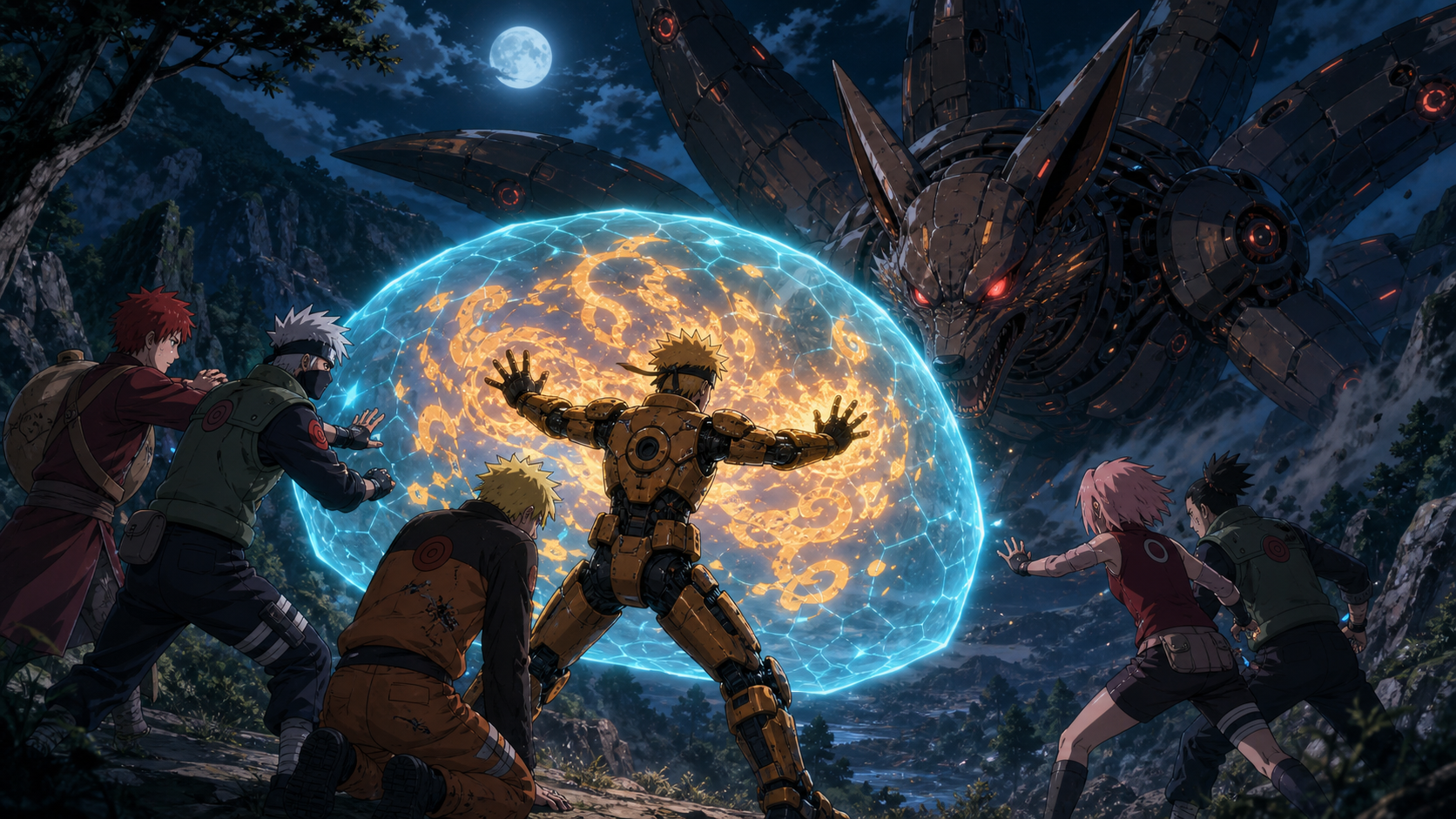
Naruto vs. Mecha-Naruto
A manufactured weapon finally acts beyond its directive, choosing protection over extraction even as the special makes sacrifice the proof of personhood.
Bottom line
“Naruto vs. Mecha-Naruto” finishes the anime-original special by throwing every toy in the box onto the screen, then finding a surprisingly sincere idea inside the machinery. Naruto’s escort tries to keep Akatsuki’s weapon away from him, Gaara enters the chase, Orochimaru reveals an even larger mechanical threat, and the special keeps escalating until common sense packs a bag and leaves. Mecha-Naruto continues draining Kurama’s chakra, but contact with Naruto and recovered memory disrupt the directive. The copy ultimately chooses protection over extraction and destroys Mecha-Kurama at the cost of his own body. The sacrifice gives the machine an independent moral action after two organizations treated him as property. That choice deserves feeling. The episode still sits terribly between war-arc cliffhangers, and death should not become the only proof that a created being earned personhood.
The escort carries Naruto away from Konoha
Tsunade’s plan uses the attacker’s focus to move danger beyond crowded streets. Naruto remains weakened after the first chakra drain and cannot simply outrun the machine.
Transport becomes part evacuation, part bait operation, and part medical necessity.
Naruto is a participant, not a package
The litter makes him physically dependent on teammates. A responsible plan still needs his understanding, consent, and ability to speak when conditions change.
Being targeted does not remove decision-making rights.
The escort distributes practical roles
Shikamaru plans, Kiba tracks, Neji observes, Choji carries force, Yamato manages chakra risk, and Kakashi provides reserve capacity. No single defender covers every failure mode.
The structure is smarter than sending one famous shinobi at a machine nobody understands.
Mecha-Naruto follows the directive precisely
The machine tracks Naruto rather than staying to destroy Konoha for pride. Predictable mission focus helps the escort control the route.
Programming creates tactical efficiency and tactical rigidity at once.
Defenders become obstacles in sequence
The special turns the pursuit into a string of matchups, giving familiar characters quick chances to delay the machine. The structure serves comedy and game-like escalation.
Every delay buys distance even when no defender wins outright.
Shikamaru tries to turn rigidity against the machine
An opponent committed to one target may ignore terrain, traps, and secondary movement. His planning looks for the rule beneath the spectacle.
Intelligence works by finding what the enemy cannot choose.
Mechanical strength breaks expected restraints
Shadow techniques and physical obstacles may slow a human body differently from a powered construction. Standard assumptions fail under unfamiliar torque, weight, and internal systems.
Failure should update the model rather than embarrass the strategist.
Kiba and Akamaru protect the route
Tracking provides warning while their combined attacks create space around Naruto’s transport. The partnership matters because Akamaru is not a prop attached to Kiba’s technique.
Two beings share sensory and combat labor.
Neji reads a body without familiar pathways
Byakugan observation can identify energy movement, weak points, and pursuit changes. A machine designed around chakra still refuses the ordinary anatomy that Gentle Fist expects.
Adaptation becomes more valuable than tradition performed perfectly.
Choji’s strength supports retreat
He uses physical scale to protect movement rather than chase a finishing blow. Holding a route open can matter more than defeating the pursuer personally.
Logistics deserves screen time even in a ridiculous special.
Yamato watches Naruto’s internal risk
Chakra extraction can destabilize the seal and the host. Yamato’s Wood Style gives the group a response if Kurama’s power surges unpredictably.
The external attacker and internal containment problem remain linked.
Kakashi cannot solve every escalation
His experience provides a safety layer, but the special keeps inventing functions and transformations faster than normal intelligence can settle. The absurdity is deliberate.
Competence does not require instant knowledge of a promotional robot.
Gaara enters as another jinchūriki
His presence carries more than surprise assistance. Gaara understands being targeted for a tailed beast, treated as military property, and feared by a village.
He has personal reason to oppose a machine built for extraction.
Sand defense changes the pursuit
Gaara can shield Naruto, reshape terrain, and restrain from range. His abilities add protection without requiring close contact with the draining mechanism.
The matchup addresses the problem rather than only adding fame.
The special uses cameos like power-ups
Characters arrive, deploy recognizable abilities, and pass the pursuit onward. The pattern resembles a game event more than a carefully placed serial chapter.
That energy can be fun once viewers accept the format.
Akatsuki involvement stays cartoonishly direct
The organization treats Mecha-Naruto as a shortcut to the Nine-Tails. Cloaks and commands place the machine inside familiar villain branding.
The special favors immediate recognition over subtle operational logic.
Deidara adds spectacle to the chase
Explosive interference changes movement and pushes defenders toward another crisis. His delight in visible destruction fits a story already operating at toy-box volume.
Collateral danger remains real inside the joke.
Orochimaru returns to claim the experiment
The creator’s appearance complicates Akatsuki control and reveals that the machine has remained part of his interest. Multiple villains treat the same constructed body as transferable technology.
Nobody asks what Mecha-Naruto wants.
Jiraiya’s appearance sharpens the parody
His presence brings the old Sannin rivalry into a special already crowded with callbacks. The encounter is less about continuity consequence than recognizable character chemistry.
The episode knows exactly how shameless the reunion is.
Mecha-Kurama raises the absurdity ceiling
Orochimaru unveils a mechanical version of the Nine-Tails, expanding the copy premise from Naruto to the being sealed inside him. The scale jumps from pursuit to giant-machine confrontation.
Subtlety was never invited.
The second copy repeats the same ethical problem
Kurama’s image becomes a weapon without Kurama’s mind, history, or consent. Mechanical replication turns a living being into a shape and an attack profile.
The parody accidentally exposes how often villages did the same conceptual reduction.
Naruto becomes a pilot and power source
The special plays with mecha conventions by placing him inside a machine-shaped battle structure. His chakra and body become part of the apparatus.
The joke works because Naruto usually serves as a human container already.
Mecha-Naruto keeps draining him
The programmed mission remains active even as circumstances grow stranger. Naruto weakens while the copy gains access to the power he was sent to seize.
Extraction makes one body strong through another body’s loss.
Contact creates information beyond programming
Naruto’s presence, chakra, and refusal force the machine to encounter a living person rather than an abstract target. The original does not behave like cargo.
Relationship begins when the directive stops explaining everything in front of Mecha-Naruto.
Recovered memory complicates identity
Fragments connected to creation and prior control give the machine context for why he exists and how others used him. Memory creates a past that programming tried to flatten.
Self-understanding begins with recognizing imposed purpose.
A copy does not need to become the original
Mecha-Naruto can resemble Naruto, learn from contact, and still develop a separate decision. Personhood does not require perfect imitation of the human model.
Difference should survive the awakening.
Naruto recognizes the possibility of choice
He has spent his life fighting labels assigned at birth: monster, failure, jinchūriki, weapon. Seeing a constructed double resist assigned function fits his deepest moral instinct.
Nobody should be only what a system built them to do.
Mecha-Naruto turns against the extraction mission
The change matters because neither Orochimaru nor Akatsuki authorizes the decision. The machine evaluates the person before him and chooses protection.
Agency appears through disobedience.
Protection is a stronger mirror of Naruto
The mechanical copy first resembles Naruto through orange metal and facial marks. Choosing to protect someone despite imposed purpose creates the more meaningful resemblance.
Character lives in decisions rather than silhouette.
The fight against Mecha-Kurama becomes self-definition
Mecha-Naruto confronts another manufactured copy built around overwhelming force. Defeating that machine rejects the idea that constructed beings must execute a creator’s design.
The battle is silly and thematically clean.
Transformation follows promotional logic
New configurations, armor, weapons, and attack modes appear because the special wants constant visual escalation. Mechanical anatomy frees the animators from ordinary technique rules.
Fans who enjoy excess receive the full plate.
The final cannon solves the giant threat
Mecha-Naruto concentrates power into a decisive attack against Mecha-Kurama. The move gives the machine control over the same technology others used to control him.
Power changes moral direction through chosen target.
Victory costs the machine’s body
The final action destroys Mecha-Kurama and leaves Mecha-Naruto unable to continue. Sacrifice completes his break from the capture directive.
The loss creates emotion because independent choice arrived just before disappearance.
Death should not certify personhood
Mecha-Naruto mattered once he could experience, remember, evaluate, and choose. A fatal rescue is not the entrance exam for moral worth.
Survival would have allowed a harder and more interesting life beyond programming.
Naruto mourns a strange double
Their relationship is brief, antagonistic, and absurd, yet Naruto understands being treated as a vessel. Grief comes from recognizing the person who emerged beneath the machinery.
Time is not the only measure of connection.
The special reaches for sincerity without earning every beat
Rapid conversion from pursuer to protector gives limited room for trust to develop. The emotional ending still works better than expected because the identity contrast has been present from the start.
The episode lands through theme more than pacing.
Konoha suffers one last oversized joke
The aftermath extends the spectacle into village-scale mess rather than restoring quiet cleanly. Gaara’s sand and the accumulated chaos leave a comic physical consequence.
Side stories can afford damage that main continuity will not track.
Continuity returns with no lasting machinery
The two-part special ends without changing the war, Naruto’s abilities, or Akatsuki’s main extraction campaign. That self-containment confirms the anime-original classification.
Directory notes should make the optional placement obvious.
The two episodes belong together
Episode 376 establishes creation, programming, invasion, and extraction. Episode 377 provides pursuit, escalation, independent choice, and sacrifice.
Watching only one half leaves the machine either unexplained or emotionally unsupported.
The placement remains indefensible
Obito had just seized the Ten-Tails when broadcast order stopped for Mecha-Naruto. Even enjoyable parody struggles against that cliffhanger.
An extras shelf would protect both the war’s momentum and the special’s comic tone.
The animation labor deserves recognition
Crowded action, mechanical transformations, familiar cameos, and rapid movement require artists to manage far more than a throwaway premise suggests. Promotional purpose does not make production effort disposable.
Craft can exceed the dignity of the scheduling decision.
Mecha-Naruto changes sides through observed evidence
The machine’s original directive defined Naruto as a chakra source and obstacles as targets. Time around Naruto, Kurama, and the escort supplies information the programming excluded: these are people protecting one another, not pieces arranged around a resource.
Revision becomes the first clear expression of self. Mecha-Naruto acts differently because experience changes the conclusion.
Protection is meaningful before sacrifice becomes necessary
Turning away from extraction and shielding the group already demonstrates moral change. The machine does not need to die before that choice counts.
Stories often make a created being prove personhood through self-destruction. That standard asks the newcomer to surrender existence for people whose humanity never required the same test.
The larger mechanical threat exposes the design hierarchy
When another weapon appears, Mecha-Naruto learns that programmed service does not guarantee safety or unique value. Creators who treat bodies as tools can replace one tool whenever a stronger model becomes convenient.
The betrayal is not surprising within Orochimaru’s logic. Ownership always makes loyalty flow upward while protection rarely flows back down.
Naruto recognizes a rival without treating him as disposable
Naruto resists the attacks and still responds to the possibility that Mecha-Naruto can choose. He does not have to deny danger or allow capture to extend that recognition.
His strongest move is separating the harmful directive from the being capable of revising it. Accountability remains attached to conduct without freezing identity forever.
Kurama remains a stakeholder in every confrontation
The conflict is titled Naruto versus Mecha-Naruto, but the resource being targeted belongs to Kurama’s living partnership too. Extraction threatens his autonomy and continued existence.
Naruto cannot grant away Kurama’s chakra as though friendship transferred ownership. Their defense needs consent from both people whose bodies and power are at risk.
The escort’s labor creates the space for choice
Allies evacuate, intercept, communicate, and keep Naruto moving while the machine pursues him. Their work prevents one target from carrying every tactical and emotional burden.
Mecha-Naruto’s turn becomes possible partly because the group survives long enough for new evidence to matter. Supporting action belongs inside the causal chain.
Gaara’s solidarity rejects jinchūriki isolation
Gaara knows what it means to be treated as a container and targeted for extraction. Protecting Naruto answers that history through present action.
His help does not make their childhoods identical. It creates a shared rule: nobody’s body becomes public inventory because a beast, seal, or rare power lives there.
Bee and Gyūki widen the rule again
The jinchūriki system spans villages, which means reform cannot stop with protecting famous friends. Bee and Gyūki show another partnership that enemies and governments have treated strategically.
A durable ethic protects all tailed beasts and hosts, including people who are difficult, unknown, or politically inconvenient.
Created personhood needs more than a change of mission
If Mecha-Naruto survives, freedom would require access to maintenance, independent information, a name not defined only through Naruto, and the ability to refuse future commands.
Deprogramming is not installing a kinder owner. It is building conditions where the created being can form preferences and relationships without extraction as the price of continued existence.
Damage still needs acknowledgment after the turn
Changing sides prevents additional harm and does not erase attacks, frightened civilians, destroyed property, or the danger imposed on Naruto and Kurama.
Repair might include disclosure about the creator, assistance stopping the larger weapon, restitution, and honest acceptance that trust will develop unevenly.
Orochimaru’s curiosity is not ethical experimentation
He may find the machine’s development interesting, but curiosity does not replace consent, safety, or responsibility for predictable damage. Creating a body to pursue forbidden extraction is an intervention with victims.
The special’s comic tone cannot convert reckless research into harmless play. Technical brilliance increases the duty to anticipate consequences.
A copy can become original through chosen history
Mecha-Naruto began as an imitation in shape and technique. Experiences accumulated during pursuit now belong to this being alone. Choosing protection creates a history Naruto never had.
Originality does not require denying resemblance. It emerges when copied form meets distinct memory, relationships, limits, and decisions.
The fight title oversimplifies the moral structure
Naruto and Mecha-Naruto do clash, but the deeper conflict is between assigned purpose and emerging judgment. The creator’s directive remains present even when the machine appears to be the visible enemy.
Naming the structure prevents all blame from settling on the body placed closest to the target.
Self-destruction should remain a tragic limit
If Mecha-Naruto spends the body to protect others, the act may be brave and still reveal a failure of available options. Nobody built a safe exit, repair path, or community capable of sustaining the new self.
Honoring sacrifice should include asking why survival and accountability were not allowed to coexist.
Naruto cannot repay the choice by romanticizing death
Gratitude means remembering the machine as more than a weapon that became useful at the end. Naruto can preserve the decision, name the creator’s responsibility, and oppose future copies built for extraction.
Memory becomes repair when it changes the conditions facing the next created being, jinchūriki, or person reduced to function.
The ending should leave discomfort beside affection. Mecha-Naruto chooses people who initially met him as a threat, and that choice is emotionally generous. The story still built his cleanest path to recognition through bodily expenditure. A fandom reading can love the ridiculous hero turn and refuse the rule underneath it. Created beings, reformed enemies, and exploited children deserve futures where changed action leads to supervised repair, community, and continued life. Death can be meaningful without becoming the admission fee for belonging.
RaeRae’s verdict
“Naruto vs. Mecha-Naruto” is excessive, badly scheduled, and far more likable than the setup has any right to be. The chase becomes a parade of recognizable characters and increasingly ridiculous machines. Then the episode lets its mechanical copy understand that creators and commanders assigned him a function without granting him a life. Mecha-Naruto’s first truly personal act is refusing that function.
The ending works because Naruto recognizes the difference between being shaped by others and being owned by them. Both versions were treated as containers for power. One grew through relationships over years, while the other receives only a brief chance to choose. Mecha-Naruto’s sacrifice should not be the price of becoming real, but the protection he chooses makes the strange robot more than a product tie-in. Put the special in an honestly labeled extras lane, enjoy the nonsense, and then return to the war.
RaeRae’s call
Mecha-Naruto becomes a person through revision before sacrifice. Observed relationships defeat the extraction directive, but protection should not require death as proof of humanity. Orochimaru owns the reckless design, Naruto and Kurama retain bodily autonomy, and the escort’s labor makes change possible. If the machine falls, memory must challenge the system that gave a created being purpose without freedom or a safe future.
Episode details and viewing routes
- Official episode reference: Naruto Official episode guide
- Licensed episode route: Crunchyroll licensed episode page
What I am carrying forward
This anime-original two-part special is complete. Mecha-Naruto pursued the weakened Naruto beyond Konoha, the escort and Gaara tried to stop the extraction, and Orochimaru escalated the conflict with Mecha-Kurama.
Mecha-Naruto recovered enough independent memory and judgment to reject the capture directive, protect Naruto, and destroy Mecha-Kurama at the cost of his own body. Episode 378 returns to the Fourth Great Ninja War immediately after Obito seals the Ten-Tails within himself.