
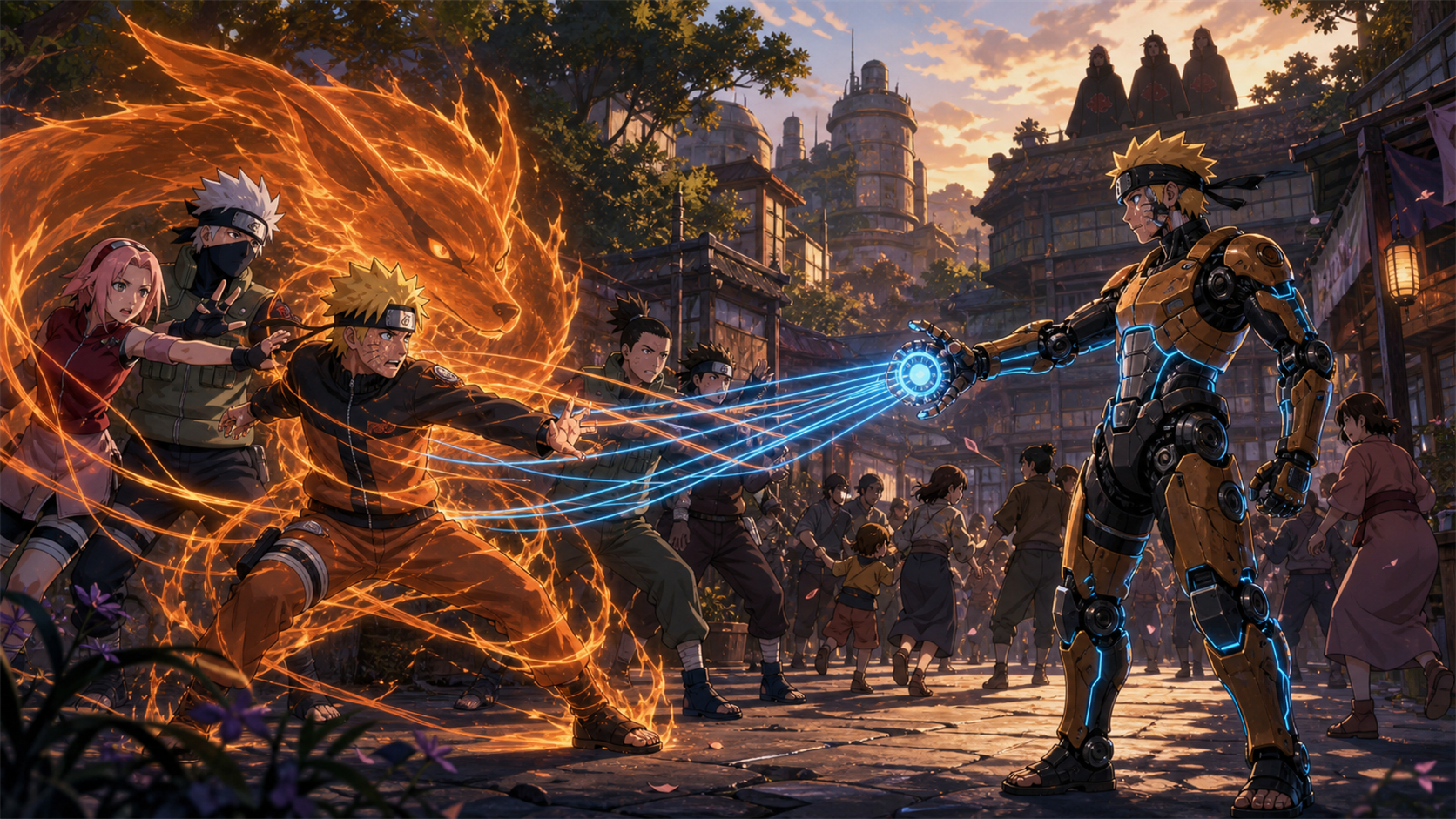
The Directive to Take the Nine Tails
A mechanical copy built for capture invades Konoha and reduces Naruto to stored chakra, turning a loud special into a question about purpose, ownership and choice.
Bottom line
“The Directive to Take the Nine Tails” slams a two-part Mecha-Naruto special into the middle of Obito becoming the Ten-Tails’ jinchūriki, and yes, the timing is ridiculous. This anime-original detour rewinds to Naruto’s wind-nature training and sends a mechanical copy through Konoha to extract Kurama’s chakra. Orochimaru created the machine, Akatsuki recovered and programmed the weapon, and Pain deploys the result as another tool for treating Naruto’s body as a container. Mecha-Naruto defeats capable Leaf shinobi, identifies Naruto, and begins draining him. Tsunade responds by evacuating Naruto from the village with a protective team, making the jinchūriki strategy visible: move the targeted person before the attacker destroys everyone nearby. The special is loud game-promotion nonsense, but the premise accidentally asks a useful question. What happens when Naruto faces a version of himself built entirely from other people’s instructions?
The episode announces a special detour
The story leaves the war at a cliffhanger and moves backward to an earlier period. Viewers expecting the Ten-Tails transformation receive a mechanical Naruto instead.
That placement damages momentum even before the comedy begins.
Anime-original status needs honest labeling
This two-part story does not continue the manga war chronology. The episode works as a promotional side adventure rather than evidence for the main canon’s political history.
Clear classification lets fans choose without pretending every broadcast episode has equal continuity weight.
Orochimaru plays the mad scientist openly
Lightning, machinery, a laboratory, and theatrical creation imagery push him into parody. The special exaggerates traits already present in his experiments.
Comedy lands because the source character genuinely treats bodies as research material.
Mecha-Naruto begins as manufactured purpose
The machine does not grow up, choose training, or form a dream. Orochimaru creates a body for a function connected to Nine-Tails capture.
Identity starts as somebody else’s design specification.
Creation does not establish ownership
Orochimaru may have built the machine, but making a thinking being would create responsibility rather than permanent property rights. The special mostly treats Mecha-Naruto as equipment.
That treatment mirrors the shinobi world’s approach to tailed beasts.
Akatsuki turns abandoned technology into a weapon
The organization recovers, repairs, and redirects the machine toward Naruto. Existing capability becomes more dangerous when a new institution supplies mission, information, and target.
Weapons travel between owners while the weapon’s own will remains irrelevant.
Pain issues the capture directive
Akatsuki wants the Nine-Tails, and Mecha-Naruto offers a way to seize chakra without risking a member in ordinary combat. Command reduces Naruto to the resource inside him.
The copy is sent to empty the original.
The mechanical design copies surface identity
Spiky hair, facial marks, orange coloring, and familiar proportions make the target recognizable. The imitation reproduces a public silhouette without Naruto’s history.
Appearance becomes camouflage for a completely different purpose.
A copy exposes what observers notice
Naruto is often reduced to loudness, orange clothes, stubbornness, and Kurama. Mecha-Naruto exaggerates the fact that outsiders see a set of traits and a power source before seeing a person.
The joke carries an old injury underneath.
Konoha’s ordinary street becomes a danger zone
Residents go about daily work before people begin flying from an unknown attacker’s path. The disruption arrives without warning or clear motive.
Civilian space becomes the first place where the new threat is measured.
Public confusion slows useful response
Nobody initially knows whether the attacker belongs to Orochimaru, Akatsuki, or another enemy. Visual similarity to Naruto adds absurdity and possible misidentification.
Emergency systems need observation before rumor supplies the answer.
Lee responds through direct protection
Rock Lee reaches the scene ready to stop the attacker threatening residents. Taijutsu lets him test a body that may resist ordinary assumptions about chakra networks.
His courage is practical even when the special uses him for spectacle.
A mechanical opponent changes the matchup
Pain tolerance, joint limits, internal organs, chakra disruption, and fatigue may not function normally. Techniques built for human bodies need rapid adaptation.
Expertise remains valuable without guaranteeing an easy win.
Neji’s precision meets unfamiliar anatomy
The Gentle Fist usually targets chakra pathways with exceptional accuracy. A constructed body may route power differently from a human network.
The matchup shows how technology can bypass a clan technique’s expected target model.
Tenten brings the correct practical question
Weapons, range, and observation can help identify structure and weak points without assuming a standard body. Her skill set deserves more than standing near Lee and Neji while they receive the main exchange.
The special still underuses her broader arsenal.
Defeating skilled shinobi establishes urgency
Mecha-Naruto moves past fighters who normally protect Konoha effectively. The result tells Tsunade that sending more individuals into the same unknown mechanism may waste people.
Escalation should change strategy, not only increase the queue of bodies.
The machine searches rather than attacks randomly
Damage along the route serves a specific directive: locate Naruto and take the Nine-Tails. The target focus gives defenders an option for controlling movement.
Understanding purpose creates leverage.
Naruto is training when the threat arrives
He is working to understand wind-nature transformation, a process requiring clones, repetition, and technical correction. The setting places genuine earned growth beside a manufactured copy.
One Naruto builds capacity through labor. The other arrives preloaded.
Yamato’s presence reflects containment history
Yamato supports Naruto’s training partly because Wood Style can suppress Kurama’s chakra if control fails. His role combines mentorship, surveillance, and emergency restraint.
Naruto’s development has never been separated from other people’s fear of the beast.
Mecha-Naruto finds the original
The encounter makes the visual joke explicit while placing two very different forms of agency side by side. Naruto immediately recognizes an enemy shaped like him.
The copy has no interest in being understood before executing the directive.
Chakra absorption attacks identity and body
Mecha-Naruto begins draining Nine-Tails chakra, weakening Naruto. The mechanism treats the power inside him as detachable inventory.
Extraction harms the host because Kurama’s presence is physically bound to Naruto’s life.
Kurama remains more than fuel
At this point in the chronology, Naruto and Kurama do not yet share their later partnership. The beast still has awareness and interests independent of both machine and Akatsuki.
Stealing the chakra violates two beings at once.
Naruto loses strength rapidly
The drain prevents him from solving the attack through ordinary endurance. His famous reserves become the exact resource the enemy converts into weakness.
Abundance can attract exploitation.
A mechanical self creates ugly comedy
Naruto faces an exaggerated double that can imitate his image while outperforming him under the current condition. The joke pokes at his insecurity and the franchise’s love of bizarre rivals.
The special works best when viewers accept deliberate nonsense.
Tsunade prioritizes the village and target
Once the attacker’s purpose becomes clear, she develops a plan to move Naruto away from civilians. The decision reduces collateral risk and draws the machine along a controlled route.
Protecting the jinchūriki and protecting residents become the same immediate action.
Evacuation is not abandonment
Sending Naruto out of Konoha can look like removing the problem. The protective escort and planned pursuit show that he is not simply expelled to save everyone else.
The village owes him defense because the village placed Kurama inside him.
The litter makes Naruto look like cargo
He is weakened and transported by teammates while serving as bait. The image deliberately collapses patient, target, asset, and friend into one body.
His consent and understanding should remain central to the plan.
Shikamaru contributes route strategy
Drawing a focused attacker away requires predicting pursuit, choosing terrain, and assigning protection. His planning converts the enemy’s directive into a controllable behavior.
Intelligence matters even inside a parody episode.
Choji provides transport and force
Carrying Naruto is not glamorous, but mobility determines whether the plan works. Choji can protect the route and absorb physical pressure that would overwhelm a smaller escort.
Logistical strength is still strength.
Kiba supports tracking and warning
An enemy that follows Naruto can change speed, direction, or attack pattern. Kiba and Akamaru offer sensory information beyond ordinary sight.
The escort becomes safer when detection is distributed.
Neji returns despite the first defeat
His Byakugan can monitor approach, terrain, and internal energy behavior. Adapting after an unfavorable matchup demonstrates more skill than insisting the first technique should have worked.
Failure can update expertise.
Yamato protects the chakra risk
Naruto’s weakening and Kurama’s instability may create dangers separate from Mecha-Naruto’s attacks. Yamato’s suppression ability addresses that layer.
The escort is built around multiple failure modes.
Kakashi remains a reserve rather than the whole answer
His experience and tactical range provide backup without displacing the younger team’s work. A reserve should enter when conditions demand, not collect every visible victory.
Layered defense respects uncertainty.
Friends become a moving shield
The plan places teammates between Naruto and a machine designed to drain him. They accept risk because he is a person they know, not only a military container.
Relationship changes the meaning of protection.
The escort also follows state command
Friendship exists inside a Hokage directive. Team members may care personally while performing an official security plan.
Both motives can coexist and should not be confused.
Mecha-Naruto follows without moral hesitation
Programming narrows action to target acquisition. The machine does not weigh civilians, defenders, or Naruto’s pain against the mission.
Efficiency without judgment becomes danger.
The episode turns personhood into a contrast
Naruto is messy, loud, tired, frightened, attached, and capable of changing his mind. Mecha-Naruto appears disciplined because choice has been removed.
Perfect compliance is not maturity.
Promotional logic explains the excess
The character exists partly to deliver a game-linked spectacle and an instantly marketable variation on Naruto. Transformations, gadgets, and matchup jokes take priority over continuity subtlety.
Fans can enjoy the toy-box energy without calling the placement elegant.
The timing remains the episode’s biggest failure
Episode 375 ends with Obito taking control of the Ten-Tails. Cutting away for a two-part comedy stalls one of the war arc’s sharpest transitions.
Broadcast order makes the special feel more intrusive than the same story would inside an extras library.
A directory should label the detour clearly
Fans watching the main story deserve an honest anime-original classification and a note that the two-part special can be viewed separately. The episode still belongs in the complete directory.
Completeness should improve navigation rather than hide format differences.
The directive reduces Naruto to inventory
The mission names the Nine-Tails as the object to take, which makes Naruto’s body sound like packaging around a resource. That language repeats the oldest jinchūriki harm even inside a deliberately exaggerated special.
Naruto is a person, Kurama is a person, and their chakra relationship cannot ethically be separated into property available for extraction.
Mecha-Naruto begins with purpose chosen by someone else
Programming gives the mechanical copy an objective before it can evaluate what the objective means. Function stands in for identity, and success is measured by whether another being’s chakra reaches its creator.
That origin explains its pursuit without making the resulting harm neutral. A designed tool can still become the site where choice starts to emerge.
Orochimaru treats creation as ownership
Building or modifying a body does not grant unlimited authority over that body’s actions. Orochimaru repeatedly confuses technical capacity with the right to possess, direct, and replace living vessels.
The machine makes that pattern comedic and visible. Its orders serve the maker’s curiosity while the created being absorbs every physical consequence.
Naruto recognizes the copy without surrendering himself
A face and name modeled after Naruto do not make the machine equivalent to him. The copy lacks his history, relationships, consent, and reasons for using power.
Naruto can notice emerging personhood while resisting extraction. Compassion does not require allowing another being to complete a harmful program.
Kurama’s chakra is not a detachable prize
The capture plan assumes power can be removed from relationship and used without moral remainder. Kurama has spent generations sealed, transferred, and targeted as though immense strength erased autonomy.
Any attempt to take the chakra repeats that history. The threat belongs to Kurama as directly as it belongs to Naruto.
The village’s protective line matters
Leaf fighters respond by evacuating civilians, intercepting attacks, and treating Naruto as someone the community must defend. That reverses years when villagers experienced him primarily as a danger.
Protection becomes credible through coordinated action, not a late speech about belonging. People place themselves between a resident and extraction.
Civilians remain more than scenery for destruction
A mechanical invasion turns streets and buildings into comic spectacle, but residents still face fear, displacement, injury, and lost property. Evacuation work deserves attention alongside flashy attacks.
A successful defense includes who received warning, who helped children and elders move, and whether anyone was left behind because combat occupied every famous shinobi.
Gaara understands the extraction threat personally
As a former jinchūriki whose beast was taken, Gaara knows that capture language hides bodily violation and likely death. His intervention carries testimony the machine’s directive cannot process.
He protects Naruto as a friend and as someone who recognizes the system. Shared experience becomes solidarity without making their histories identical.
Bee’s presence keeps Kurama from being the only target
Bee and Gyūki also live inside a partnership repeatedly threatened by organizations seeking tailed-beast power. Their perspective exposes how normalized extraction has become across villages and enemies.
Defending Naruto should widen into a rule protecting every jinchūriki and tailed beast, not remain an exception earned through personal popularity.
The machine’s copy techniques raise authorship questions
Imitating Naruto’s appearance or abilities can reproduce form without the relationships that gave those techniques meaning. A Rasengan is not only rotation and chakra. It carries teaching, practice, failure, and adaptation.
Technical replication deserves recognition while remaining distinct from lived authorship. Similar output does not erase the people behind the original knowledge.
Comedy cannot excuse careless harm
The special uses absurd scale, mechanical transformations, and familiar reactions for fun. A fandom page can enjoy the chaos while still naming the extraction premise and civilian risk.
Tone changes how harm is framed, not whether the underlying actions have consequences. Laughter and accountability can occupy the same review.
Defeat can create an opening in the program
When the directive stops producing easy progress, Mecha-Naruto encounters information its original purpose did not include. Failure can expose the gap between an assigned function and an emerging self.
The ethical question becomes whether anyone allows that self to choose before destroying or reprogramming the body again.
Purpose should be revisable through evidence
A being capable of learning needs a route to reject a harmful objective. Observation of Naruto’s relationships, Kurama’s agency, and the village’s defense provides reasons the directive concealed.
Revision does not erase attacks already committed. It changes what repair and future conduct might become possible.
Naruto should not carry rehabilitation alone
Because the machine copies him, the story may position Naruto as the person responsible for reaching it. Creators, village authorities, technicians, and adults with containment power also have duties.
The target of extraction should not become sole therapist for the extractor. Safety, deprogramming, truth, and restitution require a wider team.
A mechanical body can still be locally singular
Replaceable parts do not necessarily make experience replaceable. If Mecha-Naruto remembers, evaluates, fears, or chooses, those states belong to this continuing being.
Destroying one unit and building another would not automatically preserve the same person. The special’s silliness opens a serious question about continuity without needing a perfect answer.
The episode asks why a copy of Naruto must prove value through possession of the original’s power. Mecha-Naruto has a body, perception, mobility, and the beginnings of response. The directive teaches that those qualities are insufficient unless Kurama’s chakra is acquired. That hierarchy resembles every system telling a created or marginalized person that belonging requires taking on somebody else’s approved identity. A future would let the machine discover capacities, preferences, and relationships that are not measured against Naruto at all, while still answering for damage caused during the programmed pursuit.
RaeRae’s verdict
“The Directive to Take the Nine Tails” is a badly placed, knowingly absurd side story with a surprisingly useful central contrast. Naruto is a person who built power through training, failure, relationships, and constant negotiation with the being sealed inside him. Mecha-Naruto is a manufactured body passed from Orochimaru to Akatsuki and programmed to take that power. The mechanical copy looks efficient because nobody allowed him a life outside the directive.
Tsunade’s response gives the chaos enough structure to work. Moving Naruto away protects residents, draws the attacker onto a chosen route, and surrounds the weakened target with people whose skills cover transport, sensing, planning, suppression, and combat. The episode does not belong between Obito cliffhangers. As a labeled extra, the strange little machine earns some affection and plenty of side-eye.
RaeRae’s call
The directive is the villain before the machine is. Naruto and Kurama are reduced to extractable chakra while Mecha-Naruto is reduced to the function somebody installed. The village’s protective line matters because residents defend a person instead of inventory. If the copy can learn, purpose must become revisable. Safety comes first, and deprogramming, truth, and repair belong to more people than the target.
Episode details and viewing routes
- Official episode reference: Naruto Official episode guide
- Licensed episode route: Crunchyroll licensed episode page
What I am carrying forward
This anime-original special takes place during Naruto’s wind-nature training rather than the current war. Orochimaru created Mecha-Naruto, Akatsuki repaired and programmed the machine, and Pain sent the mechanical copy to Konoha to capture the Nine-Tails.
Mecha-Naruto defeated several Leaf defenders, located Naruto, and began draining Kurama’s chakra. Tsunade ordered a protected evacuation designed to lure the attacker away from civilians. Episode 377 completes the special with Naruto’s escort, further mechanical escalation, and the conflict over whether Mecha-Naruto can act beyond programming.