
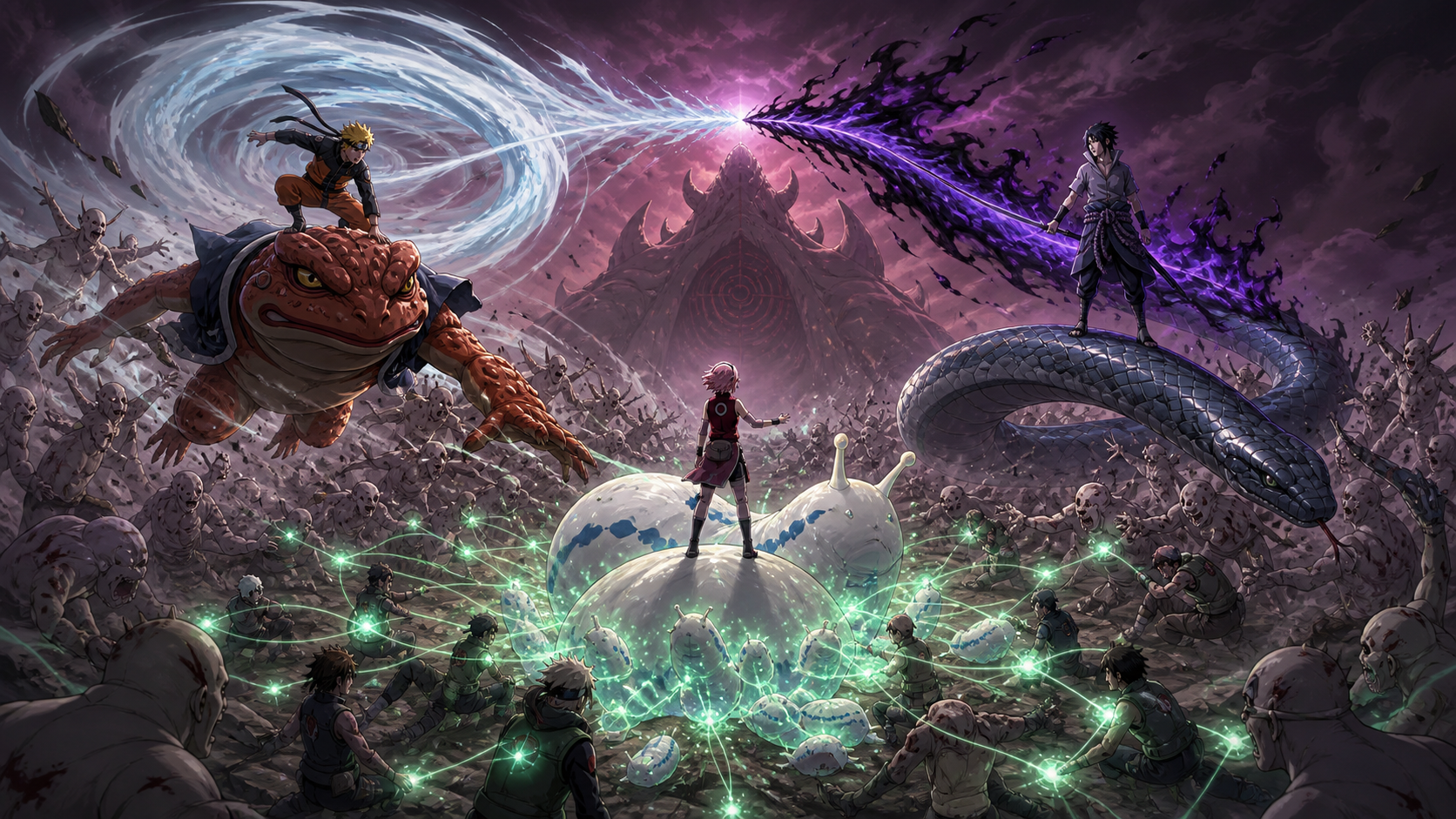
The New Three-Way Deadlock
Team 7 inherits the silhouette of the Legendary Sannin, but its future depends on treating care, force, consent and accountability as equal forms of power.
Bottom line
“The New Three-Way Deadlock” borrows the silhouette of the Legendary Sannin and gives each member of Team 7 a different battlefield responsibility. Naruto summons Gamakichi to cross the Ten-Tails divisions and reach the central body. Sasuke summons Aoda for speed and precision. Sakura summons Katsuyu, divides healing support across the Allied Shinobi Forces, and turns stored chakra into survival for people beyond her immediate sight. Naruto and Sasuke combine wind and black flame into a dangerous attack against the Ten-Tails. Their spectacle depends on Sakura and the medical network keeping the wider army alive. Elsewhere, Orochimaru reaches the critically wounded Five Kage with Karin and Suigetsu. The parallel to Jiraiya, Tsunade, and Orochimaru is useful, but the younger trio should not inherit their teachers’ failures as destiny. Team 7 can build a new relationship only by treating care, force, consent, and accountability as equal parts of power.
Three summons reshape the battlefield
Naruto, Sakura, and Sasuke call giant partners associated with their teachers’ traditions. The image immediately recalls Jiraiya, Tsunade, and Orochimaru.
Visual inheritance establishes a comparison without declaring the students finished copies.
Summoning is a relationship
Each animal arrives through a contract and chooses how to respond within that bond. The summon is not a disposable special effect produced by the shinobi alone.
Recognition should include the partner carrying the fighter.
Gamakichi arrives as an experienced ally
Naruto once met a much smaller toad with personality, family ties, and opinions. Gamakichi has grown through his own life alongside Naruto’s development.
Their shared history gives the entrance warmth beyond scale.
Mobility becomes Naruto’s immediate need
Ten-Tails divisions crowd the route to the main body. Gamakichi can leap over, crush through, and create angles that Naruto cannot reach from the ground.
The summon expands access rather than merely increasing damage.
Aoda responds to Sasuke differently
The snake is direct and cooperative, contrasting with Manda’s hostility and Orochimaru’s exploitative use of summoning relationships. Sasuke receives fast movement through a partner who is not constantly threatening him.
Inherited technique can support a different ethical pattern.
Sasuke’s treatment of partners remains under review
He sacrificed Manda to escape Deidara’s explosion and has often treated allies as tools when cornered. A respectful exchange with Aoda matters only if the conduct continues.
One courteous moment cannot settle a pattern.
Katsuyu arrives for distributed care
Sakura summons a being capable of dividing into many smaller bodies and reaching injured shinobi across a huge area. The choice matches the actual needs of an exhausted army.
Medical scale is strategic power.
Healing thousands lacks one dramatic target
Naruto and Sasuke can aim attacks at the Ten-Tails and receive an immediate visual payoff. Sakura must support many bodies with different injuries, locations, and remaining capacity.
Diffuse labor is harder to frame and no less essential.
Katsuyu is a knowledgeable participant
She communicates, evaluates conditions, transmits information, and regulates healing. Sakura provides chakra and direction within a partnership built through Tsunade’s training.
The medical network belongs to both of them.
Sakura spends stored chakra on other people
The forehead seal represents years of accumulation. She could reserve that power only for personal survival and combat.
Using a substantial share for the alliance turns private discipline into collective capacity.
Care work preserves offensive options
Every stabilized fighter can defend a medic, maintain a formation, relay intelligence, or evacuate another person. Healing changes what the army can continue doing.
Support does not sit outside strategy.
The Sannin comparison has sharp history
Jiraiya, Tsunade, and Orochimaru trained together, separated through trauma and conflicting choices, and never restored a simple team. Their students now stand in a similar formation.
Parallel imagery should function as warning as well as celebration.
Naruto inherits more than Jiraiya’s techniques
He carries teachings about perseverance, peace, research, and connection. He also inherits a world where Jiraiya’s intelligence system, travel, and mentorship came with personal absences and institutional compromises.
Respect does not require imitation of every habit.
Sakura inherits Tsunade’s medical doctrine
Tsunade turned grief into reforms that placed trained medics on teams and built systems for survival. Her strength also developed beside gambling, avoidance, political burden, and repeated loss.
Sakura can continue the reforms without reproducing the coping failures.
Sasuke inherits a compromised lineage
Orochimaru trained him for possession, experimentation, and personal ambition. Sasuke took techniques and then turned against the teacher who intended to consume him.
Technical inheritance does not create moral loyalty.
Team 7 can reject the old fracture
The Sannin could cooperate under pressure but remained divided by Orochimaru’s crimes and the village’s inability to hold him accountable early. Team 7 has similar unresolved violence in its center.
Breaking the pattern requires direct repair rather than nostalgia.
Naruto and Sasuke move toward the main body
Their summons carry them past divisions while Sakura’s network supports the forces behind. The three jobs operate at once.
Front-line progress depends on the rear remaining alive and organized.
Wind and black flame combine
Naruto’s wind technique increases the reach and cutting force around Sasuke’s Amaterasu. Sasuke shapes the black flames so the powers can function together.
Combination requires technical compatibility, timing, and mutual awareness.
Cooperation does not require emotional repair first
They know each other’s combat rhythms well enough to coordinate against a common target. That competence can save lives immediately.
Trust outside the attack still needs a longer record.
The attack carries serious risk
Amaterasu continues burning and can threaten unintended targets without control. Wind expands force and area.
Combining dangerous techniques increases responsibility for placement and containment.
Minato reacts as a father and shinobi
He sees Naruto working beside Sasuke and recognizes the technical ambition. His enthusiastic naming instinct adds family comedy during a severe battle.
The humor grows from character instead of dismissing casualties.
Tobirama punctures the dramatic name
His dry reaction keeps the moment from floating away in spectacle. The brothers’ contrasting temperaments appear through a small exchange.
Even legendary leaders can sound like family while working.
The combined strike is not the whole plan
Damaging the Ten-Tails matters, but the creature’s scale and changing state prevent one attack from ending the war. Containment, healing, intelligence, and defense continue around the impact.
Spectacle must remain attached to system work.
Sai questions Sasuke’s motive
The original trio may accept immediate cooperation, but Sai has reason to observe the return critically. He knows Sasuke through the damage his absence caused and through missions shaped around retrieving him.
Asking why he came is responsible team behavior.
Jugo cannot provide a simple guarantee
Jugo follows Sasuke and understands parts of his recent decisions. He cannot promise what Sasuke will choose after the common enemy falls.
Loyalty should not pretend certainty where none exists.
Sasuke remains difficult to read
His stated goal of protecting Konoha and becoming Hokage still contains multiple possible meanings. Reform, control, atonement, rivalry, and personal reinterpretation of Itachi may all be present.
The alliance needs conduct more than confident guesses.
Sai’s place in Team 7 matters
He joined during Sasuke’s absence, learned connection, and risked himself beside Naruto and Sakura. The nostalgic formation should not erase the teammate who lived the intervening years with them.
Teams can hold more than one valid history.
The Five Kage remain critically wounded
Their battle with Madara left bodies broken far from the main alliance. Political rank did not protect them from catastrophic injury.
Their survival depends on medical access and timely discovery.
Tsunade’s condition reflects her role
She spent extraordinary power keeping herself and others alive. Her body carries the cost of fighting and healing at once.
Medical leaders are not protected from becoming patients.
Katsuyu stayed with the Kage
The summon maintained support under conditions that exceeded ordinary treatment. Her presence connects Tsunade’s survival to a long partnership rather than solitary endurance.
Again, the animal partner performs crucial labor.
Orochimaru reaches the wounded leaders
His arrival creates immediate uncertainty because he killed Hiruzen, attacked Konoha, and pursued the bodies of others. He may now help people aligned with Sasuke’s chosen direction.
Urgent care can require cooperation without trust.
Karin brings rare healing capacity
Her chakra and Uzumaki vitality can support survival in extreme conditions. The ability has repeatedly made her body useful to people who bite, drain, or command her.
Emergency value should not erase bodily autonomy.
Consent still matters during crisis
Saving the Kage is urgent, but Karin deserves explanation and agency over how her body is used. A history of exploitation makes that standard more important.
Heroic outcomes do not retroactively authorize coercion.
Suigetsu becomes part of the medical route
He often presents himself through self-interest and comic fear, yet his presence can assist transport, communication, or practical support. People do not need saintly motives to do useful work.
Contribution should be named accurately without moral laundering.
Orochimaru’s help does not settle his crimes
If he assists the Five Kage, those lives matter. His experiments, murders, body theft, and manipulation also remain.
Accountability is not a balance sheet where one rescue cancels many victims.
The younger trio inherits a damaged world
Their teachers’ generation left knowledge, reforms, affection, crimes, and unfinished political problems. Naruto, Sakura, and Sasuke receive all of that at once.
Inheritance creates responsibility to choose, not an obligation to repeat.
Three-way balance should include three voices
The iconic formation can become two rivals with Sakura positioned between them. A genuine team needs her judgment inside planning, leadership, and disagreement.
Equality is more than equal visual height on a summon.
Sakura’s role spans the whole army
Naruto and Sasuke focus on the Ten-Tails while Sakura connects to injured fighters through Katsuyu. Her immediate field of responsibility may be wider than either attack route.
Scale should be measured by lives affected, not explosion size.
Naruto’s network and Sakura’s network complement each other
Kurama’s chakra increases protection and strength. Katsuyu distributes healing and information. Both systems move support through many recipients.
The alliance survives through overlapping networks rather than a single chosen hero.
Sasuke adds force without owning direction
His techniques make the main assault stronger. The alliance still has commanders, unit leaders, Kage, and thousands of people with stakes in the outcome.
Exceptional power should join collective purpose rather than seize control.
The silhouette is inherited, not the outcome
Naruto, Sakura, and Sasuke resemble Jiraiya, Tsunade, and Orochimaru when their summons fill the battlefield. Visual inheritance gives the audience a history to compare, not a prophecy requiring the younger team to repeat every fracture.
The new deadlock earns its name by using inherited techniques inside relationships that can still choose different boundaries.
Gamakichi arrives as a partner with his own growth
Naruto no longer summons the small toad who struggled to carry him. Gamakichi has developed size, technique, experience, and a voice that affects how they coordinate.
That growth matters independently of Naruto’s progress. A summon is not equipment upgraded offscreen for a hero. Partnership requires recognizing what both participants learned and what each risks.
Aoda’s cooperation is not ownership
Sasuke can call Aoda and direct movement, but the snake remains a living ally with preferences and capacity. Their arrangement should not be confused with Orochimaru’s pattern of treating bodies as replaceable containers.
The ethical difference lives in conduct: clear purpose, limited demand, respect for the summon’s life, and no assumption that power grants possession.
Katsuyu turns Sakura’s seal into public infrastructure
Sakura does not spend all her stored chakra on one spectacular strike. Through Katsuyu, healing and communication can reach injured people across the alliance.
The scale is enormous because care is distributed. Her power becomes more than a personal milestone when thousands gain access to survival they could not receive from one medic moving body to body.
Medical labor changes the meaning of the formation
A three-way deadlock can sound like three equal attackers facing outward. Sakura expands the formation by making preservation one of its central powers.
She attacks when necessary and builds a living network for everyone else. The battlefield is not won merely by producing the largest wound. Victory needs bodies capable of returning home.
Tsunade’s legacy is institutional as well as personal
The seal and Katsuyu connect Sakura to her teacher, but Tsunade also fought for medical systems, training standards, and teams designed around survival. Sakura inherits that public vision.
Mentorship becomes durable when techniques can support people beyond the mentor’s immediate reach. The student advances the work by applying it to a coalition-wide crisis.
Naruto’s attack relies on alliance-created opportunity
His power is extraordinary, yet the route toward the Ten-Tails exists because barriers, elemental divisions, medics, sensors, communication teams, and ordinary fighters continue doing their jobs.
The dramatic strike should carry the chain behind it. Naruto is central without becoming the sole author of a battlefield thousands kept open.
Sasuke’s efficiency does not settle trust
He contributes decisive force and understands the target quickly. Tactical competence gives the alliance a reason to coordinate with him now. It does not answer what he plans after the war or how he will address prior harm.
Temporary cooperation can be wholehearted about the shared objective and cautious about everything still unknown.
Sakura reads both boys while holding her position
She knows Naruto’s impulsive rhythms and recognizes Sasuke’s strategic distance. That knowledge helps her operate between them without becoming responsible for managing every emotion or rivalry.
Her role is teammate, medic, fighter, and decision-maker. Emotional awareness is expertise, not an assignment to keep two men functional at her expense.
The Sannin comparison must include their failures
Jiraiya, Tsunade, and Orochimaru possessed legendary skill and failed to remain a safe, accountable team. One pursued a student’s body, one left under grief, and one often watched without preventing fracture.
Team 7 can honor their teachers by keeping the valuable techniques and refusing the harmful relational pattern.
Three specialties do not need identical scale
Comparing one punch, one Rasengan, and one flame technique as though equality requires sameness misses how a team works. Their abilities solve different problems across different time horizons.
Equal worth appears through decision rights, recognition, protection, and the ability to challenge one another, not matching visual effects frame for frame.
Summoning creates obligations after deployment
Partners who arrive to absorb attacks, transport fighters, or spread healing need recovery and acknowledgment when the mission ends. The contract should not vanish from the story once the visual set piece is complete.
Ethical power includes what happens to the beings whose labor makes the hero’s move possible.
The alliance needs access to Katsuyu without gatekeeping
Injured fighters should receive care according to medical need rather than clan, rank, fame, or proximity to Team 7. Distributed healing becomes just when triage remains consistent across the coalition.
Sakura’s leadership includes deciding how limited chakra reaches the greatest danger while preserving accountability for impossible choices.
The deadlock can become cooperation instead
The older three-way relationship was defined by competing strength and eventual separation. Naruto, Sakura, and Sasuke do not have to remain locked in permanent comparison.
A team can coordinate distinct power toward shared protection, admit conflict, and renegotiate roles. The formation becomes new when rivalry stops being its governing structure.
Kakashi’s teamwork lesson reaches a larger scale
The bell test taught three children that individual success achieved through abandonment was failure. Here, their choices affect an entire alliance, and the same rule applies.
Power that leaves teammates, summons, medics, and ordinary fighters expendable would betray the reunion. Team 7 succeeds when connection changes how force is used.
The formation also asks who gets remembered when history turns a battlefield into legend. Future retellings may name Naruto, Sasuke, and Sakura while forgetting the summon clans, medics, barrier teams, and fighters who created the conditions for their success. Editorial honesty resists that compression. A signature technique has a supply chain of trust, training, communication, and bodies taking risk. Preserving those names does not diminish Team 7. It makes their achievement more accurate and shows the next generation that great power is almost never truly solitary, even when one image becomes iconic.
RaeRae’s verdict
“The New Three-Way Deadlock” works when the Sannin parallel reveals difference instead of assigning destiny. Naruto, Sakura, and Sasuke arrive through three traditions, three summons, and three battlefield jobs. Gamakichi and Aoda carry the offensive route. Katsuyu turns Sakura’s stored chakra into a medical network reaching far beyond the trio. The quieter function may be the most important one once the episode’s explosions stop.
The comparison also exposes unfinished danger. Orochimaru’s legacy sits beside Sasuke. Karin’s body remains vulnerable to being treated as a healing resource. Sai cannot know whether the original teammate has truly returned. Team 7 has enough shared skill to fight together, but a new deadlock worth celebrating needs three equal voices and real accountability. Otherwise, the old formation is only a prettier picture of unresolved harm.
RaeRae’s call
The new Three-Way Deadlock matters because inheritance is not destiny. Gamakichi, Aoda, and Katsuyu are partners. Sakura makes healing battlefield-scale infrastructure instead of a side duty. Naruto’s attack carries alliance labor, and Sasuke’s help remains separate from automatic trust. Team 7 honors the Sannin by keeping their knowledge while refusing to make rivalry, possession, or abandonment the price of legendary power.
Episode details and viewing routes
- Official episode reference: Naruto Official episode guide
- Licensed episode route: Crunchyroll licensed episode page
What I am carrying forward
Naruto summoned Gamakichi, Sasuke summoned Aoda, and Sakura summoned Katsuyu, recreating the three-way visual associated with Jiraiya, Orochimaru, and Tsunade. Sakura distributed medical support across the alliance while Naruto and Sasuke combined wind and black flame against the Ten-Tails.
Orochimaru, Karin, and Suigetsu reached the critically wounded Five Kage. Sai questioned Sasuke’s motives, and Jugo could not guarantee what Sasuke would choose later. Episode 375 returns to Kakashi and Obito for the direct fight their shared history has made unavoidable.