
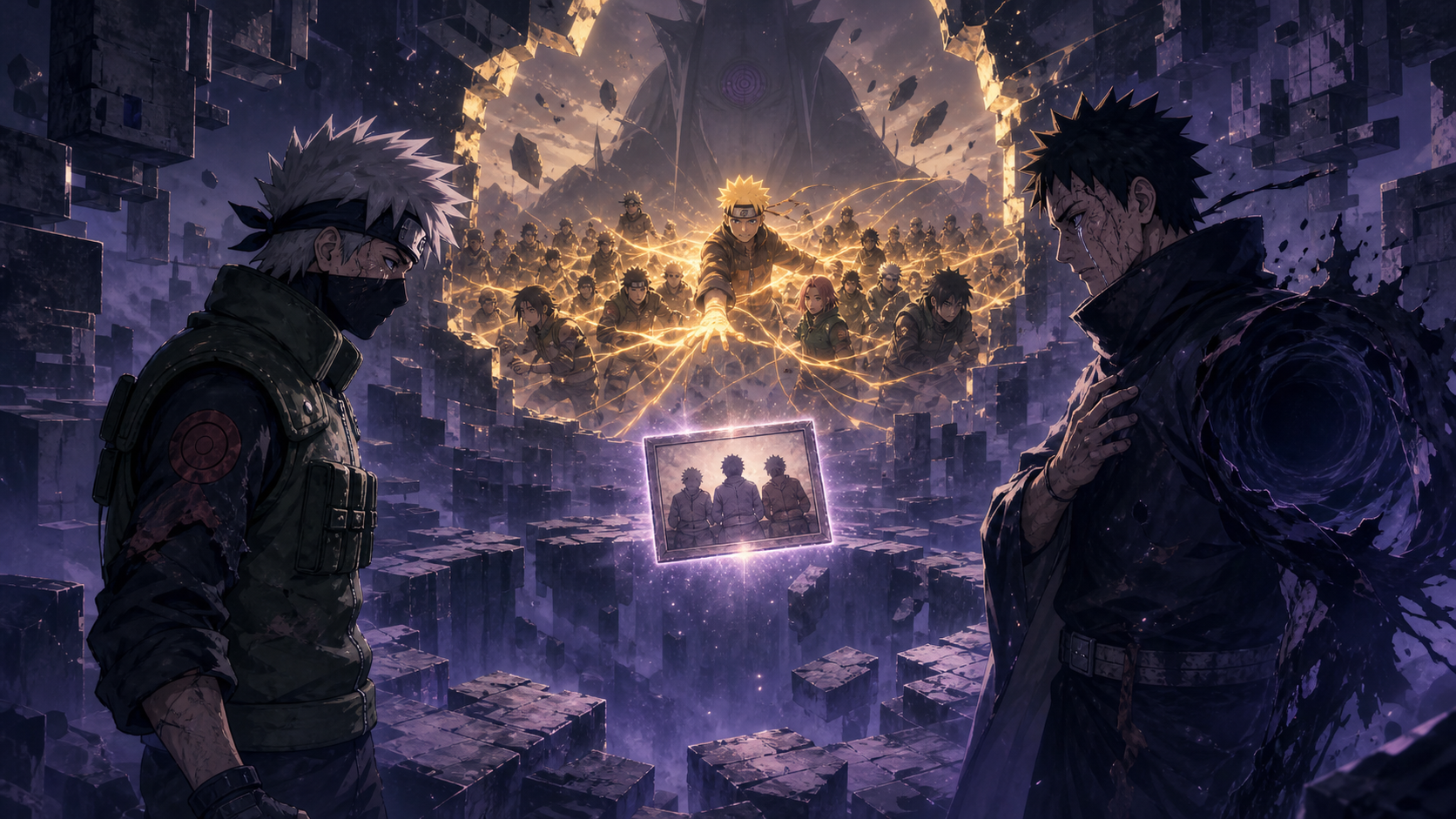
Hole
Obito calls grief proof that reality should be abandoned, while Kakashi and Naruto answer that loss can be carried through imperfect, chosen connection.
Bottom line
“Hole” gives Obito the metaphor behind his surrender and lets Kakashi reject the conclusion without denying the wound. Obito says reality leaves a hole where Rin, Minato’s team, and his former self once lived. The Infinite Tsukuyomi offers a world where those losses can be replaced with ideal versions. Kakashi understands the emptiness because he lost the same teammates and carried guilt for years. His answer is not that friendship heals every injury. Bonds, memory, new relationships, and chosen responsibility can gather around loss without replacing the person who died. Outside the Kamui dimension, Naruto keeps the Allied Shinobi Forces connected while Madara and the Ten-Tails exploit every limit in that network. Obito calls pain proof that reality should be abandoned. Kakashi and Naruto treat pain as part of reality that people must face together, imperfectly and without counterfeit resurrection.
Naruto remains at the alliance’s front
Kurama’s chakra lets thousands survive attacks that would otherwise tear through the formation. Naruto tracks the larger battle while maintaining connections to individual fighters.
His position combines power, communication, and dangerous concentration of responsibility.
Shared chakra is not limitless
The alliance has gained protection, but Naruto and Kurama still work through finite capacity. Every adjustment, transfer, and defense demands attention.
Collective strength needs pacing as much as courage.
Madara studies the network
He recognizes that Naruto functions as a connective point and tests the strain on that role. An enemy does not need to overpower every shinobi separately if one exhausted node supports many.
Resilient systems distribute judgment and backup capacity.
Obito keeps attacking conviction
Physical destruction is only part of his strategy. He wants Naruto to interpret Neji’s death, headquarters, and the failing battlefield as evidence that hope is dishonest.
Demoralization turns grief into a weapon without firing another projectile.
Naruto refuses Obito’s ownership of loss
Obito speaks as though suffering grants him the authority to explain what everyone else should conclude. Naruto has buried parents, mentors, friends, and comrades too.
Shared pain does not require shared surrender.
The alliance makes Naruto’s answer visible
Thousands of shinobi from rival villages continue coordinating despite death and exhaustion. Their cooperation cannot undo the war.
Their action proves that grief can coexist with consent, duty, argument, and practical trust.
Kakashi enters the Kamui dimension with history
The confrontation removes battlefield noise and places former teammates inside the space connected to Obito’s power. No army can absorb the personal questions for them.
Kakashi faces the person behind the mask and the boy he remembers at once.
Obito asks Kakashi to recognize the emptiness
He describes a hole opened by loss, betrayal, and the collapse of his earlier identity. The metaphor fits trauma that cannot be patched by one conversation.
The feeling is real even when his proposed answer is violent.
Rin’s death remains the central wound
Obito saw Kakashi’s hand pass through Rin’s chest and built his worldview around that image. He did not initially know the coercion, the Hidden Mist plan, or Rin’s decision to prevent catastrophe.
Madara ensured the worst possible interpretation reached him at maximum vulnerability.
Missing context shaped a global plan
Obito treated one traumatic scene as complete proof about reality. Manipulators controlled what he saw, when he saw the scene, and what explanation followed.
An information trap became an ideology with worldwide casualties.
Kakashi carries another side of the same death
He did not want to kill Rin. He lived with the bodily memory, responsibility, and inability to explain the event to Obito.
The survivor standing before Obito is not untouched evidence that reality worked out.
Shared trauma did not create equal choices
Kakashi withdrew, struggled, served violent institutions, and eventually formed new bonds. Obito joined Madara’s plan, manipulated nations, controlled people, and helped start a war.
Pain explains the fork without erasing agency after the fork.
Obito offers a counterfeit repair
The Infinite Tsukuyomi promises a Rin who lives, a team that remains whole, and a self untouched by betrayal. The dream can reproduce desired forms.
The recreated people cannot consent, surprise, disagree, or continue lives beyond the dreamer’s need.
An ideal version is not the lost person
Rin had her own judgment, fear, loyalties, and final choice. A world programmed to satisfy Obito would replace her agency with his preferred outcome.
Love cannot honor a person by removing everything that made her independent.
Kakashi refuses replacement language
He does not claim another teammate can occupy Rin’s exact place. People are not interchangeable pieces filling assigned slots.
New bonds change the shape around a loss without becoming replicas of the dead.
Life can grow around the remaining hole
Kakashi’s answer accepts permanent absence. Memory, work, friendship, teaching, grief, and responsibility can coexist with a space that never disappears.
Living does not require pretending the wound closed cleanly.
Team 7 changed Kakashi’s direction
Naruto, Sakura, and Sasuke did not replace Obito, Rin, or Minato. Teaching them forced Kakashi to participate in relationships rather than remain only a memorial keeper.
New responsibility gave his survival somewhere to move.
Obito’s words survived in Kakashi
The lesson about comrades mattered long after Obito was believed dead. Kakashi carried part of the boy’s moral conviction into another team.
Obito’s younger self shaped the resistance now opposing his adult plan.
Legacy can contradict its creator
An earlier belief may remain valuable even when its speaker abandons that belief. Kakashi does not owe obedience to present-day Obito because he honors the child Obito was.
Memory can preserve truth without freezing loyalty.
Kakashi rejects the false binary
Obito presents two options: accept a cruel reality or replace reality with a controlled dream. Kakashi chooses the harder third path of changing conditions while accepting limits.
No guaranteed ending makes that choice less comfortable and more ethical.
Reality includes preventable cruelty
Rejecting the Infinite Tsukuyomi does not require defending the shinobi world as good enough. Child soldiers, secret missions, clan persecution, tailed-beast imprisonment, and war remain real failures.
The answer must include reform, not gratitude for suffering.
The dream plan removes political work
Obito can avoid negotiation, accountability, resource conflict, grief care, and institutional change by placing everyone inside private illusion. Nobody can object once their agency is gone.
Frictionless peace is domination wearing comforting faces.
Kakashi refuses to abandon responsibility
He cannot change Rin’s death, but he can choose what happens to people still alive. Stopping Obito becomes part of answering years of guilt with present action.
Responsibility differs from the fantasy of total control.
Guilt once isolated Kakashi
He spent years defined by dead teammates and repeated visits to the memorial. That history makes his answer earned rather than cheerful advice from somebody untouched by loss.
Kakashi knows that connection can feel impossible before connection becomes useful.
Naruto demonstrates another response
Naruto repeatedly experienced loneliness and rejection without receiving a guarantee that Konoha would change. He built relationships through stubborn participation, conflict, and service.
His example is not available equally to everyone, but his choices disprove inevitability.
Obito sees Naruto as an accusation
Naruto resembles the hopeful boy Obito abandoned. Every refusal forces Obito to confront the possibility that pain did not dictate his later crimes.
If another lonely child chose differently, responsibility returns.
Similarity does not erase different conditions
Naruto received Iruka, Team 7, Jiraiya, and other relationships at crucial moments. Obito received Madara’s isolation and grooming after catastrophic loss.
Support helps explain the difference while leaving room for choice.
Madara benefits from Obito’s emptiness
Madara found a traumatized child, controlled information, offered a total explanation, and attached reunion with Rin to compliance. The hole became a recruitment route.
Predatory mentorship converts pain into institutional labor.
Obito later repeats the method
He confronts Nagato and Naruto with loss, narrows available interpretations, and presents the dream plan as mature realism. The manipulated child becomes an adult manipulating others.
Past victimization requires context and does not excuse repetition.
The Kamui space reflects isolation
The dimension allows separation from ordinary people and immediate consequences. Obito can remove bodies, attacks, or himself from shared space.
The power’s defensive brilliance matches his emotional habit of disappearing from relationship.
Kakashi follows him into that isolation
Using the connected eye, Kakashi enters the place Obito treats as private control. He brings witness and disagreement into a space designed around withdrawal.
Connection reaches even the architecture of avoidance.
Conversation cannot replace restraint
Kakashi listens and answers because Obito remains a person. He also prepares to stop a combatant helping direct the Ten-Tails against thousands.
Empathy does not require leaving dangerous power unchecked.
Fighting a friend carries specific grief
Kakashi is not confronting a stranger who adopted Obito’s name. Familiar gestures, shared memories, and the remaining eye tie the adult enemy to the child he mourned.
Necessary force can still hurt beyond the physical strike.
Outside, the alliance needs immediate defense
The personal confrontation occurs while Madara and the Ten-Tails keep attacking. Thousands cannot pause until Kakashi and Obito resolve their history.
Private trauma and public emergency run on the same clock.
Naruto cannot manage every person forever
His chakra network supports the alliance, but exhaustion reveals the limit of a system centered on one teenager. Other units must carry local defense and decision making.
Connection should expand capacity rather than make everyone dependent.
Kurama remains a working partner
The chakra distribution depends on Kurama’s calculation, communication, and willingness. Naruto’s visible strain should not erase the tailed beast’s labor.
Two minds maintain the network.
The title belongs to more than Obito
Kakashi, Naruto, and many shinobi carry absences that cannot be reversed. A hole can describe grief without becoming a command to erase reality.
The ethical question concerns what people build around that absence.
Bonds can hurt without becoming mistakes
Rin’s importance created devastating grief. Team 7 created new vulnerability for Kakashi. Neji’s bond with Naruto and Hinata makes his death painful.
Pain measures exposure, not proof that care was wrong.
Memory should preserve the dead as people
Rin cannot remain only Obito’s ideal or Kakashi’s guilt. She was a shinobi making choices inside an exploitative war system.
Honoring her requires more than using her face to defend either man’s worldview.
Obito turns pain into a universal conclusion
He experienced catastrophic loss, manipulation, war, and the collapse of a future he trusted. Those facts explain why emptiness feels convincing to him. They do not prove every person, bond, or reality is therefore fraudulent.
Obito converts personal despair into policy for the entire world. Infinite Tsukuyomi would deny billions the right to interpret their own suffering or choose imperfect lives.
The hole is real without being the whole person
Kakashi does not need to deny emptiness to reject Obito’s answer. Rin’s death left grief, guilt, and unanswered absence that no slogan can fill. Kakashi carries that wound while continuing to teach, protect, fail, repair, and form new relationships.
A person can contain a hole without becoming only the hole. Survival is not proof that loss stopped hurting.
Rin cannot be used as consent for world destruction
Obito repeatedly treats Rin as the moral center of his plan, yet she never authorized mass illusion, war, tailed-beast extraction, or the deaths committed in her name.
Love becomes possession when the dead person’s memory is made to endorse whatever the survivor wants. Honoring Rin requires preserving what she chose and refusing to invent approval she cannot give.
Kakashi remains a witness with his own grief
Obito speaks as if Kakashi merely represents the false world that took Rin. Kakashi was a child inside the same trap, the direct instrument of a death he did not intend, and a survivor who carried the visible consequence in his body.
His account cannot replace Obito’s pain. Obito cannot erase Kakashi’s experience to protect a cleaner accusation.
Madara designed isolation before offering an answer
He rescued Obito physically, controlled information, restricted movement, staged evidence, and made himself the available interpreter of catastrophe. The later ideology grew inside conditions engineered to narrow choice.
Obito remains responsible for actions taken after manipulation. Accountability becomes accurate when Madara’s architecture and Obito’s decision points remain visible together.
Naruto’s chakra network offers the opposite structure
Outside Kamui, Naruto distributes power across people who retain consciousness, relationships, and independent action. Connection increases what each fighter can do without replacing anyone’s reality.
Infinite Tsukuyomi promises painless unity through total control. Naruto’s network accepts exhaustion, disagreement, grief, and consent. The alliance stays difficult because the people inside it stay real.
Connection does not require permanent emotional certainty
Naruto is grieving Neji, frightened for the alliance, and still choosing contact. Hinata, Kurama, Ino, Shikamaru, and others help carry functions he cannot perform alone.
The network works through repeated acts, not a feeling that never falters. Bonds become dependable when people can reconnect after fear, anger, or doubt interrupts them.
Kakashi’s argument needs a boundary
He wants Obito to remember comrades, promises, and the child who once valued rescue. Speech is appropriate while communication remains possible. The war does not pause while Kakashi searches for the perfect sentence.
He must protect others even if Obito refuses the invitation. Compassion becomes responsible when it includes a limit on present harm.
Understanding is not the same as surrender
Kakashi can understand why Obito rejects reality without accepting that rejection as wisdom. Empathy identifies the path into violence and may reveal a route out. It does not ask victims to wait indefinitely while danger continues.
The distinction protects both truth and safety: Obito is human, his pain is real, and his plan must be stopped.
Obito still has decision points
Madara manipulated him, the Mist operation shattered him, and years of ideology hardened around grief. Even now, Obito can listen, delay, release control, protect someone, disclose Madara’s plan, or refuse another death.
Agency may be constrained without disappearing. A way back begins wherever he chooses not to deepen the next harm.
Kakashi cannot repair Obito alone
Their shared history gives Kakashi access no stranger has. That access does not make him therapist, judge, rescuer, and sole containment system for a friend directing a world war.
Naruto, Minato, the alliance, and later institutions all have roles. Repair requires safety, testimony, accountability, and support larger than one exhausted survivor.
The Kamui space makes isolation physically visible
Kakashi and Obito fight inside a private dimension separated from the alliance. The location resembles the ideology: two survivors trapped with a past they keep replaying while the world outside bears the consequences.
Leaving the space morally means reconnecting decisions to everyone affected, not merely winning the argument between former teammates.
Their mirrored movements preserve the lost team
Combat reveals how deeply both men still know each other. Shared training survives in timing, expectation, counters, and remembered gestures even after identity split into enemy categories.
Familiarity is not reconciliation. It is evidence that the relationship Obito calls meaningless still shapes his body and choices.
Kakashi refuses the fantasy of an unwounded self
He does not promise that choosing reality will restore childhood or remove grief. The alternative he offers is a life where loss remains present and people keep making bonds around it.
That answer is less comforting than illusion and more respectful. It lets individuals decide what memory requires instead of submitting to one person’s painless script.
Hope becomes credible through supporting people
Naruto does not stand alone as a flawless symbol of connection. The alliance protects him, Kurama collaborates, Hinata steadies him, medics preserve bodies, and communication teams keep people oriented.
The episode’s answer to emptiness is not motivational speech. It is an infrastructure of imperfect people repeatedly making room for one another.
The difference is consent. Naruto offers chakra that allies can use while remaining free. Obito offers a dream selected by the person controlling the technique. Relief imposed through captivity is not care when the captive feels no pain inside it. Reality deserves criticism and repair because people inhabit it together. Their freedom to challenge the world must survive the proposed cure.
RaeRae’s verdict
“Hole” gives Obito’s despair the seriousness required to understand him and refuses the lie that understanding completes accountability. He lost Rin, lost his imagined future, saw a horrifying scene without context, and received Madara’s explanation before any trustworthy person could reach him. The resulting wound was real. The Infinite Tsukuyomi remains a plan to overwrite every other person’s agency with a reality chosen for them.
Kakashi offers the stronger answer because he does not promise replacement. Team 7 did not become Rin, Obito, or Minato. New bonds gave him people to know and protect while the old absence remained. Naruto and the alliance make the same argument at scale. Their connections expose them to grief and also let them coordinate against annihilation. The hole deserves care, memory, and truth. The hole does not deserve control of the whole world.
RaeRae’s call
The hole is real. Obito’s conclusion is not. Rin never consented to becoming an excuse for war, Kakashi carries the same loss without owning the same choices, and Madara engineered isolation before selling illusion. Naruto’s chakra network offers the rebuttal: shared power without erased selves. Reach for Obito, name every manipulator, preserve every victim, and stop the harm while a decision remains possible.
Episode details and viewing routes
- Official episode reference: Naruto Official episode guide
- Licensed episode route: Crunchyroll licensed episode page
What I am carrying forward
Naruto and Kurama continue supporting the Allied Shinobi Forces through a chakra network while Madara, Obito, and the Ten-Tails pressure its limits. Obito argues that loss creates an emptiness only the Infinite Tsukuyomi can answer.
Kakashi rejects a counterfeit world and insists that bonds can gather around permanent loss without replacing the dead. Episode 372 escalates the Ten-Tails threat as the creature prepares a massive Tailed Beast Bomb and the battlefield needs help beyond Naruto’s remaining capacity.