
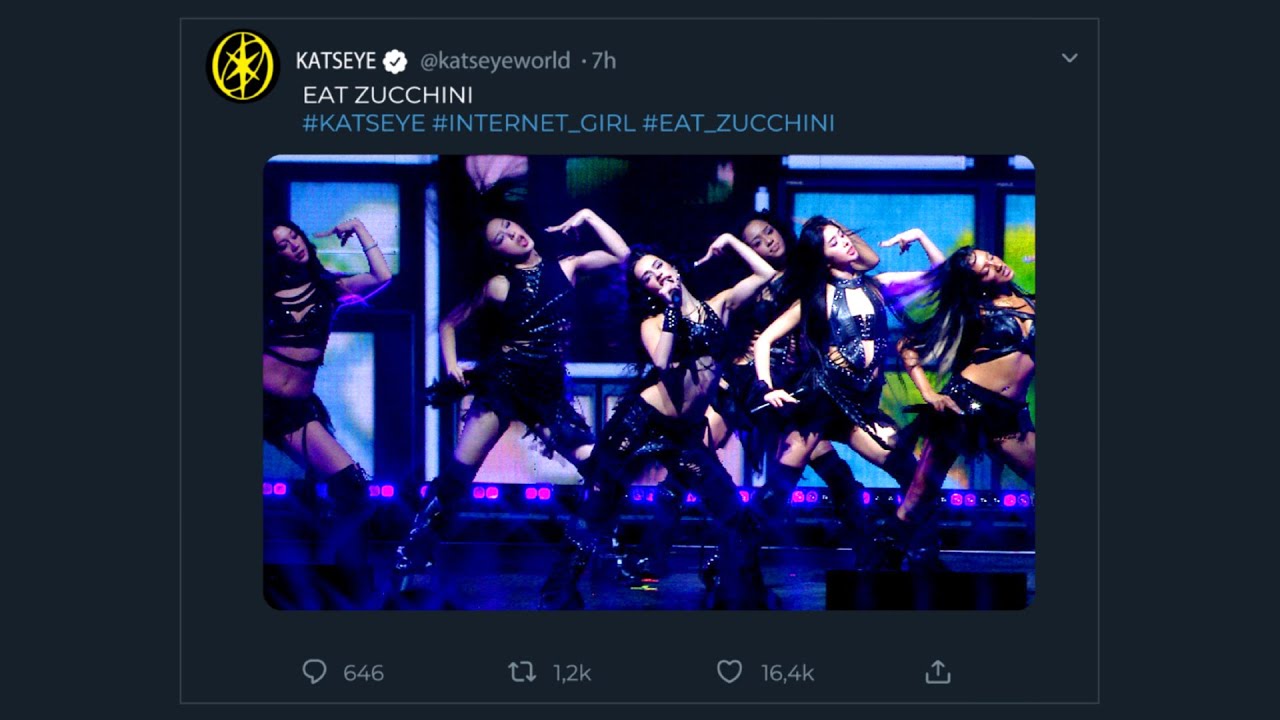
Internet Girl
The feed wants authenticity, but only when it is hot, captioned, correctly lit and delivered before the algorithm loses interest.
Members: Daniela, Lara, Manon, Megan, Sophia and Yoonchae
Project: HYBE x Geffen Records
Format: Official visualizer
Sound: Jittery electropop, clipped phrases and scrolling energy
Central question: When does self-expression become customer service?
Official source: KATSEYE’s website and YouTube channel
What changed every time I replayed it
First play: Recognition arrived disguised as laughter. The phrases felt meme-ready, the production moved like five tabs loading before breakfast, and the girls sounded like they knew the joke would become a caption before the song ended.
Second play: The brightness started carrying fatigue. Being perceived works as currency here, but it also becomes labor that never clocks out. The fun did not disappear. It gained an invoice.
Third play: I listened without the visualizer. The arrangement’s quick turns began to feel like scrolling. A thought appears, earns half a second, then gets replaced before it can become inconvenient. The song lives after the camera leaves, but it feels lonelier.
Fourth play: The looping images became the argument. A pose repeats until personality becomes pattern, then the audience mistakes the pattern for access. We do not know the girl better because the feed refreshed.
Fifth play: I wanted more frightening specificity. Filters, validation and performance are real targets, but KATSEYE knows the uglier version: ranking bodies, translating silence into scandal, turning health into content and treating a young woman’s bad day like public inventory.
Where I landed: Funny until it is bleak, bleak until the beat makes it funny again. Very internet. Very good at making complicity dance.
The beat scrolls before the feeling finishes loading
The production uses jitter as structure. Percussion clips the edges, electronic textures blink in and out, and phrases repeat like posts returning through a recommendation system. The song does not build one smooth emotional arc because the internet rarely allows one. It moves through reaction, pose, joke, fatigue and another pose before anybody finishes processing the first one.
That makes the track catchy in a slightly irritating way, which fits. The hook does not politely ask to stay in memory. It behaves like a sound that an app will place under three hundred videos before lunch. KATSEYE understand that a pop song about the feed must be able to survive inside the feed. Otherwise the critique remains a lecture with expensive hair.
The risk is thinness. Speed can hide the difference between compressed writing and unfinished writing. A few ideas appear as familiar social-media commentary instead of observations only these six women could make. I wanted one bridge where the beat stopped performing coolness and let the exhaustion speak plainly.
Still, the arrangement’s self-awareness matters. It does not pretend music can criticize virality without wanting to go viral. The song enters the machine, looks directly at the camera and asks whether knowing the trap makes us less trapped. The answer is not especially comforting.
The internet girl is a person and a product assembled from reactions
The surface character knows how to look available, desirable, funny and unaffected. She studies which version receives love, then repeats it until the audience calls the repetition authenticity. That is the joke under the glitter: the public rewards a person for becoming predictable, then complains when she feels manufactured.
The harder question is whether performing a successful self still counts as self-expression. Of course it can. Everybody adjusts to context. We speak differently to friends, family, coworkers and strangers. A modern Confucian lens already understands identity through relationships and roles. The problem begins when one role eats the person and every relationship becomes a market.
KATSEYE’s history gives the lyric teeth. Their formation happened through auditions, rankings, public clips, fandom comparison and a documentary that let viewers study the training process. They did not meet the internet after debut. The internet sat in the evaluation room.
That means “just ignore the comments” is nonsense advice. Online attention is not only noise around their job. It helps determine the job. Visibility affects reach, brand value, ticket demand and which member a stranger decides deserves protection or punishment. The girls cannot simply log off from the economy built around looking at them.
A Buddhist lens catches the cycle. The audience craves access, gets a clip, feels satisfied for six seconds, then wants a confession, livestream, apology or breakdown. The idol also learns to crave metrics because metrics turn uncertainty into a number. Neither side reaches enough. The feed survives by making enough impossible.
Six different relationships with the camera
Sophia gives the concept control. She can make direct address feel like leadership instead of pleading. Lara brings the sharpest knowing edge; her delivery often sounds like she has already read the comments and graded them. Daniela adds physical confidence, making the performance feel embodied instead of trapped inside screens.
Manon understands stillness. The internet projects enormous stories onto a quiet face, and the visualizer uses that tension. Megan brings elasticity and can move between comic and unsettled without announcing the switch. Yoonchae adds brightness that becomes complicated inside a song about visibility because youth is one of the internet’s favorite things to praise, protect and police at the same time.
These are my performance reads, not official position labels. The group’s strength is that the concept does not require one designated “online” member. All six have been edited into public characters, though fandom assigns each a different script.
The camera is not documenting the argument; it is inside it
The visualizer leans into screens, repeated poses, interfaces and artificial intimacy. It feels less like entering cyberspace than realizing nobody ever left. The camera keeps presenting closeness while the structure reminds us that closeness is produced.
Looping becomes the most useful device. A gesture repeats until spontaneity looks scheduled. An expression returns until the viewer feels familiarity without learning context. That is how feeds create parasocial confidence. We see enough fragments to believe we understand the whole person, then defend our invented version against the real woman when she behaves differently.
The visualizer also knows the members must look excellent for the critique to circulate. That is not hypocrisy. It is the subject. The internet girl has to package her complaint in the aesthetic language the platform rewards. A messy truth still needs a thumbnail.
Easter eggs and details worth pausing
- Repeated poses: Personality becomes a recognizable product through recurrence.
- Artificial intimacy: Close framing suggests access while giving us no private context.
- Interfaces: The girl is not merely online; the platform keeps rewriting how she can appear.
- Simulated spontaneity: Casual gestures look effortless because the labor has been edited out.
- The loop: The feed does not need a conclusion. It needs another refresh.
- Merchandise logic: The official era extended into apparel, accessories and photo strips, turning critique of the internet girl into objects fans could buy. That contradiction is capitalism doing choreography.
The big picture: girls become public utilities
At the personal level, constant visibility makes private confusion feel like professional failure. A young woman cannot simply be tired. The feed wants a theory, a villain and a statement by dinner.
At the interpersonal level, fandom can mistake care for ownership. “I support her” quietly becomes “she owes me an explanation that preserves the person I decided she is.” Protection turns into control while everybody insists they are helping.
At the global level, KATSEYE carries six cultural backgrounds through one brand. That diversity produces real connection, but it also gives the market six ways to package identity. Nationality, race, language and family become both lived experience and discoverability categories. The members can celebrate where they come from while the algorithm learns which label moves merchandise.
The satire lands because the group cannot solve the problem by standing outside it. They are internet girls critiquing internet girlhood through a visualizer designed for internet circulation. The contradiction is not a flaw to clean up. It is the reason the song belongs to them.
What works
The song packages critique inside the shiny speed of the system it examines. KATSEYE’s formation history gives familiar social-media themes unusual weight. The looping visualizer turns repetition, artificial intimacy and erased labor into part of the meaning.
What gets my side-eye
The lyric sometimes settles for broad observations when these women have lived frighteningly specific forms of surveillance. I wanted one stripped-back bridge, one uncomfortable detail and one moment where the successful online self failed to load.
The joke gets uglier when the job depends on the joke
“Internet Girl” is funny because everybody recognizes the job. Post enough to remain visible. Look casual after planning the angle, light, caption, timing and acceptable amount of honesty. Reply to fans without giving strangers ownership of your nervous system. Ignore the comments, except the company, brands and algorithm are counting those comments as evidence of whether you matter. That is not ordinary teenage posting with better makeup. It is customer service performed through a face.
KATSEYE know this system from the inside. The members entered public life through auditions, rankings, edited missions and a documentary that trained viewers to evaluate their work and relationships. The internet did not arrive after the music. It helped choose the lineup. That history makes the song sharper than a recycled speech about filters. The six women are joking about a machine that can increase ticket demand, decide whose clip travels and turn one awkward expression into a week of character testimony.
The global-group structure adds another layer. Daniela, Lara, Manon, Megan, Sophia and Yoonchae do not enter the same feed with the same cultural expectations. Race, nationality, language, body type and local beauty rules change which member gets read as confident, rude, relatable, privileged, neglected or suspicious. A single post can become six different arguments before breakfast. The visualizer’s split screens and copied interfaces make that fragmentation visible: there is no one internet girl. There are several public versions of each woman, built by the platform, the company, the fandom and the woman herself.
A Confucian lens helps explain why “be yourself” is weak advice. People always perform roles inside relationships. Daughter, friend, coworker, leader and public figure are not automatically fake selves. The problem starts when the commercial role eats the others and the audience expects permanent access. Reciprocity disappears. The performer supplies time, emotion, beauty and reassurance; the viewer decides a stream or comment purchased the right to demand more.
The Buddhist problem is attachment, but not in the lazy “delete the app and find peace” sense. The feed trains everybody to chase reactions that disappear almost immediately. The artist chases proof that attention remains. The fan chases proof that the artist noticed. The platform profits because neither side receives enough satisfaction to stop refreshing. “Internet Girl” packages that cycle as bright electropop because the trap works better when it feels fun.
That is also why the song needed one moment with less polish. The arrangement scrolls accurately, but it rarely lets the exhaustion sit still. A bridge with more exposed vocals or a final chorus that glitches apart could have made the cost physical. The current version understands the system and makes it dance. I wanted thirty seconds where the system stopped smiling back.
RaeRae verdict
“Internet Girl” understands that the feed loves young women most when they remain visible, attractive, explainable and slightly unwell. Pain creates engagement. Recovery ruins the storyline. Silence becomes evidence. A bad angle becomes a public referendum.
KATSEYE make that ugliness catchy without pretending catchy means harmless. The song could dig deeper, but its best move is refusing innocence. The group knows it benefits from the same machine that exhausts it. We laugh because the beat is fun. We feel bleak because we helped teach the algorithm what to reward.
The internet wants authenticity. What it usually means is content. KATSEYE delivered both, then left the camera running long enough for us to notice the difference.
Receipts and official watching
- KATSEYE “Internet Girl” official visualizerDaily+128.9KTotal views48.1M
- KATSEYE official “Internet Girl” release page
- KATSEYE official visualizer archive
- KATSEYE official member profiles
- KATSEYE official Pop Star Academy overview
Source note: Official release, member and training-history details come from KATSEYE’s site and YouTube. Visual, cultural and performance readings are RaeRae editorial interpretation.