
RaeRae Reacts · One Piece Episode 119
Breath of All Things
One Piece Episode 119 gives Zoro his steel-cutting breakthrough through restraint, material awareness, Kuina’s sword, and the breath of all things.
Quick reaction
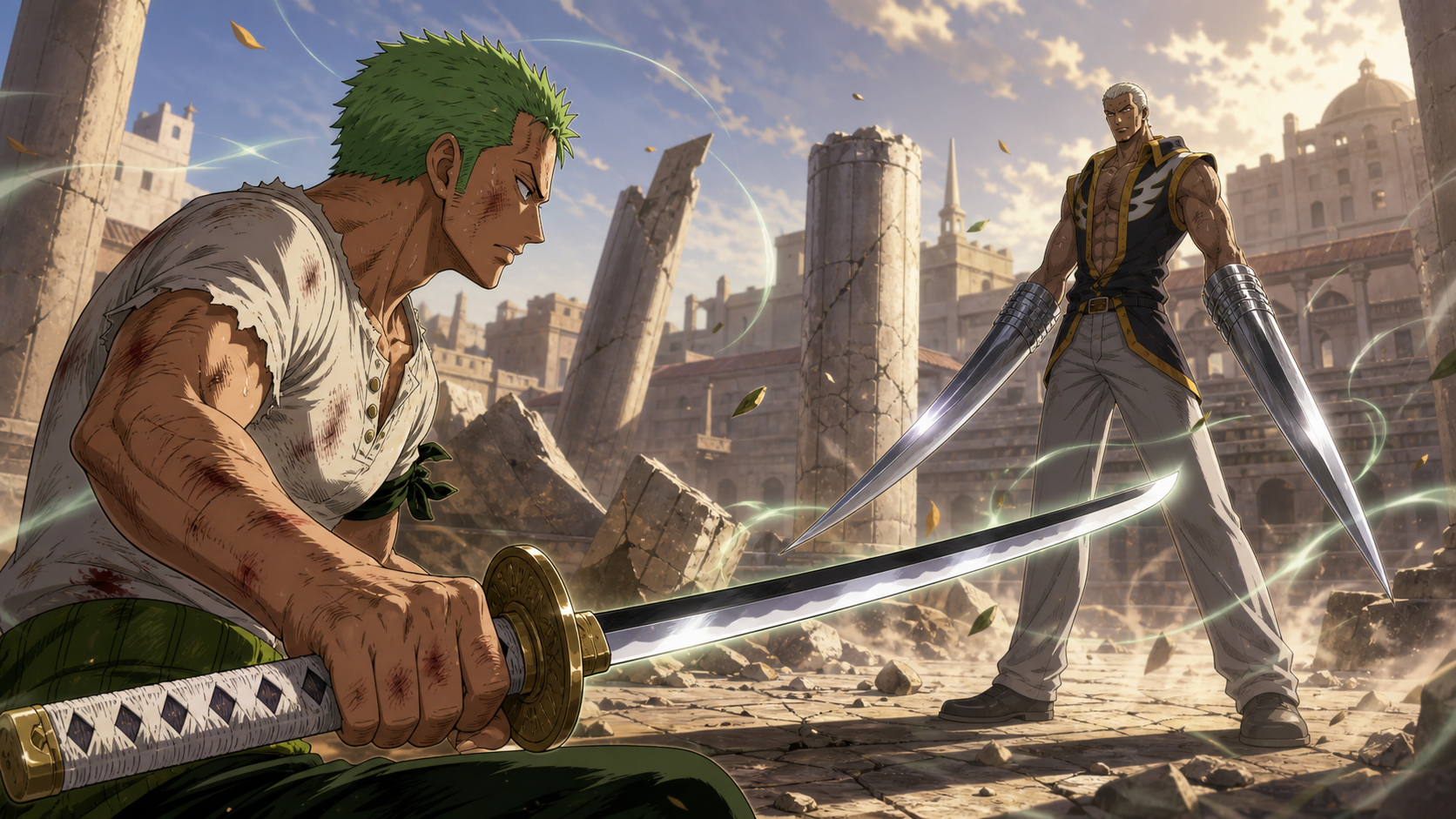
One Piece Episode 119 gives Zoro the breakthrough fans remember because the breakthrough is not “swing harder.” Mr. 1’s body carries the hardness of blades, and Zoro cannot cut him through ordinary force. After taking repeated wounds, Zoro remembers his teacher’s description of a swordsman who can cut nothing and cut steel.
Near collapse, he senses the breath of everything around him, listens for the breath of steel, and commits Kuina’s Wado Ichimonji to one exact cut.
RaeRae’s bottom line: the episode makes restraint, attention, and choice the next stage of strength.
Mr. 1 turns defense into offense
The Dice-Dice Fruit gives Mr. 1 a body with blade-like hardness and cutting surfaces.
Zoro cannot treat him as a passive block of steel because every failed approach also enters striking range.
Arms, legs, and torso can become weapons, which makes ordinary contact dangerous from several directions.
Mr. 1 controls the fight by forcing Zoro to solve durability while surviving continuous cutting pressure.
The power also erases the usual separation between weapon and wielder. Zoro can watch an opponent’s sword hand while tracking the body as ordinary mass. Mr. 1 offers no ordinary safe surface. A shoulder can become an edge, a forearm can extend the line of attack, and a defensive turn can cut anyone who closes carelessly. Reading posture therefore requires a wider map of possible blades.
Zoro’s usual answer stops working
Zoro has survived many battles by training harder, enduring more damage, and applying greater force with sharper technique.
Mr. 1 creates a material limit that those habits cannot cross automatically.
Repeated effort without a changed method only produces more wounds and damaged surroundings.
The episode respects training by showing that training must evolve rather than become a ritual of stubborn repetition.
Zoro’s stubbornness remains useful because the fight demands continued effort after frightening failure. The problem begins when endurance becomes a substitute for diagnosis. Every unsuccessful strike gives information about Mr. 1’s material response, Zoro’s alignment, and the limits of current technique. Growth requires him to treat those failures as evidence. Otherwise pain becomes expensive repetition rather than progress.
Steel is a technical threshold
Cutting steel requires more than labeling a sword attack powerful. Edge alignment, angle, material behavior, control, and the user’s perception all matter inside the story’s sword logic.
Zoro needs to direct force through the correct line instead of spreading effort across resistance.
The threshold becomes meaningful because the narrative has established failure before success.
When steel finally yields, the result reflects a changed relationship between swordsman, blade, and target.
The story does not provide a laboratory explanation, and RaeRae is not pretending the fictional metallurgy follows ordinary engineering. The internal logic still values specificity. Zoro has to recognize steel as steel rather than an abstract “hard thing.” That distinction makes the moment more credible within the series because perception targets the exact problem instead of granting a general power increase against every material.
The teacher’s lesson rejects indiscriminate cutting
Zoro remembers hearing about a swordsman capable of cutting nothing and cutting iron.
The apparent contradiction separates skill from destruction. A great blade does not need to damage every object touched.
Control includes the ability to withhold a cut when cutting would be unnecessary or wrong.
Power becomes credible when the user can choose both action and restraint.
This lesson challenges the fantasy that the greatest swordsman should leave the greatest trail of destruction. A person who can cut steel but cannot protect a leaf, wall, or civilian from an unnecessary stroke remains incomplete. Selectivity is not softness added after strength. Selectivity proves that strength answers intention. The blade stops being a force that happens to the world and becomes a tool governed by judgment.
Not cutting is still an active decision
Restraint should not be confused with weakness, hesitation, or failure to commit.
A swordsman who cannot stop an edge lacks mastery even if the edge can break stone.
The lesson asks Zoro to perceive what he intends to affect rather than treating the environment as collateral material.
Selective force has ethical value because civilians, allies, buildings, and evidence may occupy the same battlefield.
The breath of all things begins with attention
Zoro’s wounded state changes perception. Noise falls away, movement becomes distinct, and surrounding objects seem to carry recognizable presence.
The language is spiritual, but the immediate function is focused awareness.
He stops imposing one answer on every object and starts listening for differences among stone, falling debris, steel, and his sword.
The breakthrough arrives when attention becomes precise enough to guide action.
Fans sometimes connect this scene to later power systems, but Episode 119 should first be read on its own terms. The episode presents sensory awareness, a remembered teaching, and a sword technique capable of finding the relevant material “breath.” Later continuity may add language or parallels. That does not justify importing every future mechanic backward as though the episode explicitly named them here.
Near-death clarity is not a safe training plan
Zoro reaches this state after being cut repeatedly and pushed toward collapse.
The result is narratively powerful but medically catastrophic. Blood loss, shock, nerve damage, infection, and loss of consciousness remain serious risks.
No responsible mentor should reproduce the conditions as a lesson.
Growth under extreme danger can be real without turning preventable trauma into an acceptable curriculum.
Zoro’s altered perception may also reflect the body under severe stress, where time can feel different and attention can narrow sharply. The story gives that experience spiritual and technical meaning. A real person with comparable wounds would need emergency care, not encouragement to chase clarity. Fiction can explore transcendence while viewers keep the medical boundary visible.
Wado Ichimonji carries Kuina’s unfinished dream
Zoro selects the sword inherited from Kuina for the decisive strike.
The blade carries a promise, shared ambition, grief, and the memory of someone whose skill shaped his path.
Using Wado Ichimonji does not make Kuina a magical source of power. Zoro still has to understand, choose, and execute the cut.
The sword gives the moment relational weight because his ambition was never created alone.
Kuina should not become only motivation for a man
Kuina had her own skill, frustration, competitive drive, and claim to becoming the world’s greatest swordsman.
Remembering her only as fuel for Zoro would shrink a full person into a narrative device.
The promise matters most when her ability and her challenge remain visible inside his standard for excellence.
Zoro honors her by treating the shared dream as demanding work, not by claiming ownership of her life.
Wado Ichimonji also carries lineage from her family and dojo. Zoro’s use places him inside a network of teaching, craft, rivalry, and loss. He did not manufacture the blade or invent every principle guiding the strike. Acknowledging those sources does not diminish achievement. The decisive cut becomes richer because personal discipline meets knowledge and tools handed down by other people.
Mr. 1 mistakes hardness for completion
Mr. 1’s confidence is reasonable because Zoro has repeatedly failed to cut his body.
Hardness has functioned as both protection and proof that the swordsman’s current level is insufficient.
The mistake comes from assuming an opponent’s learning has stopped because earlier attacks failed.
A fixed defense becomes vulnerable when the person testing that defense changes the underlying method.
Mr. 1 still deserves recognition as a disciplined opponent rather than a training dummy placed in Zoro’s path. His defense has defeated every earlier attack and his offense has created the conditions of Zoro’s breakthrough. The problem lies in the organization’s limited purpose. Baroque Works measures whether he completes assignments, not whether his skill develops relationships, judgment, or obligations beyond the contract.
The decisive cut uses commitment without panic
Zoro does not reach the final moment by swinging wildly through fear.
He listens for steel, aligns his intention, and trusts one blade.
The calm makes the attack feel more dangerous than another loud barrage because every movement has a purpose.
Commitment comes after perception rather than replacing perception.
Sword mastery includes environmental awareness
Alubarna is full of unstable stone, injured people, narrow streets, and structures already damaged by war.
An indiscriminate cut could create secondary collapse or endanger someone outside the duel.
The breath lesson implies that advanced sword work requires awareness of more than the target.
Technique becomes safer and more effective when the user understands the material world surrounding the line of attack.
That awareness also changes evidence preservation. Alubarna will need to understand which damage came from Baroque Works, which came from defending forces, and which structures remain unstable. A swordsman who can choose a narrow line reduces needless destruction and leaves clearer conditions for rescue. The series does not pause for a formal recovery plan, but the technical lesson supports one.
Masculinity does not need pain worship
Zoro’s endurance is central to his appeal, but endurance should not become the only acceptable form of courage.
The episode’s deeper lesson actually interrupts pain worship. He wins when he listens, remembers instruction, and changes his relationship to force.
Surviving wounds proves commitment. Seeking treatment afterward would also prove responsibility to the crew.
A fighter who values the mission cannot treat his body as endlessly disposable equipment.
Mr. 1 and Zoro represent different labor systems
Mr. 1 uses his body as a perfected professional weapon inside Baroque Works.
Zoro treats swordsmanship as a lifelong discipline tied to promise, identity, and chosen relationships.
Both value competence, but the organization behind Mr. 1 reduces competence to assigned output.
Zoro’s crew gives his work a purpose beyond completing a contract for a boss.
The victory changes Zoro’s future ceiling
Cutting steel solves the immediate matchup, but the greater change is conceptual.
Zoro now knows that sharper perception can open thresholds raw effort cannot.
Future training can build on controlled intention, material awareness, and the capacity to choose what a blade cuts.
The breakthrough expands his path without declaring that mastery is complete.
Production choices create stillness inside violence
Junki Takegami’s script ties Mr. 1’s steel body, the teacher’s lesson, the breath of all things, and Wado Ichimonji into one progression.
Munehisa Sakai’s direction slows the sensory field so falling objects and material presence become readable.
Eisaku Inoue’s animation direction gives Mr. 1’s blade body weight while making Zoro’s final movement controlled rather than frantic.
Miyuki Sato and Toshiaki Marumori’s art turn broken Alubarna stone into part of the episode’s material vocabulary.
What Episode 119 changes
Zoro recognizes that ordinary force cannot cut Mr. 1’s steel-hard body.
He remembers his teacher’s lesson about a swordsman who can cut nothing and cut steel.
Zoro senses the breath of all things, listens for the breath of steel, and uses Wado Ichimonji for the decisive attack.
The victory establishes selective cutting and material perception as the next stage of his swordsmanship.
Episode details
Japanese title: 豪剣の極意!鋼鉄を斬る力と物の呼吸
English title: Essence of a Mighty Sword! The Power to Cut Steel and the Breath of All Things
Japanese broadcast: July 21, 2002
Saga: Alabasta
Material: Manga-canon adaptation
Script: Junki Takegami
Episode direction: Munehisa Sakai
Animation direction: Eisaku Inoue
Art: Miyuki Sato and Toshiaki Marumori
The official One Piece guide confirms Zoro’s inability to cut Mr. 1’s blade-hard body, the remembered lesson about cutting nothing and steel, Zoro sensing the breath of all things, listening for steel, and using Kuina’s Wado Ichimonji for the final cut. The medicine, labor, gender, mentorship, environmental safety, restraint, and accountability analysis is RaeRae’s reading of those events.
Final verdict
Episode 119 earns a 9.8 out of 10. Zoro crosses the steel threshold by becoming more precise, not more reckless.
Mr. 1 forces him to abandon the belief that determination alone can make an unchanged method work.
The breath of all things gives swordsmanship a moral and technical center: hear the world, choose the cut, and never confuse destruction with mastery.
Zoro still needs immediate treatment and a path back to the crew. The victory removes Mr. 1 from the battlefield, but blood loss and accumulated wounds may remove Zoro just as effectively if nobody reaches him. Mastery cannot end at the dramatic pose. Responsibility includes surviving long enough to share what was learned, accept help, and continue the promise carried by Wado Ichimonji.