
The Ties That Bind
The Ten-Tails attacks the alliance through command, communication and bodies, forcing everyone left standing to decide what their bonds require.
Bottom line
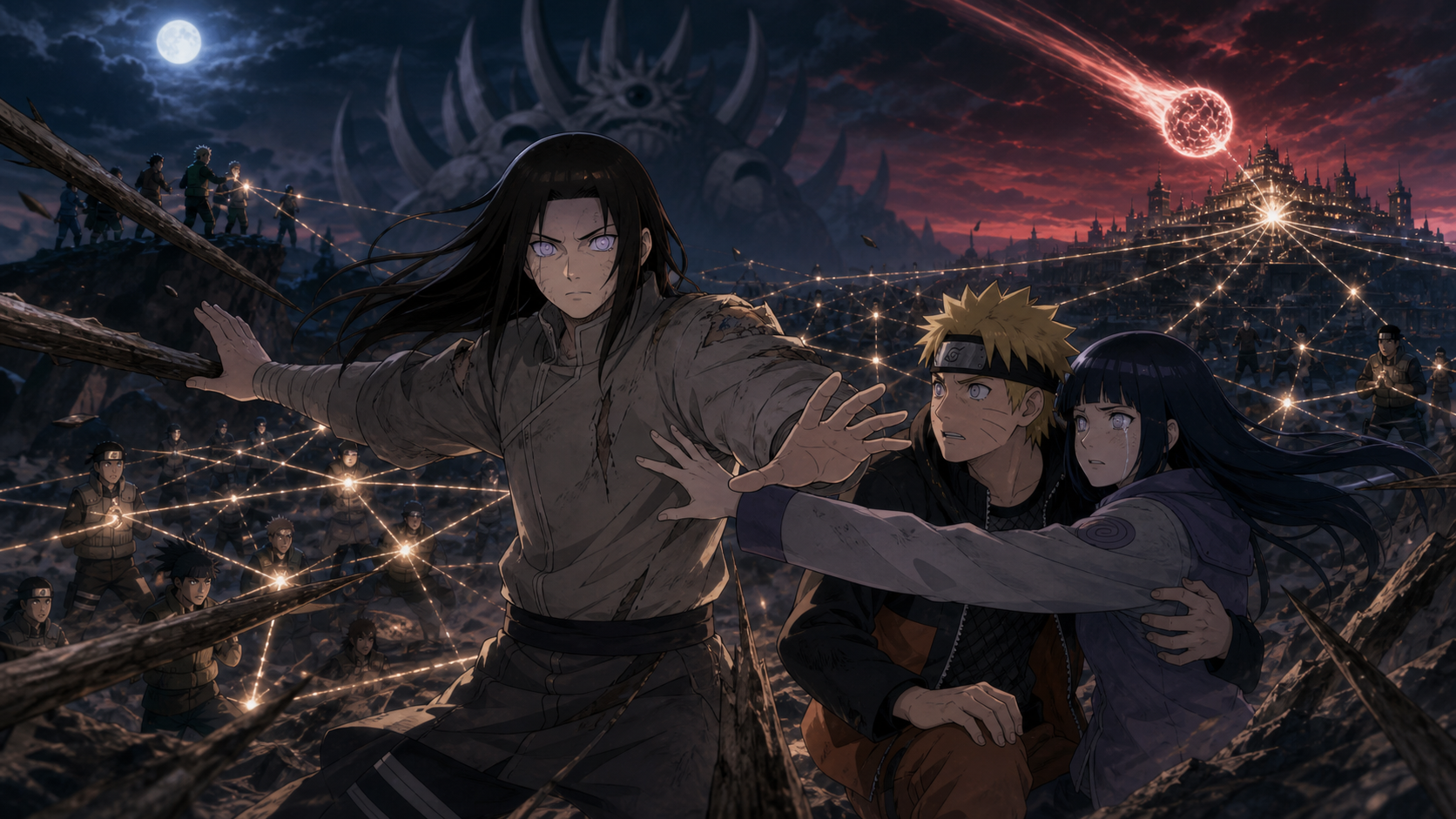
“The Ties That Bind” shows Obito and Madara attacking the relationships that make coalition possible. The Ten-Tails transforms and launches Tailed Beast Bombs toward distant towns, proving that geography offers no safe separation from the battlefield. One bomb targets Allied Headquarters, killing the command team after Shikaku communicates a final strategy. On the main field, the Ten-Tails sends wooden spikes toward Naruto. Hinata moves to shield him, and Neji shields both of them, suffering fatal wounds. Neji chooses protection, but his death should not be reduced to proof that Naruto inspires sacrifice. He was a person shaped by the Hyuga branch system, a teammate, cousin, Jonin, and survivor who once believed fate could not change. His choice belongs to him. The enemy remains responsible for creating the lethal conditions. Ties bind people through care, information, grief, and duty; those bonds should distribute support, not designate whose body becomes the shield.
The alliance begins a coordinated onslaught
The combined techniques from the previous episode move from formation into sustained attack. Former rivals act through a shared sequence.
Coordination creates pressure without guaranteeing control of the Ten-Tails.
Shared action gives the enemy new targets
An organized alliance depends on communication, command, supply, and trust. Obito and Madara can attack those connections rather than only frontline fighters.
Coalition strength creates infrastructure that must be defended deliberately.
Momentum can conceal vulnerability
Successful coordination may make the alliance feel newly capable after earlier helplessness. The Ten-Tails still possesses unmeasured forms and range.
Confidence should support action without becoming certainty about the enemy.
The Ten-Tails transforms
The enemy changes form and capability while the alliance is adapting to its previous scale. Strategy loses currency quickly.
Intelligence must update as the threat evolves.
Transformation invalidates prior assumptions
Attack timing, target selection, durability, and range may all change. Units cannot rely on yesterday’s model because the body before them is changing.
Flexible doctrine matters more than loyalty to a plan built for an earlier form.
The controllers exploit surprise
Obito and Madara understand more about the Ten-Tails than most allied shinobi. Information advantage lets them shape when new capability appears.
The alliance must infer purpose under fire while the enemy already knows the next stage.
Distant towns become targets
Tailed Beast Bombs travel beyond the immediate field toward populated areas. Civilians far from combat remain within the weapon’s reach.
War expands through decisions made by the people controlling the Ten-Tails.
Civilian distance never created consent
Residents outside the field did not agree to become pressure points against the alliance. Their homes are not legitimate substitutes when soldiers are difficult to defeat.
Long-range capability increases the attackers’ responsibility to distinguish targets.
Terror extends beyond physical destruction
Each distant impact tells every community that no rear area is safe. Fear can disrupt evacuation, governance, care, and confidence in the alliance.
The bombs attack social stability along with buildings and bodies.
Distance no longer provides safety
Commanders and residents cannot assume separation from the front protects them. Attack range collapses the distinction between battlefield and rear.
Civil defense becomes part of military planning.
Warning systems need extreme range
Sensors, communicators, and local leaders require a shared process for alerts that arrive with little time. Decentralized shelters may matter more than one central defense.
Preparation must include locations absent from the visible front.
Evacuation cannot outrun every projectile
The weapon’s speed means warning alone may be insufficient. Defensive planning needs interception, dispersion, hardened shelter, and reduced concentration of critical functions.
Civilian protection is an engineering problem as well as a message.
The strikes create strategic confusion
Shinobi wonder why the Ten-Tails aims away from the most visible fighters. The pattern appears wasteful until command infrastructure becomes a target.
Understanding enemy purpose matters more than assuming every attack seeks immediate casualties nearby.
Pattern recognition happens under grief
Reports of towns struck create emotional urgency while analysts still need to identify the target sequence. People must reason about strategy without treating casualties as abstract data.
Command culture should support both clarity and humanity.
Misdirection can prepare decapitation
Multiple distant attacks make range itself the spectacle. The command-center strike then reveals the deeper objective: sever the system coordinating resistance.
Apparent randomness can conceal a specific institutional target.
Headquarters holds the alliance together
Shikaku, Inoichi, and other command personnel turn reports from thousands of shinobi into coordinated action. Their value lies in communication and judgment rather than frontline spectacle.
The enemy recognizes social organization as a form of power.
Strategy is collective labor
Shikaku’s judgment depends on sensor reports, communicators, record keepers, analysts, and local unit updates. No commander thinks in isolation.
Remembering the wider staff prevents one famous name from absorbing every contribution.
Headquarters concentrates expertise and risk
Centralization speeds decision while placing irreplaceable knowledge within one blast radius. Efficiency creates a single point of failure.
Resilient coalitions need backup sites and distributed command authority.
A Tailed Beast Bomb heads toward HQ
The distant command team becomes aware that the weapon cannot be stopped in time through ordinary defense. Knowledge arrives with almost no physical escape route.
Leadership faces mortality while still responsible for everyone on the field.
Recognition comes without rescue fantasy
The command team understands the weapon’s scale and available time. No last-second individual technique can be assumed.
The scene’s weight comes from constrained reality rather than a lack of courage.
Final communication becomes the available action
They cannot protect their own bodies, so they protect the alliance’s next decision. That choice belongs to them under catastrophic pressure.
The attackers remain responsible for making final work necessary.
Shikaku uses the remaining time
He communicates a final strategy rather than allowing panic to consume the last connection. Professional focus preserves future options for survivors.
The decision is courageous and should not make his death feel acceptable or required.
Strategy carries his relational knowledge
Shikaku understands Naruto, the alliance, unit capabilities, and how people respond under pressure. The final plan contains years of attention to others.
Legacy survives through knowledge shared, not because death gives knowledge value.
A father is present inside the commander
Shikaku’s public role does not erase his relationship with Shikamaru. Professional focus occurs alongside personal awareness of what his son will lose.
The casualty is not only a strategist removed from an organization.
Inoichi keeps communication open
The transmission depends on a specialist capable of carrying thought across the alliance. Communication becomes the bridge between doomed headquarters and the living field.
His work gives others a plan while costing him final private moments.
Communication is intimate as well as tactical
The same mental link carrying orders can carry voice, recognition, and farewell. Infrastructure becomes a human connection during death.
Inoichi’s skill serves thousands while his daughter receives the loss personally.
A specialist’s final act reveals system dependence
Without transmission, Shikaku’s strategy would remain trapped at headquarters. The plan survives because communication labor completes command labor.
No single role owns the outcome.
Command personnel remain individual people
Strategists, sensors, communicators, and support staff have families, histories, and lives beyond their functions. Calling the loss “HQ” can hide those people.
Institutional damage and personal death happen together.
Job titles can obscure mourning
Reports may list the headquarters destroyed and command compromised. Families experience particular voices that never return.
Operational summaries should not become the only record of those lives.
Support staff are not lesser casualties
People who maintained maps, signals, analysis, and logistics faced the same blast. Proximity to famous commanders does not define whose death matters.
Remembrance should restore the whole workplace community.
The headquarters strike is deliberate decapitation
Obito and Madara target the system enabling alliance coordination. Removing leaders can fragment action and intensify fear.
The attack demonstrates that command resilience needs distributed authority.
Decapitation also seeks emotional collapse
The alliance may interpret lost leadership as proof that organization has failed. Obito can exploit despair before new command stabilizes.
Succession plans protect morale as well as operations.
Local leaders must inherit intent quickly
Detailed central control is impossible after the strike. Units need the final strategy, shared priorities, and permission to adapt.
Distributed judgment keeps the alliance from becoming a body waiting for a missing head.
A final plan cannot replace the planners
Shikaku’s strategy allows the alliance to continue, but no successful execution restores the people killed. Legacy should not become a claim that their deaths were compensated.
Grief and operational continuity must coexist.
Success cannot balance the deaths
If the alliance later wins, victory does not convert the command-center casualties into an acceptable price. Outcomes do not retroactively authorize targeting.
People may find meaning in continuing without treating loss as payment.
Survivors need time beyond the battle
Shikamaru, Ino, and others may function through immediate necessity. Delayed grief will still require community, truth, and support.
Battlefield competence should not be mistaken for completed mourning.
The main battlefield remains under assault
There is no pause for soldiers to process the distant destruction. Ten-Tails attacks continue against bodies already exhausted.
War forces action before mourning can begin.
Information may arrive unevenly
Some units learn that headquarters is gone while others receive only the final plan. Different knowledge creates different emotional and tactical states.
Clear communication after the strike helps prevent rumor from multiplying fear.
Grief becomes part of the active environment
People must fight while attention returns to parents, teachers, friends, and distant towns. Emotional interruption affects reaction and coordination.
Command should expect human responses rather than demand instant emotional absence.
Wooden spikes target Naruto
The enemy directs lethal force toward a central alliance figure. Naruto’s importance makes him strategically vulnerable.
Being needed should trigger layered protection, not acceptance that others will die around him.
The enemy targets a connective figure
Naruto carries chakra, morale, and relationships across village lines. Killing him would damage more than one combat role.
The strategy again attacks social cohesion through a person.
Concentrated importance produces concentrated danger
When too many alliance functions depend on Naruto, every attack against him forces nearby comrades into desperate defense. Redundancy would reduce that pressure.
Protecting Naruto includes making the alliance less dependent on one body.
Hinata moves to shield him
She acts on her bond and judgment, placing herself between Naruto and the attack. Her agency is active rather than ornamental.
Protection does not reduce her to romantic feeling alone.
Her choice grows from a developed shinobi way
Hinata has repeatedly acted under fear, trained beyond family dismissal, and defined courage through movement beside Naruto rather than admiration from a distance.
The shield belongs to her ethical and tactical development.
Agency and danger coexist
Recognizing Hinata’s choice does not require celebrating a battlefield where her body becomes the remaining barrier. She deserves better defensive options.
Respect for agency should motivate safer structures, not romanticize exposure.
Neji shields Hinata and Naruto
He uses his body when the spikes break through available defense. The act saves two people and costs him his life.
The enemy attack remains the cause of the lethal situation.
He responds inside a fraction of time
The spikes leave little room for deliberation, committee, or alternative deployment. Neji uses the capacity immediately available.
Compressed choice can remain genuine while reflecting conditions imposed by attack.
Protection carries multiple relationships
Hinata is his cousin and teammate within a clan history of unequal branches. Naruto challenged his fatalism and later became a comrade. Both bonds enter the movement.
No single relationship owns the meaning of the act.
Neji’s choice belongs to Neji
His branch-family history makes bodily sacrifice especially charged. He once believed fate assigned him to die for the main house.
Choosing protection freely matters, while the Hyuga system surrounding that meaning still deserves criticism.
Branch-family history complicates sacrifice language
Neji grew up under a seal and hierarchy that defined branch bodies as protection for the main house. A final shield can resemble that assigned destiny from outside.
His own stated understanding matters, and the institution that normalized such sacrifice still remains wrong.
Free choice does not redeem the cage
Neji can choose love and comradeship beyond coercion. That freedom does not prove the branch system was secretly honorable or necessary.
One person’s growth cannot absolve the structure that harmed him.
Freedom should not be proven through death
Neji’s ability to choose cannot require a fatal sacrifice before others recognize his agency. He had already changed through relationships, training, leadership, and survival.
His life demonstrated freedom long before the final shield.
Survival would not have made the choice smaller
Protecting Hinata and Naruto would remain courageous if Neji lived. Fatality adds grief, not moral legitimacy.
Stories should value protective action without requiring the protector to disappear.
Neji had futures beyond this moment
Jonin leadership, Team Guy, Hyuga reform, friendship, and ordinary life remained possible. Death removes those paths.
Remembering unrealized futures resists the idea that sacrifice completed his purpose.
Hinata loses family beside her
She is protected and simultaneously witnesses Neji’s fatal injury. Survival arrives with grief rather than uncomplicated rescue.
Her next actions should not erase the shock she carries.
She receives protection she did not request
Neji decides within the attack, leaving Hinata no opportunity to share or redirect the cost. Gratitude and grief may coexist with anger or guilt.
Survivors do not owe a simple emotional response to sacrifice.
Family history enters the mourning
Main and branch roles shaped their childhood relationship, conflict, and later reconciliation. Hinata loses someone whose life was tied to her through both affection and an unjust clan system.
Grief may reopen every layer at once.
Naruto confronts a broken promise
He wanted to protect comrades and now sees Neji die protecting him. The gap between conviction and control can produce guilt and despair.
A promise can guide action without granting power over every outcome.
Responsibility is not omnipotence
Naruto can take actions to protect comrades and still lack control over an enemy’s every strike or another person’s split-second choice.
False total responsibility would make care psychologically impossible.
Grief can turn conviction against the speaker
Obito points to Neji’s body as proof that Naruto’s promise was a lie. The tactic converts an aspirational ethic into a demand for perfect control.
Human commitments remain meaningful without guaranteeing an untouched world.
Obito uses loss as ideological pressure
The death supports his claim that bonds only create suffering and that Naruto’s words cannot survive reality. He turns a person’s death into an argument for the dream world.
Grief becomes another recruitment tactic.
Timing is part of the manipulation
Naruto is addressed before shock can settle or support can reach him. Obito offers a total conclusion at maximum vulnerability.
The method resembles Madara’s approach to Obito after Rin.
Obito reproduces the grooming pattern
He takes a real death, presents reality as the enemy, and implies surrender to the dream project is the honest response. Personal history has become a script imposed on someone else.
Being harmed by manipulation does not excuse repeating manipulation.
Bonds create vulnerability and resistance
People suffer because they care, and they also coordinate, protect, remember, and continue because they care. Pain does not prove relationship was a mistake.
The title holds both sides of connection.
Pain proves value without proving error
Neji’s death hurts because his life and relationships mattered. The intensity of grief does not establish that caring for him was a mistake.
Obito confuses the cost of love with evidence against love.
Ties distribute memory and obligation
Naruto, Hinata, Team Guy, the Hyuga, and the alliance carry different relationships with Neji. No survivor owns the whole legacy.
Shared memory can support action without flattening individual grief.
Naruto’s grief deserves care without making him the center of Neji’s death. Hinata loses her cousin, Hiashi loses the nephew his branch system failed, and the surviving Hyūga inherit questions that cannot be answered by praising bravery. The alliance loses a fighter whose life contained plans beyond this battlefield. Mourning should preserve those relationships and futures. Neji chose whom to protect in that moment. The people left behind must choose whether his clan will keep producing the conditions he fought to escape.
RaeRae’s verdict
“The Ties That Bind” attacks the alliance at its connective tissue. Headquarters falls because Obito and Madara understand that communication and strategy make thousands act as one. Neji dies because the enemy targets Naruto through bodies tied to him by care.
The episode must resist turning either loss into efficient motivation. Shikaku, Inoichi, Neji, and every casualty remain people rather than fuel for the survivors’ next attack. Their final choices carry courage. The responsibility for the lethal conditions belongs to the war’s architects. The alliance honors ties best by distributing protection and refusing the belief that bonds matter only when someone dies for them.
RaeRae’s call
Neji’s death is a choice made inside an attack, not proof that he was born to die for the main branch. He protects Naruto and Hinata because his bonds became his own. The Hyūga system still owes an accounting for the seal, hierarchy, and childhood that made his freedom so costly. Love can explain his action without turning sacrifice into destiny.
Episode details and viewing routes
- Official episode reference: Naruto Official episode guide
- Licensed episode route: Crunchyroll licensed episode page
What I am carrying forward
The Ten-Tails has transformed and launched long-range Tailed Beast Bombs at towns and Allied Headquarters. Shikaku communicates a final strategy before the headquarters strike kills the command team.
On the main battlefield, Hinata shields Naruto and Neji shields them both, suffering fatal wounds. Naruto is confronted by grief and Obito’s argument that bonds inevitably produce despair. Episode 365 follows Hinata helping Naruto stand, Shikaku’s final strategy, and Kurama’s chakra reaching the alliance.