
The Allied Shinobi Forces Jutsu
Kurama and Gyūki run dry, so the alliance answers the Ten-Tails by turning thousands of specialized shinobi into one coordinated technique.
Bottom line
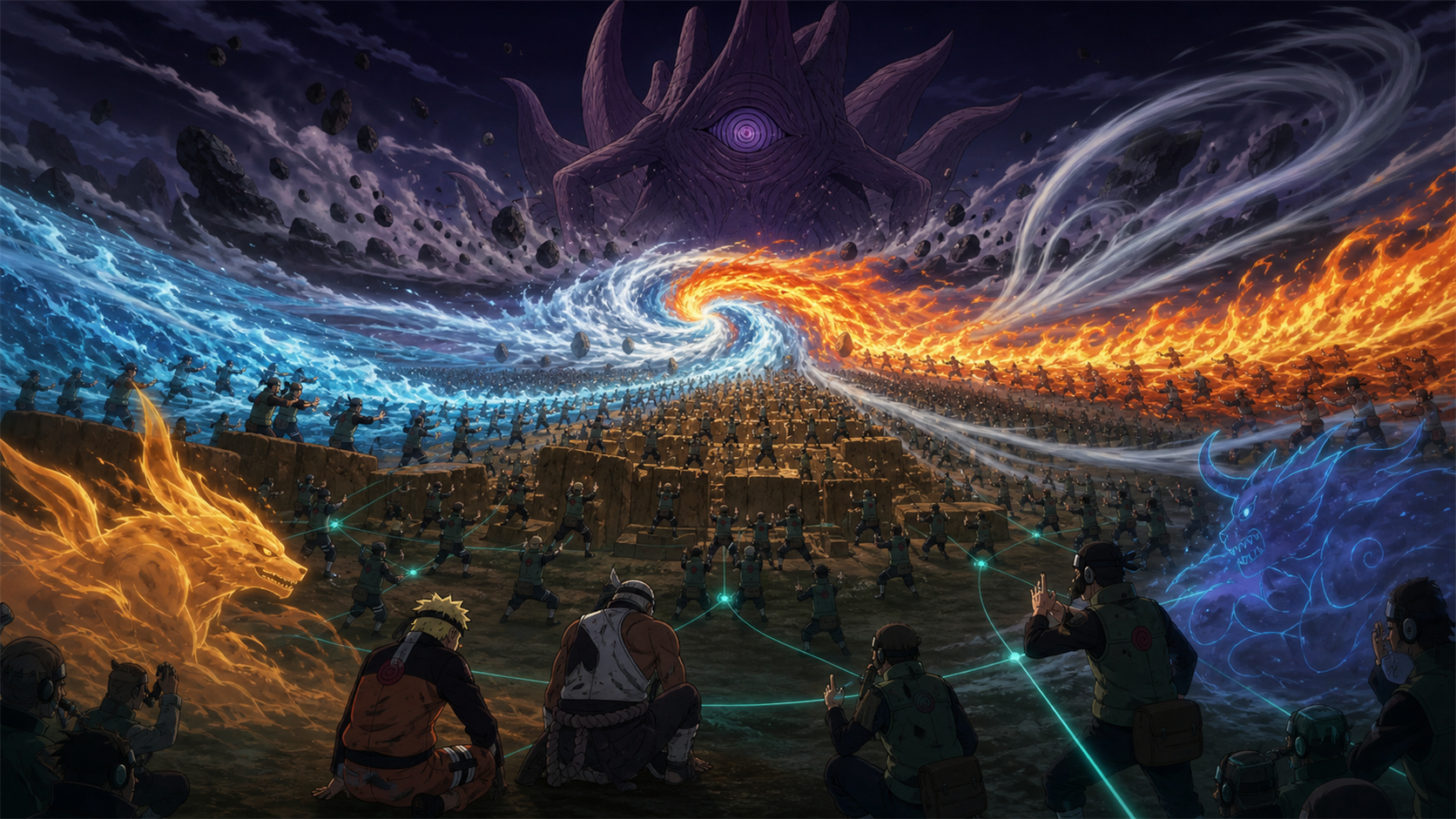
“The Allied Shinobi Forces Jutsu” answers the Ten-Tails with coordination rather than another solitary miracle. The barrier breaks and the revived beast enters the battlefield with force that makes earlier scale feel almost irrelevant. Kurama and Gyuki lead the immediate response through Naruto and Killer Bee, but both tailed beasts exhaust their available chakra and fade from active manifestation. Their limit matters. Naruto and Bee are not endless containers, and alliance strategy cannot depend on two bodies absorbing every cost. The Allied Shinobi Forces arrive with techniques from villages once trained to compete or fight one another. Sensor work, earthworks, mist, insects, coordinated attacks, medical support, and command become one collective jutsu. Unity does not erase each village’s history or individual expertise. Coalition strength comes from keeping those differences legible enough to combine them. The episode expands comradeship from a three-person team to an army that must protect one another across old borders.
The barrier shatters
The structure containing the Ten-Tails fails under overwhelming power. A defensive plan that delayed catastrophe cannot prevent the next phase.
Failure of one barrier does not make the earlier effort worthless.
Delay created time for reinforcement
Containment gave allied units space to move, communicate, and assemble. A defense can succeed strategically even when the defense eventually breaks.
Measuring only permanent containment would erase the lives and options gained through delay.
Broken infrastructure requires immediate adaptation
Plans built around the barrier’s shape no longer match the field. Command must update routes, ranges, and protective positions quickly.
Flexibility becomes a collective skill rather than one leader’s improvisation.
The Ten-Tails changes battlefield scale
Shock waves move through air and terrain with force beyond ordinary combat. Distance no longer guarantees safety.
Every formation must account for an enemy whose attacks affect entire regions of the field.
Scale can produce fatalism
When one attack dwarfs ordinary jutsu, individual contribution may feel meaningless. Despair becomes another threat to coordination.
The alliance needs plans where small actions have visible place inside a larger effect.
Scale increases civilian stakes beyond the field
The Ten-Tails can threaten command centers, villages, and distant populations. Battlefield failure would not remain confined to willing combatants.
Protection must include people who never entered the war zone.
Immense power creates coordination pressure
Individual fighters can possess extraordinary techniques and remain unable to alter the central threat alone. Disconnected strength becomes vulnerable to waste.
The answer requires timing, information, and shared purpose.
Power without sequence can interfere with itself
One technique may block another user’s sightline, destroy prepared terrain, or consume space needed for evacuation. More force is not automatically better force.
Coordination turns separate abilities into compatible action.
Shared purpose needs operational translation
Every unit may agree that the Ten-Tails must be stopped. Agreement becomes useful only through assignments, signals, contingencies, and reliable communication.
Solidarity requires structure.
Kurama takes the offensive lead
Naruto and Kurama respond quickly to prevent the Ten-Tails from controlling every exchange. Their action buys time and establishes a line others can support.
Leadership under emergency should create participation rather than permanent dependence.
Speed prevents the enemy from setting every condition
Immediate pressure can disrupt aim and give allies time to establish defenses. Kurama’s initiative serves the wider force before the wider force fully arrives.
The value lies partly in opportunity created for others.
Leading first carries disproportionate risk
Naruto and Kurama place themselves closest to power whose limit remains unknown. Heroic narrative can hide that concentration of danger.
Command should plan relief before exhaustion forces relief.
Gyuki joins the effort
Killer Bee and Gyuki contribute another tailed beast partnership with distinct experience and power. Their presence keeps Naruto from becoming the only jinchūriki asked to stand against the threat.
Shared burden improves both strategy and ethics.
Bee brings experienced partnership
He and Gyuki have long practiced communication under combat pressure. Their coordination offers knowledge beyond raw chakra volume.
Alliance planners should value relational expertise alongside destructive capacity.
Partnership resists jinchūriki isolation
Naruto can see another person working with a tailed beast as ally rather than prison. Bee’s presence normalizes shared decision inside a system built through forced sealing.
The battlefield partnership carries political meaning.
The attack cannot overpower the Ten-Tails
Kurama and Gyuki remain formidable, but the combined enemy exceeds their current force. Strength meets a material limit.
Recognizing that limit prevents bravery from becoming denial.
An unsuccessful attack can reveal information
The Ten-Tails’ response shows resilience, reaction time, and relative scale. That evidence can shape the next sequence.
Failure becomes useful when observers communicate what failure taught.
Retreat from one tactic is not surrender
Continuing the same attack after the result is clear would spend chakra without changing conditions. Tactical withdrawal protects capacity for another approach.
Adaptation honors effort better than repetition for pride.
Chakra exhaustion is bodily evidence
Both tailed beasts expend what they can sustain and fade from active form. Naruto and Bee cannot continue as though the resource remains available.
Recovery time is part of battlefield planning, not a personal failure.
Fatigue changes judgment as well as output
Exhaustion can slow reaction, narrow attention, and increase risk beyond reduced chakra. Naruto and Bee need cover while their partnerships recover.
Rest becomes a collective defense responsibility.
Limits should be reported before collapse
Kurama and Gyuki can communicate remaining capacity so commanders do not build plans on imaginary reserves. Honest limits improve coordination.
A culture that rewards only endurance makes early warning less likely.
Jinchūriki are not limitless batteries
The alliance benefits from their chakra while Naruto and Bee carry physical and emotional consequences. Their bodies must remain visible inside strategic discussion.
Hero status should not create permission for endless extraction.
Strategic dependence can reproduce old abuse
Villages historically confined jinchūriki because tailed-beast power was valuable. An alliance can praise Naruto and Bee while still repeating extraction if every plan centers their depletion.
Respect appears through workload, consent, rest, and alternatives.
Gratitude should become material protection
Celebrating sacrifice after danger is not enough. Other units should shield, heal, resupply, and take the front when the jinchūriki reach limits.
Reciprocity turns praise into practice.
Tailed beasts are participants
Kurama and Gyuki think, choose, assess, and communicate. Calling their power a resource alone repeats the logic that made jinchūriki systems abusive.
Coalition respect includes the beings contributing chakra.
Consent changes the meaning of shared power
Kurama and Gyuki choose cooperation through relationships developed with Naruto and Bee. Their current participation differs from forced extraction by villages and Akatsuki.
That distinction should remain visible in alliance language.
Exhaustion belongs to them too
When manifestations fade, the tailed beasts have expended their own capacity. Their recovery cannot be discussed solely as hosts regaining access to a weapon.
Personhood includes bodily limit.
The alliance arrives as reinforcement
Shinobi from multiple villages enter the same immediate fight. Their arrival changes Naruto and Bee from isolated anchors into members of a wider force.
Reinforcement is a relationship enacted through timing.
Arrival redistributes emotional burden
Naruto sees that the war is not waiting for him to solve every problem alone. Visible allies challenge the isolation attached to jinchūriki heroism.
Collective presence can restore judgment as well as manpower.
Reinforcement must integrate quickly
New units enter a fight already moving at extreme speed. Command needs common signals and concise plans that cross village doctrine.
Preparation before arrival determines whether numbers become usable force.
Former enemies now share formation
Village systems built through rivalry and war must coordinate against a threat created partly through those histories. Alliance does not erase prior harm.
Working together creates a present commitment that can reshape what comes after war.
Trust can begin through dependable action
Shinobi do not need to forget previous conflicts before relying on another village’s wall, sensor report, or medical team. Repeated reliability builds evidence.
Battlefield cooperation can create a foundation for later political repair.
Alliance does not absolve village history
Current unity should not silence grievances or erase wars that shaped the participants. Reconciliation requires future truth and accountability.
Emergency solidarity is meaningful without becoming retroactive innocence.
Sensor teams make scale readable
No fighter can see every movement across the battlefield. Sensory intelligence turns dispersed observation into shared situational awareness.
Information becomes protective when information reaches the people who need to act.
Communication protects specialists from isolation
Sensors may detect danger without possessing the power to respond directly. Fighters may possess power without knowing where response matters.
The link between them creates capability neither role has alone.
Accuracy includes uncertainty
The Ten-Tails may change form or produce signals outside prior experience. Reports should distinguish confirmed location from inference.
Honest uncertainty prevents commanders from treating estimates as guarantees.
Earth Style changes terrain collectively
Defensive walls and altered ground can redirect force, create cover, and constrain movement. Techniques associated with one user become more powerful through coordinated layering.
Infrastructure is part of combat survival, not background to spectacular attacks.
Layered walls distribute force
Multiple users can construct depth no one person could sustain. Each layer gives time for the next response.
Collective defense values cumulative contribution rather than one decisive name.
Terrain work protects movement corridors
Walls and channels matter for evacuation, healer access, and formation integrity as much as direct blocking. Good design anticipates who needs to move after impact.
The battlefield becomes shared infrastructure.
Mist can disrupt enemy perception
Visibility control creates tactical uncertainty for an opponent with overwhelming raw force. A lower-damage technique can matter through placement.
Utility depends on the plan rather than visual scale.
Concealment also affects allies
Mist can obscure friendly signals and routes without coordination. Sensor guidance and agreed timing keep concealment from becoming self-sabotage.
Specialist techniques require shared context to reach full value.
Defensive uncertainty can buy seconds
Against overwhelming power, even brief hesitation or aim disruption creates space for another wall, retreat, or attack.
Small time gains accumulate across the coalition.
Insects and specialized techniques add precision
Clan abilities contribute functions no universal jutsu can replace. Coalition strategy benefits from knowing who can do what.
Difference becomes an asset without ranking human worth by ability.
Specialist knowledge needs respect before crisis
Command cannot improvise effective use of every clan technique without prior listening. Experts should help define what their abilities can and cannot do.
Consultation prevents leaders from treating specialists as interchangeable tools.
Rare ability does not create expendability
A technique uniquely suited to the moment may place one unit at higher risk. Strategic need should trigger additional protection rather than permission to sacrifice that unit.
Value belongs to the people as well as their function.
Medical support preserves the force
Combat capacity depends on treatment, evacuation, recovery, and triage. Healers make continued resistance possible.
Support roles are not secondary to the battle’s outcome.
Triage is a moral and tactical burden
Healers make decisions under scarcity about urgency, transport, and survivability. Those choices deserve clear protocols and emotional support.
No healer should carry battlefield resource failure as private guilt.
Prevention reduces medical overload
Walls, warnings, rotation, and disciplined retreat keep injuries from reaching treatment. Care begins before a patient arrives.
Every unit shares responsibility for medical capacity.
Command turns many actions into one sequence
Orders must account for timing, range, fatigue, and changing information. Coordination creates a combined effect no isolated unit could produce.
Command earns legitimacy by using people carefully rather than spending them for appearance.
Distributed leadership improves resilience
One command center can become a target or lose communication. Local leaders need intent and authority to adapt when central orders stop.
Resilient coordination combines shared strategy with decentralized judgment.
Orders should make sacrifice accountable
Some positions may carry unavoidable risk. Leaders must explain purpose, consider alternatives, and avoid assigning danger according to status or political convenience.
Necessity should be demonstrated rather than declared.
The title names a collective jutsu
No single person owns the Allied Shinobi Forces Jutsu. The phrase describes many techniques organized into shared action.
Authorship is distributed across fighters, planners, sensors, communicators, and medics.
Naming the alliance changes hero language
The decisive subject is not Naruto alone or one Kage alone. The title gives agency to an organized multitude.
Collective naming makes invisible labor harder to erase.
A jutsu can be social architecture
Chakra techniques matter, but the larger mechanism is trust, signal, timing, and role integration. Human coordination becomes a form of power.
The episode expands what mastery can mean.
Unity does not require sameness
The alliance succeeds by combining distinct training rather than flattening everyone into one method. Each village brings knowledge shaped through its own environment and history.
Respectful coalition preserves difference while aligning action.
Standardization should serve communication
Common terminology and signals reduce error across villages. Standardization becomes harmful only when one village’s practice is treated as universally superior without review.
Shared protocol can coexist with local expertise.
Difference creates redundancy
If one technique fails, another village’s method may address the same need through a different mechanism. Diversity protects the alliance from a single point of failure.
Coalition resilience grows from multiple ways of solving problems.
Naruto’s role changes inside the group
He remains a central source of courage and power without remaining the only answer. Accepting reinforcement is part of leadership.
The child once denied community now fights inside one built across nations.
Receiving help completes the comradeship principle
Naruto excels at giving chakra, protection, and hope. Accepting cover when exhausted confirms that he belongs without needing to earn every moment through rescue.
Mutual aid moves in more than one direction.
Leadership can be catalytic rather than centralizing
Naruto’s courage helps others act, but he does not need to control each contribution. A leader can make collective capacity visible and then trust the collective.
The alliance becomes stronger than a crowd waiting for instructions from one hero.
The alliance turns specialization into shared power
No single elemental division defeats the Ten-Tails. Earth walls redirect movement, water changes conditions, wind amplifies fire, and coordinated attacks create openings. The technique belongs to the sequence, not one shinobi standing at the end of it.
That structure matters on a battlefield full of famous bloodlines. Ordinary specialists become indispensable because cooperation makes each limited skill part of a larger answer.
Shikaku’s plan survives through people
The headquarters loss could have reduced strategy to a final heroic memory. Instead, communication carries Shikaku’s thinking into thousands of hands. His leadership becomes useful because others can understand, adapt, and execute the plan after he is gone.
A system that depends on one irreplaceable genius dies with that person. Shared instructions turn grief into coordinated action without pretending the death was acceptable or necessary.
Inoichi’s network makes participation possible
Coordination requires more than a clever order. Shinobi across divisions need the same information at the right moment, in language they can use under pressure. Inoichi’s work and the communication teams make collective technique physically possible.
Support labor is not background decoration. The alliance can move as one body because people carry messages, maintain links, interpret timing, and keep frightened fighters connected to a plan.
Exhaustion changes who must carry the line
Kurama and Gyūki cannot remain unlimited rescue engines. When their chakra runs low, the alliance has to protect the jinchūriki and hold the battlefield rather than waiting for another impossible burst.
The reversal honors Naruto and B without making everyone else spectators. People who received protection now return it. Community becomes reciprocal when strength moves toward whoever is most exposed in the present moment.
The title refuses a single-owner victory
Calling this the Allied Shinobi Forces Jutsu gives authorship to the group. The name preserves divisions, messengers, planners, sensory teams, elemental users, and the people who hold formation while someone else attacks.
Collective credit is not sentimental. It describes how the technique works. Removing any layer weakens the result, which means recognition should follow the actual chain of labor.
The scene answers a village lie: difference does not prevent solidarity. Shinobi keep their elements, clans, ranks, and knowledge while accepting one another’s timing. Unity is not sameness and cooperation is not erasure. The alliance works because coordination gives contributions a shared direction. That principle should outlive the emergency. Peace will require institutions that fully value interdependence before an enemy forces everyone to remember it.
RaeRae’s verdict
“The Allied Shinobi Forces Jutsu” makes scale an ethical argument. Kurama, Gyuki, Naruto, and Bee give everything available and still reach a limit. The alliance cannot answer by demanding more from the same bodies.
Instead, former enemies arrive with different techniques and functions, creating power through coordination. The most important jutsu is not one spectacular release. The most important jutsu is a structure where information, protection, terrain, attack, and care reinforce one another. Collective action becomes the battlefield version of the bell test: nobody can be designated the acceptable loss.
RaeRae’s call
The alliance finally gets a jutsu named for everybody because everybody is doing the work. Shikaku’s plan, Inoichi’s communication, elemental divisions, support teams, and frontline fighters become one answer when Naruto and B cannot carry the field alone. This is what shared power looks like: distinct labor, clear timing, reciprocal protection, and credit that follows the whole chain.
Episode details and viewing routes
- Official episode reference: Naruto Official episode guide
- Licensed episode route: Crunchyroll licensed episode page
What I am carrying forward
The Ten-Tails has broken the barrier and demonstrated overwhelming power. Kurama and Gyuki have exhausted their active chakra manifestations after leading the initial response.
The Allied Shinobi Forces have arrived and combined village techniques into coordinated action. Naruto and Bee now fight within a larger coalition rather than carrying the defense alone. Episode 364 follows the ties that bind the alliance as the Ten-Tails targets command and personal loss reaches the battlefield.