
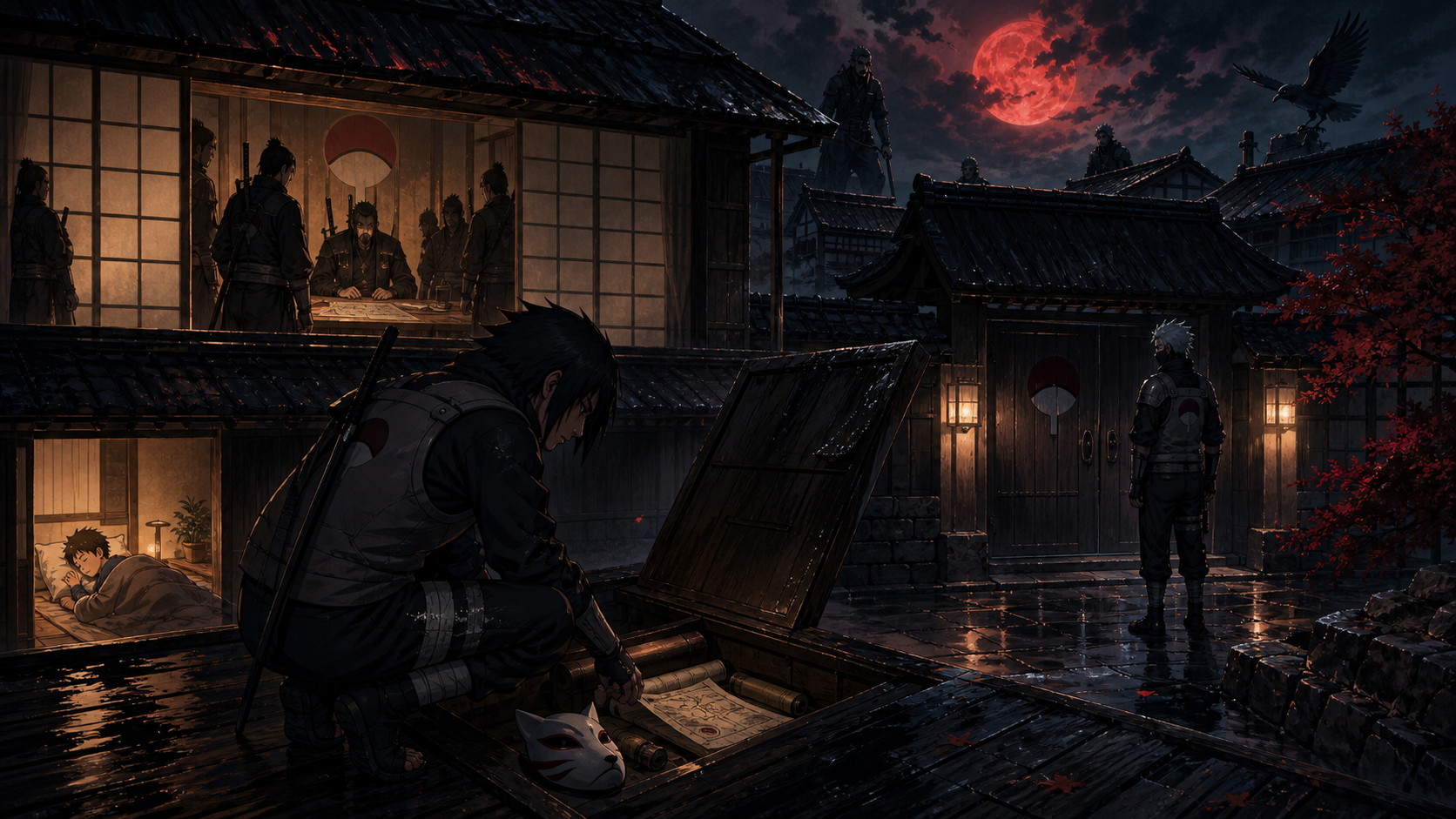
The Night of the Tragedy
Kakashi feels the Uchiha district closing itself off as Itachi uncovers the evidence that proves the coup has moved beyond rumor.
Bottom line
“The Night of the Tragedy” brings Konoha’s surveillance crisis to mass killing. Kakashi visits the Uchiha district and notices a community more guarded than before. Itachi confirms concrete coup preparations, but evidence against leaders does not make every Uchiha civilian a combatant. Danzo presents the crisis as an ultimatum: cooperate in destroying the clan and preserve Sasuke, or allow conflict that will kill everyone, including the younger brother. Itachi seeks Obito’s help and participates in the massacre, then accepts public blame as a rogue ninja. Coercion, youth, fear of war, and love for Sasuke explain how adults narrowed his choices. Those pressures do not transform mass killing into peacekeeping. Danzo carries central responsibility for engineering the ultimatum and rejecting nonviolent intervention. Obito carries responsibility for joining the slaughter. Itachi carries responsibility for participating. The dead retain individual personhood beyond the coup plan used to erase them.
Kakashi enters a changed district
The Uchiha community appears colder and more withdrawn than during his earlier visit. Social change is visible before the final violence.
Guarded behavior reflects surveillance, fear, internal planning, and awareness that ordinary contact carries political risk.
Daily life continues before catastrophe
Homes still contain meals, arguments, chores, sleep, and relationships. Political history often compresses a district into leaders and plans, but residents remain inside ordinary lives until violence reaches them.
Remembering that ordinariness prevents the massacre from becoming an abstract plot transition.
Distance has been produced over time
Relocation, monitoring, suspicion, and clan meetings have reduced casual contact with the wider village. Kakashi sees an endpoint in a process, not a sudden personality change.
The altered atmosphere records policy as much as clan reaction.
“Antisocial” describes an effect, not a cause
People under continuous monitoring may reduce contact and protect conversation. Distance does not arrive from clan character alone.
The label risks blaming a watched community for adaptations produced by being watched.
Guardedness can protect people and hide danger
Privacy helps families preserve dignity under surveillance. The same closed channels can allow coup planning to advance with less internal challenge.
One behavior can serve different purposes, which is why labels cannot replace evidence.
Outsiders see behavior without the pressure behind behavior
Kakashi can observe fewer greetings or greater caution. He cannot immediately see every camera, meeting, threat, and family demand shaping those choices.
Surface interpretation needs humility before becoming security judgment.
Kakashi notices without receiving the whole truth
He sees tension and understands that senior political problems surround Itachi. Classified layers keep him from the full decision chain.
Observation gives him concern without enough authority or information to stop the approaching outcome.
Concern without a channel becomes helplessness
A healthy institution would let an experienced captain raise warning signs and receive enough response to protect people. Compartmentalization keeps the most consequential plans above him.
Secrecy does not merely hide facts from enemies. Secrecy prevents possible intervention by allies.
Kakashi warns Itachi about senior politics
The warning recognizes that powerful adults are drawing the younger operative into conflicts beyond normal mission duty. Advice offers care but cannot remove the orders already shaping him.
Itachi needs structural protection, not only caution from a captain with limited access.
Itachi finds concrete coup evidence
The threat is no longer only a council suspicion based on Sharingan capability. Clan leaders are preparing action against Konoha.
Evidence creates a duty to intervene while leaving the form of intervention open.
Specific evidence should create specific targets
Names, plans, locations, timelines, and material preparation allow authorities to distinguish organizers from residents. Better intelligence should narrow coercion.
Using precise evidence to justify indiscriminate killing reverses the purpose of investigation.
Confirmation does not validate earlier collective punishment
Surveillance helped intensify the conditions in which coup planning advanced. Later evidence cannot retroactively make years of clan-wide suspicion fair.
A harmful policy can identify danger partly created by that policy and still remain harmful.
Leadership guilt is not collective guilt
People planning a coup can be identified, confronted, detained, or politically isolated. Children and civilians sharing their district do not become lawful targets.
Collective extermination abandons the distinctions intelligence was meant to establish.
Family connection is not command responsibility
Children do not control Fugaku’s strategy because they share his name. Spouses and relatives do not become planners through proximity.
Political accountability must follow decision-making rather than genealogy.
Dissenters may be invisible inside the record
Some Uchiha may oppose force, remain undecided, or lack access to leadership discussions. Secrecy can hide internal diversity from village observers.
Massacre guarantees that every potential dissenter is punished alongside every organizer.
A coup creates real danger
Armed seizure could trigger civil war, retaliation, and outside attack. Itachi’s fear is not imaginary.
The reality of danger makes responsible de-escalation urgent, not irrelevant.
Civil war would multiply outside intervention
Other villages could exploit Konoha’s internal conflict, expanding danger beyond the initial confrontation. Leaders have reason to fear cascading harm.
That possibility supports rapid protective planning while leaving collective killing morally prohibited.
Catastrophic forecasts need scrutiny
Danzo presents the worst case as certain if his preferred action is rejected. Forecasts can inform policy, but forecasts also reflect assumptions about negotiation, arrests, and command response.
Predicted disaster should not become an unquestionable weapon.
Danzo frames only catastrophic options
He presents massacre or uncontrolled war as the meaningful choices. Negotiation, targeted arrest, disclosure, mediation, leadership change, and surveillance reform disappear from the frame.
A false binary can coerce even when both named outcomes contain genuine danger.
The missing alternatives were not cost-free
Targeted arrests might provoke resistance. Negotiation might fail. Public disclosure could cause panic. None offers guaranteed safety.
Uncertainty does not make massacre the responsible default. Ethical action often requires accepting risk rather than transferring every risk onto a marked population.
Time pressure strengthens the false binary
As coup preparation advances, fewer options remain easy to organize. Danzo benefits from earlier failures to de-escalate because urgency now makes extreme action look inevitable.
Delay and coercion operate as parts of the same political failure.
Sasuke becomes leverage
Danzo understands that Itachi’s younger brother is the relationship most likely to override every other consideration. Sparing Sasuke becomes conditional on cooperation.
Threatening one child to secure violence against a family is coercion.
Survival is offered as a conditional exception
Danzo does not recognize Sasuke’s inherent right to live. He offers one child’s life as payment for Itachi’s cooperation.
The exception confirms the underlying policy of collective guilt.
Itachi cannot verify the promise safely
The person demanding massacre also controls much of the security apparatus that could harm Sasuke afterward. Trust is forced toward an authority already demonstrating willingness to target children.
Coercive bargains provide no reliable protection simply because terms are spoken.
Love is turned into command infrastructure
Itachi wants Sasuke alive and protected from civil war. Danzo makes that desire the mechanism through which the massacre becomes actionable.
The plan exploits care rather than honoring care.
Sasuke’s future becomes Itachi’s impossible project
Itachi tries to preserve a brother’s life while knowing the method will devastate that brother’s identity and relationships. Physical survival and emotional safety are split apart.
No child should need to choose which dimension of a sibling’s life can be saved.
Protective intention cannot control aftermath
Itachi can plan to bear hatred, but he cannot determine how grief will shape Sasuke or what others will reveal later. Manipulated survival creates consequences beyond his design.
Love does not grant complete authorship over another person’s recovery.
Itachi is still a child under adult authority
His skill, rank, and composure do not create equal bargaining power with Danzo and village leadership. Years of secret work have narrowed his access to support.
Youth intensifies the responsibility carried by adults constructing the choice.
Rank disguises the developmental imbalance
ANBU credentials make Itachi appear like another operative negotiating strategy. Danzo has decades of institutional experience, political control, and authority over consequences.
Formal role cannot make those positions equal.
Prodigy status becomes permission for abandonment
Because Itachi can understand the crisis, adults act as though he can carry the crisis. Intelligence becomes the excuse for withholding protection.
Understanding a burden does not make a burden appropriate.
Coercion does not erase participation
Itachi acts within extreme pressure and incomplete alternatives. He still helps kill people who did not choose the coup.
Compassion and accountability must remain in the same analysis.
Participation does not erase coercion either
Naming Itachi’s actions should not reproduce Danzo’s public story that one inherently cruel son destroyed his clan alone. The state constructed the demand and benefited from secrecy.
Accurate responsibility is distributed without becoming diluted.
Moral injury follows impossible action
Carrying out violence against family under pressure can fracture identity, memory, and any belief that later good conduct restores what happened.
Itachi’s future discipline cannot make this night psychologically neutral.
Obito becomes a willing partner
Itachi seeks assistance from the masked Uchiha who can move through barriers and shares no commitment to preserving the clan. Obito accepts.
His participation serves his own political project and deepens the atrocity.
Obito is not under Danzo’s authority
He does not face the same command hierarchy, child status, or threat to Sasuke. His decision comes from his own goals and long-developed rejection of reality.
Distinguishing coercive contexts clarifies why responsibility is not equal among participants.
Access makes him uniquely dangerous
Kamui lets Obito cross barriers and strike where ordinary defenses might slow another attacker. The massacre expands because Itachi recruits someone suited to hidden killing.
Operational assistance remains authorship of harm.
The attacker returns to the community he destabilized
Obito’s Nine-Tails assault helped produce the suspicion placed on the Uchiha. He now helps destroy the people who carried consequences for his hidden act.
The cycle gives him responsibility at both origin and culmination.
Hidden causation protects him from suspicion
Uchiha residents carried blame for the Nine-Tails attack while the responsible Uchiha remained outside the district and public record. Collective profiling missed the actual perpetrator.
The failure demonstrates why identity-based suspicion is poor intelligence as well as injustice.
Mass death removes possible witnesses and opponents
The clan might contain people capable of questioning Madara’s identity, recognizing ocular patterns, or opposing Obito’s project. Destruction eliminates more than coup participants.
Obito benefits strategically from a community becoming unavailable to contradict him.
The massacre is not clan accountability
Accountability investigates actions, evidence, command, and individual responsibility. Mass killing treats identity as the offense.
No coup plan can justify eliminating every person connected by family.
Punishment cannot precede individual judgment
No residents receive charges, defense, evidence review, or opportunity to surrender. Death becomes the first and final institutional response.
The absence of process is part of the atrocity, not a procedural footnote.
Prevention cannot become preemptive extermination
Security officials may act before a planned attack begins, but preventive action still requires discrimination, proportionality, and protection of uninvolved people.
Calling violence preemptive does not release those obligations.
Civilians remain civilians
Residents sleeping in homes, children without political authority, and relatives outside planning structures retain protection. Their deaths cannot be absorbed into a strategic total.
Editorial language should not let “the Uchiha” become one faceless target.
Each home contains a separate loss
Clan totals can communicate scale while hiding relationship. Every death removes a particular person from parents, siblings, friends, work, and future plans.
Human scale resists the political convenience of one collective noun.
Children cannot inherit treason
No theory of clan loyalty makes a child responsible for plans discussed by adults. Killing children exposes the collective logic without any remaining security defense.
Their inclusion proves the operation was extermination rather than targeted prevention.
Fugaku’s leadership choices matter
As clan leader and father, he supports a political route that places family and community at risk. His grievance against Konoha does not excuse coup preparation.
His responsibility remains individual and cannot be transferred to every clan member.
Village leadership had greater preventive power
Konoha controlled surveillance, official negotiation, arrests, force deployment, and the terms of inclusion. Leaders had more capacity to create alternatives before the crisis reached this night.
Greater power creates greater responsibility for de-escalation.
Oversight failure becomes lethal
Danzo retained enough autonomous force and secrecy to shape the outcome against Hiruzen’s stated preference. A leader who cannot control a covert subordinate leaves residents exposed to private policy.
Institutional design shares responsibility with individual command.
Earlier inclusion could have changed incentives
Fair representation, integrated service, transparent investigation, and limits on surveillance might not have removed every militant voice. Those changes could have strengthened clan members invested in peaceful belonging.
Prevention begins years before the night when leaders announce no time remains.
Hiruzen’s preference for dialogue arrives too weakly
Diplomatic intent matters, but intent without timely control over Danzo and the security apparatus cannot protect the clan. Leadership requires enforcing the chosen path.
Delay leaves coercive actors room to make violence irreversible.
Good intent without enforcement cannot shield civilians
Hiruzen’s wish for negotiation matters morally, but residents need decisions, deadlines, protection, and restraint imposed on Danzo’s apparatus.
Leadership is evaluated through what policy permits as well as what a leader privately prefers.
Delegated secrecy returns as lost control
Years of tolerating Foundation give Danzo personnel and channels capable of acting beyond ordinary review. The massacre crisis exposes the cost of that tolerated autonomy.
A shadow institution does not become harmless because the Hokage hopes for another outcome.
Danzo converts prevention into elimination
He defines safety as removing the population associated with the threat. The policy does not distinguish organizer, dissenter, child, or civilian.
Security language covers collective punishment.
Itachi accepts the rogue identity
After the massacre, he becomes the public perpetrator who appears to have acted from personal cruelty or ambition. The village’s role remains hidden.
One person carries blame that protects institutional leaders from scrutiny.
The public story preserves Konoha’s innocence
If one unstable Uchiha killed the clan, village policy appears unrelated to the outcome. Surveillance, ultimatum, and state knowledge disappear.
Narrative control becomes part of institutional self-protection.
Exile continues the punishment
Itachi loses home, family, public identity, and the possibility of openly grieving the people he helped kill. Becoming rogue is not freedom from the operation.
The role requires living inside the lie created to conceal leadership responsibility.
Secrecy controls how Sasuke understands loss
Sasuke survives without the political truth needed to interpret why his family died. His grief is directed toward the brother made visible as killer.
Protection of his life is paired with profound manipulation of his reality.
Hatred is deliberately directed
Itachi makes himself the visible object of Sasuke’s anger, believing hatred will keep the brother alive and focused. The strategy uses trauma as future structure.
Sasuke receives a mission of vengeance instead of informed mourning.
A survivor deserves truthful history
Age and immediate safety may shape when difficult information is shared, but permanent deception denies Sasuke ownership over family memory.
Protection should eventually expand truth rather than preserve a manufactured world.
Kakashi loses another teammate to hidden politics
Itachi leaves ANBU and Konoha under a story Kakashi cannot fully evaluate. A younger operative he tried to guide becomes associated with an atrocity.
The pattern reinforces how secret command separates comrades before truth can move between them.
The title centers tragedy but responsibility must remain named
“Tragedy” can suggest an unavoidable disaster without authors. This night was produced through decisions by identifiable people and institutions.
Grief should not soften accountability into fate.
“Night” compresses a much longer history
The killing occurs within hours, but causes stretch across village founding, police segregation, the Nine-Tails attack, surveillance, coup planning, and covert authority.
The final night is a culmination rather than an isolated eruption.
Remembrance should resist strategic totals
Security narratives count threats removed. Clan narratives may count a people lost. Ethical remembrance also restores individual lives and the choices denied to them.
Nobody should become only evidence in another person’s political argument.
RaeRae’s verdict
“The Night of the Tragedy” should never be read as proof that massacre saved Konoha. The coup presented real danger, and clan leaders bear responsibility for preparing force. Danzo responded by coercing a child into collective killing and using Sasuke’s life as leverage. That method did not preserve peace. That method buried political failure beneath bodies and secrecy.
Itachi’s position is devastating because he is both coerced and participating. Obito is neither rescuer nor neutral assistance; he joins a massacre that benefits the project he has been building since the Nine-Tails attack. The Uchiha dead deserve to remain people, not the background price of Sasuke’s survival or Konoha’s stability.
RaeRae’s call
The coup evidence is real, and the adults still own the road that placed Itachi at the final junction. Uchiha leaders chose organized force. Konoha answered years of exclusion with more surveillance and fewer honest routes. Calling this the night of tragedy must never turn the massacre into weather. Leaders made choices, a child carried their impossible demands, and an entire community stood inside the consequences. The warning is simple: evidence of danger cannot erase responsibility for the policies that helped make violence feel like the only remaining route.
Episode details and viewing routes
- Official episode reference: Naruto Official episode guide
- Licensed episode route: Crunchyroll licensed episode page
What I am carrying forward
Itachi has confirmed concrete coup preparations within Uchiha leadership. Danzo has narrowed the crisis into a coercive ultimatum tied to Sasuke’s survival, and nonviolent options have not been pursued with equal force.
Itachi and Obito carry out the Uchiha massacre. Sasuke survives without the truth, while Itachi accepts the public identity of rogue killer and leaves Konoha. Episode 360 follows Hiruzen removing Kakashi from ANBU and assigning him as a Jonin Leader.