
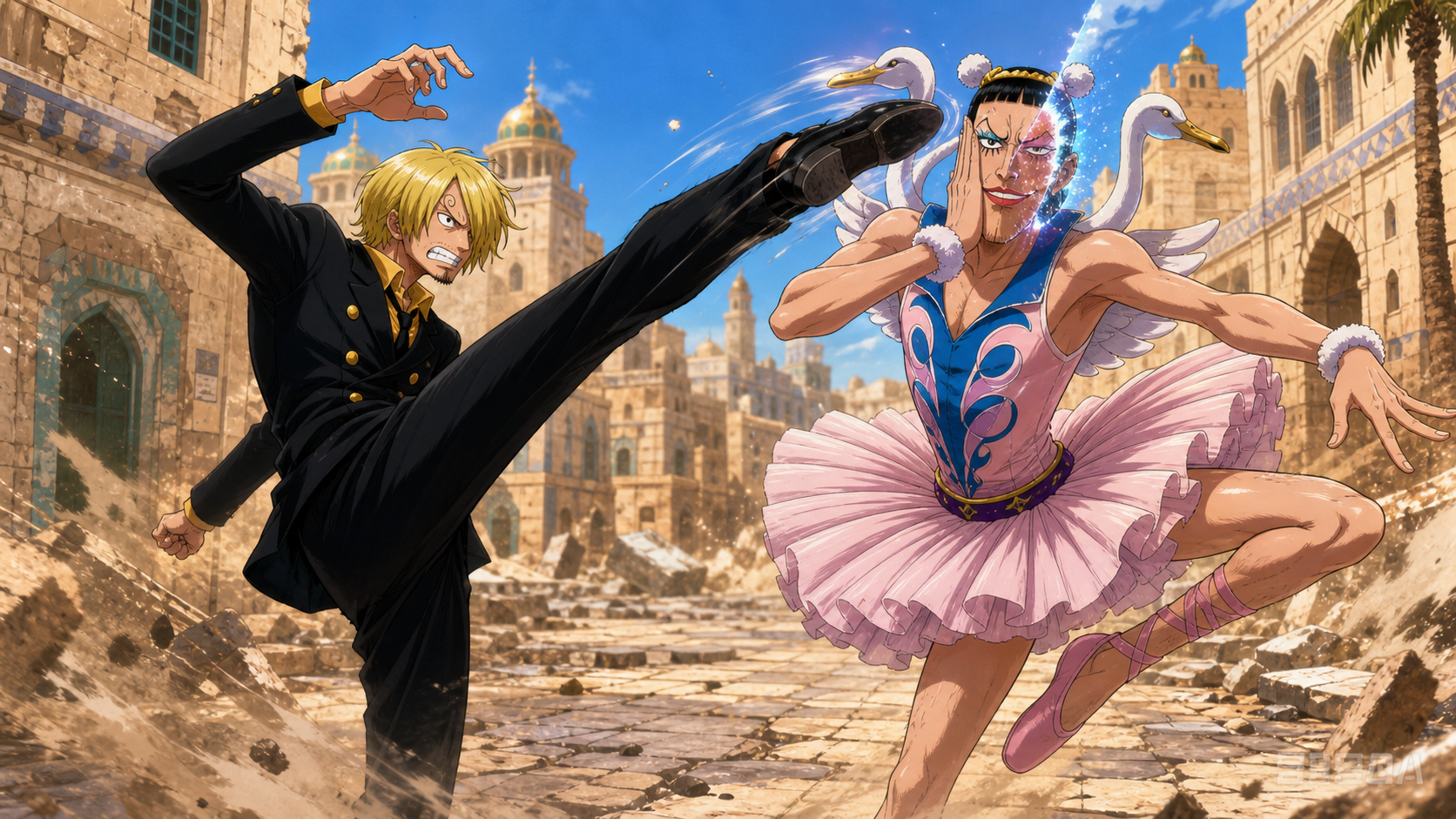
RaeRae Reacts · One Piece Episode 116
Ballet Kenpo
One Piece Episode 116 turns Sanji versus Bon Clay into a tactical fight about copied identity, predictable ethics, and the limits of transformation.
Quick reaction
One Piece Episode 116 turns Sanji versus Bon Clay into a fight about rules, bodies, and the danger of trusting a familiar face. Bon Clay can copy anyone touched by the right hand, including Nami. Sanji freezes when that face appears. The trick works until he notices the Copy-Copy Fruit’s crucial tradeoff: Bon Clay cannot use ballet combat while holding another person’s body.
Elsewhere, Usopp finishes treating Chopper, Mr. 1 chooses Zoro, Miss Doublefinger chooses Nami, and Crocodile reaches Vivi as the palace approaches demolition.
RaeRae’s bottom line: Sanji wins the tactical argument, but the episode refuses to make his code look uncomplicated.
Bon Clay fights through spectacle and precision
Bon Clay enters combat like a stage already belongs to him. Ballet poses, swan imagery, makeup, and dramatic declarations create a performance that opponents may mistake for distraction.
The movement is not decorative. Balance, rotation, flexibility, and leg strength become weapons with real reach and impact.
Sanji also fights almost entirely with his legs, so the duel becomes a contest between two disciplined movement systems rather than strength against a joke.
The theatrical surface makes Bon Clay memorable. Technical control makes him dangerous.
The Copy-Copy Fruit attacks recognition
Bon Clay can reproduce the face and body of someone touched with the right hand. The left hand returns the original appearance.
That power weaponizes the human habit of recognizing identity through visible features. A familiar face can trigger affection, caution, fear, or hesitation before evidence catches up.
Sanji knows Bon Clay stands in front of him, yet Nami’s appearance still activates a practiced refusal to strike.
The power succeeds inside the gap between intellectual knowledge and embodied reaction.
That gap matters because combat rarely allows a calm second review. Vision reaches the nervous system before a fighter can recite every fact already known. Bon Clay does not need a permanent deception. A fraction of hesitation can change distance, interrupt a kick, or expose Sanji’s ribs. The Fruit therefore rewards careful study of relationships. The most useful face is not always the strongest face, but the one connected to the target’s deepest automatic response.
Sanji’s chivalry becomes predictable behavior
Sanji treats his refusal to strike women as a moral boundary. Bon Clay treats the same boundary as an exploitable rule.
A rule visible to an opponent becomes part of the battlefield. Sanji’s consistency allows Bon Clay to predict when an attack will stop.
Respect for women does not require surrendering judgment to a copied body. Bon Clay’s agency, intent, and current conduct remain unchanged behind Nami’s face.
The episode exposes how a code can protect one value while failing to answer a new ethical problem.
Sanji’s eventual solution remains tactical rather than philosophical. He learns when Bon Clay must return to the original body and strikes during that opening. The deeper contradiction survives. If another opponent can borrow a woman’s appearance without losing combat ability, Sanji will face the same paralysis again. A durable ethical code needs principles for deception, coercion, copied identity, and the duty to protect people endangered by hesitation.
Appearance cannot carry consent
Nami did not consent to having her body reproduced as a weapon against a friend. The copied appearance remains connected to her social identity even though Bon Clay controls every action.
Sanji’s reaction centers his own rule, but Nami’s missing consent deserves equal attention.
The Fruit creates reputational and relational harm because observers may respond to the borrowed face as if the original person chose the behavior.
Identity theft in this world can become physical, immediate, and violent.
Sanji finds the transformation tradeoff
Bon Clay’s copied body is not compatible with the practiced ballet technique used in the original form. The disguise creates access to Sanji’s hesitation while reducing combat performance.
Sanji recognizes that the strongest psychological state and strongest fighting state cannot operate at the same moment.
That observation creates a narrow opening. He can prepare for the switch rather than responding only to the face already visible.
A Devil Fruit weakness matters most when an opponent can convert knowledge into timing.
Transformation has operational costs
Power discussions often treat transformation as a free expansion of options. Episode 116 shows a cost hidden inside abundance.
Each copied body carries different dimensions, balance, reach, and muscle memory. Bon Clay may reproduce physical form, but trained movement still belongs to practiced habits.
Switching also requires a hand gesture and a decision. Both actions create observable signals.
More available identities produce more choices, and more choices create moments where the user must select, commit, and accept a limitation.
Bon Clay manages a library of bodies under pressure. Each switch requires remembering which face creates leverage, which shape preserves technique, and how the opponent has adapted. That mental workload grows during a fast exchange. Sanji reduces the advantage by forcing rapid decisions. The faster Bon Clay must alternate between disguise and ballet, the more visible the sequence becomes and the less room remains for improvisation.
Sanji wins by watching rather than overpowering
Sanji’s kicking power keeps him competitive, but observation changes the direction of the duel.
He tracks when Bon Clay transforms, what movement disappears in the copied state, and what must happen before ballet combat resumes.
The answer is not a stronger finishing move pulled from nowhere. The answer is a better model of the opponent.
Sanji’s cooking background fits that process. Professional kitchen work depends on timing, sequencing, heat, physical control, and constant adjustment.
Bon Clay’s gender expression is not the weakness
The episode uses flamboyance, ballet, and gender nonconformity as comedy, reflecting early-2000s conventions that often treated queer-coded presentation as an automatic punch line.
RaeRae is not accepting that framing without comment. Bon Clay’s makeup, costume, movement, and self-presentation do not make the character less serious or less capable.
The tactical weakness comes from a specific transformation constraint, not femininity, queerness, or theatricality.
Bon Clay remains one of the most technically demanding opponents in this phase of Alabasta.
Modern viewers can appreciate the character’s refusal to shrink while still criticizing jokes built around gender presentation. Both readings can coexist. Bon Clay’s confidence, loyalty, and later choices will earn genuine affection from fans, but future importance does not sanitize every early gag. RaeRae can celebrate the performance, name the stereotype, and keep the tactical analysis focused on what the episode actually establishes.
Rivalry begins building unexpected respect
Sanji and Bon Clay insult, strike, and study one another, but the fight also creates recognition between two leg-based specialists.
Each understands the discipline required to make a kick decisive. That shared knowledge produces a form of respect beneath the hostility.
One Piece often lets a ridiculous first impression conceal a relationship that later carries real emotional weight.
Episode 116 lays groundwork without pretending the current violence has already become friendship.
Usopp treating Chopper reverses the expected role
Chopper is the crew’s doctor, yet Usopp finishes treating him after their victory. Injury can temporarily remove the specialist from the role normally assigned to that person.
Usopp’s care demonstrates why teams need shared basic skills. First aid cannot belong to one person when that person may become the patient.
The scene also prevents the previous win from becoming consequence-free. Both fighters remain damaged and need time they barely have.
Mutual care continues after the final attack rather than ending with applause.
Usopp treating the crew’s doctor also reveals the difference between expertise and ownership. Chopper has deeper medical knowledge, but care is not a private territory that disappears when he cannot lead. Usopp can follow prior instruction, use available supplies, monitor immediate danger, and keep Chopper stable. A resilient crew spreads enough knowledge to cover emergencies while still respecting the specialist’s training once the specialist can resume work.
Mr. 1 choosing Zoro is a deliberate matchup
Mr. 1’s Dice-Dice Fruit turns his body into blades. Zoro wants to become a swordsman capable of cutting steel.
The pairing places ambition against a physical threshold. Zoro cannot solve the fight through ordinary technique if his blades cannot damage the opponent.
Baroque Works benefits from separating the crew into isolated tests where assistance becomes difficult.
The matchup promises growth, but growth will need more than a louder attack.
Miss Doublefinger targets Nami’s uncertainty
Nami faces a senior Baroque Works agent while still learning how to use the Clima-Tact Usopp built for her.
Miss Doublefinger’s Spike-Spike Fruit turns close distance into danger from nearly every angle.
Nami has intelligence, weather knowledge, and a new tool whose operation is not yet fully understood under combat pressure.
The matchup asks whether invention can become reliable before the user’s body runs out of safe mistakes.
The crew’s battles become a labor map
Alabasta divides the Straw Hats by skill, vulnerability, and available opponent. Every fight demands a different kind of labor.
Usopp and Chopper diagnose systems. Sanji reads movement. Zoro confronts material limits. Nami must translate scientific knowledge into field technique.
No single definition of strength covers all four problems.
The arc works best when each crew member’s ordinary work remains connected to combat rather than disappearing behind generic power.
This structure also protects the ensemble from becoming a ranking chart. Zoro may have greater direct destructive power than Nami, but sword strength cannot operate the Clima-Tact or expose Crocodile’s information campaign. Sanji’s speed cannot replace Chopper’s diagnosis. Usopp’s aim cannot make Vivi’s political legitimacy credible by itself. The crew succeeds when different forms of competence remain visible, connected, and accountable to a shared objective.
Crocodile reaches Vivi before the palace falls
Vivi is trying to prevent the palace demolition from becoming another mass-casualty event. Crocodile’s arrival narrows the available time and adds direct coercion.
He benefits from every divided defender and every citizen who cannot verify what caused the war.
The palace matters as infrastructure, symbol, and possible blast site. Destroying the building may alter crowd movement without resolving the conspiracy.
Vivi faces an opponent who has spent years turning public institutions into tools for private power.
Information control links every battle
Bon Clay manipulates visual identity. Crocodile manipulates political narratives. Baroque Works agents manipulate battlefield positioning.
Different powers serve the same organizational habit: control what people perceive, then make the controlled perception produce predictable behavior.
Sanji escapes one trap by identifying the mismatch between appearance and function.
Alabasta needs the same skill at national scale, where citizens must separate visible conflict from the hidden system that engineered the conflict.
Direction keeps the duel readable
Michiru Shimada’s script defines the Copy-Copy Fruit weakness through action and connects the duel to the larger battlefield.
Masaru Koyama’s direction gives transformation, hesitation, ballet movement, and counterattack separate visual beats, so the tactical discovery remains clear.
Kenji Yokoyama’s animation direction emphasizes extended kicks, balance changes, and the contrast between copied posture and Bon Clay’s practiced body.
Miyuki Sato’s art keeps the damaged Alubarna streets visually connected to the approaching palace crisis.
What Episode 116 changes
Sanji identifies that Bon Clay cannot use ballet combat while maintaining a copied body, creating a path to victory.
Usopp completes treatment for Chopper after their successful fight, preserving the physical consequences of Episode 115.
Mr. 1 selects Zoro and Miss Doublefinger selects Nami, opening two specialized battles.
Crocodile reaches Vivi as the palace approaches demolition, tightening the central political crisis.
Episode details
Japanese title: 友に変身!ボンクレー連発バレエ拳法
English title: Transformed into Nami! Bon Clay’s Rapid-Fire Ballet Kenpo
Japanese broadcast: June 23, 2002
Saga: Alabasta
Material: Manga-canon adaptation
Script: Michiru Shimada
Episode direction: Masaru Koyama
Animation direction: Kenji Yokoyama
Art: Miyuki Sato
The official One Piece guide confirms Usopp finishing Chopper’s treatment, Mr. 1 targeting Zoro, Miss Doublefinger targeting Nami, Sanji discovering that Bon Clay cannot use ballet combat in Nami’s copied form, and Crocodile appearing before Vivi as the palace nears demolition. The consent, gender, labor, identity, care, information, and accountability analysis is RaeRae’s reading of those events.
Final verdict
Episode 116 earns a 9.3 out of 10. Sanji solves a Devil Fruit problem by watching the body rather than trusting the face.
Bon Clay remains dangerous because the performance and the technique belong together. The episode’s dated comedy does not erase the character’s skill or the sharper questions created by copied identity.
Across Alubarna, every Straw Hat now faces a test built around personal limits. Crocodile expects those limits to isolate them. The crew keeps turning specialized work into resistance.