
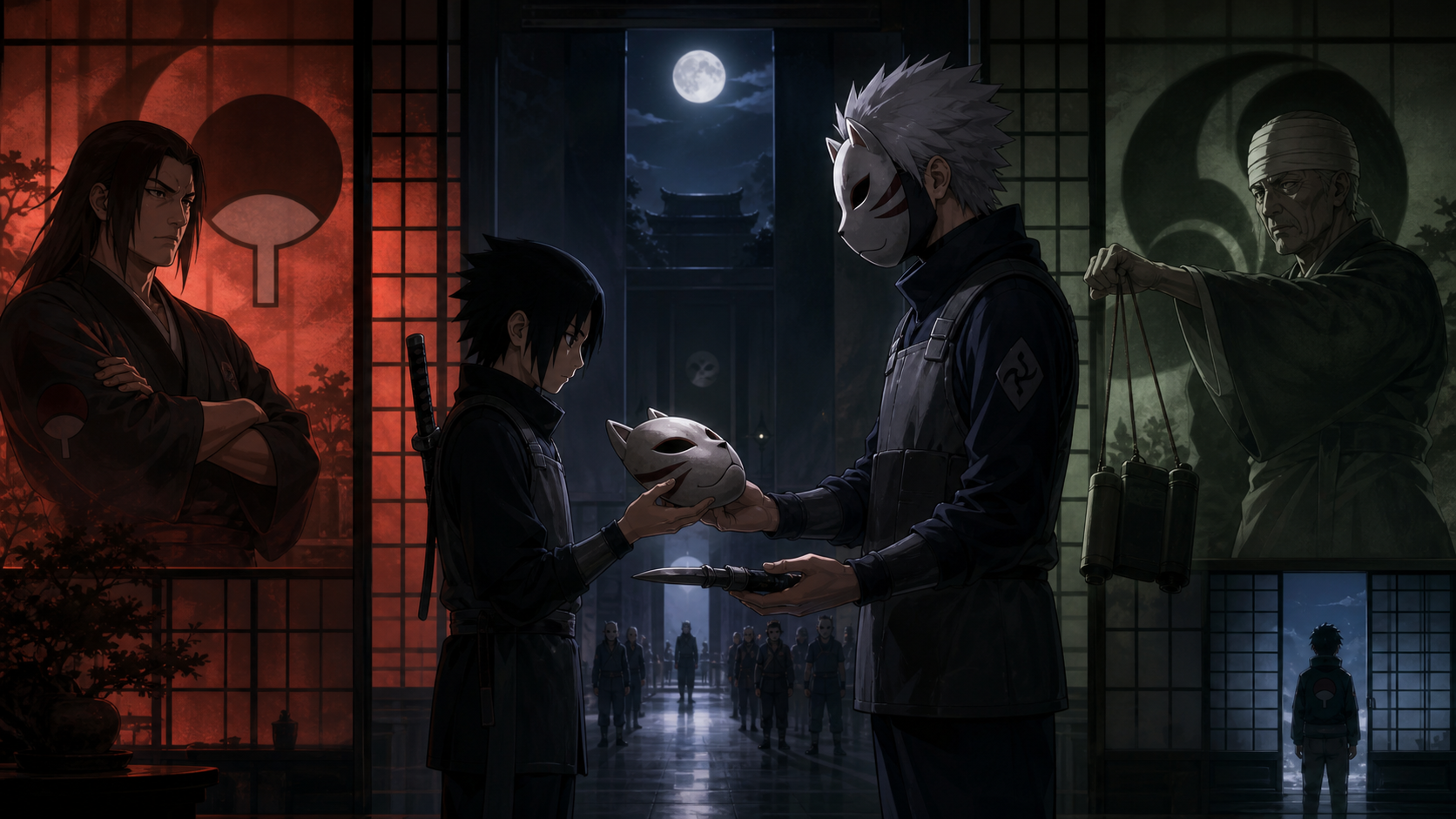
An Uchiha ANBU
Itachi enters Kakashi’s unit as the youngest ANBU, but both his father and Danzō already see the appointment as access to secrets.
Bottom line
“An Uchiha ANBU” places Itachi inside a covert unit before he has adult power over the political conflict surrounding him. He joins Kakashi’s team as the youngest ANBU member. Fugaku sees the appointment as a route to classified village intelligence that could strengthen the Uchiha position. Danzo sees the same child as a route into the clan and orders him to act as a double agent against his family. Both sides praise Itachi’s unusual ability while assigning him responsibility for distrust created by older leaders. The position appears prestigious because he has earned rare recognition. The same prestige isolates him inside secrets he cannot safely share with either community. Kakashi can guide a young operative within the unit, but no team leader can make the double-agent structure developmentally appropriate. Itachi’s skill explains why adults select him. Skill does not make their burden his rightful burden.
Itachi enters Kakashi’s ANBU unit
The appointment places him under a captain who understands childhood promotion, Sharingan expectations, and covert work. Kakashi has relevant experience but limited institutional power.
The unit gains an exceptional operative while a child enters another adult system.
Admission validates a dangerous pace
Every institution that promotes Itachi confirms the idea that moving faster is evidence of health. Few incentives encourage adults to ask what has been skipped to maintain that pace.
Achievement becomes self-reinforcing: early success produces harder work, and surviving harder work produces another promotion.
The unit inherits a duty the village created
Kakashi and teammates did not decide the political conditions that placed Itachi there. They still become responsible for how the youngest member is trained, protected, and treated during missions.
Institutional harm can arrive inside an appointment that appears routine.
He is the youngest member
Age is not background trivia. His youth defines the imbalance between Itachi’s technical capacity and the political authority surrounding him.
Exceptional performance can make adults forget how little time a child has had to develop independent boundaries.
Technical readiness differs from developmental readiness
Itachi may understand tactics, codes, and lethal force beyond many adults. Double-agent pressure asks different capacities: resisting family authority, evaluating state claims, carrying secrecy, and surviving isolation.
Mastery in one domain cannot prove readiness in every domain.
Age changes the meaning of consent
Accepting ANBU membership occurs under parental pride, village praise, and a shinobi culture that equates service with worth. Those pressures matter even if Itachi says yes.
Adults retain responsibility for assignments a gifted child appears willing to accept.
Early achievement looks like honor
ANBU induction recognizes discipline, intelligence, and combat skill. Family and village can describe the role as evidence of Itachi’s promise.
Honor makes refusal harder because declining can appear ungrateful or disloyal.
Prestige can silence concern from others
Peers may assume Itachi has received an enviable opportunity. Family members may fear that questioning the role would diminish his success.
Celebration leaves fewer openings for anyone to name the emotional cost.
The mask becomes a status symbol and barrier
ANBU gear signals rare trust while concealing the face of the child carrying that trust. Public recognition and personal invisibility arrive together.
The village can admire the title without seeing the person’s daily strain.
Skill attracts adult agendas
Itachi’s ability gives different factions reasons to place him near information. Adults do not merely celebrate what he can do; they plan what his access can produce for them.
Praise becomes dangerous when praise is attached to extraction.
Prodigy language shifts responsibility downward
Calling Itachi unusually mature lets leaders justify giving him problems they failed to solve. His capacity becomes the reason adults need not carry their own political burden.
Exceptional ability should produce greater protection from exploitation, not less.
Every faction sees a different resource
ANBU sees combat and intelligence talent. Fugaku sees access. Danzo sees surveillance. Konoha sees symbolic proof that an Uchiha can serve within elite structures.
Itachi must live beneath all of those projections while remaining one person.
Kakashi knows the cost of being exceptional
He also advanced young and learned to turn grief into mission efficiency. His history may help him recognize warning signs others call maturity.
Recognition is valuable, though recognition cannot cancel orders arriving above his rank.
Shared experience can improve supervision
Kakashi may notice overcontrol, isolation, or a willingness to accept impossible responsibility because he has lived comparable patterns. That knowledge can change how he trains Itachi.
Empathy becomes useful when empathy produces practical limits, check-ins, and room to speak.
Similarity can also normalize harm
Kakashi survived early promotion and covert work, which could make the same route appear manageable for another child. Survival can be mistaken for evidence that a system was acceptable.
His own unprocessed history may both sharpen and complicate judgment.
A captain has a duty of care
Kakashi must train Itachi, evaluate mission readiness, and protect team members during operations. The role includes responsibility beyond tactical results.
Care becomes difficult when political leaders conceal the most dangerous assignment from the unit captain.
Supervision requires truthful information
Kakashi cannot assess Itachi’s workload or conflict exposure if Danzo privately adds clan surveillance. The hidden order makes ordinary performance evaluation unreliable.
Secrecy denies the captain the knowledge needed to protect the team member.
Command responsibility has limits and obligations
Kakashi cannot control Danzo, Fugaku, or the council. He can observe behavior, create space for disclosure, question unusual directives, and report concerns through available channels.
Limited power does not mean no responsibility, and responsibility does not mean total control.
Fugaku welcomes ANBU access
Itachi’s father sees opportunity for the Uchiha to learn secrets normally kept beyond clan reach. Access appears to reduce an information imbalance.
Using a son as the bridge places family and political expectation inside the same relationship.
A father’s pride can be sincere and instrumental
Fugaku may believe the role honors Itachi and benefits a marginalized clan. Those beliefs can coexist with pressure that reduces the son to a channel.
Good intention within family does not automatically create a safe burden.
Family expectation makes refusal intimate
Declining to share information could feel like disappointing a father, weakening the clan, or rejecting collective struggle. The cost reaches home rather than ending at an office.
Political duty becomes entangled with a child’s desire for parental recognition.
The clan has reasons to seek information
Uchiha leaders face distrust, exclusion, and decisions made without them. Classified knowledge can appear necessary for anticipating threats.
Those conditions explain the desire without making Itachi responsible for solving institutional exclusion.
Exclusion creates predictable suspicion
When leaders make decisions about a clan without meaningful participation, members have reason to wonder what classified discussions contain. Information scarcity magnifies rumor.
The answer should be accountable dialogue and fair representation, not covertly recruiting a child as a pipeline.
Collective vulnerability can pressure individuals
The Uchiha face real structural danger, but shared danger does not make every demand placed on one member ethical. A community can reproduce harm internally while responding to harm from outside.
Protecting the clan requires protecting children inside the clan too.
Fugaku’s pride carries pressure
A father can genuinely admire a son while also valuing what the son’s position offers the clan. Love and political use can coexist.
Itachi receives the message that personal achievement should serve collective strategy.
Danzo wants intelligence on the Uchiha
He treats the clan as a security problem and seeks information through someone living inside the family. Suspicion becomes an assignment before trust has been tested openly.
Surveillance substitutes control for political engagement.
Suspicion becomes self-confirming
Secret monitoring communicates distrust. Discovery or felt surveillance increases clan anger. Danzo can then cite that anger as evidence that monitoring was necessary.
A policy can manufacture the behavior used to defend the policy.
Danzo prefers access without accountability
Open investigation would require standards, evidence, and review. A child double agent supplies information directly into a private command channel.
The method protects Danzo’s interpretation from competing analysis.
Danzo orders betrayal
Itachi is told to report on his family and clan. The order demands divided loyalty while framing one side of that division as duty.
An adult commander creates the betrayal and assigns the emotional consequences to a child.
The word duty conceals coercion
Danzo can describe surveillance as protecting Konoha, making refusal sound like willingness to risk the village. The framing places catastrophic responsibility on Itachi before any specific report exists.
Fear narrows the imaginable alternatives.
Betrayal is demanded in advance
Itachi is not responding to one clearly verified criminal act. He is asked to make ongoing secrecy toward family part of his role.
The assignment turns ordinary contact into continuous intelligence collection.
Double agency destroys safe disclosure
Truth told to the clan can violate village orders. Truth told to Danzo can endanger family. Silence can be interpreted as betrayal by both.
Every relationship becomes a potential intelligence channel.
Truth fragments by audience
Itachi must remember which facts each side knows, which motive each side expects, and which silence will trigger suspicion. Conversation becomes constant operational calculation.
That cognitive labor consumes space needed for ordinary emotional development.
Help becomes difficult to request
Explaining distress could reveal classified orders or appear to expose one side to the other. The very structure causing harm blocks honest access to support.
Isolation is a feature of the assignment’s design.
Itachi cannot be fully honest anywhere
ANBU secrecy already limits ordinary conversation. Double-agent work adds another layer in which even authorized colleagues may not know his complete instructions.
Isolation is built into the assignment rather than caused by a personality flaw.
Home loses the presumption of safety
Family questions can sound like intelligence requests, and private observations can become reportable material. Rest becomes surveillance work.
A child should not need to evaluate every household interaction for political consequence.
Work loses the presumption of team trust
Kakashi and other ANBU members may believe Itachi shares the same chain of command. Danzo’s private role gives him obligations the unit cannot see.
Hidden divided command undermines the comradeship ANBU depends upon.
The village converts family access into utility
Danzo values Itachi partly because blood relation opens doors an outside spy could not enter. Intimacy becomes operational infrastructure.
That conversion damages the meaning of home even before any report is delivered.
Intimacy produces information without permission
Family members reveal concern, strategy, and fear because Itachi belongs among them. Danzo seeks to capture knowledge generated through that trust.
The method exploits relationship rather than earning cooperation.
Reports can endanger people beyond their content
Even accurate observations pass into a system already inclined to suspect the Uchiha. Danzo controls how details are framed and what action follows.
Itachi cannot guarantee that nuance survives the reporting chain.
The clan converts village access into utility
Fugaku’s hope mirrors the structure from the other direction. Itachi’s ANBU membership becomes a channel toward secrets rather than only his work.
Both sides ask one young person to carry an institutional trust crisis.
Classified information will not repair exclusion alone
Learning council plans may help the Uchiha anticipate policy, but secret acquisition can deepen the same distrust members oppose. Knowledge arrives without legitimate participation.
Political repair needs a channel where concerns can be stated and answered openly.
Itachi becomes a bridge no structure supports
Bridges carry traffic from both directions and absorb strain between separate sides. Neither village leadership nor clan leadership gives Itachi independent protection from that strain.
Admiring his ability to endure does not make the arrangement sustainable.
Symmetry does not erase unequal power
Fugaku and Danzo both want information, but Danzo commands a covert state apparatus with punishment, surveillance, and lethal reach. Their methods and authority are not identical.
Accurate comparison should identify shared instrumentalization without flattening political position.
Itachi’s loyalty is not a divisible object
Adults speak as though allegiance can be allocated between village and clan. Itachi also has relationships, values, fear, and a younger brother.
His inner life exceeds the strategic categories placed around him.
Clan and village are not naturally opposites
The Uchiha are part of Konoha. Framing loyalty as a choice between them accepts the political separation that surveillance has intensified.
Itachi should not have to betray family to prove village belonging.
Peace commitments can become another pressure point
Itachi’s desire to prevent war makes warnings about conflict especially powerful. Adults can imply that any refusal will allow catastrophe.
A child’s compassion becomes leverage when leaders present themselves as the only barrier against violence.
Sasuke remains outside the assignment
The younger brother experiences Itachi through family connection rather than full political knowledge. That bond becomes vulnerable to decisions Sasuke cannot understand.
Protecting Sasuke may increasingly shape Itachi’s choices under pressure.
A younger brother anchors ordinary identity
With Sasuke, Itachi can still be admired as a sibling rather than evaluated as an operative or intelligence channel. That relationship preserves a part of life outside political function.
The more pressure rises, the more vulnerable that refuge becomes.
Secrecy creates future misunderstanding
Sasuke cannot interpret distance or absence through orders he never sees. Protective silence may feel like rejection.
Good intention cannot control how concealed actions affect the person being protected.
Secrecy makes competence look calm
Itachi can perform missions and speak with restraint while carrying incompatible demands. Adults may interpret composure as readiness for more responsibility.
Controlled expression does not show that the burden is healthy.
Silence invites additional responsibility
When Itachi does not complain, adults may conclude the arrangement is working and add more sensitive work. Each successful concealment produces another reason to conceal.
The system rewards the symptom that keeps the system invisible.
A child can look composed while losing options
Itachi’s strategic intelligence may let him anticipate consequences clearly. Seeing every trap does not guarantee power to exit any trap.
Awareness without authority can intensify rather than reduce distress.
The ANBU mask offers no neutral identity
The mask conceals Itachi’s face during village work, but clan membership remains central to why he was selected for intelligence. He cannot become simply an operative.
Institutions invoke or suppress identity according to usefulness.
Kakashi and Itachi share visual history
Both carry Sharingan in ANBU, but their relationships to the eye differ. Kakashi received Obito’s gift; Itachi inherited Uchiha ability and clan expectation.
Similarity can support understanding without erasing those differences.
Every adult calls access an honor
Itachi’s ANBU appointment is presented as recognition, yet Fugaku and Danzō immediately calculate what the child can report. Rank becomes a delivery system for competing institutions. Neither man begins by asking what secrecy, killing, divided allegiance, and constant surveillance will do to a thirteen-year-old.
Praise is not protection when adults attach incompatible obligations to the promotion. The achievement is real. So is the exploitation hiding inside everyone’s celebration.
Kakashi inherits responsibility without full authority
Kakashi receives Itachi as a unit member, but the young shinobi arrives carrying expectations Kakashi did not create and may not see. Command gives Kakashi a duty to supervise missions, notice isolation, and refuse assignments that use age or clan identity as expendable advantages.
That responsibility does not make him the architect of the crisis. Hiruzen, Fugaku, Danzō, and the institutions around them control the political conditions. Kakashi can become a protective adult only if information reaches him before the trap closes.
Itachi is not neutral territory
Both sides treat him like a corridor through which secrets should travel. That metaphor erases the person forced to absorb every contradiction. Information does not pass cleanly through him. Each request creates risk, loyalty pressure, and possible punishment from the other side.
A child cannot fairly consent to becoming the hidden meeting place for a village and clan already preparing to distrust each other.
Prodigy language disguises missing safeguards
Exceptional skill answers whether Itachi can perform ANBU work. Skill does not answer whether he should carry political espionage between powerful adults. Competence cannot replace age-appropriate protection, independent counsel, clear reporting lines, or permission to refuse an unlawful demand.
The more capable he appears, the easier it becomes for leaders to pretend he needs less care. His brilliance increases what adults want from him, not what they owe him.
RaeRae’s verdict
“An Uchiha ANBU” turns prestige into a warning. Itachi’s induction recognizes astonishing skill, then immediately gives powerful adults more access to his life. Fugaku imagines information flowing toward the clan. Danzo orders information flowing toward village hardliners. Itachi stands between those currents without a safe place to be only a son, brother, teammate, or child.
Kakashi’s unit may offer mentorship and comradeship, but the assignment’s central damage comes from above the unit. Calling Itachi a prodigy cannot justify making him responsible for resolving the Uchiha conflict through secret betrayal. Adults created the political structure. Adults should carry responsibility for changing the structure.
RaeRae’s call
Itachi’s mask is not proof that the adults protected him. Fugaku wants clan intelligence, Danzō wants village intelligence, and a thirteen-year-old becomes the contested route between them. Kakashi can offer real mentorship, but the burden belongs first to the leaders who created a job with mutually dangerous loyalties and called the arrangement an honor. A gifted child still needs adults willing to carry adult consequences themselves.
Episode details and viewing routes
- Official episode reference: Naruto Official episode guide
- Licensed episode route: Crunchyroll licensed episode page
What I am carrying forward
Itachi has joined Kakashi’s unit as the youngest ANBU member. Fugaku expects the appointment to give the Uchiha access to classified Leaf intelligence.
Danzo has ordered Itachi to act as a double agent against his family and clan. Itachi now carries incompatible demands inside relationships where full honesty is dangerous. Episode 358 follows the surveillance imposed on the Uchiha after Nine-Tails suspicions and the escalating coup crisis.