
RaeRae Reacts · One Piece Episode 114
Molehill Fourth Street
One Piece Episode 114 traps Usopp and Chopper inside a coordinated tunnel-and-baseball bombing system, then attacks their morale through Luffy’s dream.
Quick reaction
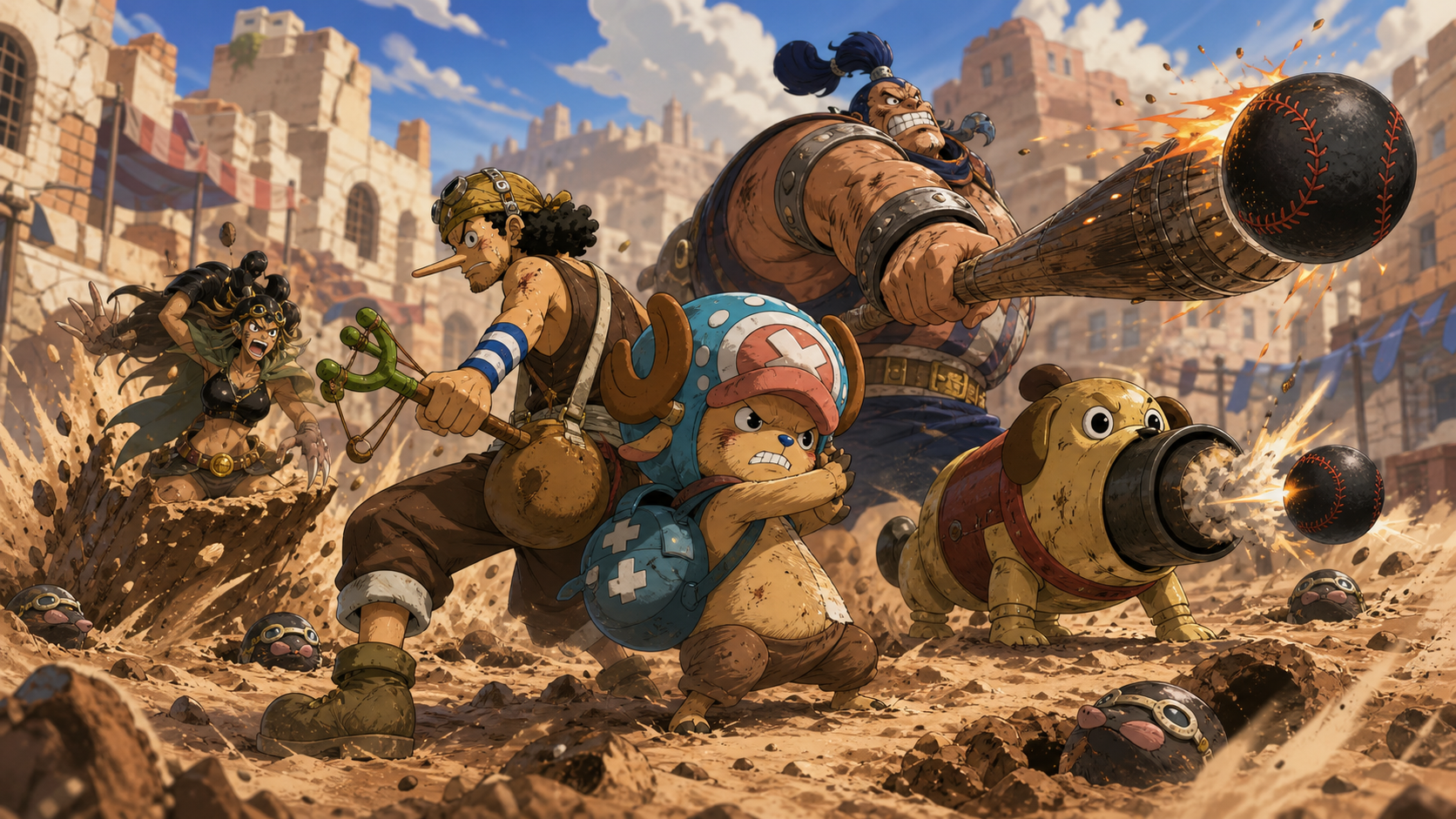
One Piece Episode 114 traps Usopp and Chopper inside the most aggressively ridiculous artillery system in Alubarna. Miss Merry Christmas tunnels beneath Molehill Fourth Street. Lassoo, a gun transformed into a dog, sneezes baseball-shaped timed bombs. Mr. 4 swings a four-ton bat and sends those explosives wherever the pair tries to escape.
The physical mismatch is obvious, but the cruelest attack is verbal. Miss Merry Christmas claims Crocodile killed Luffy and treats his dream of becoming Pirate King as pathetic.
RaeRae’s bottom line is simple: Usopp and Chopper survive because neither partner has the complete answer. One reads traps, one changes form, and both refuse to let an enemy define their captain’s dream.
Molehill Fourth Street is an engineered kill zone
The street no longer functions as ordinary city space. Tunnels, holes, debris, timed explosives, and a heavy batter divide movement into predictable lanes.
Miss Merry Christmas controls the underground route. Mr. 4 controls the impact zone. Lassoo supplies repeatable ammunition.
The combined system punishes standing still, moving openly, and following the first apparent escape path.
Usopp and Chopper must understand the pattern before accumulated damage removes their ability to respond.
Miss Merry Christmas turns tunneling into surveillance
The Mole-Mole Fruit lets Miss Merry Christmas move beneath the street, emerge from unexpected positions, and create a network of hidden routes.
Her tunnels do more than provide mobility. They let the team observe where targets stand and shape the ground around them.
Underground control makes ordinary cover unreliable. A wall or pile of rubble may protect against a direct swing while exposing the person to an attack from below.
The defenders need to read disturbed sand, sound, timing, and repeated emergence points rather than relying only on sight.
Lassoo is an animal and a weapon at once
Lassoo began as a gun and gained the characteristics of a dog through the Dog-Dog Fruit. The result can move, respond, and sneeze explosive baseballs.
That combination raises an uncomfortable question about agency. A living weapon may follow commands, display animal behavior, and still be designed around harm.
Baroque Works treats Lassoo as equipment because the organization values output over autonomy.
Stopping the attack remains necessary, but accountability belongs most heavily with the people who created, trained, and deployed the weaponized body.
Timed baseball bombs create delayed uncertainty
Lassoo’s ammunition does not explode at the instant of release. Delay changes every ball into a moving countdown.
Usopp and Chopper must track where a bomb lands, whether Mr. 4 will strike the bomb again, and how much time remains.
Delayed explosives corrupt safe space because an object can appear stationary while danger continues developing.
The pair needs shared calls and clear attention. Losing track of one ball can make a correct response to every visible opponent meaningless.
The countdown also forces priority decisions. Usopp may see Miss Merry Christmas surface while a bomb waits behind Chopper. Chopper may need to abandon an attack to move a projectile away from civilians. Their opponents benefit whenever attention splits. A successful defense needs one partner tracking the immediate body threat while the other preserves a mental map of every active explosive.
Mr. 4 converts weight into range
Mr. 4’s four-ton bat turns explosive baseballs into high-speed projectiles. His strength matters because the team supplies him with predictable ammunition and targets.
The bat extends his threat beyond close range. A slow-looking fighter can dominate the whole plaza when another agent controls setup.
Raw power becomes more dangerous through coordination. Miss Merry Christmas positions opponents, Lassoo produces bombs, and Mr. 4 supplies launch force.
Separating the parts may be more effective than challenging the strongest part directly.
That systems view protects the pair from intimidation. Mr. 4 can lift a weapon neither underdog could move, but his swing still depends on stance, timing, sight line, and a ball arriving within reach. Disrupting the supply chain can reduce four tons of threat without requiring four tons of counterforce. Intelligence becomes a way to change the scale of the fight.
Usopp recognizes weapons as systems
Usopp lacks Mr. 4’s strength, but he understands trajectories, timing, distance, misdirection, and improvised ammunition.
That knowledge lets him read the attack as a system rather than a collection of impossible powers.
A projectile needs a path. A timed bomb needs a countdown. A batter needs a moment to swing. A tunnel network creates patterns through repeated use.
Usopp’s survival depends on finding the interruption point where a small action can change a large outcome.
His slingshot also offers flexible ammunition rather than one fixed attack. Smoke, noise, impact, distraction, and false trajectories can each serve a different purpose. Usopp does not need every shot to injure an opponent. A projectile that changes where Mr. 4 looks or when Miss Merry Christmas surfaces may protect Chopper more effectively than a direct hit.
Chopper supplies bodies for different tasks
Chopper can change form to move, defend, strike, analyze, or carry Usopp through danger.
No single transformation solves every part of the trap. A larger body may absorb force but present an easier target. A smaller form may evade bombs but lack reach.
Choosing the correct body becomes tactical labor under time pressure.
Chopper’s medical knowledge also helps him judge injury and remaining capacity, which matters when both partners accumulate damage.
That judgment carries ethical weight. Transformations consume energy, and continued fighting can turn survivable injuries into permanent damage. Chopper must decide when the mission requires risk and when pride would only waste his body. Medical competence does not remove fear. Medical competence makes the consequences harder to ignore while action remains necessary.
The pair works because their weaknesses do not match
Usopp fears direct impact and lacks Chopper’s physical resilience. Chopper lacks Usopp’s projectile intuition and deception experience.
Their different limits create coverage. One partner can act where the other becomes vulnerable.
Teamwork does not require pretending both people contribute the same strength. Teamwork requires understanding which difference belongs to which problem.
Mr. 4’s team also uses specialization, but Baroque Works organizes around command and disposal. Usopp with Chopper organizes around mutual survival.
Miss Merry Christmas attacks Luffy’s dream
The claim that Crocodile killed Luffy aims beyond grief. Miss Merry Christmas mocks the dream that holds the crew together.
Psychological warfare works when physical exhaustion has already weakened confidence. Usopp and Chopper are injured, isolated, and unable to verify Luffy’s condition.
The enemy supplies a frightening fact and an interpretation at once: Luffy is dead, and his ambition was always foolish.
Rejecting the interpretation becomes the first step toward resisting the claimed fact.
Unverified death reports are battlefield weapons
Usopp and Chopper cannot immediately contact Luffy or another witness. That information gap gives the lie room to operate.
False casualty reports can break morale, disrupt command, and pressure fighters into surrender or reckless revenge.
Responsible teams need verification channels and language that distinguishes confirmed death, observed injury, missing status, and enemy claims.
Baroque Works benefits because the fragmented city denies the crew those safeguards.
The lie also tries to isolate the pair from the rest of their relationships. If Luffy is dead and the dream is finished, continuing the fight can feel irrational. Miss Merry Christmas wants grief to become surrender before Usopp and Chopper can compare the claim with everything they know about their captain’s resilience, Crocodile’s manipulation, and the enemy’s incentive to deceive.
Usopp’s courage is not the absence of retreat
Usopp often wants to escape overwhelming danger. That instinct does not erase courage.
Courage appears when he identifies a line that fear cannot make him abandon. An enemy may injure him, but contempt for Luffy’s dream changes the decision.
The response works because Usopp’s loyalty remains specific. He knows Luffy’s dream, has watched him risk his life, and understands what the promise means to the crew.
Fear and conviction coexist. One makes the threat real; the other determines the next action.
Dreams create obligations between friends
Luffy’s dream belongs to Luffy, yet the crew has chosen to travel beside that dream.
Support does not require blind agreement with every plan. Support means refusing to let an enemy erase a friend’s purpose through mockery and unverified claims.
Usopp’s own dream of becoming a brave warrior gains meaning through the same relationship. He cannot protect one dream while treating another as disposable.
The oath is mutual rather than hierarchical. Friendship turns ambition into shared responsibility without transferring ownership.
The villains weaponize coordination without care
Miss Merry Christmas, Mr. 4, and Lassoo coordinate with impressive precision. Their teamwork still lacks mutual accountability.
Lassoo becomes an ammunition source. Mr. 4 becomes impact force. Miss Merry Christmas becomes targeting and psychological pressure.
Each body is valued for function inside the attack. Baroque Works offers no visible structure for recovery, refusal, or protection after failure.
Efficiency without care can produce powerful systems that remain morally bankrupt and operationally brittle.
Brittleness appears when any component refuses or fails. Mr. 4 loses range without Lassoo. Lassoo’s bombs lose direction without the bat. Miss Merry Christmas loses control when opponents read the tunnel rhythm. Baroque Works hides those dependencies behind spectacle, but Usopp and Chopper can survive by forcing the system to experience its own missing handoffs.
Urban civilians inherit unexploded risk
Timed bombs, tunnel collapses, shattered buildings, and displaced debris do not disappear when the named fighters leave.
Residents and recovery workers may encounter damaged weapons or unstable ground long after the duel.
Baroque Works externalizes cleanup because the organization plans to claim Alabasta after others absorb the cost.
Evidence mapping, explosive disposal, tunnel inspection, structural repair, and medical support belong in any honest account of the battle.
The fight tests communication under noise
Explosions, underground movement, collapsing walls, and rapid transformations make ordinary conversation difficult.
Usopp and Chopper need short signals that distinguish incoming ball, tunnel movement, retreat direction, injury, and counterattack.
Shared vocabulary reduces explanation during the few seconds available.
The episode shows why teams build trust before crisis. Partners who know one another’s habits can act from partial signals without guessing every intention.
Production choices turn absurdity into danger
Junki Takegami’s script introduces each mechanism clearly: tunnels, dog-gun, timed baseball bombs, four-ton bat, and the casualty claim about Luffy.
Koji Tanaka’s direction lets the attack remain funny in concept while making trajectories and consequences threatening.
Noboru Koizumi’s animation direction gives Mr. 4’s swing weight, Lassoo’s sneezing rhythm personality, and the mole movement enough speed to destabilize the street.
Miyuki Sato’s art turns a desert plaza into an exposed grid of holes, walls, and impact zones.
What Episode 114 changes
Usopp and Chopper become fully engaged against Miss Merry Christmas, Mr. 4, and Lassoo at Molehill Fourth Street.
Miss Merry Christmas uses the Mole-Mole Fruit and a tunnel network to control position and attack from below.
Lassoo fires baseball-shaped timed bombs, while Mr. 4 launches those explosives with a four-ton bat.
Miss Merry Christmas claims Crocodile killed Luffy and attacks his dream, creating the psychological turning point for the underdog pair.
Episode details
Japanese title: 仲間の夢に誓う!決闘モグラ塚4番街
English title: Sworn on a Friend’s Dream! The Battle at Molehill Fourth Street
Japanese broadcast: June 9, 2002
Saga: Alabasta
Material: Manga-canon adaptation
Script: Junki Takegami
Episode direction: Koji Tanaka
Animation direction: Noboru Koizumi
Art: Miyuki Sato
The official One Piece guide confirms Miss Merry Christmas using mole tunnels, Lassoo as a gun transformed through the Dog-Dog Fruit, Lassoo firing baseball-shaped timed bombs, Mr. 4 striking them with a four-ton bat, and Miss Merry Christmas claiming Crocodile killed Luffy. The weapons, animal agency, teamwork, labor, morale, and accountability analysis is RaeRae’s reading of those events.
Final verdict
Episode 114 earns a 9.4 out of 10. The battle is absurd by design, but the system behind the absurdity is disciplined and lethal.
Usopp and Chopper cannot win by copying their opponents. They need the marksman’s timing, the doctor’s transformations, and enough trust to cover the moments when one partner becomes overwhelmed.
Miss Merry Christmas attacks Luffy’s dream because broken morale would finish what the bombs started. She miscalculates the bond. Usopp may fear the next swing, but fear does not give her permission to name his friend’s future.
That distinction makes the cliffhanger land. Usopp does not suddenly become stronger than a four-ton bat, and Chopper does not discover an easy medical answer for an exploding baseball. Their advantage begins with refusing the enemy’s version of reality. Once they reject the lie, they can study the attack, protect one another, and turn coordination into a weapon of their own. Episode 114 treats loyalty as practical battlefield intelligence. A trusted relationship gives both fighters a reason to verify bad news, keep communicating through panic, and remain present when every physical signal says run.