
The Rogue Ninja Orochimaru
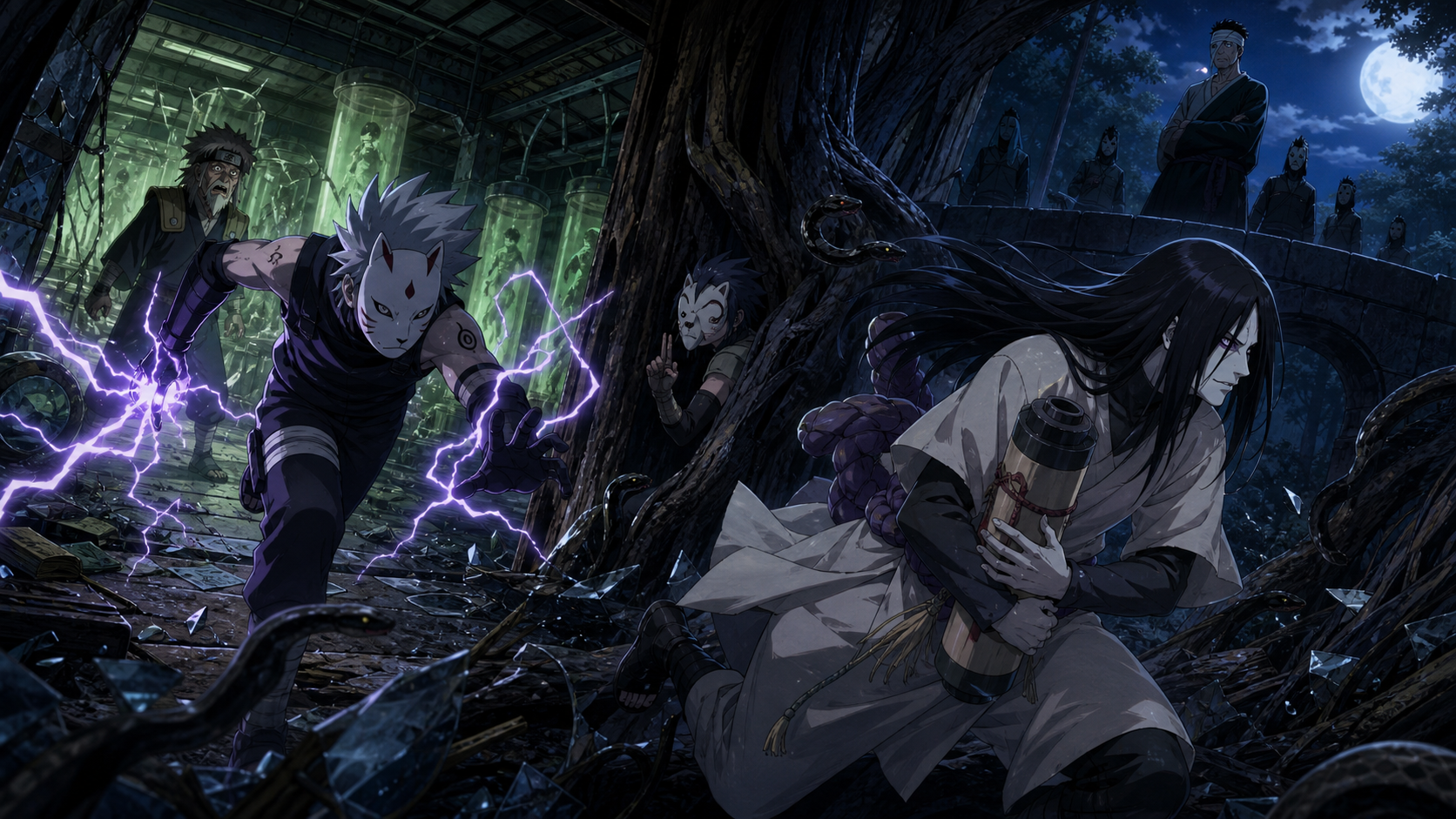
Orochimaru flees the crimes Hiruzen finally sees, while Danzo protects the escape and sends Kakashi chasing through a cover-up built inside the village.
Bottom line
“The Rogue Ninja Orochimaru” shows accountability arriving late and then being sabotaged from inside Konoha. Hiruzen exposes Orochimaru’s illegal human experiments, forcing his former student to flee the village. Capture could reveal the full network that enabled the research. Danzo therefore sends a Foundation operative to help Orochimaru escape, protecting his own involvement while publicly aligned with village security. Kakashi pursues a dangerous rogue without access to the fact that another Konoha authority is undermining the mission. The conflict is not simply loyal shinobi against traitor. One official orders pursuit while another official covertly protects the target. Orochimaru remains responsible for experimenting on people and fleeing consequences. Hiruzen remains responsible for how long personal attachment delayed decisive action. Danzo adds obstruction to complicity by choosing secrecy over victims, truth, and the safety of future subjects.
Hiruzen exposes the experiments
The Third Hokage reaches the hidden work and sees evidence that Orochimaru has crossed from prohibited ambition into direct abuse of human beings.
Discovery ends the village’s ability to treat warning signs as speculation.
Illegal describes policy, not the whole harm
The experiments violate village rules, but legal status is only one measure. People were confined, altered, and treated as expendable material.
An ethical account must keep the subjects visible rather than centering only a breach of authorization.
The subjects are not laboratory scenery
Rooms, equipment, and records can make discovery feel like a mystery solved by investigators. Every procedure documented there happened to a person with a life beyond Orochimaru’s question.
The story of exposure must not give the perpetrator more individuality than the people he used.
Consent separates research from extraction
Scientific work involving human bodies requires informed choice, understandable risk, the freedom to refuse, and independent safeguards. Captive subjects have none of those protections.
Calling a procedure research does not neutralize coercion.
Orochimaru pursued knowledge through bodies
His search for mastery treats other lives as instruments. Curiosity becomes extraction when the researcher decides consent and survival are obstacles.
Brilliance increases capacity for harm when no moral boundary limits method.
Immortality ambition externalizes every cost
Orochimaru seeks knowledge and continuity for himself while other people absorb injury, fear, and death. His desired future depends on treating their futures as disposable.
The imbalance reveals why personal aspiration cannot justify experimentation without consent.
Discovery does not create remorse
Exposure changes Orochimaru’s tactical position rather than his ethical judgment. He flees because Konoha can now constrain him, not because subjects have become visible as people.
Escape preserves the worldview that produced the laboratory.
Hiruzen confronts a former student
The relationship makes enforcement emotionally difficult. Hiruzen remembers talent, mentorship, and a younger person before him.
Personal history can explain hesitation without granting permission to leave victims exposed.
Affection delayed accountability
Orochimaru’s trajectory did not become alarming in one instant. Earlier choices, disappearances, and ethical warning signs accumulated.
Leaders cause additional harm when attachment makes standards flexible for favored people.
Mentorship creates grief and duty
Hiruzen can mourn the person his student might have become while stopping the person before him. Those emotions do not cancel one another.
Leadership fails when grief over a favored perpetrator receives more protection than people already harmed.
Mercy requires attention to future victims
Sparing or delaying action may feel compassionate toward Orochimaru. The same choice leaves everyone he can reach carrying increased danger.
Mercy directed upward toward power can become cruelty distributed downward.
The laboratory reveals institutional failure
A program using human subjects requires space, supplies, secrecy, and freedom from inspection. Orochimaru’s individual crimes existed inside conditions that allowed sustained operation.
Finding one perpetrator cannot complete accountability for the system around him.
Procurement leaves an accountability trail
Experiments require materials, transport, facilities, and people willing to ignore unusual activity. Some participants may know little, while others may understand the full purpose.
Investigation must distinguish levels of knowledge without pretending the program existed through one person’s hands alone.
Oversight failed before the raid
A functioning safeguard should detect missing people, unauthorized facilities, abnormal requisitions, or prohibited procedures before years of harm accumulate.
Late discovery is necessary, but prevention would have protected lives that enforcement can no longer restore.
Orochimaru chooses flight
Exposure gives him an opportunity to submit to investigation or escape. He protects freedom, research, and future ambition rather than answering to the people harmed.
Leaving Konoha does not turn the crime into a political disagreement.
Rogue status follows broken obligations
The label identifies a shinobi who abandons village authority, but the moral breach began before departure. Experiments had already violated the community Orochimaru claimed to serve.
The flight makes prior disloyalty visible rather than creating disloyalty from nothing.
Village loyalty cannot excuse village abuse
Orochimaru could have remained physically inside Konoha while continuing to betray its residents. Location and obedience to selected orders are not complete measures of loyalty.
A community is not protected when leaders preserve its symbol while sacrificing its people.
Departure gives the village a simpler story
Once Orochimaru becomes a rogue ninja, officials can describe danger as external. That framing obscures the years when his work developed under Konoha’s roof and through Konoha relationships.
Accountability must follow the history across the border he crosses.
Capture could expose collaborators
Orochimaru knows who supplied access, tolerated secrecy, or benefited from the results. Interrogation threatens more than his personal freedom.
That knowledge gives complicit officials an incentive to prevent lawful return.
Testimony threatens Danzo’s moral narrative
Danzo presents covert harm as a necessary burden carried for the village. Orochimaru could reveal arrangements driven by ambition, experimentation, and shared strategic interest.
Exposure would challenge not only particular acts but the claim that secrecy makes those acts selfless.
Records may survive even if the target escapes
Capture is valuable, but investigators should also preserve documents, interview survivors, trace supplies, and examine command links. One fugitive cannot be allowed to become the only container for truth.
Broad evidence work reduces the power of any official who depends on silence from one person.
Danzo fears his own involvement becoming known
His response centers self-protection rather than subjects or village safety. Exposure would challenge the image that every hidden act served necessity.
Fear of accountability becomes the reason to commit another breach.
Foundation receives a covert order
Danzo sends one of his operatives to assist Orochimaru. A Konoha-linked unit acts against a Konoha pursuit while claiming service to Konoha.
Compartmentalization lets contradiction operate without immediate public conflict.
The operative inherits an unethical mission
Foundation conditioning emphasizes obedience and suppressed identity. The person carrying the order may have limited space to evaluate Danzo’s private motive.
That coercive structure explains participation without transferring responsibility away from the commander.
Obedience is Foundation’s designed outcome
Danzo does not merely find a willing helper. His system trains operatives to suppress names, attachments, questions, and personal judgment.
The command benefits from constraints imposed long before this assignment.
A subordinate can still face a moral conflict
Conditioning narrows choice without turning a person into machinery. The operative may recognize that assisting Orochimaru conflicts with Konoha’s official pursuit.
Editorial care must hold both realities: individual action matters, and the commander engineered the pressure surrounding action.
Danzo converts subordinates into insulation
Using another person creates distance between his decision and Orochimaru’s escape. If the operation fails, the operative faces the visible risk.
Hierarchy allows leaders to hide behind the obedience they trained into others.
Deniability is built into compartmentalization
Kakashi need not know who blocked him. Hiruzen need not immediately see which order reversed his own. Each operative holds only one fragment.
Danzo gains room to describe the outcome as ordinary escape rather than coordinated obstruction.
Secret authority competes with lawful authority
Foundation is not merely gathering intelligence outside public view. Danzo uses command power to oppose the Hokage’s active decision.
That contradiction turns covert autonomy into a governance crisis.
Kakashi pursues without the full truth
He receives a mission to stop a dangerous fugitive and reasonably understands the assignment as village policy. He does not know village power is divided around the target.
Missing intelligence places him inside a conflict whose rules have been secretly altered.
Information asymmetry changes the encounter
Orochimaru knows escape routes, research networks, and the possibility of covert assistance. Kakashi knows the target and official objective.
Skill cannot fully compensate for an opponent receiving help from the same political system directing the pursuit.
Kakashi carries personal context into the mission
His recent discovery of Hashirama-cell records makes Orochimaru’s work more than an abstract violation. The Foundation boy’s body demonstrates that experiments continue affecting living people.
Pursuit therefore connects immediate security with the unresolved history Kakashi has begun uncovering.
Mission failure can be manufactured above him
If Orochimaru escapes, Kakashi’s performance may be questioned even though Danzo has provided covert assistance. Operational review without political context would blame the visible pursuer.
Accountability must travel upward toward whoever changed the conditions.
Performance review can become another cover
An institution may ask whether Kakashi moved quickly enough or struck decisively enough. Those questions are easier than asking which official wanted the target free.
Technical critique becomes misdirection when political sabotage remains outside the report.
Ruthlessness would not solve betrayal
Kakashi’s cold-blooded reputation suggests that greater force is always the available answer. Danzo’s interference proves otherwise.
No amount of personal hardness can repair a chain of command that secretly protects the person being hunted.
Kakashi’s efficiency meets institutional sabotage
ANBU taught him to complete clear objectives decisively. This mission demonstrates that skill cannot solve a command system working against itself.
The problem is political architecture, not insufficient ruthlessness.
Orochimaru remains dangerous beyond Konoha
Escape preserves his ability to recruit vulnerable people, build new laboratories, and continue experiments outside village oversight.
Danzo’s short-term concealment transfers risk to future subjects and neighboring communities.
Crossing a border reduces oversight further
Outside Konoha, Orochimaru can build hidden facilities among people with less ability to identify his history or demand village records.
The escape expands the geographic distance between harm and the officials who enabled harm.
Vulnerable people become recruitment targets
Orochimaru offers power, belonging, treatment, or purpose to people whose needs have been neglected. Those offers can conceal conditions that make leaving difficult or impossible.
Future coercion grows from the freedom preserved in this episode.
Secrecy multiplies the victim pool
Protecting the truth does not freeze harm at the moment of escape. Every later experiment becomes part of the cost of allowing a known perpetrator to continue.
Obstruction creates future consequences even when those consequences occur elsewhere.
Hiruzen’s action is necessary and incomplete
Exposing the laboratory and ordering pursuit are meaningful steps. Those steps do not erase prior delay or neutralize Danzo’s hidden power.
Leadership must follow discovery through capture, survivor care, records review, and investigation of collaborators.
The village has two security policies
Official Konoha seeks Orochimaru. Danzo’s Konoha preserves him. Both actions use village personnel and resources.
A government cannot claim coherent ethics while secret factions reverse public accountability.
Public safety becomes a contested phrase
Hiruzen’s order treats capture as necessary protection. Danzo’s order treats concealment as necessary protection. Identical language covers opposite actions.
The difference must be judged through who receives safety, who carries risk, and who avoids scrutiny.
Accountability must include institutional repair
Stopping Orochimaru would address an urgent perpetrator. Preventing repetition requires limits on Foundation, independent oversight, survivor support, and consequences for officials who obstruct investigations.
Without structural repair, another laboratory can grow behind a different name.
The laboratory proves prolonged institutional access
Orochimaru needed subjects, equipment, medical supplies, secure rooms, transport, guards, and time. Those resources leave a wider trail than one scientist’s private obsession.
Finding the chamber should trigger an investigation into procurement, missing-person records, supervisors, and officials who ignored warnings. Calling Orochimaru rogue after discovery cannot erase the support that made the work possible inside Konoha.
Hiruzen’s hesitation protects the student over future victims
He sees the evidence and understands what Orochimaru has done, yet personal history interrupts decisive capture. Love and mentorship make the confrontation painful.
Leadership requires holding that pain without transferring the risk to strangers. Mercy toward a powerful perpetrator becomes cruelty toward later victims when escape remains predictable and no containment plan exists.
Orochimaru converts curiosity into entitlement over bodies
He wants knowledge about immortality, jutsu, bloodlines, and human limits. Curiosity can drive research, but his method assumes every useful body is available for extraction.
The ethical failure begins before death. Subjects never receive informed choice, independent advocacy, proportional risk, withdrawal rights, or continuing care. Scientific ambition becomes violence when discovery matters more than the person carrying the experiment.
Danzō needs Orochimaru free because evidence points backward
Capture could reveal shared projects, protected facilities, Hashirama-cell work, and the officials who benefited from successful subjects. The rogue knows too much about Foundation’s operations.
Helping him escape protects more than an ally. Danzō preserves his own deniability by turning subordinates into the visible obstruction while secret command remains off the mission record.
Kinoe receives an order designed to divide responsibility
He must help the experimenter who shaped his body escape from the village investigating those experiments. Foundation frames obedience as duty while hiding the personal history that would make informed refusal possible.
The child operative becomes both survivor and instrument of concealment. Danzō uses identity erasure to prevent Kinoe from recognizing that the order protects the people responsible for his harm.
Kakashi fights an opponent protected by his own village
He pursues Orochimaru believing authorized leadership wants capture. Another Konoha unit quietly opens the route away. Mission failure is manufactured above the field.
No amount of speed or ruthlessness can fix contradictory command. Kakashi needs accurate intelligence and a lawful channel for reporting interference without becoming the scapegoat for decisions officials refuse to document.
Rogue status simplifies a crime with institutional roots
Once Orochimaru crosses the boundary, Konoha can describe the danger as an outsider attacking village safety. The label is operationally useful and historically incomplete.
He learned, researched, recruited, and experimented within systems that rewarded results and concealed abuse. Prevention requires examining those systems, not pretending the problem began when one man left the gate.
Records must be protected before collaborators erase them
Laboratory notes can identify subjects, procedures, locations, supplies, injuries, and officials. The same files may expose survivors to stigma or further exploitation.
An independent team should preserve evidence, restrict access, notify victims, and separate clinical care from prosecution. Destroying records protects perpetrators; unrestricted circulation repeats the violation through another form.
Orochimaru’s escape expands the geography of harm
Outside Konoha, he can target displaced people, prisoners, orphans, desperate shinobi, and communities with less power to investigate disappearances. Secrecy travels with him.
The village owes warning, coordination, survivor support, and a serious capture strategy. Declaring him missing-nin does not complete responsibility for a danger developed under Konoha’s protection.
Victims need care before their testimony becomes evidence
Surviving subjects may hold information prosecutors want, but medical stabilization, privacy, and independent counsel must come first. Their bodies cannot become state resources again through investigation.
Testimony should remain voluntary and supported. A person can help expose the laboratory without surrendering control over treatment records, identity, or future contact with officials.
Kakashi needs protection from a manufactured failure record
Foundation interference can make his pursuit look careless or incomplete while the true obstruction stays classified. That false record may justify more control over his assignments.
Supervisors must compare timelines, routes, witnesses, and command access before judging performance. Covert secrecy cannot become permission to punish the operative least able to reveal what happened.
Hiruzen’s next action matters more than his shock
Discovering a former student’s crimes creates grief and disbelief, but leadership is measured through what follows: warrants, evidence protection, survivor care, oversight, and consequences for collaborators.
Private horror without public action leaves the same network capable of regrouping.
Kinoe’s conflict shows why truthful history is protective
If he knew how Hashirama-cell experiments shaped his body, Danzō’s order would look different. Erased history makes manipulation easier because the child cannot identify his interests.
Records are not abstract closure. Accurate identity, medical provenance, and knowledge of responsible adults give survivors tools to recognize coercion and refuse repeated harm.
RaeRae’s verdict
“The Rogue Ninja Orochimaru” makes escape an institutional story rather than a contest of speed. Orochimaru is exposed because Hiruzen finally confronts the experiments, but the village’s response is compromised by Danzo’s fear of his own name entering the record. The order to help a known abuser flee protects power, not Konoha.
Kakashi pursues under incomplete information, demonstrating the cruelty of sending operatives to enforce rules that senior officials secretly undermine. Orochimaru carries full responsibility for experimentation and flight. Danzo carries responsibility for complicity, obstruction, and every foreseeable danger preserved by the escape. Hiruzen’s late action matters, but accountability remains unfinished while hidden collaborators retain command.
RaeRae’s call
Orochimaru becomes a rogue after Konoha gives him subjects, space, supplies, time, and protection. Hiruzen’s grief explains hesitation without excusing the escape, while Danzō turns Kinoe into insulation for shared crimes. Preserve the records, identify every subject, protect survivors, expose collaborators, and stop treating the village gate as the beginning of responsibility.
Episode details and viewing routes
- Official episode reference: Naruto Official episode guide
- Licensed episode route: Crunchyroll licensed episode page
What I am carrying forward
Hiruzen has exposed Orochimaru’s illegal human experiments, and Orochimaru has fled Konoha rather than submit to capture. Kakashi joins the pursuit without knowing that Danzo ordered a Foundation operative to assist the escape.
Danzo’s involvement in the experiments remains concealed, while Orochimaru is free to continue harming people outside the village. Episode 353 turns directly toward Orochimaru’s test subjects and the human cost carried beyond the laboratory Kakashi has already begun investigating.