
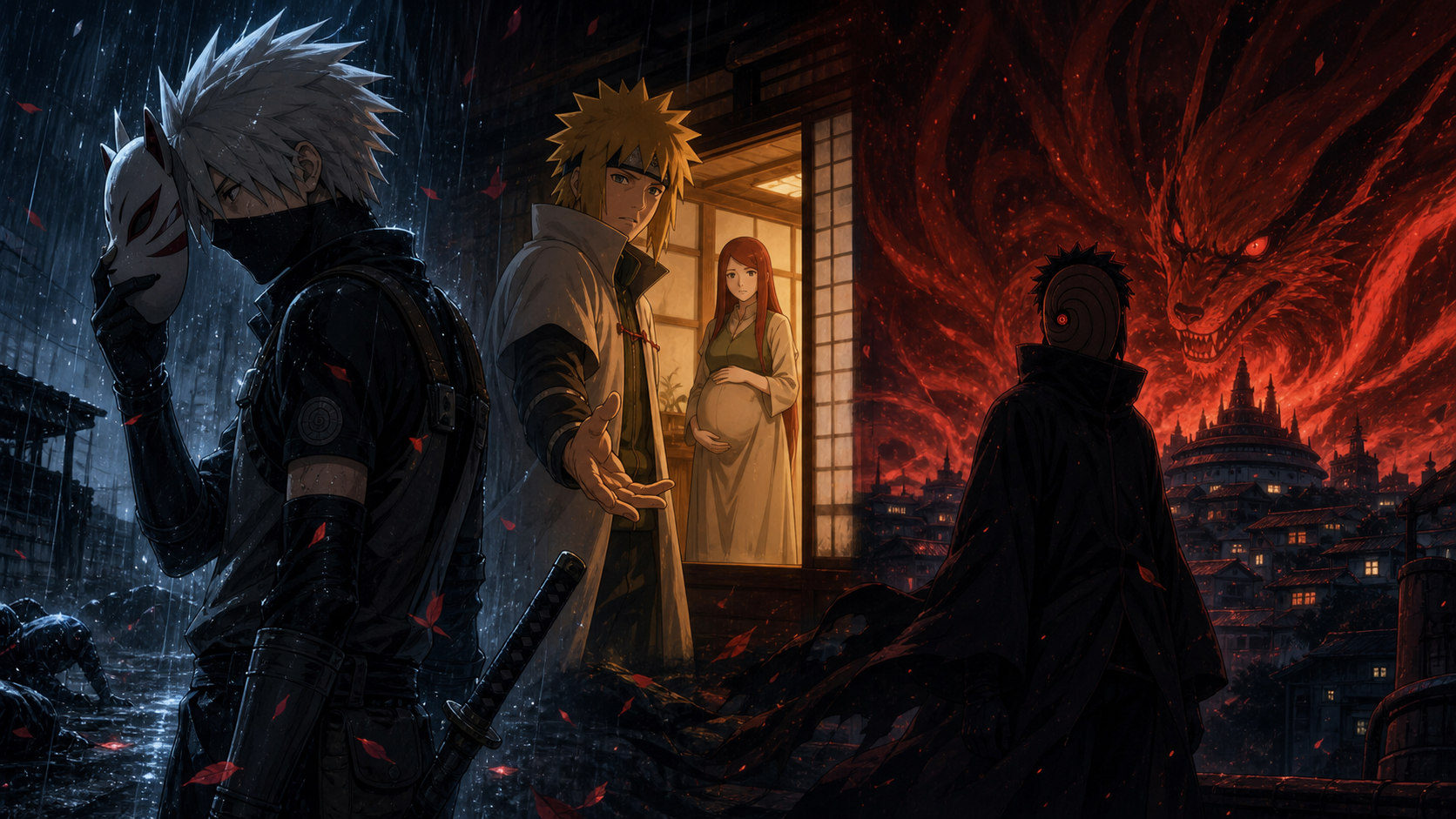
Minato’s Death
Minato tries to turn ANBU service into a lifeline for Kakashi, but the masked man approaches a family and village already carrying too many unspoken wounds.
Bottom line
“Minato’s Death” follows a decision meant to protect Kakashi into a system that rewards his emotional shutdown. Minato places his former student in ANBU, an elite force under the Hokage’s direct command. The structure gives Kakashi focus, proximity to a trusted leader, and work suited to his extraordinary skill. ANBU also surrounds grief with secrecy, lethal missions, and praise for detachment. Kakashi becomes known as “Cold-blooded Kakashi” because he kills enemies with ruthless efficiency. The nickname mistakes a trauma adaptation for an ideal professional identity. When the Nine-Tails attacks Konoha and Minato dies protecting the village, Kakashi loses the teacher positioned to recognize the person beneath the mask. ANBU does not cause every wound, but the unit gives those wounds a language of usefulness rather than recovery.
Minato chooses ANBU for Kakashi
The Fourth Hokage acts from concern as well as command. He wants to keep Kakashi close and redirect a gifted shinobi whose ordinary missions have become unstable.
The choice has understandable logic and serious risk.
Direct command offers proximity
ANBU answers to the Hokage, which places Kakashi within Minato’s institutional reach. A teacher can monitor changes more closely than a distant mission office.
Proximity can support care, but proximity inside a covert combat unit remains different from treatment.
Minato is trying to interrupt a decline
Kakashi’s impaired focus makes ordinary deployment dangerous to him and teammates. Leaving the pattern untouched would also be a decision.
Minato responds rather than looking away, which separates his choice from institutional neglect. The question is whether the available response addresses Kakashi’s injury or mainly relocates the injury into a more controlled setting.
A trusted commander can reduce uncertainty
Kakashi knows Minato’s voice, judgment, and history with Team Minato. Direct orders from that relationship may feel safer than assignments passed through unfamiliar layers of command.
Trust can make difficult work survivable. Trust cannot remove the cumulative effect of killing, secrecy, and repeated exposure.
The unit gives Kakashi rigid structure
Clear objectives, hierarchy, masks, and procedures reduce ambiguity. Kakashi can narrow attention to the next action rather than remain alone with recurring memory.
Structure may stabilize a crisis while leaving the source of the crisis untouched.
Predictability can become emotional shelter
ANBU procedure tells Kakashi where to stand, what to observe, and when to act. Grief offers no comparable instructions and no mission point where loss becomes complete.
The appeal of structure deserves compassion. A survivor may choose the environment that asks the fewest unanswerable questions.
Completion replaces mourning temporarily
A mission can end. Kakashi can confirm an objective, return, and receive another task. Grief has no comparable report status.
Measurable completion provides short relief from a loss that cannot be solved, making work an increasingly attractive place to disappear.
Elite status validates existing strengths
Kakashi’s speed, precision, Sharingan, and tactical judgment make him valuable to ANBU. The appointment tells him that the village still sees usefulness after his mission failures.
Being needed can feel like belonging, especially when grief has damaged every other identity.
Usefulness is not wellness
The ability to perform lethal work does not show that nightmares, guilt, and dissociation have resolved. Performance can coexist with severe distress.
Konoha receives evidence of capability while Kakashi receives fewer reasons to reveal the cost.
The ANBU mask formalizes concealment
Kakashi already hides much of his face. The animal mask adds an official identity designed to separate the operative from ordinary recognition.
Anonymity protects missions and makes emotional distance look like part of the uniform.
Classified work narrows honest conversation
Kakashi cannot freely describe assignments to friends outside the unit. Experiences accumulate behind security rules.
Secrecy may protect intelligence while increasing the isolation of the person carrying that intelligence.
The team behind the mask is still human
ANBU operatives may form bonds, notice one another’s habits, and develop trust under pressure. Covert structure does not erase every possibility of care.
Yet relationships built around missions may lack permission, time, or language for the grief Kakashi carries from outside the unit.
Shared danger can imitate intimacy
Depending on another operative during combat creates real connection. That connection may still remain bounded by aliases, masks, and classified experience.
Kakashi can feel less alone during an operation while becoming more isolated from ordinary life afterward.
Ruthlessness earns a reputation
Peers observe how quickly and decisively Kakashi kills enemies. “Cold-blooded Kakashi” converts repeated behavior into a stable character judgment.
The label praises usefulness while flattening the grief, fear, and training behind the behavior.
Cold-blooded is not emotionless
Kakashi’s earlier nightmares already show intense feeling. Emotional constriction during missions is better read as compartmentalization than absence of care.
A person can appear cold precisely because feeling has become overwhelming.
The label protects observers from discomfort
Calling Kakashi naturally cold makes his behavior easier to admire or fear. Observers no longer need to ask what happened to him or whether village policy is amplifying harm.
A personality label converts a collective responsibility question into a story about one exceptional individual.
Reputation begins shaping expectation
Once commanders expect ruthless efficiency, hesitation may appear like decline and restraint may appear like failure. Kakashi receives pressure to keep performing the identity others have named.
Reputation therefore does more than describe behavior. Reputation helps reproduce behavior.
Mission culture rewards the visible outcome
Enemies are eliminated and objectives are completed. Command structures can count those results more easily than they can measure moral injury.
What receives praise is likely to be repeated, even when repetition makes recovery harder.
Killing becomes a place of certainty
Combat presents immediate categories: threat, target, ally, objective. Grief presents unanswered questions and permanent limits.
Kakashi may feel more controlled inside danger than inside quiet, which makes dangerous work emotionally reinforcing.
Chidori carries more than combat function
The technique remains associated with Rin’s death even when used against enemies. Repetition can place the same body posture and sensory intensity inside new missions.
Operational mastery does not guarantee emotional neutrality. A signature technique can also become a recurring pathway into traumatic memory.
Ruthlessness reduces time for memory
Fast action leaves little space for doubt during the strike. Hesitation might allow the past to intrude or the present situation to become emotionally complicated.
Efficiency can therefore function as avoidance while still producing outcomes the village rewards.
The nickname travels faster than context
Other operatives can repeat “Cold-blooded Kakashi” without knowing Obito, Rin, or the promise that shapes his guilt.
Reputation becomes another mask placed on him by the institution.
Minato’s concern remains real
The assignment should not be reduced to indifference. Minato knows Kakashi is suffering and tries to intervene using the tools available to a Hokage.
Good intent deserves recognition without making the decision immune from criticism.
Command limits the form of care
Minato’s available response still emerges from a military village. Reassignment is administratively legible in a way that rest and long-term trauma support may not be.
Institutions often answer pain with a different job because jobs are what institutions know how to provide.
A better response would combine roles
Kakashi may benefit from structured service, but service should be paired with rest, confidential support, monitored exposure, and relationships outside covert work.
The editorial problem is not that every assignment is automatically wrong. The problem is treating assignment as the whole answer.
Risk review should include emotional evidence
Mission readiness cannot be measured only through speed, accuracy, and obedience. Nightmares, dissociation, concentration loss, and cumulative bereavement are operational evidence too.
Ignoring those signals endangers Kakashi and anyone expected to depend on him.
Kakashi remains exceptionally young
Elite status can obscure age. He enters a covert assassination structure after a childhood already defined by war and bereavement.
Skill changes what he can do, not what repeated exposure asks from a developing person.
The village calls exceptional exposure an honor
Selection for ANBU confirms status and can look like recognition of rare potential. Honor makes refusal difficult when the recipient already defines worth through service.
Prestige can conceal how much danger an institution is asking a young person to absorb.
Consent exists inside military pressure
Kakashi can accept the role and find meaning in the role. His choice still occurs within a culture where obedience, sacrifice, and usefulness define belonging.
Acknowledging that pressure does not erase his agency. Context explains why a harmful arrangement can also feel chosen.
ANBU transforms symptoms into assets
Hypervigilance becomes readiness. Emotional numbing becomes composure. Distance from ordinary relationships becomes operational secrecy.
The unit can benefit from adaptations that signal unresolved injury.
Success makes intervention less likely
Each completed mission supports the conclusion that Minato’s choice worked. Short-term operational improvement can conceal long-term emotional decline.
A system measuring only mission outcomes will miss the person disappearing beneath those outcomes.
The village enters another catastrophe
The Nine-Tails attack ends any gradual postwar recovery. Konoha faces mass danger inside its own walls.
Emergency again makes private needs appear postponable.
The attack confirms Kakashi’s fear of instability
Just as Konoha begins a new administration, overwhelming violence reaches the village. Safety proves temporary again.
For someone already expecting attachment to end in catastrophe, the attack can reinforce hypervigilance rather than challenge the expectation.
Public disaster multiplies private grief
Kakashi is not the only person losing someone during the Nine-Tails attack. Collective mourning surrounds him, yet shared scale does not make individual pain smaller.
Large tragedy can also make survivors feel that their personal need is too minor to name.
Minato responds as Hokage and father
He must protect the village while Kushina and newborn Naruto face direct danger. Public duty and intimate love converge during one impossible night.
His final decisions save lives and leave his own family permanently altered.
Minato dies protecting Konoha
The teacher Kakashi still has is removed by another act of sacrifice. Leadership changes again before the new administration can mature.
Kakashi loses both a personal bond and the commander who understood the history behind his symptoms.
The title announces the rupture plainly
“Minato’s Death” removes ambiguity about the episode’s destination. The emotional question is what the loss changes for a student already organized around death.
Kakashi does not merely add another name to memory. He loses the person who placed him in ANBU and might have revised that decision.
Hiruzen inherits a damaged system again
The Third Hokage returns to leadership after the Fourth’s brief tenure. Continuity may stabilize Konoha while postponing deeper questions about covert power and young operatives.
Kakashi remains inside structures built across administrations, showing how institutional consequences outlive the leader who made one appointment.
Another protector becomes a memory
Obito, Rin, and Minato now occupy Kakashi’s internal world as people connected to promises, sacrifice, and survival.
Repeated loss can make attachment feel inseparable from eventual death.
Grief compounds rather than replacing grief
Minato’s death does not move Kakashi beyond Obito and Rin. New loss joins older loss, adding another relationship to nightmares, guilt, and silence.
Recovery work becomes more complex because each memory can activate the others.
Kakashi remains valuable and increasingly alone
ANBU still has missions for him after Minato is gone. Institutional demand continues even when the personal relationship that made the placement seem protective disappears.
The arrangement has changed in meaning without changing uniform, rank, or procedure.
Minato chooses proximity when the village lacks treatment
Placing Kakashi under direct command lets Minato observe him, control assignments, and keep a grieving student within reach. The choice comes from care.
ANBU cannot provide trauma treatment simply because the commander is kind. Classified lethal work may offer structure while reinforcing the belief that usefulness is Kakashi’s safest route to relationship.
Structure can stabilize a day without healing the person
Clear objectives, routes, signals, and command reduce the ambiguity that lets intrusive memories flood Kakashi’s attention. Missions give his body a predictable sequence.
The relief is real and temporary. Recovery requires spaces where he can stop performing, sleep without punishment, discuss Rin and Obito, and remain valued when no operational result follows.
ANBU turns emotional distance into professional excellence
Kakashi’s silence, fast decisions, lethal precision, and willingness to enter danger produce successful missions. Supervisors see traits the unit rewards.
The same behavior may express dissociation, guilt, and indifference toward his own survival. Organizations fail injured workers when they celebrate a symptom because the symptom improves output.
The cold-blooded label protects everyone except Kakashi
Calling him naturally ruthless saves peers and leaders from asking why a young shinobi kills with such detachment. Reputation makes distress look like personality.
Once the label spreads, every new mission confirms the story. Kakashi receives dangerous work because he appears cold, then appears colder because dangerous work leaves no room for recovery.
Minato’s protective mission carries domestic trust
Assigning Kakashi near Kushina and the coming birth brings him close to ordinary family anticipation rather than another assassination target. Minato appears to hope responsibility can reconnect him to care.
The mission may help, but a pregnant woman and unborn child cannot become therapy tools. Kakashi needs support designed around his health while he provides protection through clearly defined duty.
Obito attacks the home he once wanted to rejoin
The masked survivor targets Kushina’s seal, releases Kurama, and turns Konoha into the catastrophe Madara taught him to expect. He now helps manufacture the evidence for his worldview.
Trauma explains how he became vulnerable to that ideology. The attack remains a chosen act against his teacher, civilians, a mother, and a newborn whose lives had no role in Rin’s death.
Minato dies across several responsibilities at once
He fights as Hokage, protects the village, responds as Kushina’s husband, and makes decisions as Naruto’s father. No role cancels the others.
The compressed emergency forces choices with consequences Naruto will carry for years. Heroic framing should sit beside the institutional question of why one family bears so much of the village’s survival.
Kakashi loses another anchor before recovering from the first losses
Minato’s death removes teacher, commander, witness, and one of the few adults who noticed his decline. The new grief arrives before Rin and Obito have become bearable memories.
Loss compounds rather than replacing what came before. A village that immediately returns Kakashi to useful silence will convert another personal rupture into operational capacity.
Hiruzen inherits responsibility for the support gap
Returning to office means inheriting shinobi, policies, covert units, and young people damaged under the previous administration. Continuity cannot mean leaving every harmful practice untouched.
Kakashi needs a review of duty, confidential care, and protection from recruiters who interpret isolation as loyalty. Leadership succession must preserve people, not only command structures.
Kushina’s pregnancy requires security beyond one operative
Her jinchūriki status, weakening seal during childbirth, and position as Hokage’s wife create overlapping risks. Assigning Kakashi adds skilled protection, but no single young operative should carry the entire perimeter.
A responsible plan needs medical staff, layered barriers, verified access, communication routes, evacuation options, and independent command if Minato must fight elsewhere. Personal trust belongs inside a system strong enough to survive one person’s absence.
The attack weaponizes confidential medical timing
Obito knows when Kushina’s seal will weaken and reaches the hidden birth site. That access suggests a security failure involving information, surveillance, or both.
After the attack, Konoha should investigate how the timing and location became exposed without blaming the mother whose body created the vulnerability. Institutions owe both.
Naruto inherits a public role before personal care
Minato and Kushina die protecting him and the village, leaving a newborn carrying Kurama and enormous political meaning. Adults immediately gain reasons to see him as weapon, symbol, threat, or legacy.
The child needs stable caregivers, truthful age-appropriate information, protection from stigma, and relationships unrelated to his usefulness. Honoring his parents should begin with care rather than secrecy.
Kakashi’s absence from the final fight does not create guilt
He cannot reasonably prevent an attack designed around space-time ninjutsu, a compromised seal, and Kurama.
Survivor guilt may still tell him that another death proves personal failure. Leadership must name the real threat chain before Kakashi turns institutional breakdown into another reason to surrender his life to work.
RaeRae’s verdict
“Minato’s Death” shows why ANBU can look like both rescue and danger for Kakashi. Direct command, structure, and meaningful work give him a way to function. The same environment rewards the numb efficiency everyone should recognize as a warning sign. “Cold-blooded Kakashi” is not the discovery of his true nature. The name is what a military culture calls pain when pain completes the mission.
Minato’s death removes the person most likely to remember Kakashi as a student before seeing an operative. The tragedy extends beyond losing a Hokage. Kakashi is left inside a secret institution that knows how to use his control but has little incentive to ask what the control conceals.
RaeRae’s call
Minato brings Kakashi close because he cares, but ANBU converts the same grief signals into elite performance. Structure can steady a day without healing a child soldier. After Minato dies, Hiruzen inherits more than an office: he inherits Kakashi’s untreated trauma, Danzō’s recruitment pressure, and the duty to build care that survives one good teacher.
Episode details and viewing routes
- Official episode reference: Naruto Official episode guide
- Licensed episode route: Crunchyroll licensed episode page
What I am carrying forward
Kakashi has entered ANBU under Minato’s direct authority and earned the name “Cold-blooded Kakashi” through ruthless mission conduct. His performance has improved while the emotional injuries beneath that performance remain unresolved.
Minato has died during the Nine-Tails attack, removing Kakashi’s teacher and commander. Hiruzen returns to the Hokage role, and covert factions retain influence. Episode 351 brings Kakashi into contact with a Foundation boy capable of Wood Style and the records surrounding Hashirama’s cells.