
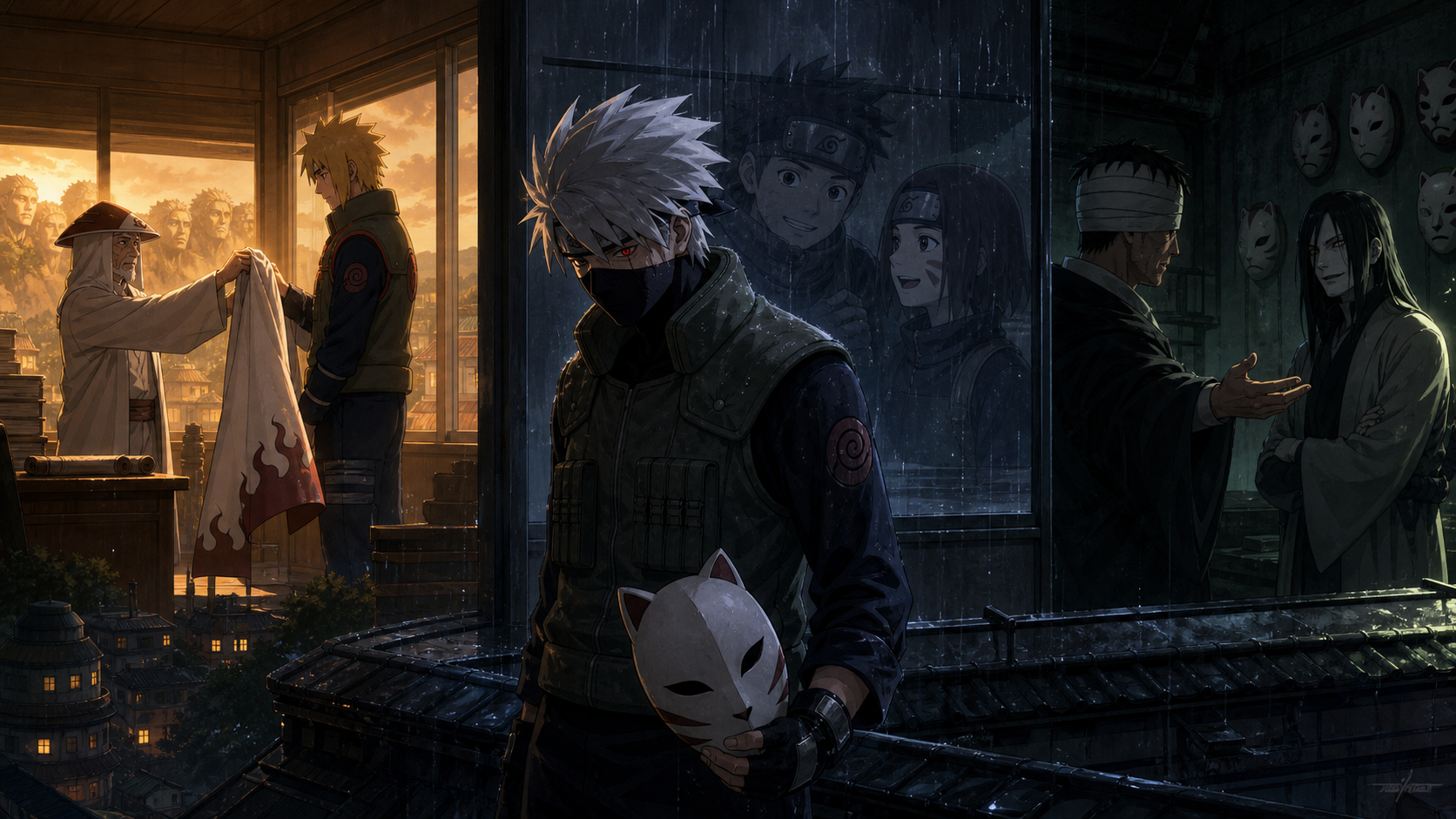
A Mask That Hides the Heart
Minato’s appointment promises compassionate leadership, but Kakashi’s grief makes the blank ANBU mask look like both protection and disappearance.
Bottom line
“A Mask That Hides the Heart” begins Kakashi’s ANBU story by refusing to treat competence as proof of recovery. The Third Great Ninja War has ended, and Konoha must choose a Fourth Hokage. Danzo promotes Orochimaru, while Hiruzen’s support helps Minato Namikaze receive the position. The public transition promises renewal, but Kakashi remains trapped inside losses the village has not helped him process. Obito died at Kannabi Bridge as far as Kakashi knows. Rin then moved into Kakashi’s Chidori to prevent the Three-Tails inside her from destroying Konoha. Nightmares, intrusive memories, and impaired concentration follow him into missions. The mask in the title is both shinobi discipline and emotional concealment. Kakashi can still wear a uniform, complete assignments, and appear controlled while his mind repeatedly returns to the people he could not save.
The war ends before Kakashi’s war ends
Konoha can mark a political transition and redirect military structures. Kakashi cannot declare the same clean boundary inside his nervous system.
Public peace and personal safety are related but not identical. A ceasefire does not automatically teach a survivor how to sleep.
Konoha must choose a Fourth Hokage
Leadership succession becomes the village’s visible postwar question. The decision will shape which values receive institutional power during recovery.
Selection is not merely ceremonial. A Hokage controls missions, appointments, security priorities, and the stories a village tells about sacrifice.
Hiruzen and Danzo represent competing visions
Both men emerged from the same generation, yet they understand protection differently. Hiruzen publicly supports Minato, while Danzo attempts to advance Orochimaru.
Their disagreement reaches beyond personality. Konoha is choosing between forms of authority and different tolerances for secrecy, experimentation, and control.
Danzo nominates Orochimaru
Orochimaru’s brilliance makes him attractive to a leader who values results and strategic advantage. Talent becomes the central argument while ethical danger receives less weight.
Technical ability cannot substitute for judgment about what power is for or whose bodies become acceptable costs.
Ambition links Danzo and Orochimaru
Neither man approaches leadership as simple service. Danzo wants influence over the village’s direction, and Orochimaru’s pursuit of mastery repeatedly pushes beyond ordinary limits.
Their alignment shows how institutional ambition can make warning signs appear useful rather than disqualifying.
Hiruzen supports Minato
The retired Third Hokage places his authority behind a younger leader whose battlefield record and relationships have earned broad respect.
Support from an established figure helps stabilize succession, but endorsement also creates responsibility to help the new administration confront inherited systems.
Minato represents a different possibility
He combines exceptional speed and combat ability with attention to individual bonds. Kakashi knows him as a teacher, not only as a war hero.
That personal history gives the appointment emotional weight. Someone who cared about Team Minato now holds the village’s highest office.
The appointment cannot restore Team Minato
Minato’s success does not return Obito or Rin. Celebration exists beside a private history of failure, guilt, and interrupted adolescence.
Kakashi may respect his teacher while finding no relief in the public achievement.
Kakashi carries survivor guilt
Obito entrusted him with a Sharingan and asked him to protect Rin. Kakashi now believes he failed the promise in the most direct possible way.
Survival can feel like evidence against the survivor when friends are dead, even though continued life is not a betrayal.
Rin’s death remains physically remembered
Kakashi’s hand delivered the Chidori that killed her, but the event was not a chosen execution. Rin moved into the attack to prevent a coerced Three-Tails plan from reaching Konoha.
His body can remember contact and blood without preserving every moral distinction available to an outside observer.
Context does not erase trauma
Knowing that Rin acted to protect the village might reduce false blame under ideal conditions. Knowledge alone cannot make the sensory memory harmless.
Trauma is not a logic error corrected by presenting the right sentence once.
Kakashi experiences recurring nightmares
Sleep returns him to the loss rather than providing recovery. The past enters a space where he has less control over sequence and outcome.
Nightmares extend battlefield conditions into hours that should allow rest, leaving exhaustion to compound grief.
Intrusive memories interrupt the present
Images of Obito and Rin break into current missions. Kakashi’s attention moves between the assignment before him and danger that has already happened.
The disruption is a trauma response, not proof that he has stopped caring about his team or village.
Mission focus begins to fail
Kakashi has built identity around precision, rules, and reliable execution. Losing concentration threatens both safety and the self-concept that kept him functioning.
High performance can hide distress until symptoms interfere with the very skill everyone uses as evidence of wellness.
The village sees a gifted shinobi
Peers and leaders know his record, Sharingan, intelligence, and early promotion. Those achievements create expectations that he will continue absorbing difficult assignments.
Competence attracts more work while reducing the chance that anyone asks what continued work costs.
The child soldier becomes an adult asset
Kakashi has carried military responsibility since childhood. The village benefits from skills shaped during years when ordinary emotional development was repeatedly interrupted.
Calling him elite does not change the age at which loss, killing, and command became normal.
Early promotion compresses childhood
Rank gives Kakashi authority before he has the support needed to metabolize what authority demands. Adults can praise unusual maturity while overlooking the conditions that forced a child to perform maturity.
The result is a dangerous loop. Competence earns harsher assignments, harsher assignments create more injury, and continued competence becomes the reason nobody interrupts the cycle.
Achievement becomes evidence against care
Kakashi can point to completed missions, technical mastery, and survival. Commanders can use the same record to conclude that intervention would be unnecessary.
Performance measures what he can produce under pressure. Performance does not measure sleep quality, intrusive memory, grief, fear, or the effort required to appear composed.
Discipline becomes a mask
Rules and controlled behavior help Kakashi move through situations that feel internally chaotic. Structure can be stabilizing without constituting recovery.
The same habits that preserve function can keep pain invisible to people positioned to help.
The literal mask protects privacy
Kakashi’s covered face becomes an enduring visual boundary between inner experience and public access. Others receive only what he chooses or manages to show.
Privacy is not dishonesty. The problem begins when an institution interprets concealment as evidence that no care is needed.
Silence is rewarded in shinobi culture
Mission systems prize composure, obedience, and the ability to continue after casualties. Open distress can be read as unreliability.
Such incentives teach people to hide symptoms until danger becomes impossible to ignore.
Mission reports leave grief off the page
Operational records capture objectives, casualties, intelligence, and outcomes. They rarely preserve the private meanings attached to a teammate’s last words or the sensation of a friend dying against one’s hand.
What an institution records shapes what the institution can recognize. A narrow report can make profound injury administratively invisible.
Teammate loss is treated as occupational risk
Shinobi know death is possible, but familiarity with risk does not make each loss emotionally ordinary. Professional expectation cannot cancel attachment.
Treating grief as part of the job often means transferring the cost from the institution to the individual survivor.
Minato notices Kakashi’s decline
A former teacher has context that ordinary commanders may lack. Minato knows the people behind the names and understands the promise that binds Kakashi’s guilt.
Recognition is an important beginning, but recognition must lead to support rather than simply reassignment.
Care and command now occupy one person
As Hokage, Minato must protect Kakashi while also deploying shinobi for village needs. Those roles can conflict when dangerous work appears to offer structure or purpose.
Good intent does not remove the institutional pressure attached to a commander’s decision.
Minato carries his own grief and responsibility
He also lost two students and knows that Kakashi was placed in circumstances no child should have faced. Becoming Hokage adds an entire village to the people he is expected to protect.
His concern can be genuine while his available responses remain shaped by a military institution. Compassion needs structure behind compassion or care becomes dependent on one exhausted leader.
A teacher cannot substitute for a care system
Minato’s attention gives Kakashi a relationship the village should value. One trusted adult, however, cannot provide every form of recovery while also serving as commander and head of state.
Konoha needs durable practices for rest, assessment, confidential support, and reintegration that survive leadership changes.
Kakashi needs treatment, community, and time
He needs space to tell the story without being judged by the outcome, reliable sleep, reduced exposure, and people who can challenge false responsibility.
No single mission assignment can supply all of those conditions.
Grief should not become a promotion path
Moving a traumatized shinobi into more secretive and violent work may look practical because his skills fit the role. Fit on paper can conceal emotional risk.
An institution should not answer visible deterioration by finding a unit where deterioration is easier to hide.
Dangerous work can feel temporarily clarifying
High-risk missions narrow attention to immediate objectives. For someone overwhelmed by memory, that intensity may briefly quiet everything outside the assignment.
Temporary relief can make repeated exposure feel useful while deepening dependence on crisis. Feeling functional during danger does not prove danger is treatment.
Secrecy can intensify isolation
Classified missions limit what Kakashi can discuss and with whom. Even supportive peers cannot respond to experiences they are forbidden to know.
Moving him toward increasingly secret work risks pairing trauma with fewer opportunities for honest connection.
Obito’s survival remains unknown
Kakashi mourns a friend he believes died saving him. The audience now knows Obito survived and was manipulated underground.
That dramatic distance makes both stories more painful. Each boy suffers through an incomplete account of the other.
Neither survivor receives the truth
Obito does not receive honest context about Rin before embracing Madara’s project. Kakashi does not know Obito lived or witnessed Rin’s death.
Secrecy isolates them into different forms of guilt and makes manipulation easier.
Kakashi cannot mourn Obito accurately
He honors a friend’s presumed final sacrifice while lacking the knowledge that Obito survived, recovered, witnessed Rin’s death, and accepted Madara’s identity. His grief is sincere even though the underlying account is incomplete.
Incomplete information does not make mourning false. The missing truth shows how war and manipulation can keep survivors emotionally organized around events that no longer match reality.
Obito turns the shared past into accusation
Obito interprets Kakashi through the promise to protect Rin and the image of Chidori. Kakashi interprets himself through the same promise and image.
Both boys become trapped by a moment whose coercive context neither has processed with the other. Madara’s project benefits from that separation.
The village celebrates while he dissociates
Public optimism around Minato’s appointment contrasts with Kakashi’s inward withdrawal. Both realities can exist in the same streets.
Community milestones should make room for people whose bodies do not experience the moment as safe.
Recovery cannot be ordered on a schedule
The village has practical reasons to resume missions and establish leadership quickly. Kakashi’s mind follows no administrative calendar.
Expecting grief to align with operational demand turns normal trauma responses into perceived failures of discipline.
The title names concealment, not emptiness
A hidden heart is still a feeling heart. Kakashi’s restraint should never be mistaken for indifference toward Obito, Rin, Minato, or the village.
The mask protects a person carrying too much, and the story asks viewers to look beyond the surface everyone around him finds convenient.
Konoha treats competence as proof that Kakashi is fine
He completes missions, follows orders, and carries exceptional skill, so the village keeps finding harder work. Performance hides the nightmares and dissociation from people trained to evaluate output.
Competence can coexist with crisis. A system that rewards functioning without asking what functioning costs will keep promoting injured people until a visible collapse becomes impossible to ignore.
Minato’s promotion increases his duty and reduces his time
Becoming Hokage gives him authority to protect Kakashi, but leadership expands the number of people, threats, and institutions demanding attention. Personal concern now competes with national command.
That conflict is why care cannot depend on one good teacher. Kakashi needs medical confidentiality, trauma specialists, time away from lethal assignments, peer support, and supervisors who can intervene without waiting for the Hokage.
Danzō sees grief as operational opportunity
A talented shinobi who avoids attachment, obeys quickly, and wants danger can look ideal for covert work. Those traits may also signal a young person who cannot imagine a future beyond usefulness.
Recruiting from that condition turns injury into institutional leverage. ANBU service might provide structure, but Root-style secrecy would deepen the same isolation already keeping Kakashi from recovery.
The Hokage debate exposes what leaders reward
Danzō backs Orochimaru because ambition, experimentation, and willingness to cross limits look useful to his security model. Hiruzen backs Minato as a leader capable of trust and public responsibility.
The choice shapes more than one office. Promotions tell every shinobi which behavior the village considers worthy. A system that elevates results without ethical limits will reproduce Orochimaru long after one candidate loses.
Nightmares are symptoms rather than secret messages
Kakashi relives Rin’s death because his body and mind have not integrated the event. The dreams interrupt sleep and pull the battlefield into the present.
He needs care, not another mission interpreting distress as readiness. Shinobi culture often mistakes silence for resilience, leaving trauma to surface through exhaustion, narrowed emotion, risk-taking, and compulsive work.
The ANBU mask offers privacy and institutional concealment
Covering Kakashi’s face may reduce the pressure to perform ordinary emotion around teammates. The same anonymity makes supervisors less likely to see the person behind successful operations.
A mask can help someone complete a task without healing the reason concealment feels necessary. Protection becomes dangerous when the organization prefers a quiet operative to a recovering human being.
Neither Kakashi nor Obito receives accurate grief
Kakashi believes Obito died saving him and that he later killed Rin. Obito believes he saw Kakashi betray Rin and that reality itself made their promises meaningless.
Madara and wartime secrecy keep both accounts incomplete. Each survivor builds identity around missing evidence, while the institutions involved never create a process for testimony, investigation, or repair.
Grief should trigger support before reassignment
Kakashi has lost his father, Obito, and Rin while serving as a child soldier. Another dangerous post cannot substitute for mourning or clinical care.
A humane village would assess sleep, intrusive memories, self-harm risk, isolation, and mission functioning before deciding future duty. Rest is not punishment, and treatment is not proof that a shinobi has become unreliable.
Mission reports cannot carry the whole injury
A report can list objectives, casualties, routes, and tactical errors. The form cannot capture what Kakashi sees when he closes his eyes or why ordinary contact now feels dangerous.
Confidential care must remain separate from rank and mission evaluation.
Early promotion removed normal stages of development
Kakashi learned leadership, killing, and responsibility before he had adult support for grief, identity, or failure. Rank made the compression look like success.
Young talent needs time to become a person outside work. Accelerated careers require stronger safeguards, not fewer, because skill can place a child inside consequences emotional development has not prepared them to carry.
Minato must distinguish protection from usefulness
ANBU may keep Kakashi physically near the Hokage and assign missions under closer supervision. The placement may also tell Kakashi that remaining valuable is the condition for receiving attention.
Care should continue during leave, reduced duty, mistakes, and refusal. Otherwise a grieving student learns that relationship survives only while he produces results for the village.
The political celebration leaves private casualties unseen
Konoha marks Minato’s appointment as renewal after war. Kakashi experiences the same moment through teammates who cannot stand beside their teacher.
Public recovery often moves faster than individual bodies. Ceremonies can honor peace while institutions fund long-term support for the people whose nightmares continue after banners rise. One story does not cancel the other.
RaeRae’s verdict
“A Mask That Hides the Heart” treats Kakashi’s famous composure as a survival strategy rather than a complete personality. The war may be over institutionally, but Obito’s presumed death and Rin’s coerced sacrifice remain active inside his sleep, attention, and missions. His difficulty focusing is not moral weakness. His mind is signaling an injury the village has trained him to conceal.
The Hokage debate adds a second layer of masking. Konoha presents succession as orderly while Danzo attempts to place Orochimaru’s dangerous brilliance near ultimate authority. Minato’s selection offers a better possibility, but good leadership will be tested by how the village treats damaged people, not only by which name appears on the monument.
RaeRae’s call
Kakashi’s mission record is not a mental-health assessment. The village sees competence and keeps assigning danger while nightmares, dissociation, and survivor guilt remain untreated. Minato can care, but one grieving teacher cannot become a whole support system. Build confidential treatment, protected leave, peer support, and leadership willing to value recovery above another perfect report.
Episode details and viewing routes
- Official episode reference: Naruto Official episode guide
- Licensed episode route: Crunchyroll licensed episode page
What I am carrying forward
Minato has been selected as Fourth Hokage with Hiruzen’s support, over Danzo’s preferred candidate Orochimaru. The political loss deepens Danzo and Orochimaru’s frustration.
Kakashi is suffering nightmares, intrusive memories, survivor guilt, and impaired mission focus after Obito’s presumed death and Rin’s death through his Chidori. Minato recognizes that his former student is deteriorating. Episode 350 follows Kakashi’s placement in ANBU, his increasingly ruthless battlefield reputation, and the crisis surrounding Minato’s death.