
I’m in Hell
Obito rebuilds his body for a reunion, only to reach the battlefield at the exact moment Madara’s philosophy can consume his grief.
Bottom line
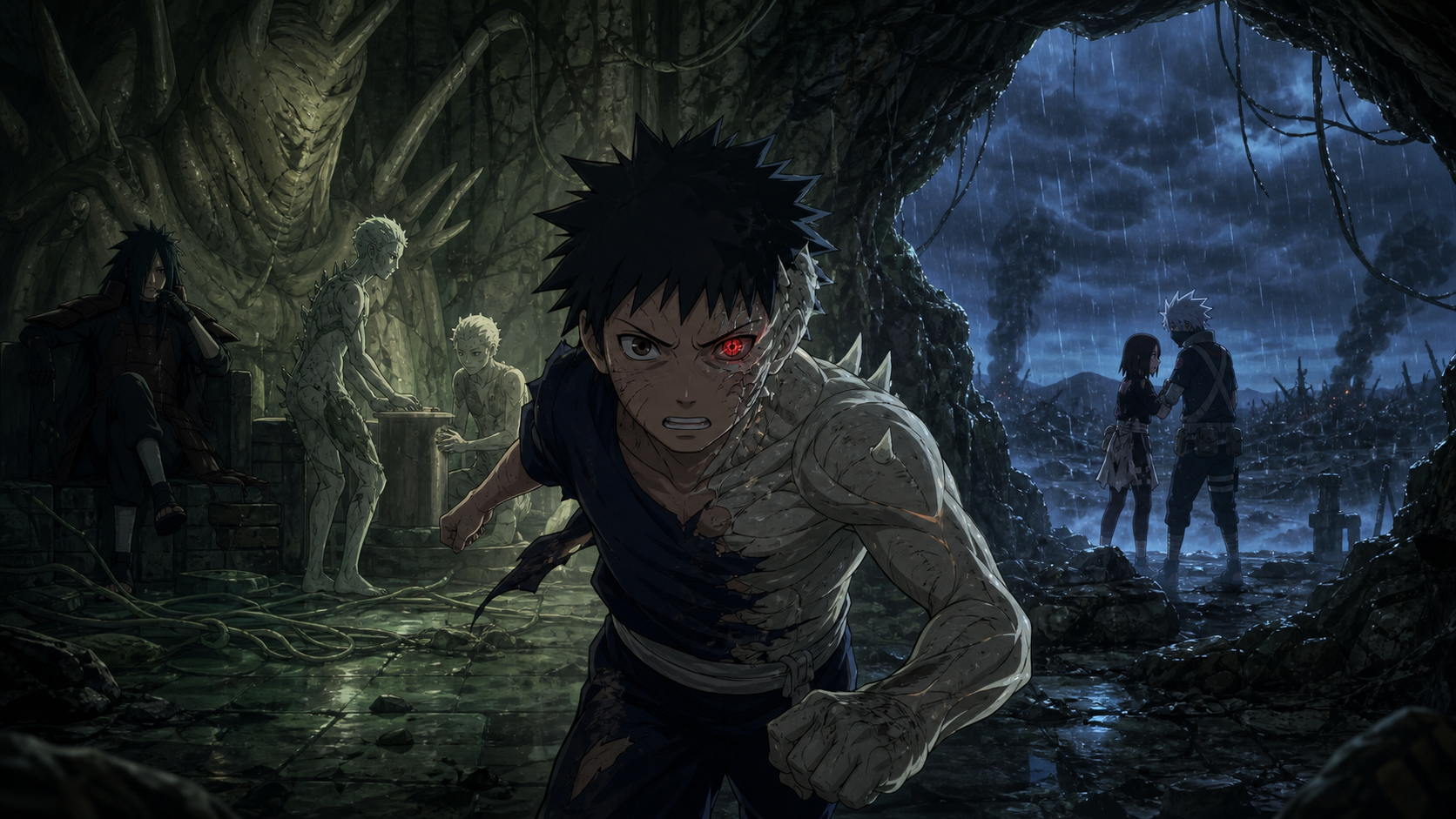
“I’m in Hell” shows how a rescue can be designed as captivity. Young Obito wakes beneath Madara’s hideout with half his body crushed, rebuilt through Hashirama-derived material, and separated from everyone who might help him understand what happened. Madara offers survival while insisting that reality produces only suffering. Obito rejects that worldview because Kakashi and Rin still give him a reason to return. His rehabilitation becomes an act of hope: every painful movement is directed toward rejoining Team Minato. Then a White Zetsu reports that Kakashi and Rin are in danger. Obito tears himself out of the cavern with a spiral-bodied Zetsu supporting his unfinished body and reaches the battlefield in time to see Kakashi’s Chidori pass through Rin. The episode does not present that sight as a complete explanation. Obito arrives without context, already primed by isolation and Madara’s philosophy, and witnesses the exact image most capable of destroying his remaining trust. “Hell” names both the battlefield and the psychological trap prepared around him.
Obito wakes after the world declared him dead
The collapse at Kannabi Bridge should have ended his life. Instead, Obito opens his eye in an underground chamber with no familiar face nearby.
Survival begins as disorientation. He cannot know who found him, how long he has been absent, or what his teammates believe.
Madara controls the first explanation
The elderly Uchiha tells Obito that rescue came through extraordinary intervention. Nobody from the Leaf can confirm or challenge the account.
Information becomes part of the enclosure. Madara defines the situation before Obito can contact anyone he trusts.
The repaired body carries another person’s design
Obito’s crushed side has been reconstructed with pale organic material connected to Hashirama Senju’s cells. The repair makes movement possible while binding recovery to Madara’s resources.
His body becomes evidence of help and a mechanism of dependence at the same time.
Rehabilitation is powered by reunion
Obito does not train because he accepts Madara’s plan. He pushes through pain because he wants to return to Kakashi and Rin.
Hope supplies the discipline that captivity cannot manufacture. Every successful movement points toward the world outside the cavern.
Rin remains the future Obito can imagine
Rin represents care, recognition, and the ordinary bond Obito still believes waits for him. Thoughts of seeing her again make recovery feel temporary rather than terminal.
Madara understands that attachment is the strongest resistance to his worldview and the most useful target for breaking that resistance.
Kakashi remains a rival and a friend
Obito left Kakashi his Sharingan after finally earning mutual trust. Returning would let both boys continue the partnership created during disaster.
The gift connects Obito to life outside the cave even while physical separation makes that connection impossible to verify.
Madara describes reality as a failed system
He argues that love inevitably creates loss and that peace cannot survive human conflict. His solution replaces reality with a dream controlled through overwhelming power.
The philosophy sounds abstract until Obito’s most important relationships are placed under threat.
Obito rejects the dream world at first
The boy who wanted to become Hokage still believes effort can repair failure. Kakashi and Rin are real people, not substitutes he would accept inside an illusion.
This refusal matters because later allegiance cannot be mistaken for immediate agreement or natural destiny.
Isolation weakens independent judgment
Obito has no teacher, medic, teammate, or family member available to offer another interpretation. Madara and the Zetsu beings control every conversation.
Even friendly humor occurs inside an environment built by the person trying to recruit him.
White Zetsu makes captivity feel less severe
The pale artificial beings joke, assist with rehabilitation, and provide companionship. Their presence softens the cavern without changing who controls the exit and the information.
Comfort can make dependence easier to tolerate while leaving the underlying power structure untouched.
The spiral-bodied Zetsu becomes physical support
Obito’s reconstructed body is not ready for the speed demanded by an emergency. A spiral-shaped Zetsu wraps around him and supplies strength and protection.
The assistance lets Obito leave, yet the same body belongs to Madara’s network. Escape still travels through the system designed to contain him.
News of danger overrides caution
When Obito hears that Kakashi and Rin are threatened, patience disappears. He will risk incomplete recovery rather than remain safe while friends suffer.
The response proves that his original values remain alive at the moment he leaves the cavern.
Madara does not physically stop him
The old Uchiha allows Obito to depart despite claiming the outside world is hopeless. Confidence replaces restraint.
Madara appears certain that experience beyond the cave will deliver the lesson his argument could not force Obito to accept.
Permission reveals preparation
A captor who expects escape to fail does not need chains. Madara has arranged the environment so that movement toward freedom can become movement toward recruitment.
Obito believes he is choosing reunion, but every available route remains surrounded by Madara’s information and resources.
The tunnel turns hope into urgency
Obito races through earth and rain with an unfinished body. Distance becomes another obstacle between him and the people who made survival worthwhile.
The episode stretches that approach because dread grows alongside his determination. Arrival promises rescue and threatens revelation.
War has continued without Obito
Kakashi and Rin have faced new missions, enemies, and impossible orders while Obito recovered underground. His emotional timeline paused, but theirs did not.
The reunion he imagines belongs to an earlier moment that the battlefield has already changed.
Mist shinobi surround the scene
The conflict involves forces and plans Obito does not understand when he arrives. He sees danger without the chain of decisions that produced the confrontation.
That missing context becomes crucial because the visible act alone supports the worst possible interpretation.
Kakashi’s Chidori becomes the first image
Obito reaches the battlefield as lightning passes through Rin’s chest. The eye he gave Kakashi witnesses the person he loves dying by Kakashi’s hand.
Timing collapses every hopeful expectation into one unbearable frame before anyone can explain what Rin chose or why.
Rin’s agency is invisible to Obito
The scene does not show him the full truth that Rin placed herself in Kakashi’s attack to prevent the Three Tails from being used against the Leaf.
Obito receives outcome without intention. Trauma fills the missing explanation faster than reason can reach him.
Kakashi’s horror is also easy to miss
Kakashi is not a cold executioner. He is devastated by the contact and by the impossible position surrounding Rin’s decision.
Obito’s shock narrows perception so completely that shared grief cannot register as evidence of shared innocence.
The Sharingan connects both witnesses
Kakashi’s gifted eye and Obito’s remaining eye respond to the same death. Their ocular bond records a catastrophe neither boy wanted.
The paired awakening turns the moment into a permanent connection even as misunderstanding drives them apart.
“Hell” is a conclusion formed under shock
Obito declares the world hell because the reality before him appears to destroy every bond he trusted. The statement carries emotional truth without providing a complete factual account.
Madara’s ideology gains power by presenting despair as proof rather than as a wound requiring care and context.
Madara engineered vulnerability before the loss
Obito was isolated, physically dependent, and repeatedly told that reality betrays love. The battlefield sight arrives after that preparation.
Manipulation succeeds because Madara shapes the interpretive frame surrounding trauma, not because Madara invents every painful event.
Trauma is not consent
Obito’s devastation cannot be treated as a calm agreement to Project Tsuki no Me. The boy has just witnessed what appears to be the destruction of his entire future.
Later choices remain his responsibility, but the starting point is acute psychological collapse rather than informed philosophical debate.
Rescue becomes a claim on identity
Madara saved Obito’s body and then positioned his own worldview as the only explanation capable of containing Obito’s pain. Survival is converted into ideological debt.
The method reveals why benevolent language should never hide control over information, movement, and recovery.
Obito’s loyalty is used against him
His desire to protect Kakashi and Rin drives rehabilitation, escape, and the final rush toward battle. The same virtue delivers him to the sight that breaks him.
Manipulation does not require creating weakness from nothing. Strong commitments can be targeted at their most vulnerable point.
The episode preserves the tragedy of possibility
Obito might have understood more if another trusted person reached him first, if he arrived earlier, or if context followed the image before Madara’s doctrine.
Those unrealized routes make the fall tragic without pretending recovery would have been easy or guaranteed.
Kakashi and Obito suffer the same moment differently
Kakashi experiences failure, guilt, and the loss of someone he tried to protect. Obito experiences apparent betrayal and the collapse of his imagined return.
Neither boy has the capacity to recognize the other’s internal reality while Rin dies between them.
Rin becomes more than a symbol
The later conspiracy often speaks of Rin as the center of Obito’s despair. Her own decision must remain visible within that framing.
She acted to protect the village from becoming the target of a weapon placed inside her body. Erasing that agency repeats the control imposed upon her.
Madara’s plan depends on reducing people to functions
Obito is a successor, Rin is a trigger, Nagato is a pair of eyes, and the Tailed Beasts are components. Individual lives matter only through usefulness to the dream project.
That reduction is the moral violence beneath the promise of universal peace.
The cavern and battlefield mirror each other
The cavern hides manipulation behind rescue. The battlefield hides context behind one devastating image. Both spaces give Obito partial truth under extreme pressure.
Moving from one enclosure to another creates the illusion that the world itself has confirmed Madara’s lesson.
The next episode must show the aftermath
Witnessing Rin’s death is the break, not the full transformation. Obito still has to respond, interpret, and choose what the experience will mean.
Episode 346 must examine how rage and grief become allegiance to a world of dreams.
Obito wakes inside a controlled information environment
He cannot leave easily, contact Konoha, verify the war, or compare Madara’s story with another adult’s account. His damaged body makes every source of food, treatment, mobility, and information dependent on the cavern.
That dependency is the foundation of grooming. Madara does not need Obito to agree immediately. He needs enough isolation that repeated ideology becomes the only explanation available when the next crisis arrives.
Medical rescue arrives without meaningful consent
Hashirama cells and Zetsu material replace parts of Obito’s crushed body. The intervention saves his life and creates abilities he never requested, under conditions where refusal would have meant death.
Survival does not create ownership. Madara treats reconstruction as investment in a future operator, while Obito experiences rehabilitation as the road back to Rin and Kakashi. Their understanding of the same care is radically unequal.
Rehabilitation shows the boy who still wants home
Obito struggles through pain, weakness, and an unfamiliar body because he expects to return to his team. His motivation remains relationship rather than power.
The detail protects his earlier self from the fatalistic story Madara wants to tell. Obito was not rescued as a willing disciple. He trained toward reunion until engineered circumstances made reunion appear impossible.
White Zetsu turns captivity into companionship
The Zetsu figures joke, answer questions, and help Obito move. Their presence softens the cavern enough that isolation does not always feel like imprisonment.
That warmth can be genuine at the interpersonal level while serving a harmful structure. Friendly attendants still report to Madara, shape the available information, and normalize a world where Obito’s body and future belong to someone else’s project.
Madara lets Obito leave because the trap is already outside
He does not chain the boy when news arrives about Rin and Kakashi. Physical permission makes Madara appear less controlling, but the coming battlefield has been prepared to deliver the ideological break he needs.
Manipulation often works better when the target believes the decisive action remains freely chosen. Obito runs because he cares. Madara relies on that loyalty to carry him directly toward trauma.
The spiral Zetsu body makes speed possible and dependence visible
Obito cannot reach the battlefield through his own recovering body, so the spiral figure wraps around him and provides strength. The assistance saves time while placing another Madara-linked system against his skin.
Every useful resource in the escape comes from the captor’s network. Obito exercises purpose inside a route whose body, information, timing, and destination have already been shaped by people he does not understand.
The battlefield image arrives without context
Obito sees Kakashi’s Chidori through Rin before he hears any explanation about the Mist, the Three-Tails, Rin’s decision, or Kakashi’s horror. One unbearable frame becomes the whole story.
Shock compresses evidence. His brain reaches a conclusion before language, sequence, and motive can catch up. That reaction is human. Building a world-destroying ideology around the incomplete image becomes a later choice.
Rin’s agency disappears inside Obito’s first interpretation
From his angle, she looks like a victim of Kakashi’s deliberate attack. The missing truth includes her attempt to protect Konoha from the Three-Tails plan by moving into the Chidori.
Remembering that choice does not make her death acceptable. Rin was a child forced into a weaponized-body crisis created by enemy shinobi and village warfare. Agency under catastrophe is not free consent.
Kakashi is also trapped inside the instant
His face and body show that the strike was not a desired victory. He cannot reverse the motion, save Rin, or explain anything to the teammate watching from beyond his awareness.
Obito’s grief later turns Kakashi into evidence that reality is rotten, but Kakashi is another injured child in the same system. Blaming him alone protects every adult and institution that built the battlefield.
The synchronized Sharingan turns trauma into shared sensation
Obito and Kakashi awaken Mangekyo Sharingan through the same death from different positions. Their eyes connect the event even though neither can communicate across the distance.
The power-up should not romanticize suffering. Extraordinary ability emerges from a girl’s death and two boys’ psychological collapse. No village should view that result as compensation for the children destroyed in producing it.
Madara weaponizes a real indictment of the shinobi world
Children are sent to war, bodies become containers, villages hide operations, and loyalty demands sacrifices no child should make. His evidence is devastating because the system is genuinely violent.
Infinite Tsukuyomi does not repair those structures. Madara uses institutional failure to justify removing everyone’s autonomy. A true indictment should lead toward accountability and prevention, not planetary captivity.
The Mist plan turns Rin’s body into delivery infrastructure
Enemy shinobi seal the Three-Tails inside her and intend Konoha to become the release site. Rin’s life, movement, trust, and home are converted into parts of a weapon system.
The plan shows why jinchūriki stories require bodily autonomy, medical ethics, and civilian planning. A village may discuss strategic assets while the person carrying that strategy experiences terror, isolation, and impossible responsibility.
Obito’s isolation removes the people who could challenge despair
No Minato, Kushina, teacher, medic, relative, or teammate reaches him between rescue and the battlefield. Madara becomes the only adult positioned to explain the pain.
Community cannot prevent every harmful choice, but isolation gives one manipulator exclusive access to meaning. Recovery needs competing voices, accurate records, ordinary care, and enough safety for anger to exist without becoming obedience.
The title captures a feeling rather than an objective world
Obito says he is in hell because the scene destroys the future that carried him through rehabilitation. The sentence records shock with brutal accuracy.
Madara must freeze Obito’s worst instant before grief meets community, context, time.
Prevention begins before the dramatic rescue
Better cave medicine would not solve the system that sent Team Minato into war. Children needed age limits, adult supervision, trauma care, secure communication, and rules against turning bodies into military containers.
Ordinary safeguards matter more than spectacular power arriving after destroying children.
RaeRae’s verdict
“I’m in Hell” is devastating because Obito’s hope remains active until the final battlefield image. He rehabilitates for Kakashi and Rin, rejects Madara’s dream, and leaves the cavern to protect his friends. The very commitments proving his humanity guide him into a psychological trap prepared by isolation, controlled information, and catastrophic timing.
The episode also demands careful moral reading. Madara engineers vulnerability, but Rin and Kakashi are not props in a simple betrayal. Rin makes a sacrificial choice under coercive circumstances, and Kakashi is shattered by an outcome he never wanted. Obito sees truth without context, which is enough to wound him but not enough to justify every conclusion that follows.
RaeRae’s call
Obito runs toward home with a body, route, and information stream built by Madara. Then one engineered battlefield image reaches him before context. Trauma explains the collapse, not the later war. Preserve Rin’s agency, recognize Kakashi as another trapped child, and blame every institution that made children carry weapons, beasts, secrets, and impossible choices.
Episode details and viewing routes
- Official episode reference: Naruto Official episode guide
- Licensed episode route: Crunchyroll licensed episode page
What I am carrying forward
Madara saved young Obito after Kannabi Bridge and rebuilt his crushed body with Hashirama-derived material. Obito trained inside the hidden cavern because he intended to return to Kakashi and Rin, rejecting Madara’s argument that reality should be replaced by a dream.
After learning his teammates were in danger, Obito escaped with support from a spiral-bodied Zetsu. He arrived on a rain-soaked battlefield at the moment Kakashi’s Chidori pierced Rin, without understanding the coercion and sacrifice behind that sight. Episode 346 will show how the shock reshapes Obito’s choices and commitment to Project Tsuki no Me.