
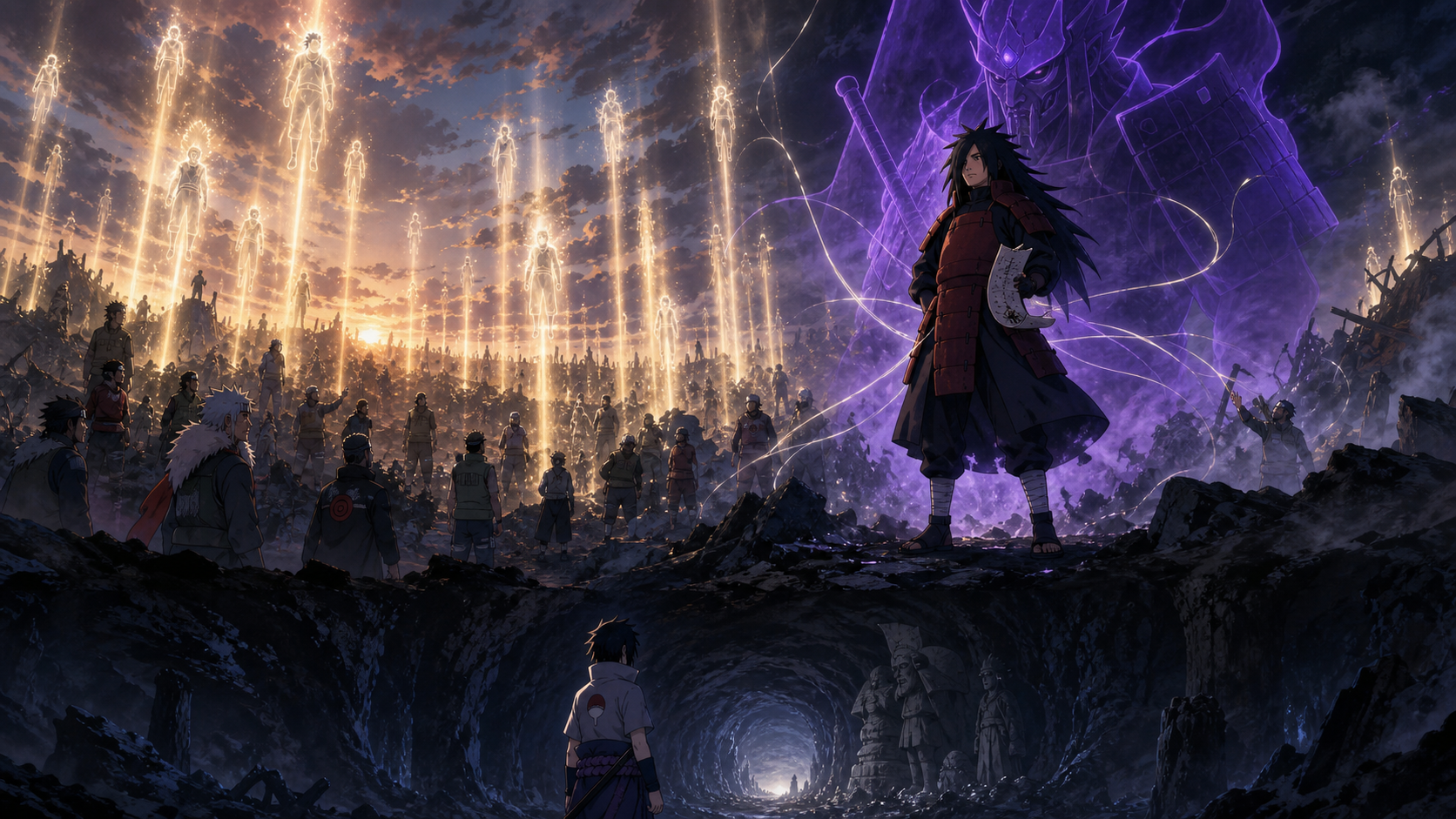
Reanimation Jutsu, Release!
The dead regain rest across the war, but Madara knows the control system well enough to inherit the immortal weapon Kabuto thought he owned.
Bottom line
“Reanimation Jutsu, Release!” shows the scale of Itachi’s victory and the limit built into every system that depends on control. Across the war, reanimated shinobi lose their imposed bodies and return to rest. Allies and enemies receive brief chances to recognize one another without Kabuto directing the encounter. Dan reaches Tsunade before departing, turning the end of a weaponized resurrection into an intimate goodbye. The battlefield begins to breathe, but Madara refuses the universal ending. Because he understands Edo Tensei’s mechanics, he severs the summoning contract from his side and keeps the immortal body after Kabuto’s release. Knowledge converts a controlled weapon into an autonomous catastrophe. Meanwhile, Sasuke remains in the cave with the truth Itachi finally gave him and no instruction for what to do next. The episode closes one machinery of war while leaving its most dangerous product active. Release is real. Release is also incomplete whenever one subject knows the system better than the person claiming ownership.
The release becomes visible everywhere
Episode 339 showed Kabuto perform the ending signs and Itachi begin to disappear. Episode 340 follows the consequence across battlefields that never saw the cave.
Bodies brighten, cracks loosen, and souls rise as the reanimation technique stops supplying form. One hidden operation changes the war’s physical landscape.
Reanimated fighters feel the contract ending
The summoned dead recognize that their time is closing. Some have retained awareness throughout the war, while others regain enough control to understand the release.
Their reactions remind us that Edo Tensei never produced empty copies. Kabuto forced people with memories and relationships into bodies designed for obedience.
Death becomes freedom from forced service
Returning to the afterlife is framed as release because continued animation means captivity. Immortality has no dignity when another person owns movement and purpose.
The episode reverses the usual fantasy. Survival is not automatically merciful, and death is not automatically defeat.
The living watch without one shared emotion
Some shinobi feel relief because impossible enemies are vanishing. Others lose a final chance to speak with someone they loved.
The same event can end danger and reopen grief. Collective victory does not produce one emotionally correct response.
Farewells interrupt battlefield logic
War normally reduces people to positions, units, and threat levels. The release briefly restores names and relationships before bodies disappear.
Those moments expose what Kabuto’s technique tried to hide. Every reanimated asset was somebody’s parent, teacher, rival, child, or unfinished conversation.
Dan still thinks about Tsunade
Dan’s bond with Tsunade survives death, reanimation, and forced combat. He uses the remaining interval to reach her rather than pursue another military objective.
The choice returns agency at the edge of release. His final act belongs to the person he was, not to Kabuto’s strategy.
Spirit Transformation changes the goodbye
Dan’s technique lets his spirit travel beyond the failing reanimated body. He reaches Tsunade while she is still facing Madara’s overwhelming pressure.
A jutsu associated with combat becomes a route for care. Function changes when the person using power regains ownership of intention.
Tsunade receives acknowledgment, not rescue fantasy
Dan cannot remain or rewrite the years since his death. Their reunion offers recognition inside a crisis rather than a restored relationship.
The scene respects grief by keeping the limit visible. A farewell can support the living without pretending loss has been reversed.
Chakra becomes a final practical gift
Dan leaves Tsunade with help she can use in the battle. Affection and battlefield necessity share the same moment.
Care does not become less emotional because the gift is practical. Knowing what someone needs under pressure can be a form of intimacy.
The forehead gesture echoes across stories
Dan’s closeness with Tsunade follows Itachi’s final forehead contact with Sasuke. Both scenes use touch to communicate after language has reached its limit.
The echoes remain distinct. One closes romantic grief, while the other ends a brother’s lifetime of controlled distance.
Other souls recover their own exits
Reanimated shinobi across the alliance leave with varying degrees of peace, frustration, or unfinished feeling. Kabuto no longer chooses their final motion.
The release cannot compensate for forced participation. The release can stop the violation from continuing.
Itachi’s intervention becomes collective
Itachi entered the cave because Naruto trusted him with Shisui’s eye and because he recognized Edo Tensei’s danger. His choice now protects people he will never meet.
That reach fits his best ideal: protection without public recognition. The difference is that he finally told Sasuke the truth before disappearing.
Hidden work still needs honest accounting
Protecting from the shadows can be necessary during war. The phrase also allowed Konoha to hide crimes and consume children through secrecy.
Itachi’s success should not rehabilitate every secret action. Outcomes and methods still require separate judgment.
The Five Kage expect Madara to leave
Madara’s reanimated form begins responding to the release. For a moment, the battlefield appears ready to lose its most impossible threat.
The Kage have survived long enough for an external solution to arrive. Relief becomes plausible before Madara reveals the exception.
Madara knows the summoning contract
He understands Edo Tensei as a system rather than merely experiencing the result. That knowledge gives him options unavailable to ordinary summoned shinobi.
Power matters, but procedural literacy creates the escape. Madara wins this moment by knowing where control actually lives.
He cancels the contract from his side
Madara performs the release sequence that severs the summoner’s authority while preserving his soul inside the immortal body. Kabuto’s global command no longer applies.
The act converts a summoned weapon into a self-directed one. Ownership changes without dismantling the dangerous infrastructure.
Kabuto created a transferable catastrophe
Edo Tensei looked safe to its caster because command tags, regeneration, and release signs centralized control. Madara demonstrates that centralization was conditional.
A system becomes more dangerous when a subject can inherit privileges the creator assumed were exclusive.
Forbidden technique warnings become operational
Tobirama created Edo Tensei, Orochimaru developed the practice, and Kabuto expanded the army. Every generation treated greater control as progress.
Madara shows why the original prohibition mattered. Technical refinement cannot eliminate every adversarial use of the mechanism.
Immortality now belongs to the wrong person
Madara retains endless regeneration, replenishing chakra, Rinnegan, Sharingan, Wood Style, and battle knowledge. No summoner remains able to issue a final command.
The Five Kage face a threat with the advantages of life, death, and autonomy combined.
Release reduces the war without resolving the war
Most reanimated forces vanish, removing enormous pressure from the Allied Shinobi Forces. That change saves lives and simplifies multiple fronts.
Madara’s survival prevents celebration from becoming strategic complacency. A partial victory can still be essential.
The episode respects downstream consequences
Stopping Kabuto does not rewind casualties, restore consumed bodies, or erase information Madara gained. Systems leave residue after shutdown.
The war must continue inside conditions Edo Tensei already changed. Ending a cause does not instantly remove every effect.
Sasuke is left with silence
In the cave, Itachi is gone again. Sasuke has received the truth he demanded, but the person who carried that truth can no longer answer follow-up questions.
The silence differs from earlier secrecy. Information has finally been given, while interpretation remains Sasuke’s responsibility.
Itachi removed his final instruction
Sasuke was not told to protect Konoha, avenge the clan, forgive the massacre, or repeat Itachi’s sacrifice. Love was offered without a destination.
Freedom feels destabilizing after years organized around assignments. Sasuke must decide what matters when no brother defines the task.
The village question remains unresolved
Itachi’s memories show institutional crime, clan rebellion, parental love, and catastrophic choices. No single fact answers whether Konoha deserves destruction or protection.
Sasuke needs a wider account of why the village was created and how leadership became capable of the massacre.
Truth creates the need for more witnesses
One honest testimony can correct a lie without completing history. Itachi knew the massacre from inside his assigned role, not from every political position.
Sasuke’s next movement toward the people who know Konoha’s founding grows from that limitation.
Kabuto remains inside Izanami
The release signs were performed under Itachi’s control. Kabuto’s consciousness still repeats the loop until his own recognition changes.
Operational cooperation does not equal personal recovery. The story keeps those processes separate.
Kabuto’s army disappears before his ideology
Edo Tensei ends, but the beliefs supporting Kabuto’s body experiments and stolen identities have not automatically vanished.
Stopping a harmful system should not be confused with transforming the person who built the system.
Madara becomes the inverse of every farewell
Other souls accept departure or lose the ability to resist release. Madara rejects the common ending and binds himself more tightly to the world.
The contrast clarifies his defining drive. Where others reconnect with relationships, Madara prioritizes control over reality and history.
Perfect Susanoo remains a warning overhead
The enormous form still places the Five Kage beneath a threat capable of changing terrain with a sword. The visual relief of rising souls cannot remove that shadow.
The war has fewer enemies and one extraordinary crisis. Scale shifts rather than disappears.
Knowledge functions as power without morality
Itachi’s knowledge ends the reanimation army. Madara’s knowledge preserves his own reanimation. Understanding the same system produces opposite consequences.
Information carries no ethical direction by itself. Values determine whether mastery releases captives or secures domination.
The title sounds more complete than the event
“Reanimation Jutsu, Release!” accurately names Kabuto’s command and the departure of nearly every summoned shinobi. Madara exposes the dangerous gap inside that apparent finality.
The exclamation point belongs to victory. The surviving exception keeps victory from becoming closure.
Release finally reveals the army as stolen lives
Kabuto’s battlefield presentation emphasized numbers, famous names, strategic matchups, and regenerative bodies. The simultaneous departure changes that visual language. Instead of units disappearing from a board, individual lights rise from places where relationships were interrupted.
That shift matters because large systems can hide harm through scale. Five hundred controlled people may sound like inventory until the story restores five hundred separate endings. Edo Tensei was effective precisely because Kabuto converted personal histories into reusable capacity. The release reverses that conversion for everyone except Madara. Souls become people again at the moment military usefulness ends, which makes the surviving exception feel even more unnatural.
The release restores consent at the final boundary
Edo Tensei dragged people across death, placed commands inside their bodies, and forced them to attack descendants, students, friends, and strangers. Ending the technique removes that occupation even when no reunion can repair what happened.
The departing souls regain control over their last words, gestures, and attention. That small agency carries enormous weight after a war strategy treated identity as equipment attached to an immortal weapon.
Every farewell proves the army was never anonymous
As bodies dissolve across separate battlefields, the series returns names and relationships to figures previously counted as enemy units. Each person had history before Kabuto opened a grave and assigned another mission.
The living react differently because grief has no uniform military rhythm. Some receive comfort, some lose an opponent before gaining answers, and some watch a beloved person vanish for a second time. Release ends coercion without simplifying mourning.
Dan uses his last movement to reach Tsunade
Spirit Transformation lets him cross the battlefield, enter Tsunade’s consciousness, and speak to the woman whose future he once shared. The scene gives them contact without pretending decades of loss disappear.
Dan does not replace her leadership or become the reason she survives. He recognizes what she built, returns chakra she urgently needs, and leaves. Affection supports her work rather than taking ownership of her story.
Tsunade’s grief belongs beside her authority
She is Hokage and battlefield commander, but rank does not cancel the shock of seeing Dan. The episode lets her receive tenderness while wounded, exhausted, and responsible for four other Kage.
That balance matters. Women in command should not have to perform emotional emptiness to prove competence. Tsunade can grieve, accept help, recover focus, and continue making decisions without any one response negating the others.
Itachi saves people who will never know the full story
Most fighters see the release without seeing the cave, Kabuto, Sasuke, Izanami, or the brother whose last mission created the opening. Their survival depends on labor hidden from public view.
Hidden service still needs honest historical accounting. Konoha repeatedly protects institutions by erasing the people and crimes beneath official peace. Remembering Itachi accurately requires naming both the lives saved and the state violence he carried out.
Madara turns technical knowledge into self-emancipation
He knows the summoning contract well enough to sever Kabuto’s control while keeping the reanimated body. Expertise gives him freedom without returning freedom to anyone else.
The maneuver is brilliant and catastrophic. Knowledge has no built-in ethics. The person who understands a system best may repair the system, exploit the loophole, or preserve the danger after everyone responsible believes shutdown succeeded.
Kabuto created a weapon he could not reliably revoke
Summoning Madara added overwhelming force to the war, but Kabuto never demonstrated a secure method for containing a subject with deeper knowledge of Edo Tensei. Ambition outran governance.
That failure belongs in every discussion of forbidden techniques. Power is not mastered when activation succeeds. Mastery also requires limits, reversal, oversight, failure planning, and a response when the subject behaves outside the creator’s assumptions.
The Five Kage need information before another charge
They are injured and facing an opponent who has just survived the release expected to remove him. Madara now controls an immortal body, regenerating chakra, and Perfect Susanoo without Kabuto’s command structure.
Courage cannot substitute for an updated threat assessment. Someone must communicate what happened, identify whether sealing remains possible, protect medical support, and prevent exhausted leaders from spending their lives on an attack designed for the wrong condition.
Sasuke receives freedom without emotional support
Itachi leaves him truth and unconditional love, but Sasuke remains alone in the cave beside Kabuto’s trapped body. The farewell ends control without providing community for the confusion that follows.
That gap helps explain why Sasuke seeks older witnesses instead of returning immediately to Naruto. He needs history from people who can answer questions Itachi could only frame at the end of a life built around secrecy.
The title celebrates a release that remains incomplete
Most reanimated fighters depart, making the command accurate across the war. Madara’s continued presence turns the exclamation point into warning. A system can be released centrally while one privileged actor preserves local control.
The exception does not diminish Itachi’s achievement. The exception defines the next problem honestly. Victory deserves recognition, then verification, because survivors cannot afford to confuse dramatic relief with complete operational closure.
Families need answers after the souls depart
The release ends immediate possession, but relatives may still need to know who summoned a body, where that person fought, which injuries occurred, and whether final words reached anyone. Battlefield closure requires records.
A responsible alliance would collect testimony before memories scatter, identify every reanimated person, notify families honestly, and preserve evidence against the people who designed and operated the technique. Privacy matters, but secrecy cannot become another disappearance.
Sealing teams carried the unglamorous burden
Frontline shinobi repeatedly restrained bodies that regenerated faster than ordinary attacks could destroy them. Their barriers, tags, coordinated timing, and physical endurance kept reanimated fighters contained until Itachi reached Kabuto.
The release belongs to those workers too. A dramatic solution succeeds because hundreds of people maintained temporary limits long enough for the central intervention to matter. The war would have collapsed without their patient, dangerous labor.
Madara’s exception changes the meaning of immortality
Before severing the contract, he remained dangerous within Kabuto’s imperfect control. Afterward, Madara gains the body’s regeneration without the controller’s ability to recall him. The strongest subject becomes the owner of the weapon.
Leaders should fear systems whose subjects can seize control after creators lose authority over them.
Sasuke’s next move requires historical witnesses
Itachi confirms the massacre’s political setting and admits his own failure, but he cannot speak for Hashirama, Tobirama, Hiruzen, the Uchiha leadership, or everyone excluded from secret decisions.
Sasuke needs competing accounts because one trusted narrator has shaped his life repeatedly, and verification now protects his agency directly.
RaeRae’s verdict
“Reanimation Jutsu, Release!” works because the episode treats system shutdown as both enormous success and incomplete repair. The dead regain release, the living regain breathing room, and Dan reaches Tsunade through one final act of care. Itachi’s cave victory becomes visible across the war without needing public credit.
Madara’s contract escape is the necessary counterweight. Kabuto built a technique around centralized ownership and assumed release remained his final authority. Madara knows enough to take ownership away while keeping every advantage. The result is less an arbitrary loophole than a warning about sophisticated weapons whose control model can be inherited.
RaeRae’s call
The release gives stolen bodies their final agency and gives the living room to grieve, regroup, and survive. Dan’s farewell supports Tsunade without stealing her authority. Madara’s loophole proves why shutdown needs verification and why forbidden power requires governance before activation, not shocked discussion after one immortal expert walks away with control.
Episode details and viewing routes
- Official episode reference: Naruto Official episode guide
- Licensed episode route: Crunchyroll licensed episode page
What I am carrying forward
Edo Tensei has ended for the reanimated army, allowing the dead to return to rest and giving several fighters final farewells. Dan reached Tsunade before departing and left practical support for the continuing battle.
Madara severed the summoning contract from his side and retained the immortal reanimated body, leaving the Five Kage in danger. Sasuke remains with Itachi’s truth and no prescribed future. Episode 341 brings Suigetsu and Jūgo back to him as Sasuke chooses to revive Orochimaru and seek broader answers.