
RaeRae Reacts · One Piece Episode 107
Operation Utopia Begins
One Piece Episode 107 launches Operation Utopia through impersonation, staged violence, and a manufactured disaster that drives both armies toward war.
Quick reaction
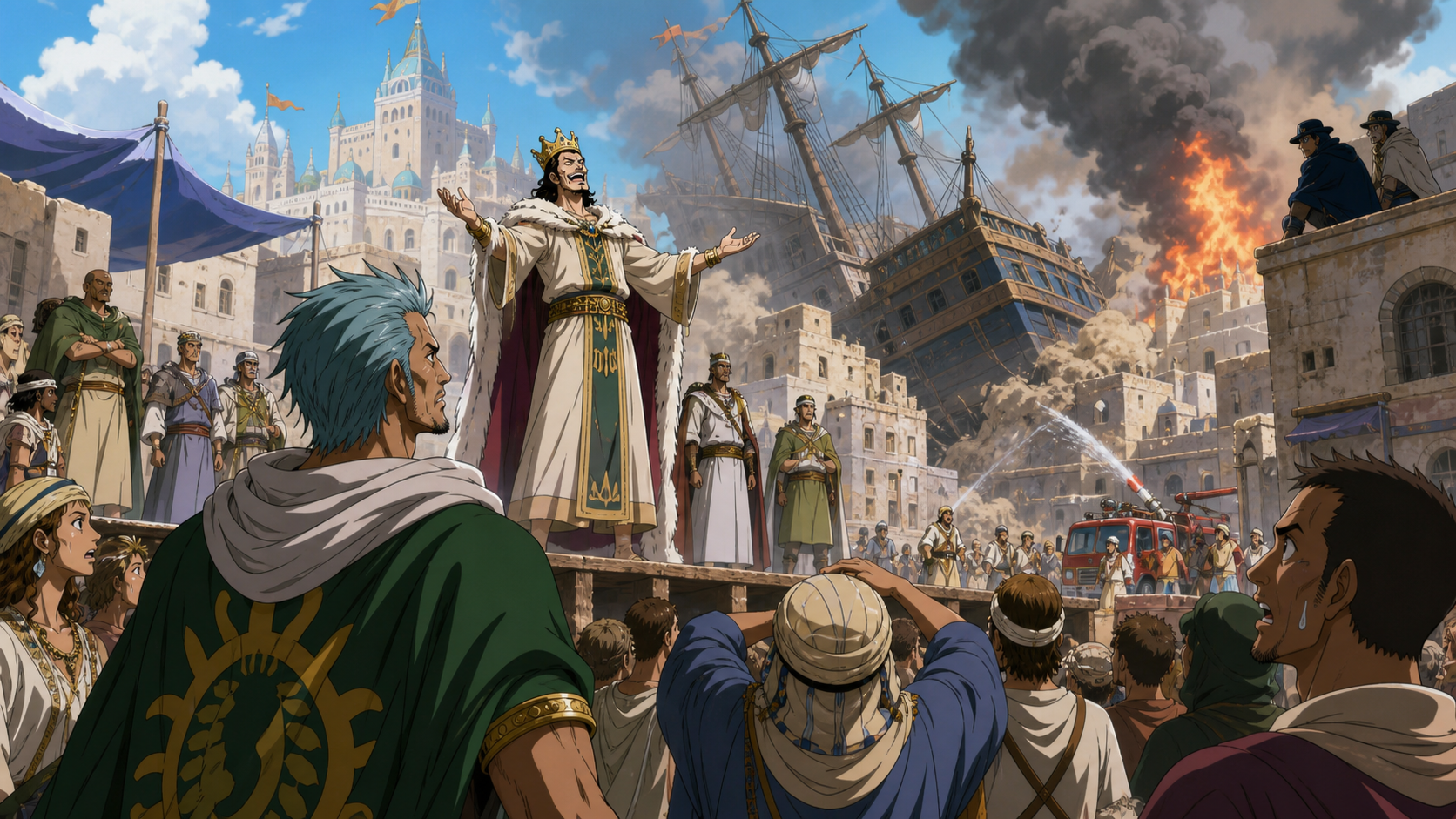
One Piece Episode 107 shows Operation Utopia working exactly as Crocodile designed: a counterfeit king supplies the confession, covert agents manufacture public catastrophe, and frightened leaders make decisions from evidence produced by the enemy. Bon Clay appears in Nanohana wearing Cobra’s face and claims the crown used Dance Powder to steal three years of rain. Koza arrives, hears the false admission, and becomes the target of staged violence.
Mr. 1 and Miss Doublefinger drive a massive ship into the city and set the area ablaze. Koza responds by ordering an all-out attack on Alubarna. Chaka, seeing the rebellion move, orders the royal army to defend the capital.
RaeRae’s bottom line is simple: Crocodile does not persuade either side through a better argument. He manufactures the evidence each side already fears, removes time for verification, and lets responsible leaders carry blame for choices made inside his trap.
Cobra disappears before the counterfeit king appears
The real king vanishes from Alubarna Palace while Bon Clay uses the Clone-Clone Fruit to wear Cobra’s appearance in Nanohana. The sequence creates two problems at once: leadership is absent where the state needs confirmation, and false leadership appears where public anger needs a target.
Identity theft becomes political infrastructure. Bon Clay does not merely imitate a face for personal disguise. Crocodile deploys the copied body as state evidence.
Citizens have no immediate biometric test, secure broadcast, or trusted verification channel. They see the king, hear a confession, and connect his words to years of drought.
A government that depends on one person’s visible authority becomes especially vulnerable when an enemy can reproduce that appearance. Institutional trust needs records, multiple witnesses, and communication beyond the ruler’s body.
Succession and emergency protocols matter for the same reason. When Cobra disappears, another authorized official should be able to confirm his location, freeze unusual orders, and communicate with regional leaders. Alabasta’s dependence on personal recognition gives the counterfeit king room to act before any institutional correction reaches Nanohana.
That vulnerability does not make citizens responsible for being deceived. Secure verification is governance work. Ordinary residents should not need specialist knowledge of Devil Fruits before deciding whether the person wearing the crown is authentic.
Bon Clay performs the confession Crocodile needs
The counterfeit Cobra says the crown used Dance Powder and stole three years of rain from the rest of Alabasta. The statement supplies intention behind every painful observation citizens already hold.
Propaganda works best when a lie attaches to real harm. The drought is real. Displacement is real. Royal rainfall created through Dance Powder appeared real. Crocodile changes the cause and assigns guilt to the king.
Bon Clay’s theatrical skill becomes a weapon because public performance can feel more immediate than distant administrative truth. Voice, posture, face, costume, and setting reinforce one another.
The scene also shows why representation carries responsibility. A copied identity can authorize harm even when the original person never speaks. Public systems must evaluate provenance rather than only appearance.
Dance Powder becomes a weapon of accusation
Dance Powder can force rain in one location while depriving another area. Crocodile arranged evidence that made the capital appear to benefit from the country’s drought.
The false confession completes that story. Citizens no longer need to infer greed because the fake king seems to admit deliberate theft.
Environmental crisis therefore becomes political ammunition. Water distribution, weather, food, migration, and trust are connected. Crocodile exploits every connection while remaining publicly separate from the harm.
Resource governance requires transparent measurement. Without shared rainfall data, supply records, independent inspection, and credible local communication, rumors can become more usable than truth.
Koza arrives looking for accountability
Koza reaches Nanohana because the rebellion needs answers and action. He has watched communities lose water while the capital appeared protected.
The fake confession meets his demand for a causal explanation. Years of suffering suddenly fit one visible perpetrator, and the urgency of the crowd discourages slow verification.
Koza is not gullible because he responds to staged evidence. Crocodile has invested years in making the lie match lived experience. A responsible observer can still reach the wrong conclusion when an adversary controls the record.
His leadership burden becomes cruel. Waiting may look like abandoning suffering citizens. Acting may advance Crocodile’s plan. Manufactured crisis turns caution and urgency against one another.
The attack on Koza turns doubt into rage
Koza is shot during the staged confrontation. The violence appears to confirm that royal authority will silence the person challenging the king.
Crocodile’s operation does not depend on the crowd hearing every sentence. A wounded rebel leader and visible chaos communicate faster than explanation.
The attack also creates emotional compression. Fear for Koza, anger at the confession, and panic from the surrounding destruction arrive together. People must react before separating each source.
Political violence often produces its own evidence. Once force appears, observers interpret force through the story already offered. Crocodile writes that story first.
Mr. 1 and Miss Doublefinger manufacture a disaster scene
Mr. 1 and Miss Doublefinger drive a massive ship into Nanohana and set the area ablaze. The collision gives the false royal confession a material aftermath.
The officers do not need citizens to understand their identities. Their work succeeds when people attribute destruction to the crisis around Cobra and Koza.
Baroque Works divides labor precisely. Bon Clay performs legitimacy. Other agents create injury, fire, and spectacle. Crocodile coordinates meaning across separate tasks.
The operation resembles a production where every department delivers one effect. That coordination makes accountability harder because no single worker appears to create the entire war.
The ship turns civilian space into evidence
A ship belongs at the harbor, not inside homes and streets. Driving the vessel into the city converts ordinary infrastructure into a weapon.
The resulting fire displaces civilians and damages property while creating visual proof that peaceful negotiation has ended. Crocodile uses the city itself as a message.
Residents pay twice. They endure the direct loss, then their loss becomes justification for escalation. The people harmed by the operation have the least control over the narrative assigned to their suffering.
Emergency response, evacuation, treatment, and rebuilding require labor that Baroque Works never intends to provide. Destruction remains cheap for leaders who externalize recovery.
Recovery also creates records that may later expose the operation. Ship ownership, navigation damage, fire origin, agent routes, and witness accounts can reveal coordination after the immediate panic passes. Crocodile’s plan relies on winning the war before investigators can compare those details.
Preserving evidence during rescue is difficult but essential. Communities need systems where saving lives comes first while photographs, manifests, material fragments, and testimony remain available for accountability.
Operation Utopia is a coordinated information attack
The plan combines impersonation, false confession, hidden agents, public violence, destroyed infrastructure, delayed communication, and synchronized timing.
No component needs to convince everyone alone. Each reinforces the next until disagreement looks unreasonable. A person questioning the fake king must explain the confession, the shooting, the ship, and the fire at once.
Crocodile also targets verification. Cobra is missing. Vivi is trapped in Rain Dinners. Koza is injured. Karoo’s message cannot instantly reach every rebel. Trusted messengers are separated while false evidence travels through spectacle.
The operation demonstrates that misinformation is not merely inaccurate speech. Misinformation can be an engineered environment where bodies, buildings, and clocks are arranged to support a lie.
Koza orders the attack because the window feels closed
Koza decides the rebel army must launch a total assault on Alubarna. From his position, the king has confessed, peaceful accountability has failed, and royal violence has answered dissent.
The choice carries enormous risk, but Crocodile has designed delay to look more dangerous than battle. Koza believes action may protect citizens from continued theft and repression.
Leadership under manipulation still has consequences. Understanding why Koza decides does not erase the people endangered by the order. Accountability must examine available evidence, coercive pressure, and foreseeable harm together.
Crocodile wants history to record a rebel attack rather than the conspiracy that manufactured necessity. The distinction matters for every future judgment.
Chaka responds from the opposite information prison
Chaka learns that the rebels will attack Alubarna and orders the royal army to meet them. His duty is to protect the capital, palace, and civilians.
He does not see Bon Clay’s performance from Koza’s position. He sees an armed force moving toward the seat of government. Defense appears necessary.
Both leaders therefore make internally coherent decisions from incomplete realities. Crocodile wins by ensuring neither side can access the other’s evidence before mobilization.
Conflict resolution requires shared facts before positions harden into troop movement. Once armies march, every preparation can look like proof of hostile intent.
Vivi’s missing voice is part of the operation
Vivi could challenge the counterfeit Cobra, explain Baroque Works, and reconnect Koza with evidence of Crocodile’s manipulation. She is trapped at Rain Dinners when Nanohana needs her.
Crocodile understands that silencing one trusted relationship can matter more than silencing thousands of strangers. Vivi and Koza share history that might survive propaganda.
Her absence also forces others to interpret royal intent without the person who has risked years investigating the crisis. Knowledge becomes politically useless when confinement blocks delivery.
Rescuing Vivi is therefore not separate from stopping war. Restoring a trusted communication line is part of the intervention.
The episode refuses a simple good-side bad-side war
Rebels contain citizens responding to deprivation. Royal soldiers contain people protecting communities from an armed assault. Neither group needs to be inherently cruel for civil war to become catastrophic.
Crocodile exploits legitimate duties and real grief. He does not invent every disagreement. He directs existing wounds toward mutual destruction.
The moral center belongs with people trying to verify, protect, communicate, and reduce harm across labels. Vivi represents that work, but responsibility cannot rest on her alone.
A country needs institutions capable of surviving one missing princess, one copied king, and one hostile information network. Alabasta currently lacks that resilience.
Production choices make propaganda feel immediate
Michiru Shimada’s script organizes the episode as a chain of manufactured proof: missing king, copied king, confession, attack, collision, fire, rebel order, and royal response.
Konosuke Uda’s direction lets public reaction carry the speed of the operation. Citizens do not receive a quiet room for analysis. Faces, movement, smoke, and shouting create collective pressure.
Kenji Yokoyama’s animation direction distinguishes performance from panic. Bon Clay’s royal gestures need confidence, while Koza and the crowd respond with disbelief that becomes urgency.
Miyuki Sato’s art turns Nanohana into a vulnerable civic space. Streets and buildings make the consequences legible, while smoke connects propaganda to material damage.
What Episode 107 changes
The real Cobra disappears from Alubarna Palace. Bon Clay appears in Nanohana disguised as the king and falsely claims responsibility for using Dance Powder to steal rain.
Koza arrives and becomes the target of staged violence. The apparent attack reinforces the counterfeit confession.
Mr. 1 and Miss Doublefinger crash a huge ship into the city and ignite a destructive public crisis. Operation Utopia converts propaganda into visible catastrophe.
Koza orders a full assault on Alubarna. Chaka orders the royal army to meet the rebellion, placing both sides on Crocodile’s planned battlefield.
Episode details
Japanese title: ユートピア作戦発動!動き出した反乱
English title: Operation Utopia Commences! The Swell of Rebellion Stirs
Japanese broadcast: April 14, 2002
Saga: Alabasta
Material: Manga-canon adaptation
Script: Michiru Shimada
Episode direction: Konosuke Uda
Animation direction: Kenji Yokoyama
Art: Miyuki Sato
The official One Piece guide confirms Cobra’s disappearance, Bon Clay’s impersonation and false Dance Powder confession, the attack on Koza, the ship collision and fire arranged by Mr. 1 and Miss Doublefinger, Koza’s order to attack Alubarna, and Chaka’s defensive mobilization. The governance, propaganda, labor, crisis, and accountability analysis is RaeRae’s reading of those events.
Final verdict
Episode 107 earns a 9.8 out of 10. Operation Utopia is terrifying because every lie arrives wearing evidence. Citizens see their king confess, their rebel leader attacked, their city struck by a ship, and their homes burning. Crocodile has built a reality where verification looks like delay and delay looks like betrayal.
Koza and Chaka make opposite decisions for reasons each can defend. Their armies will carry the cost while Crocodile remains outside both chains of command.
The episode’s warning is not that people are foolish. The warning is that coordinated power can manufacture the conditions under which careful people reach catastrophic conclusions. Stop the fire, restore communication, expose the copied face, and put the architect back inside the story he created.