
RaeRae Reacts · One Piece Episode 105
Rainbase, City of Dreams
One Piece Episode 105 sends Vivi, Luffy, Smoker, and Baroque Works into the same Rainbase trap while Karoo carries the truth to Cobra.
Quick reaction
One Piece Episode 105 moves the Alabasta crisis from argument into coordinated action. Vivi changes course from Katorea to Rainbase because Luffy’s confrontation in Yuba clarified the target. Crocodile remains the person manufacturing every false choice between rebels and royal soldiers. Reaching him will not repair the country by itself, but chasing every consequence while he controls the clock will keep the crew permanently late.
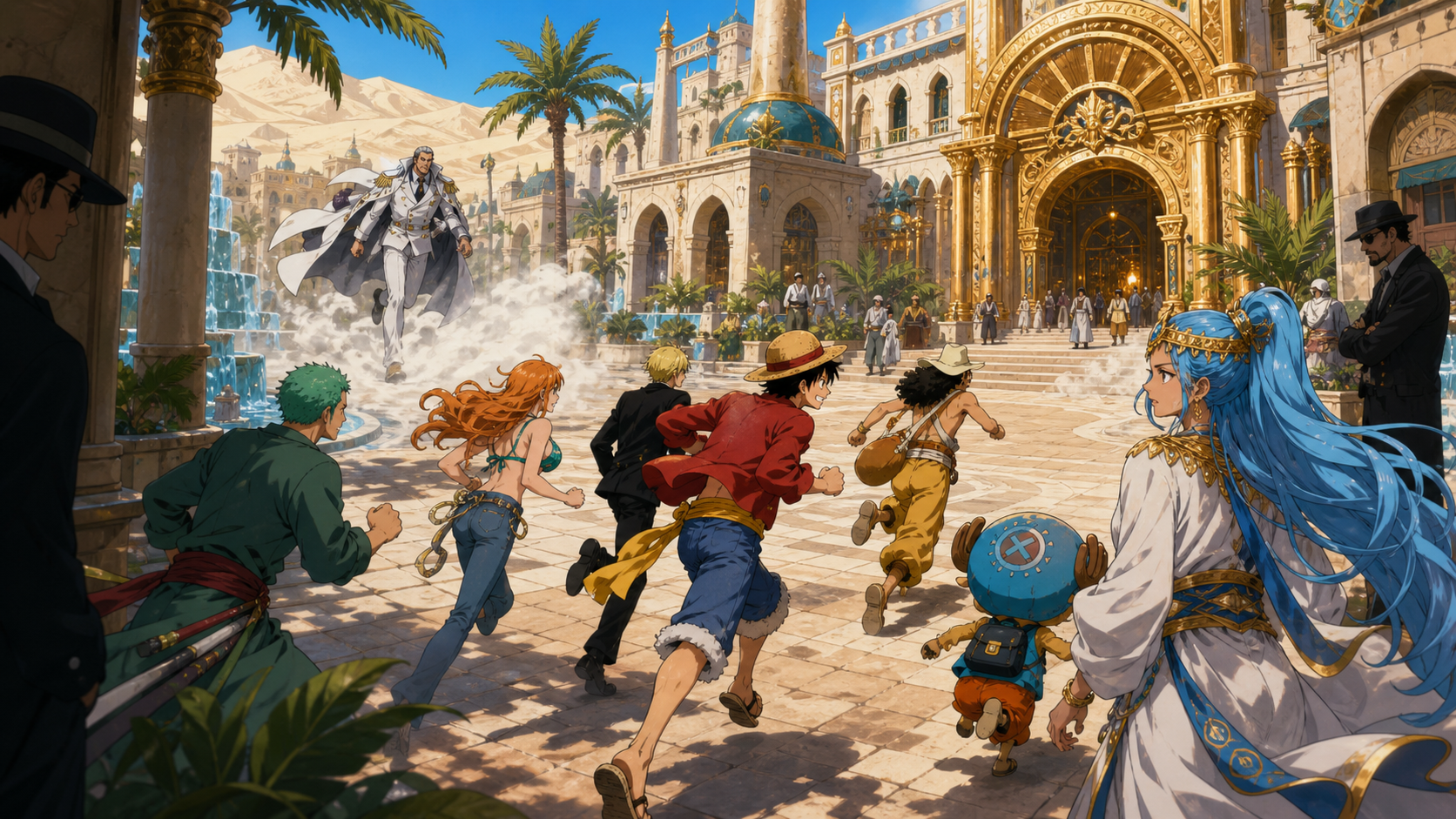
Karoo reaches Alubarna with Vivi’s message, allowing Cobra to learn that Crocodile leads Baroque Works. The king orders troops toward Rainbase. Meanwhile, the Straw Hats arrive in the casino city and immediately attract Smoker, Marines, Baroque Works agents, and public attention. The city of dreams becomes a surveillance funnel.
RaeRae’s bottom line is simple: better strategy does not remove danger. Better strategy concentrates effort around the person producing danger. Episode 105 rewards Vivi for changing her plan while showing how little time remains for clean execution.
Vivi changes course because accountability worked
Vivi wanted to reach Katorea and stop Koza before the rebel army marched. After the fight with Luffy, she agrees that Rainbase offers the more direct route toward Crocodile. The change matters because leaders often confuse consistency with credibility.
A credible leader can revise a route when evidence and trusted criticism expose a weakness. Vivi does not lose moral authority by admitting the earlier plan cannot meet the deadline. She gains operational clarity.
The crew also proves that disagreement did not destroy their alliance. Everyone resumes movement together. Their argument produced a decision rather than a permanent fracture because the relationship could hold anger, tears, correction, and consent.
Rainbase remains risky. Crocodile designed the city as his public stage and private headquarters. Choosing the correct target does not mean choosing a safe target.
Karoo carries intelligence when the group cannot split again
Karoo reaches Alubarna with the information Vivi entrusted to him. His route creates a second line of action without requiring another Straw Hat to leave the main group.
Messenger work looks less dramatic than combat, yet national response depends on communication arriving before misinformation hardens into orders. Cobra cannot deploy against Crocodile without knowing who engineered the crisis.
Karoo’s success also honors Vivi’s habit of building relationships across rank and species. She treats him as a partner with judgment, endurance, and responsibility. The mission never frames him as decorative transport.
Communication carries physical cost. Crossing Alabasta exposes Karoo to heat, distance, enemies, and exhaustion. Intelligence systems rely on labor, and the story keeps that labor visible.
Cobra finally receives the name behind the conspiracy
Cobra learns that Crocodile is the enemy destabilizing Alabasta. The revelation reorganizes years of confusing evidence. A celebrated Warlord and public protector has been using legal status, reputation, and Baroque Works to manufacture civil war.
The king now faces a governance test. Knowing the perpetrator does not automatically persuade citizens who have lived through drought and perceived royal abuse. State authority needs verifiable evidence and conduct worthy of renewed trust.
Cobra orders the army toward Rainbase because the command center presents an immediate threat. That choice aligns the palace with Vivi’s revised route, even though father and daughter cannot coordinate in real time.
The parallel movement creates hope and danger. Multiple groups now converge on Crocodile, but poor communication could make allies misread one another inside a crowded city.
Rainbase sells fantasy while hiding extraction
Rainbase looks prosperous because water, gambling, architecture, and entertainment create an oasis of abundance. The city offers the dream that luck can erase ordinary limits.
Crocodile benefits from that image. Rain Dinners lets him appear as a successful businessman and civic protector while the wider country loses water. Wealth gathered in one controlled destination can disguise deprivation elsewhere.
A casino also turns uncertainty into revenue. Visitors believe individual choices might produce escape, while the house sets rules and probabilities. Crocodile has applied the same model to Alabasta. Citizens make desperate choices inside conditions he designed.
The city of dreams therefore functions as a political metaphor. Crocodile sells hope at the front door and manufactures hopelessness beyond the fountains.
Smoker arrives with authority and incomplete information
Smoker waits in Rainbase because he expects Luffy. His pursuit follows a Marine mandate against pirates, and the Straw Hats have repeatedly escaped him.
His information remains incomplete. He knows Luffy is a pirate and suspects larger trouble, but he does not yet possess the full map of Crocodile’s conspiracy. Institutional rules point him toward the visible outlaw while a state-approved Warlord operates behind public legitimacy.
Smoker’s presence complicates every movement. The crew cannot stop in the street to explain a national operation to an officer already committed to arrest. Trust would require time and evidence nobody has available.
The episode does not make Smoker foolish. His persistence is rational within his evidence. The problem lies in a system where legal classification can make the wrong threat easier to pursue.
Baroque Works recognizes the crew at the worst moment
Baroque Works agents also spot the Straw Hats. Crocodile’s surveillance network turns an arrival into an alert before the group can study the city.
The crew now faces pursuers with different goals. Marines want an arrest. Baroque Works wants to protect Operation Utopia and prevent Vivi from reaching Crocodile or Koza. Civilians cannot easily distinguish those motives during a street chase.
Overlapping enforcement benefits the conspiracy. Crocodile can let legitimate authority pressure his enemies while his own agents close routes from the side. He does not need to control every Marine to benefit from Marine priorities.
Surveillance also shrinks decision time. The crew must choose direction while moving, which rewards their newly clarified target.
That pressure also changes who can safely ask questions. A frightened resident watching Marines chase pirates and suited agents follow behind may avoid intervening, even after noticing contradictions. Surveillance does not only gather information for power. Surveillance teaches bystanders that curiosity carries risk.
Baroque Works depends on that silence. Agents can move through public space because most people lack a complete picture and because challenging an apparently ordinary worker could invite retaliation. Crocodile’s network remains strongest when everybody sees one fragment and nobody feels safe enough to compare notes.
Luffy turns pursuit into forward motion
Luffy does not retreat from Rainbase after Smoker appears. He runs toward Rain Dinners. The chase becomes propulsion toward Crocodile’s headquarters.
That instinct can look reckless, and danger remains real. Yet the direction follows the group’s agreed strategy rather than a random appetite for conflict. Luffy keeps the target visible when competing threats could scatter everyone.
His leadership works through decisive momentum. Nami and Vivi provide navigation and political context. The rest of the crew protects the group’s movement. Luffy supplies refusal to become trapped in reactive loops.
Momentum still needs boundaries. A fast captain can lead friends into an ambush before specialists assess the entrance. Episode 105 lets that tension build instead of pretending courage guarantees control.
The crew stays together under converging pressure
The Straw Hats have many reasons to separate. Smoker can target Luffy, Baroque Works can target Vivi, and crowded streets offer multiple escape paths. Staying together protects communication.
Shared movement also demonstrates the promise made in Yuba. Vivi has accepted their chosen risk, and the crew now carries that risk collectively. Nobody treats her as a package to deliver.
Each member brings a different form of situational awareness. Nami reads routes, Zoro identifies combat pressure, Sanji watches vulnerable teammates, Usopp notices danger early, and Chopper can respond to injury. Group capacity exceeds heroic independence.
The chase works because the crew looks chaotic without becoming directionless. Their personalities remain visible inside coordinated movement.
Rain Dinners presents a door built by the enemy
The casino entrance offers apparent shelter from Smoker and the surrounding agents. Crocodile expects exactly that calculation. A door controlled by the enemy can turn urgency into capture.
Entering still makes strategic sense because Crocodile remains inside. The crew is not wandering into an unrelated trap. They are accepting a trap attached to the target they chose.
Awareness changes the moral meaning, not the physical mechanics. A chosen risk can still harm people. Consent does not make crocodile teeth less sharp or a sealed room easier to escape.
The episode ends by converting public pursuit into private vulnerability. Once the crew crosses the threshold, Crocodile can control architecture, information, and timing more directly.
Operation Utopia keeps moving beyond the chase
The street action can distract from the larger clock. Operation Utopia is scheduled for noon, and Baroque Works agents continue their assignments while the Straw Hats run.
Crocodile’s advantage comes from parallel work. He can trap one group, manipulate another, move weapons, and shape public evidence through delegated roles. Defeating him requires interrupting more than his body.
Vivi’s government also begins parallel movement through Cobra’s order. The conflict becomes a race between systems rather than a duel between two individuals.
Good resistance needs communication across those systems. Karoo has connected Vivi and Cobra, but Koza and the rebels still lack the same verified information. One missing line can preserve the war.
The episode asks who gets believed in public
Crocodile has a heroic reputation. Luffy has a wanted poster. Vivi has royal identity but has spent years operating under a Baroque Works codename. Smoker has institutional authority.
Rainbase citizens see those public labels before they see private evidence. Reputation determines whose movement looks protective and whose movement looks criminal.
The conspiracy succeeds partly because Crocodile invested in public trust while producing private harm. Exposure must therefore address both facts and the emotional investment citizens have placed in his image.
One dramatic accusation cannot automatically reverse years of branding. The crew needs evidence, survival, and enough public rupture for people to reconsider the protector they thought they knew.
Public belief also affects recovery after exposure. Citizens who trusted Crocodile may feel shame, anger, or denial when the truth emerges. A responsible transition must make room for people to revise their judgment without treating every deceived resident as a willing collaborator. Accountability should follow power and conduct, not humiliation for having believed a carefully maintained public lie.
Production choices make convergence feel crowded
Michiru Shimada’s script connects Vivi’s revised decision, Karoo’s arrival, Cobra’s response, Smoker’s pursuit, Baroque Works surveillance, and the casino entry. Each strand advances the same deadline.
Yuji Endo’s direction gives Rainbase speed and density after the open quiet of Yuba. Streets, crowds, pursuers, and entrances narrow the crew’s options without requiring a long explanation.
Naoki Tate’s animation direction emphasizes running, abrupt turns, smoke movement, and group reaction. The crew must remain individually recognizable while sharing one action line.
Miyuki Sato’s art contrasts Rainbase abundance with the dry settlements already shown across Alabasta. Water and gold become evidence of concentrated power rather than proof that the national crisis has ended.
What Episode 105 changes
Vivi officially changes the destination from Katorea to Rainbase. The crew commits to confronting Crocodile rather than continuing to chase the rebel army.
Karoo reaches Alubarna and delivers intelligence identifying Crocodile. Cobra orders royal forces toward Rainbase.
The Straw Hats enter Rainbase, where Smoker and the Marines pursue them. Baroque Works agents recognize the group and join the pressure.
The crew runs into Rain Dinners, knowingly moving toward Crocodile and unknowingly surrendering more control over the battlefield.
Episode details
Japanese title: アラバスタ戦線!夢の町レインベース
English title: The Battlefront of Alabasta! Rainbase, the City of Dreams
Japanese broadcast: March 17, 2002
Saga: Alabasta
Material: Manga-canon adaptation
Script: Michiru Shimada
Episode direction: Yuji Endo
Animation direction: Naoki Tate
Art: Miyuki Sato
The official One Piece guide confirms Vivi changing course, Karoo reaching Alubarna, Cobra learning Crocodile’s identity, the royal army moving toward Rainbase, Smoker pursuing the Straw Hats, Baroque Works recognizing them, and the crew entering Rain Dinners. The governance, communication, surveillance, labor, and accountability analysis is RaeRae’s reading of those events.
Final verdict
Episode 105 earns a 9.4 out of 10. The story proves that the Yuba argument changed behavior. Vivi revises the route, shares risk, and lets the crew attack the source. Karoo carries truth to Cobra, and the kingdom finally begins responding to the correct enemy.
Rainbase then shows why a correct decision can still produce disaster. Crocodile owns the public story, the building, the surveillance network, and the timetable. Smoker brings lawful pressure from another direction. Every path narrows toward the casino entrance.
Run toward the source, but remember who designed the door. Rain Dinners is not safety. Rain Dinners is the house, and the house has been setting Alabasta’s odds for years.