
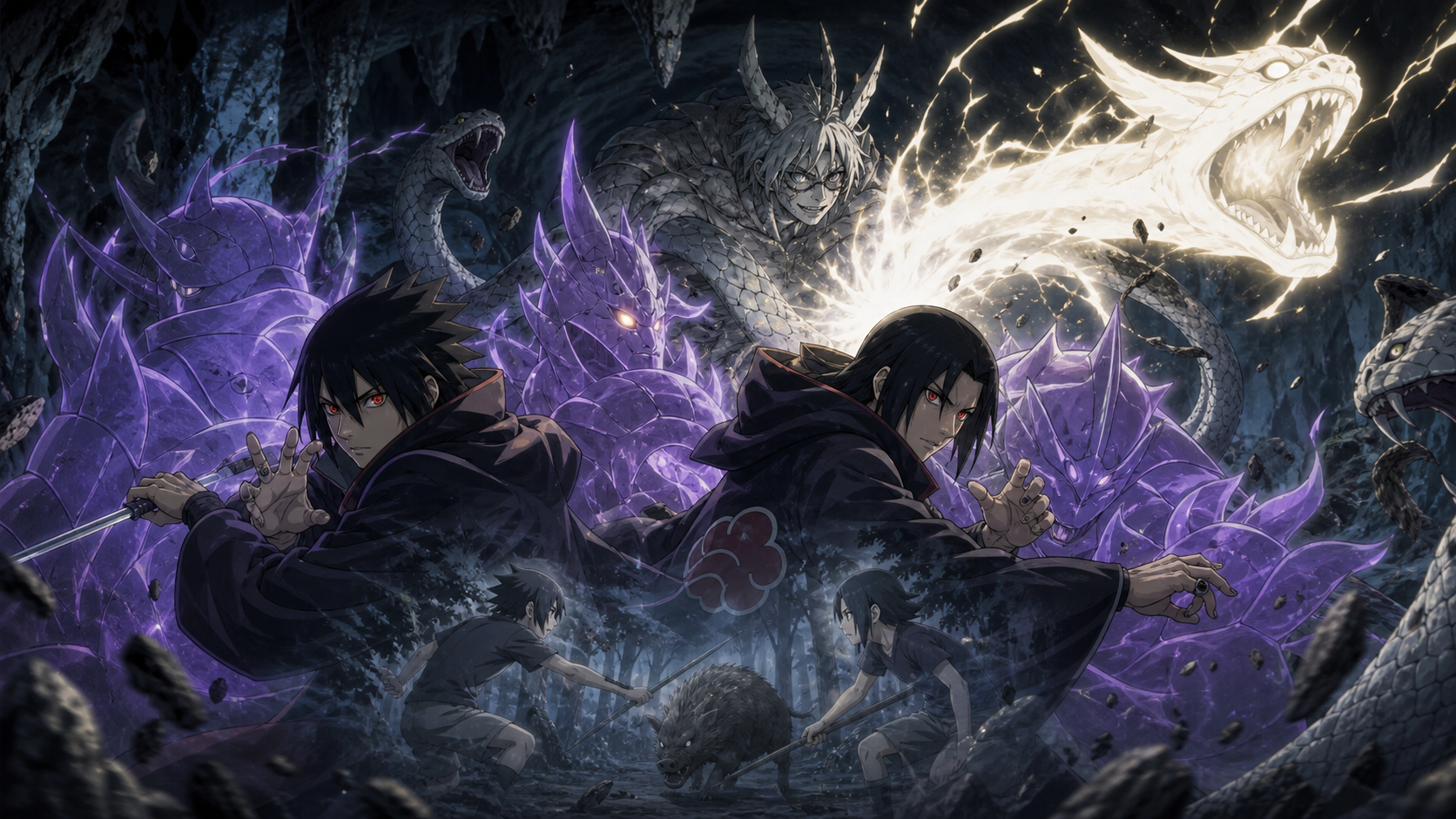
Sibling Tag Team
Itachi and Sasuke coordinate before reconciliation, using a childhood rhythm to restrain the one caster who must remain alive long enough to release Edo Tensei.
Bottom line
“Sibling Tag Team” gives Sasuke a reunion built around work before answers. Itachi needs Kabuto alive, conscious, and vulnerable to genjutsu so Edo Tensei can be released. Sasuke wants the truth from Itachi and has every reason to resent another delayed explanation, yet he accepts the constraint and fights beside his brother. Kabuto counters their Sharingan with Sage Mode, heat sensing, a cave he can animate, and White Rage’s overwhelming light and sound. The brothers recover an old boar-hunting rhythm to sever Kabuto’s horn, proving that childhood coordination survived beneath massacre, secrecy, and revenge. The title is tender and cruel at once. They can still function as siblings, but the relationship they are briefly performing exists only because an unethical reanimation brought one brother back from death.
Itachi defines the mission before the fight
Kabuto cannot simply be killed. Edo Tensei must be released through the caster’s hand signs, and Itachi plans to compel those signs through genjutsu.
The objective requires restraint under lethal pressure. Every attack has to create control without destroying the only person who can cancel the technique safely.
Sasuke accepts an answer delayed again
Sasuke follows Itachi because his life was shaped by secrets his brother chose to carry alone. He wants an explanation now.
Itachi prioritizes the war and promises that the conversation can follow. The urgency is real, but the delay repeats the pattern that injured Sasuke.
Cooperation begins without repaired trust
The brothers do not reconcile before entering Kabuto’s cave. They share a target while holding unresolved anger, grief, and guilt.
Teams can coordinate around a clear boundary before emotional agreement exists. Temporary cooperation should not be mistaken for completed repair.
Kabuto chose the cave deliberately
The enclosed terrain limits large attacks, controls sightlines, and gives Kabuto access to stone surfaces around every opponent.
Home-field advantage matters because the Uchiha brothers’ visual power is strongest when they can read movement. Kabuto designs the environment to reduce ordinary visual certainty.
Snakes extend Kabuto’s awareness
His altered body incorporates Orochimaru’s techniques and snake physiology. Movement can come from coils, a tail, or hidden extensions rather than a standard human stance.
The brothers must read a body built from several acquired systems. Familiar anatomy no longer predicts every attack.
Sage Mode changes Kabuto’s senses
Kabuto has trained at Ryūchi Cave and learned to use natural energy. Sage Mode expands perception beyond ordinary eyesight.
That adaptation is central to fighting Sharingan users. Kabuto can reduce dependence on eye contact without becoming unaware of their position.
Kabuto claims to have surpassed Orochimaru
He presents Sage Mode as proof that the assistant has exceeded the master who failed to achieve the same form. Technical accomplishment supports part of the claim.
Personal independence requires more than acquiring a technique Orochimaru lacked. Kabuto still measures identity through the person he insists he surpassed.
Borrowed bodies complicate the achievement
Kabuto has incorporated cells, abilities, and research from other people into himself. The result is powerful and difficult to categorize as individual growth.
Learning from others differs from consuming others as material. The ethical boundary lies in consent, ownership, and whether the original person remains visible.
The Sharingan cannot command a closed gaze
Kabuto avoids direct eye contact and relies on alternative sensing. Standard visual genjutsu becomes harder to establish.
Itachi’s plan therefore needs a moment where Kabuto’s defenses are disrupted without killing him. The central tool has lost its easiest route.
White Rage attacks the senses themselves
Kabuto releases a dragon-shaped technique that produces intense light and violent sound. Vision, hearing, balance, and body control are overwhelmed together.
The attack does not need to beat Susanoo’s armor directly. Disabling the people operating that armor creates an opening from inside their perception.
The episode lets the glare wash detail out of the cave before sound and vibration break the brothers’ balance. Recovery happens through touch, remembered spacing, and trust in where the other brother will move. That choice makes their old hunting coordination useful without pretending childhood memory can erase the years Itachi controlled Sasuke through silence.
The cave amplifies the sound
Stone walls reflect and concentrate the vibration. Terrain turns one technique into a chamber-wide sensory assault.
Kabuto’s preparation converts location into part of his body. The brothers are fighting architecture as well as a person.
Sasuke loses the benefit of his new eyes
The Eternal Mangekyō Sharingan provides extraordinary vision, but overwhelming light makes visual precision painful and unreliable.
The episode immediately tests the limit of a power introduced through sight. Stronger eyes do not guarantee a readable battlefield.
Itachi protects Sasuke through Susanoo
Itachi positions his defense to reduce Sasuke’s exposure while both brothers struggle against the technique. Protection arrives through action before explanation.
The gesture recalls the older brother Sasuke once trusted. That familiar care exists beside the secrecy and violence Itachi also chose.
Reanimation changes Itachi’s risk tolerance
Itachi can absorb injuries that his Edo Tensei body will repair. He may place himself between Sasuke and danger without paying a living person’s permanent cost.
The advantage remains ethically compromised. Kabuto created the condition by violating Itachi’s death, even when Itachi uses the condition to protect someone.
Inorganic Reanimation animates the cave
Kabuto sends natural energy into surrounding stone and makes the cave attack through spikes and shifting surfaces. The environment stops behaving as inert terrain.
Ordinary Sharingan prediction reads muscles before movement. Rock under external control provides different warnings and attack origins.
The brothers cannot solve the field separately
Sasuke has destructive power, and Itachi has wider experience with deception and restraint. Neither advantage alone neutralizes Kabuto’s sensory and environmental control.
They need overlapping defense, timing, and attacks that force Kabuto toward a chosen route.
Susanoo creates a shared perimeter
The brothers use their armored chakra forms to survive attacks from the cave and Kabuto. Separate defenses become parts of one protected space.
The image reflects their relationship: walls built from grief can isolate, but coordinated walls can also shelter another person.
Killing Kabuto would be easier
Amaterasu, Susanoo weapons, and direct lethal strikes offer more obvious solutions than controlled capture. Itachi repeatedly prevents the mission from collapsing into assassination.
Restraint is the harder form of strength when one mistake can leave the reanimated army active.
Sasuke has to trust Itachi’s technical knowledge
Sasuke did not design the release plan and cannot independently verify every Edo Tensei rule during combat. He follows Itachi’s constraint because the reasoning fits available evidence.
That trust is provisional and task-specific. Sasuke still deserves answers about the choices Itachi made beyond this cave.
Kabuto tries to exploit their fracture
He understands that Sasuke’s anger toward the Leaf and Itachi’s loyalty create an ideological split. Turning Sasuke could reduce a two-person threat to one controllable conflict.
Manipulation works best when built around genuine injury. Kabuto does not invent Sasuke’s grievance; he tries to claim ownership of the conclusion.
Childhood provides a tactical memory
The brothers remember hunting a wild boar together when Sasuke was young. The earlier exercise required coordination, timing, and trust in Itachi’s direction.
Memory becomes more than sentiment. A pattern stored before the massacre can still organize movement under present danger.
Young Sasuke wanted recognition
The boar hunt gave him a chance to prove usefulness beside the older brother everyone praised. Sasuke’s eagerness carried admiration and competition.
Those needs did not disappear after the clan’s death. Revenge distorted the relationship while preserving the desire to be seen by Itachi.
Itachi once corrected without humiliating him
During the hunt, Itachi could guide Sasuke’s position and timing while letting him participate. The memory contains a version of teaching not built through cruelty.
That contrast makes later manipulation more painful. Itachi knew how to help directly and still chose trauma as his long-term strategy.
The boar pattern becomes a live feint
The brothers reproduce the old coordination against Kabuto, assigning pressure and anticipating the escape route. Their bodies remember how the other person moves.
The technique works because Kabuto prepares for Uchiha powers, not for a family rhythm learned before either Mangekyō existed.
Sasuke and Itachi sever Kabuto’s horn
Their combined maneuver catches Kabuto and cuts one horn from his Sage Mode form. The strike demonstrates that his sensory defenses can be penetrated.
The wound is controlled rather than fatal. Progress remains aligned with the requirement to keep the caster alive.
The horn is proof, not victory
Kabuto retains Sage Mode, environmental control, medical modifications, and knowledge of the cave. Losing one piece does not end the battle.
The brothers have established a repeatable possibility: coordinated memory can create an opening where direct visual dominance could not.
Every minute keeps the wider war active
The cave battle is private, but Edo Tensei bodies continue attacking divisions elsewhere. Itachi cannot let Sasuke’s questions or Kabuto’s provocations stretch the encounter indefinitely.
That pressure explains his focus without excusing another permanent silence. Ending the technique creates the first safe opportunity for a fuller answer, provided both brothers survive long enough to use that opportunity.
Kabuto’s identity remains assembled
He presents the snake-dragon form as a completed self, yet keeps speaking through names and powers borrowed from Orochimaru’s network.
The episode does not mock hybridity. The problem is Kabuto’s attempt to resolve uncertainty by consuming other people’s traits without consent.
Sasuke sees a brother he thought was gone
Fighting side by side restores gestures, timing, and protection Sasuke believed the massacre erased forever. The reunion is emotionally real despite the artificial body.
That reality creates another wound. Edo Tensei can return interaction for a moment without returning the future the brothers lost.
Itachi treats the mission as his final correction
Stopping reanimation may save the Alliance and reduce consequences of choices Itachi made while serving the village and Akatsuki.
The mission cannot repair the Uchiha massacre. Responsibility still requires preventing additional harm within his reach.
The tag team is unequal
Itachi holds more information about Kabuto, the technique, and their family history. Sasuke supplies equal battlefield power without equal access to truth.
Functional teamwork can coexist with informational injustice. The next conversation must address that imbalance if the relationship is to mean more than tactics.
The episode protects the next boundary
Kabuto’s attempt to recruit Sasuke and the deeper conflict over what the Leaf means continue beyond this opening exchange. His personal history also needs its own space.
Episode 334 earns the brothers’ coordination first. Later episodes test the identities each fighter brings into that coordination.
The mission requires restraint before reconciliation
Itachi tells Sasuke that Kabuto must remain alive long enough to release Edo Tensei. The boundary prevents anger and battlefield efficiency from deciding the wrong objective.
The brothers can cooperate without resolving their history first because the immediate task is specific. Trust here means following a necessary limit, not pretending every lie and abandonment has already healed.
Sasuke accepts delay without surrendering his questions
He follows Itachi into the cave after being promised answers later. The choice is tactical, but it does not erase his right to demand an account.
Itachi cannot use urgency forever. Every delay adds to a pattern in which he controls what Sasuke knows, supposedly for protection, while Sasuke absorbs consequences without informed participation.
Kabuto chose terrain that limits visual dominance
The cave narrows movement, multiplies echoes, hides attack paths, and gives his snakes surfaces to monitor. He builds the battlefield around opponents known for eye techniques.
Preparation matters more than abstract power. Sasuke’s new sight and Itachi’s experience cannot solve a space designed to overwhelm vision with sound, vibration, and moving stone.
Sage Mode expands perception beyond borrowed eyes
Kabuto closes his gaze and still reads the brothers through environmental sensing. The choice blocks genjutsu while letting him treat the cave as an extension of his body.
His achievement is technically impressive and ethically compromised by bodies, cells, research, and abilities taken from others. Mastery must include the provenance of what made mastery possible.
White Rage turns sensory access into pain
Light and sound overwhelm sight, hearing, balance, and concentration at once. The cave amplifies the effect, making ordinary communication nearly impossible.
The brothers need touch signals, protected positioning, and recovery time rather than shame for disorientation. Sensory injury is not weakness. It is the intended mechanism of the technique.
Susanoo becomes shared shelter instead of private status
Itachi uses the avatar to protect Sasuke when White Rage removes his ability to respond. A power often displayed as individual dominance becomes a perimeter holding two people.
The protection matters because it creates time for Sasuke to recover without forcing him to perform invulnerability. Strength serves relationship when shelter is treated as a complete action.
Itachi’s reanimated body distorts sacrifice calculations
He can regenerate from injuries that would kill Sasuke, which makes taking a hit appear like an obvious choice. Edo Tensei removes one consequence while leaving pain, control, and strategic risk.
Itachi should use the advantage without pretending he has become disposable. Kabuto may exploit damage windows, and Sasuke still experiences the terror of watching his brother be broken again.
Inorganic Reanimation makes the environment another captive
Kabuto sends life through stone and forces the cave itself to attack. Walls, floors, and spikes stop behaving like neutral terrain.
Escape routes and cover can no longer be assumed stable. The brothers need constant spatial updates and a plan that distinguishes Kabuto’s body from the animated field supporting him.
Kabuto weaponizes the brothers’ information gap
He knows Sasuke wants answers and Itachi keeps withholding them, so every taunt pushes at a real fracture. The manipulation works because it touches truth.
Defending against it requires more than calling Kabuto a liar. Itachi must acknowledge the gap he created, while Sasuke decides which questions can wait without pretending the delay feels safe.
The childhood boar hunt restores a shared rhythm
A remembered pattern gives the brothers timing neither could manufacture through explanation during White Rage and moving stone. Childhood becomes practical coordination.
The memory is not proof their past was healthy. One moment of patient instruction survives inside a relationship also shaped by secrecy and violence. Both truths can guide the present without canceling each other.
Severing the horn is evidence, not domination
The feint succeeds and cuts Kabuto’s horn, proving the brothers can penetrate his sensory advantage. The injury does not end Sage Mode, release Edo Tensei, or resolve the cave.
Good strategy treats the result as information. Celebrate the opening, update the plan, and keep the mission boundary visible before confidence turns one success into a fatal rush.
Sasuke deserves answers without owing immediate forgiveness
Itachi’s urgent plan to stop Edo Tensei may save thousands of people, but strategic importance does not cancel the harm he caused his brother. Sasuke followed him into the cave because the war created an urgent overlap between public survival and private truth. When the mission ends, Itachi owes a direct account of the massacre, the orders, his choices, the manipulation he used, and what he believed each lie would accomplish. He should distinguish explanation from excuse and leave room for Sasuke to reject the protection story. Sasuke may understand the pressure without forgiving the person who shaped his childhood through terror. He may also hold conflicting love, anger, relief, and grief without choosing one final emotion before Itachi disappears. The conversation needs time, specificity, and no demand that Sasuke comfort the dead brother speaking. Itachi’s reanimated condition creates another unfair deadline, but the deadline should make honesty more urgent rather than justify one last withholding. Cooperation in the cave proves they can coordinate. It does not prove trust has been repaired. Repair begins when the person who controlled the story gives up control over how the survivor receives it.
Kabuto will keep trying to use that fracture because coercive systems benefit when families cannot share a complete record. The brothers can resist him tactically while refusing his claim that pain makes either one predictable. Sasuke’s questions are not a distraction from the mission; they explain why Kabuto’s taunts find an opening. Itachi’s responsibility is to close that opening through truth, not another command. Whether Sasuke forgives afterward belongs entirely to Sasuke alone now.
RaeRae’s verdict
“Sibling Tag Team” works because the brothers do not need a sentimental reconciliation before their bodies remember how to cooperate. Kabuto has prepared for Sharingan sight with Sage Mode, White Rage, and an animated cave. He has not prepared for a childhood hunting pattern preserved beneath years of deliberate estrangement.
The victory is appropriately small. One severed horn proves Kabuto can be reached while keeping him alive for the release signs. More importantly, Sasuke experiences Itachi protecting and coordinating with him again. The tenderness does not excuse Itachi’s secrecy; the episode lets care and harm remain attached to the same brother.
RaeRae’s call
The brothers do not become healed because an old hunting pattern still works. They cooperate around one necessary boundary while Sasuke’s questions remain alive. Keep Kabuto breathing, name the stolen provenance behind his Sage Mode, protect sensory recovery, and let the shared Susanoo mean shelter before anyone calls it reconciliation.
Episode details and viewing routes
- Official episode reference: Naruto Official episode guide
- Licensed episode route: Crunchyroll licensed episode page
What I am carrying forward
Sasuke and Itachi are actively working together to capture Kabuto alive and force the Edo Tensei release signs. Kabuto has revealed Sage Mode, White Rage, alternative sensing, and the ability to animate the cave through natural energy.
The brothers used a pattern from their childhood boar hunt to sever Kabuto’s horn. Their tactical bond is functioning, but Sasuke still lacks the answers he followed Itachi to obtain. Episode 335 expands the ideological contest over the Leaf and belonging.