
RaeRae Reacts · One Piece Episode 104
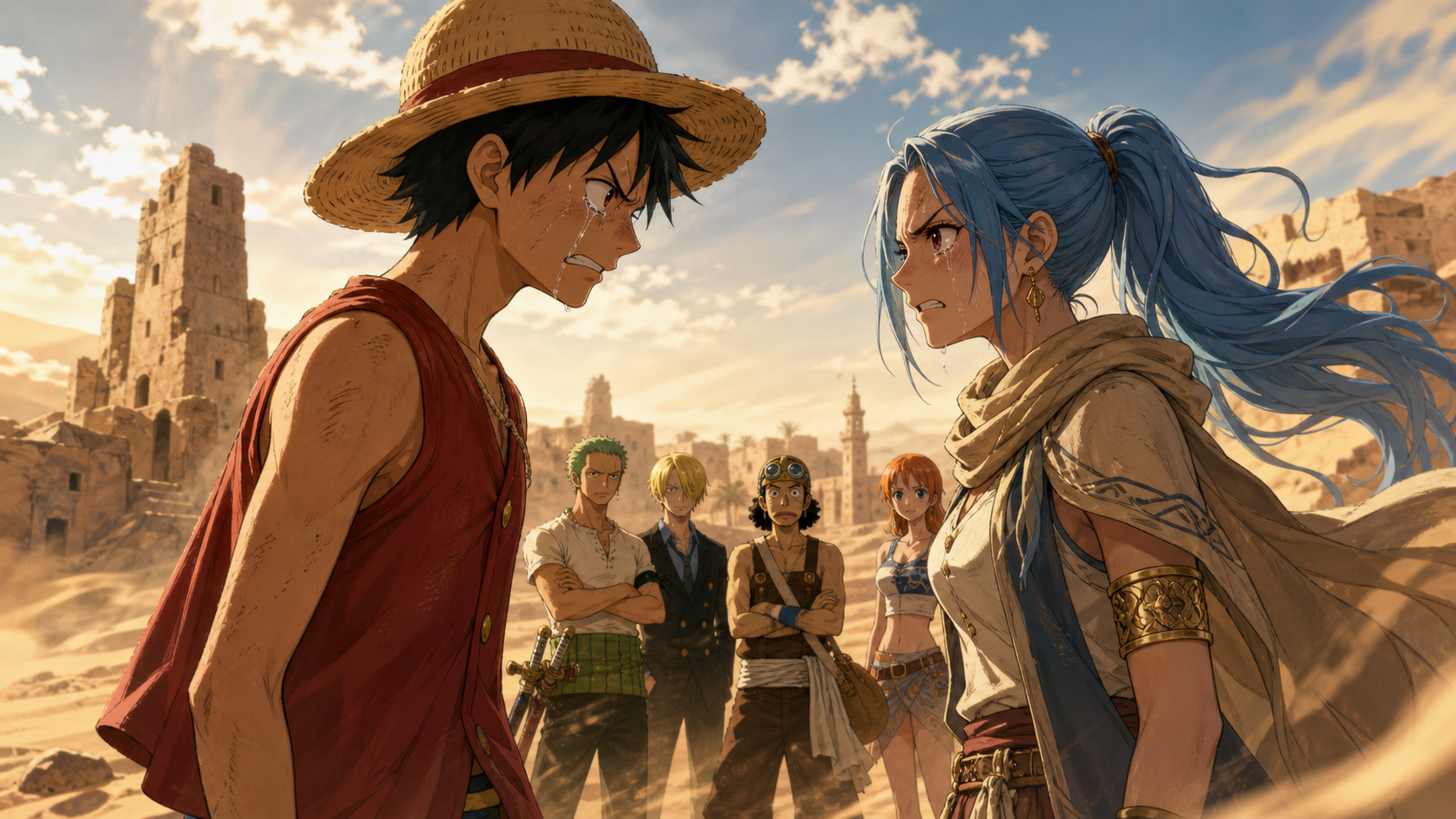
Luffy vs. Vivi
One Piece Episode 104 forces Vivi to share Alabasta's burden when Luffy challenges her impossible promise to prevent every casualty.
Quick reaction
One Piece Episode 104 turns a desert argument into the clearest definition of friendship the Alabasta story has offered. Vivi wants to reach Katorea, stop the rebel army, protect the royal soldiers, defeat Crocodile, and somehow prevent every death. Luffy hears the impossible promise beneath her plan. She intends to carry a country alone while treating the Straw Hats like escorts whose safety matters more than her own.
He refuses that arrangement. Their confrontation becomes physical because polite reassurance has allowed Vivi to keep hiding the true scale of her fear. Luffy does not tell her to stop caring about lives. He tells her to put her friends’ lives beside hers and let them help attack the person creating the war.
RaeRae’s bottom line is simple: shared risk is not a failure of leadership. A leader who conceals danger to protect everyone can remove the consent, judgment, and strength of the people who volunteered to stand beside her. Vivi needs allies, not an audience for self-sacrifice.
Yuba gives the crew a night to face reality
The Straw Hats sleep at Toto’s shelter after crossing a country scarred by drought and sandstorms. Rest does not repair their strategic problem. Koza and the rebel army have moved to Katorea, while Crocodile has already ordered Operation Utopia to begin at noon the next day.
Yuba carries emotional weight for Vivi because the ruined oasis connects her childhood, Koza’s family, and the government’s promise of national development. Toto still trusts Cobra and keeps digging for water. His loyalty proves that Crocodile has not convinced every suffering citizen, but one loyal survivor cannot halt an army.
The quiet night also makes Vivi’s urgency more painful. She has found a witness who understands the kingdom, yet the person she needs to persuade has already left. Her original route was morally serious and operationally stale.
A plan should change when new information arrives. Vivi instead tries to preserve the goal of zero casualties by moving faster toward Katorea. The goal sounds compassionate, but compassion cannot replace updated strategy.
Crocodile runs Operation Utopia like a deadline
At Rain Dinners, Crocodile gives the conspiracy a precise execution time: noon tomorrow. He has spent years manufacturing distrust, controlling information, and positioning Baroque Works agents around Alabasta. The final stage depends on synchronized action rather than one dramatic attack.
Mr. 3 arrives with news that Vivi and the Straw Hats survived Little Garden. His report exposes a gap in Crocodile’s control. The boss believed the threat had already been removed, and the employee responsible for that assumption now stands before him.
Crocodile responds by ordering his agents to prevent Vivi from reuniting with Koza. That order confirms her voice matters. A conversation between two childhood friends could weaken years of manufactured division, so the conspiracy must keep truth from reaching the rebel leader.
The contrast with Vivi is sharp. Crocodile delegates harm through a hierarchy and protects himself. Vivi tries to absorb protection work personally and shield her allies. Both structures concentrate power, but only one can change through honest friendship.
Mr. 3 learns how disposable workers become
Mr. 3 expects information and excuses to preserve his status. Crocodile evaluates results. Failure threatens the agent because Baroque Works does not provide repair, learning, or accountability with dignity. Rank lasts only while usefulness lasts.
This workplace design encourages concealment. Employees who expect punishment have incentives to delay bad news, inflate success, and redirect blame. Crocodile may look efficient, yet fear has already damaged the accuracy of his own intelligence.
Miss Goldenweek’s absence also hangs over the report. Mr. 3 speaks for a failed pair inside a system where leadership treats people as interchangeable tools. No one asks what happened to her because the organization values completion above care.
Baroque Works can coordinate a national crisis, but coordination should never be mistaken for healthy leadership. A machine can move quickly while grinding down every person inside.
Vivi’s zero-casualty promise comes from love and trauma
Vivi insists that nobody should die. The demand does not come from childish ignorance. She has watched her country lose rain, homes, public trust, and time. Every possible casualty represents a citizen her family was supposed to protect.
Her position also reflects survivor responsibility. Vivi entered Baroque Works, learned Crocodile’s identity, and returned with knowledge unavailable to most citizens. Knowing more can create the false belief that one person must therefore control every consequence.
She is allowed to want an outcome without deaths. She is not required to pretend that desire guarantees a path. War has already produced deprivation, displacement, attacks, and political terror. The absence of a formal battlefield does not mean everyone remains unharmed.
Grief makes impossible bargains feel like duties. If Vivi can save everybody, perhaps no one can accuse her of arriving too late. The bargain punishes her for a conspiracy Crocodile built.
Luffy refuses a plan built around one martyr
Luffy stops walking toward Katorea because he no longer accepts the premise. Chasing the rebels may delay the collision, but Crocodile can keep manufacturing evidence, moving agents, and changing the timetable. The crew needs to confront the architect.
His refusal sounds cruel because Vivi is speaking from terror. He tells her people will die, a statement that attacks the promise holding her together. The scene works because his next demand reveals the purpose. He wants her to include his life and every crew member’s life in the plan.
Luffy does not romanticize sacrifice. He rejects unilateral sacrifice. Vivi has already asked for their help, and the crew has already chosen the danger. She cannot honor friendship by quietly deciding that their consent no longer counts.
A captain must sometimes name the risk everyone else avoids. Luffy’s language lacks diplomacy, but his strategic correction is sound: stop chasing every visible symptom and move against Crocodile.
Their punches expose what polite conversation concealed
Vivi strikes Luffy because his words sound like surrender to death. Luffy hits back because she continues presenting self-destruction as responsibility. Neither blow solves the political crisis, yet the exchange strips away a performance of calm that had become dangerous.
The scene should not become a general endorsement of violence during conflict. Physical force is not healthy communication. Within this heightened adventure, the punches externalize an emotional collision already harming the mission.
Vivi finally says what she fears. Luffy finally says what the crew has offered. Tears replace managed composure, and the argument reaches the relationship beneath the route map.
The most important shift is mutual recognition. Luffy sees the princess trying to become a shield for millions. Vivi sees friends who refuse to remain protected spectators.
Putting friends on the line requires consent
Luffy’s demand works because the Straw Hats have chosen this journey. Shared risk without consent would repeat Crocodile’s exploitation. Shared risk after informed agreement becomes solidarity.
Vivi has not deceived the crew about Crocodile’s danger, but she still withholds emotional authority. She decides which costs they should be permitted to bear. That choice places her judgment above their stated loyalty.
Consent also remains renewable. Every crew member can challenge a route, raise a concern, or leave. Luffy’s intervention demonstrates that membership includes the right to dispute the plan.
Friendship does not erase leadership. Friendship changes leadership from private burden into accountable relationship. Vivi can still name the mission while letting others shape how the group pursues the goal.
Nami understands the argument before Vivi can answer
Nami and the crew do not rush to rescue Vivi from an uncomfortable truth. Their restraint matters. They know Luffy’s phrasing is brutal, and they also know Vivi has been collapsing under a promise no person can guarantee.
Nami has already negotiated stakes with Vivi, protected her, argued about money, navigated the desert, and survived enemies sent by Baroque Works. Her presence confirms that care can be practical, impatient, and loyal at once.
The crew’s silence is not indifference. They give Vivi room to choose whether these pirates are temporary transportation or genuine partners. Nobody can make that choice for her.
Once Vivi accepts shared risk, the Straw Hats do not become less concerned about civilians. They become more capable of directing force toward the source of the crisis.
Going after Crocodile changes the mission
The original mission centered on delivering Vivi and helping her reach Koza. The new mission centers on defeating Crocodile before Operation Utopia completes. That shift moves the crew from messenger work into direct intervention.
Stopping the mastermind will not automatically repair every conflict. Rebels and royal soldiers still carry fear, anger, weapons, and incomplete information. Removing Crocodile is necessary because he continues producing the conditions that make reconciliation harder.
Rainbase becomes the strategic destination. Crocodile’s casino, public reputation, and hidden operations converge there. The location offers no guarantee of success, but confronting the command center creates a clearer causal link between action and outcome.
Luffy’s plan is simpler, not simplistic. A bounded target allows the crew to coordinate. Vivi can pursue national repair after the person actively sabotaging every repair attempt loses control.
Toto’s trust gives Vivi something worth carrying
Toto believes Cobra did not steal Alabasta’s rain. His faith cannot serve as universal proof, yet his testimony reminds Vivi that Crocodile has not erased every relationship between citizens and the crown.
She does not need to manufacture hope from nothing. She needs to protect existing threads of trust and expose the system attacking them. Toto’s shovel is one thread. Her friendship with Koza is another. The Straw Hats become a third.
Trust needs evidence, communication, and material support. Toto deserves water and reconstruction, not praise for endless endurance. Koza deserves current truth, not a lecture about loyalty. Vivi deserves partners, not a ceremonial expectation that a princess absorb a nation’s pain.
The episode starts turning those needs into an actionable coalition. First, Vivi must stop measuring leadership by how much suffering she can hide.
Friendship becomes an accountability structure
One Piece often celebrates friends through rescue and celebration. Episode 104 adds correction. A friend can interrupt a harmful plan, reject a noble-sounding excuse, and demand honest participation.
Luffy risks Vivi’s anger because agreement would be easier and less useful. His loyalty is not obedience. He respects her goal enough to challenge a method that could waste their remaining time.
Vivi’s tears do not mark weakness. They mark the end of solitary performance. She can admit that Crocodile frightens her, that people may die, and that she cannot control every variable.
Accountability without affection can become punishment. Affection without accountability can become enabling. The confrontation succeeds because the crew’s prior care makes hard truth survivable.
Production choices keep the argument personal and political
Junki Takegami’s script places Crocodile’s operational confidence beside Vivi’s collapsing certainty. One leader treats people as pieces. Another leader fears every cost so deeply that she nearly refuses help. The parallel clarifies two different failures of control.
Ken Koyama’s direction lets the desert space around Luffy and Vivi feel exposed. There is nowhere for either person to retreat behind palace language, crew comedy, or a moving caravan.
Eisaku Inoue’s animation direction gives the confrontation weight through posture, facial strain, and abrupt physical movement. Tears and anger remain readable without turning Vivi into a passive victim or Luffy into a calm lecturer.
Miyuki Sato’s art keeps Yuba’s ruins present behind the emotional conflict. The damaged city prevents the argument from shrinking into private drama. Every word concerns real homes and people.
What Episode 104 changes
Crocodile sets Operation Utopia for noon the next day and learns that Vivi and the Straw Hats remain alive. He orders Baroque Works to prevent Vivi from reaching Koza.
Vivi proposes pursuing the rebel army in Katorea while still trying to prevent every casualty. Luffy rejects the plan and insists that the crew confront Crocodile directly.
The argument forces Vivi to acknowledge that she has been carrying the kingdom as a private burden. Luffy asks her to place the crew’s chosen lives beside her own because they are friends.
The Straw Hats leave Yuba with a clearer target and a more honest compact. Rainbase, Crocodile, and the source of the conspiracy now define their route.
Episode details
Japanese title: ルフィVSビビ!仲間に賭ける涙の誓い
English title: Luffy vs. Vivi! A Tearful Vow to Put Friends on the Line
Japanese broadcast: March 10, 2002
Saga: Alabasta
Material: Manga-canon adaptation
Script: Junki Takegami
Episode direction: Ken Koyama
Animation direction: Eisaku Inoue
Art: Miyuki Sato
The official One Piece guide confirms the night in Yuba, Operation Utopia’s deadline, Mr. 3 reporting the crew’s survival, and Crocodile ordering Vivi’s reunion with Koza stopped. The leadership, consent, labor, grief, and accountability analysis is RaeRae’s reading of those events.
Final verdict
Episode 104 earns a 9.8 out of 10. The story takes Vivi’s best quality, her refusal to treat citizens as expendable, and shows how fear can twist that care into an impossible private contract. She wants to save everybody because every life matters. She also needs to hear that her life matters to the people walking beside her.
Luffy’s intervention is messy, painful, and necessary. He does not offer a safe plan. He offers an honest one. Crocodile has already put the country at risk without consent. The answer cannot be another leader making every decision alone, even when that leader acts from love.
Put the burden on the table. Let friends choose. Name the enemy producing the crisis. Then move together toward Rainbase before noon.