
The Will of Stone
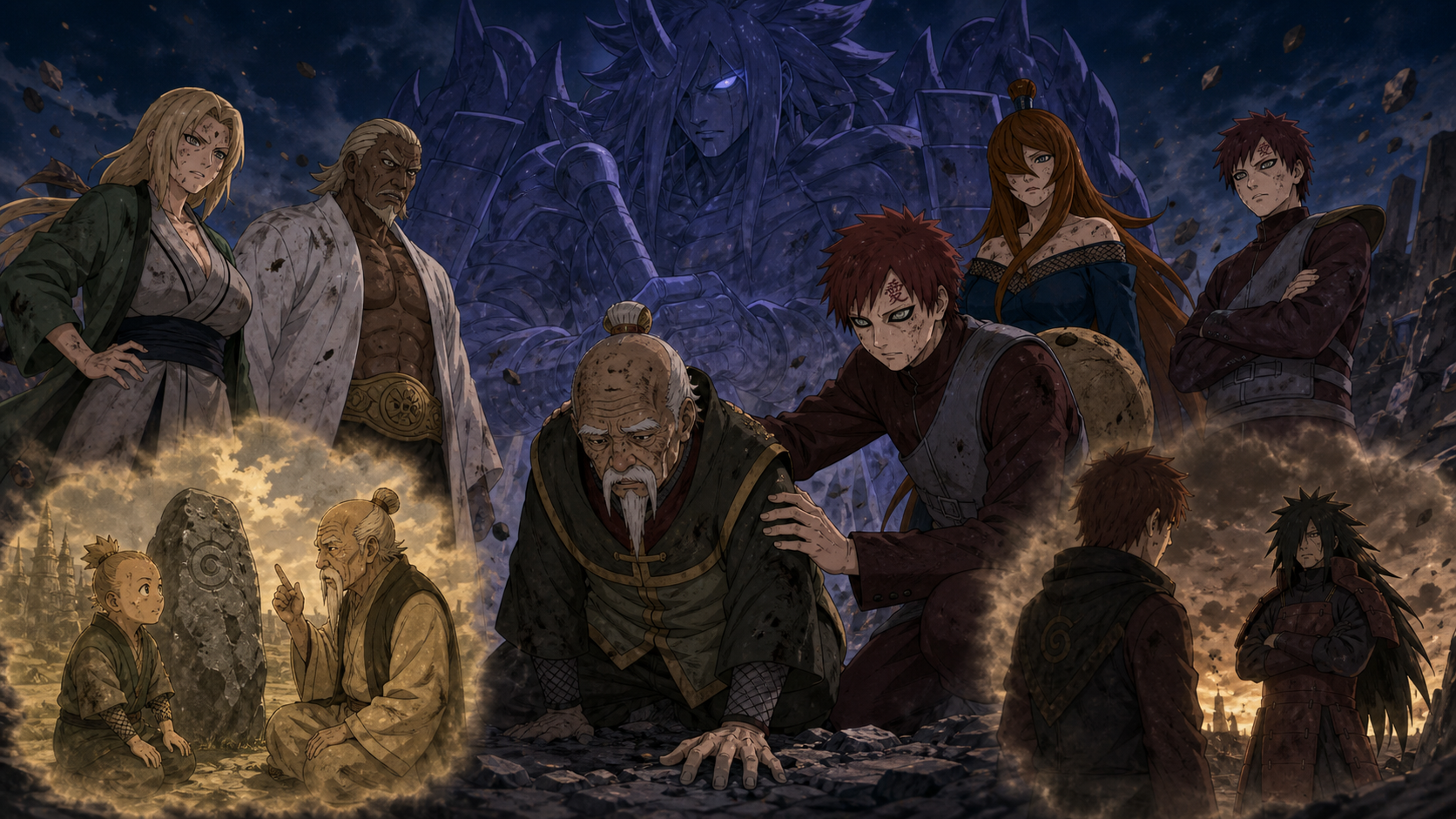
Madara pushes Ōnoki toward surrender until Gaara and an old lesson force the Tsuchikage to decide what experience should protect.
Bottom line
“The Will of Stone” gives Ōnoki’s stubbornness a history deeper than age and pride. Madara overwhelms the five Kage, mocks the institutions they represent, and pushes Ōnoki toward the belief that resistance has become pointless. The Tsuchikage remembers Ishikawa teaching him that the village’s true stone is not a monument but the will carried inside people. He also remembers meeting Madara as a younger shinobi and allowing humiliation, political compromise, and years of conflict to cover that original conviction. Gaara’s example and Naruto’s influence help him uncover the value rather than invent a new one. Ōnoki stands again because leadership requires more than surviving long enough to become cynical. Experience should clarify what deserves protection, not become an excuse to stop protecting anyone.
The five Kage remain outmatched
Tsunade, A, Mei, Gaara, and Ōnoki have assembled their complementary abilities against Madara. Numerical advantage has not closed the difference in power.
Madara’s reanimated body, Rinnegan, Susanoo, and stolen Hashirama cells allow him to answer attacks without paying the same physical costs.
Madara attacks their confidence
He does not rely only on techniques. Madara treats the current Kage as inferior successors whose titles have outlived the strength that once gave those offices meaning.
Psychological pressure matters because coordinated fighters need confidence in one another’s judgment. Doubt can separate them before any technique does.
Historical reputation becomes a weapon
Ōnoki knows Madara from more than stories. The memory of that power gives every current attack confirmation from his own youth.
Firsthand knowledge can guide strategy, but trauma can make the past feel unbeatable before the present has finished acting.
Ōnoki has already spent his body
The Tsuchikage helped stop the first meteor, endured the second impact, and continued after severe injury. Age magnifies every cost.
His exhaustion is not proof that his will is weak. Physical depletion creates the condition where an old doubt can sound persuasive.
Tsunade keeps the group functional
Tsunade’s medical techniques allow injured Kage to continue fighting. Healing becomes part of the battle plan rather than work performed after the action ends.
Her presence also challenges Madara’s model of power. Preserving allies can be as strategically decisive as destroying an opponent.
Gaara watches the oldest leader falter
Gaara has depended on Ōnoki’s knowledge and Particle Style since Madara appeared. Seeing him lose resolve threatens more than one fighter.
The youngest Kage now has to support the elder who earlier supplied historical context and battlefield strength.
Leadership support moves both directions
Age and rank do not create a permanent one-way flow of wisdom. Younger leaders can return perspective when older leaders become trapped inside experience.
The five Kage formation works only when every member can give and receive help without treating vulnerability as disqualification.
Ōnoki remembers the First Tsuchikage
As a child, Ōnoki learned from Ishikawa, the founder who helped establish the Hidden Stone. The lesson took place through ordinary work and a literal stone.
The memory matters because village ideals were once explained to him before politics turned those ideals into slogans and bargaining positions.
A village monument is not the village’s will
Stone can be polished, displayed, damaged, or replaced. Ishikawa teaches that the essential stone exists inside the people carrying responsibility forward.
Institutions need buildings and symbols, but symbols become empty when leaders defend the object while abandoning the value.
The inner stone has to be maintained
Ishikawa warns that neglect allows grime to cover a person’s conviction. The stone is not permanently pure because someone received a good lesson in childhood.
Values require repeated attention. Experience can polish judgment or bury judgment under convenience.
Young Ōnoki believed in that lesson
The child accepts the idea with direct enthusiasm. Before becoming a diplomat and war veteran, he sees leadership as something worth carrying.
The memory is not presented to shame his later complexity. The younger self preserves a question the older self stopped asking.
Madara entered Stone history early
A younger Ōnoki and Mū encountered Madara during a period when inter-village power was still unstable. Madara asserted Leaf dominance with overwhelming force.
The encounter taught Ōnoki that declared alliances could hide coercive hierarchy. Political language did not protect weaker parties from a founder’s contempt.
Mū and Ōnoki could not stop him
Their techniques and status were insufficient against Madara. The defeat left evidence that some power gaps cannot be closed through courage alone.
The correct lesson should have included preparation and coalition. Trauma compressed the event into a harsher conclusion about idealism itself.
Humiliation hardened into cynicism
Ōnoki learned to expect betrayal, calculate advantage, and protect the Stone through secrecy and leverage. Some of that caution came from real political danger.
Caution becomes corrosive when every cooperative possibility is dismissed before evidence can develop.
The Stone used Akatsuki
Under Ōnoki’s leadership, the village employed Akatsuki for military work because the organization offered efficient force at lower political cost.
That choice helped normalize the mercenary network now driving the war. Pragmatism can create tomorrow’s catastrophe while solving today’s budget or deniability problem.
Ōnoki carries institutional responsibility
He did not create every conflict among the five nations, but he made decisions inside that system and benefited from some of its arrangements.
Leadership accountability means more than feeling guilty. The war offers a chance to build different cooperation with the people harmed by the old structure.
Madara wants cynicism to look mature
His mockery suggests that ideals belong to weaker people who have not understood power. Ōnoki’s long career makes that claim especially tempting.
Cynicism often presents itself as intelligence because cynics can list every betrayal. Wisdom also has to notice evidence of change.
Gaara is evidence of change
Gaara was once treated as a Sand weapon and driven toward violent isolation. He now commands an alliance across villages.
His life contradicts the belief that systems and people can only repeat their worst history.
Naruto changed Gaara through recognition
Naruto reached Gaara as another isolated jinchūriki and refused to accept cruelty as their fixed identity. That relationship helped Gaara choose a different future.
Ōnoki can see the result standing beside him. Idealism has produced operational leadership, not merely comforting language.
The Alliance itself contradicts Madara
Five villages with histories of war, exploitation, and distrust have combined command structures and battlefield support. The arrangement is imperfect and new.
Imperfection does not make cooperation fake. The Kage are sharing risk on one battlefield, which their predecessors rarely imagined.
Ōnoki finds the stone under the grime
The First Tsuchikage’s lesson returns as a value buried beneath decades of compromise. Ōnoki does not become his childhood self again.
He brings the full knowledge of failure back to the original commitment. Renewed hope is stronger when informed rather than innocent.
Resolve is not denial of the power gap
Ōnoki still knows Madara is stronger than any individual Kage. Standing again does not change the measurement.
Resolve means using every available ability because surrender guarantees the future Madara wants.
Remembering is different from retreating into nostalgia
Ōnoki does not remember Ishikawa because the founder era was morally clean. Hidden villages were formed amid violence, rivalry, and compromises that created later harm.
The memory is useful because one lesson survived those contradictions. Leaders need an internal standard capable of judging their own institutions, not a fantasy that founders made every correct choice.
Nostalgia asks Ōnoki to restore a past that never fully existed. Responsibility asks him to recover a principle and apply the principle more honestly than previous generations did.
A renewed value must change later decisions
Standing against Madara is the immediate proof, but one battle cannot complete Ōnoki’s repair. The Stone’s use of mercenaries and distrust of other villages created consequences beyond this field.
If he survives, the recovered will should shape budgets, alliances, jinchūriki policy, and how the village remembers people harmed by its pragmatism. Otherwise the lesson becomes another dramatic feeling with no institutional future.
The five Kage need Ōnoki’s experience
Particle Style, weight manipulation, knowledge of Madara, and decades of leadership remain unique contributions. Despair would remove all four from the formation.
His recovery restores capacity to the group. Personal conviction becomes a shared strategic resource.
Ōnoki needs the other four too
Tsunade’s healing, Gaara’s sand, A’s speed, and Mei’s elemental range give Ōnoki openings he could never create alone.
The will of stone does not mean becoming immovable and isolated. A foundation gains purpose by supporting something larger.
Madara misreads cooperation as weakness
He comes from a history where Hashirama’s willingness to compromise could be interpreted as softness. The current Kage’s dependence on one another looks inferior to solitary dominance.
Their dependence is honest. Nobody in the formation needs to pretend one person contains every required skill.
Particle Style demands careful timing
Ōnoki’s most destructive technique can erase matter within its field, but chakra cost and Madara’s absorption make careless use dangerous.
The Kage have to create a moment where Madara cannot simply neutralize the attack. Resolve needs coordination to become useful.
Gaara helps create that moment
Sand can restrain, reposition, and protect while Ōnoki prepares. Their combination has already challenged Madara’s defenses.
The youngest and oldest Kage turn generational difference into complementary timing.
Tsunade protects the cost of commitment
Ōnoki’s renewed effort places more strain on an injured body. Tsunade’s presence allows courage without pretending injury has disappeared.
Support prevents resolve from becoming self-destruction. A leader should not need to die merely to prove belief was sincere.
A and Mei keep pressure distributed
A forces rapid defensive decisions, while Mei’s elemental techniques restrict routes and answer different chakra natures. Madara cannot focus on Ōnoki alone.
The formation earns chances through distributed pressure. Every Kage helps make another Kage’s specialty viable.
The battle becomes a test of institutions
Madara represents founder-era power concentrated in one reanimated body. The five Kage represent offices shaped by generations of imperfect governance.
Their strength lies less in matching his legend individually than in proving institutions can learn enough to cooperate against inherited disaster.
The will of stone belongs beyond one village
Ishikawa’s lesson began as a Hidden Stone value, but the war gives the principle wider application. Every village needs people who protect shared commitments beneath damaged symbols.
Ōnoki honors his village most fully when that value helps preserve people outside its borders too.
The title describes recovered purpose
Stone suggests weight, endurance, and foundation. Will gives those qualities direction.
Ōnoki has always been stubborn. The episode asks whether stubbornness serves pride, fear, or a future worth protecting.
Madara attacks the Kage’s political memory
He does more than overpower techniques. He invokes old humiliations, failed alliances, and the compromises leaders made until cynicism feels like the only intelligent response.
Psychological warfare works when it turns history into proof that change is impossible. The defense requires honest memory, not denial. The Kage must admit what happened while refusing Madara’s claim that repetition is destiny.
Ōnoki’s exhaustion is institutional evidence
His body carries decades of missions, leadership, secrecy, and wars that Stone normalized as necessary. Pain is not simply a personal weakness arriving at a bad moment.
The village relied on one leader long enough that his physical collapse threatens strategic knowledge. Succession planning, shared archives, and distributed authority should have existed before a meteor forced the lesson.
Tsunade keeps the formation medically possible
Her healing allows wounded Kage to remain conscious and coordinated while Madara attacks faster than ordinary recovery permits. Medical labor becomes part of every offensive exchange.
Tsunade also has to protect her own chakra and judgment. A healer embedded with leadership cannot be treated as an unlimited repair mechanism whenever someone chooses another reckless risk.
Gaara supports an elder without surrendering critique
He notices Ōnoki faltering and offers steadiness rather than contempt. The younger Kage can respect experience while remaining evidence that older political assumptions were wrong.
Intergenerational support works when care does not require silence about harm. Gaara helps Ōnoki stand, and his transformed leadership challenges the cynicism Ōnoki once accepted.
Ishikawa’s stone is a practice, not a relic
The First Tsuchikage teaches that a person must maintain an inner value beneath pressure, compromise, and changing circumstances. The lesson is not automatic virtue passed through office.
A stone can collect grime, crack, or become an excuse for stubbornness. Ōnoki must examine what he preserved and what he abandoned rather than invoking tradition as proof he remained faithful.
The monument cannot substitute for village people
Symbols make history visible, but a carved stone cannot tell citizens whether leaders protected them, acknowledged losses, or used their labor responsibly.
The will of Stone belongs to miners, farmers, shinobi, medics, couriers, families, and children affected by policy. Leadership values become real only when those people can see the consequence in daily life.
Madara’s earlier victory shaped policy through shame
Young Ōnoki and Mū could not stop him, and the humiliation followed Ōnoki into adulthood. Unprocessed defeat hardened into a belief that survival required harsher compromise.
That history helps explain later choices without excusing them. Shame becomes politically dangerous when leaders hide it, build policy around avoiding the feeling, and never let communities examine the cost.
Stone’s use of Akatsuki needs explicit accountability
Ōnoki admits his village hired the organization when convenient, helping sustain a market for violence that later threatened every nation. Practical language cannot erase participation.
Postwar repair needs contracts, decision makers, missions, victims, and funds documented. A renewed inner stone means changing procurement and oversight, not only fighting bravely once consequences arrive.
Gaara proves relationship can interrupt inherited policy
Naruto’s recognition helped him imagine a life beyond being a weapon, and Gaara then changed how he governed. The transformation did not happen through private inspiration alone.
Citizens, siblings, advisers, and allied relationships made the new leadership possible. Gaara is evidence that institutions can change when personal insight becomes public practice.
Particle Style requires a team-built opening
Ōnoki’s technique can erase matter, but Madara’s speed and defenses make power useless without timing. Gaara shapes position while A and Mei distribute pressure and Tsunade protects capacity.
The decisive move belongs to the formation. A legendary technique becomes effective because several leaders coordinate rather than waiting for the oldest man to prove himself alone.
Recovered purpose must survive victory
Ōnoki finds conviction under years of compromise, but one brave stand cannot settle the record. The real test comes if he lives long enough to govern afterward.
He must disclose Stone’s deals, support successors, compensate people harmed by policy, and share authority. Purpose becomes credible when it changes the next decision after applause ends.
An inner value needs public measures of change
Ōnoki can now sincerely recover the lesson Ishikawa gave him and still return to the same policies once survival pressure changes shape. Private conviction becomes political only when citizens can observe what leadership does differently. Stone needs published limits on mercenary contracts, independent review of missions involving Akatsuki, protected testimony from affected families, and a succession process that does not keep every consequential memory inside one aging Kage. Budgets should show whether medical care, reconstruction, and civilian protection receive the resources once spent on secret force. Young shinobi need a way to challenge orders without being branded disloyal to the village’s will. Elders need spaces to admit fear and failure before shame turns into another generation of cynical policy. Gaara’s presence offers evidence that a former child weapon can become a leader who changes public relationships, but Stone cannot borrow his transformation as proof of its own reform. Ōnoki has to bring the recovered stone home and let other people test its meaning. If the value survives only inside the leader, it disappears when he dies. If the value becomes records, oversight, compensation, education, and shared authority, the village can carry it without worshiping one person. That is how remembrance moves from inspiring flashback to accountable institution.
The Alliance should ask the same question of every Kage. Shared battle creates a temporary laboratory for different leadership, but cooperation becomes history unless each village changes what it rewards and hides. Tsunade, A, Mei, Gaara, and Ōnoki need a joint record of decisions, disagreements, casualties, and support labor from this field. Future leaders should inherit evidence of how unity worked, not a polished legend that asks them to reproduce courage without the structure that made courage useful.
RaeRae’s verdict
“The Will of Stone” gives Ōnoki’s comeback weight because the episode does not erase the decisions that made him cynical. Madara humiliated him, village politics rewarded suspicion, and the Stone later used Akatsuki for convenience. Experience supplied real reasons to distrust idealistic language.
Ishikawa’s lesson returns as a demand to examine what experience covered rather than discard experience. Gaara and Naruto provide present evidence that people and institutions can change. Ōnoki stands again with clearer responsibility: not because the old ideals were easy, but because abandoning them helped create the world now threatening everyone.
RaeRae’s call
Ōnoki’s stone is not a monument, a title, or permission to ignore the damage Stone caused. Gaara helps him recover purpose, Tsunade protects the body carrying it, and the five Kage build the opening together. Let renewed resolve mean public records, shared authority, and different policy after the battle.
Episode details and viewing routes
- Official episode reference: Naruto Official episode guide
- Licensed episode route: Crunchyroll licensed episode page
What I am carrying forward
The five Kage remain outmatched by Madara, but Ōnoki has recovered his resolve through the First Tsuchikage’s teaching about the inner stone. He recognizes how humiliation and political compromise buried that value.
Gaara, Tsunade, A, and Mei continue combining their abilities with Ōnoki’s Particle Style and experience. Episode 333 expands the battle while shifting toward the risks built into Edo Tensei and Sasuke’s encounter with Itachi.