
Two-Man Team
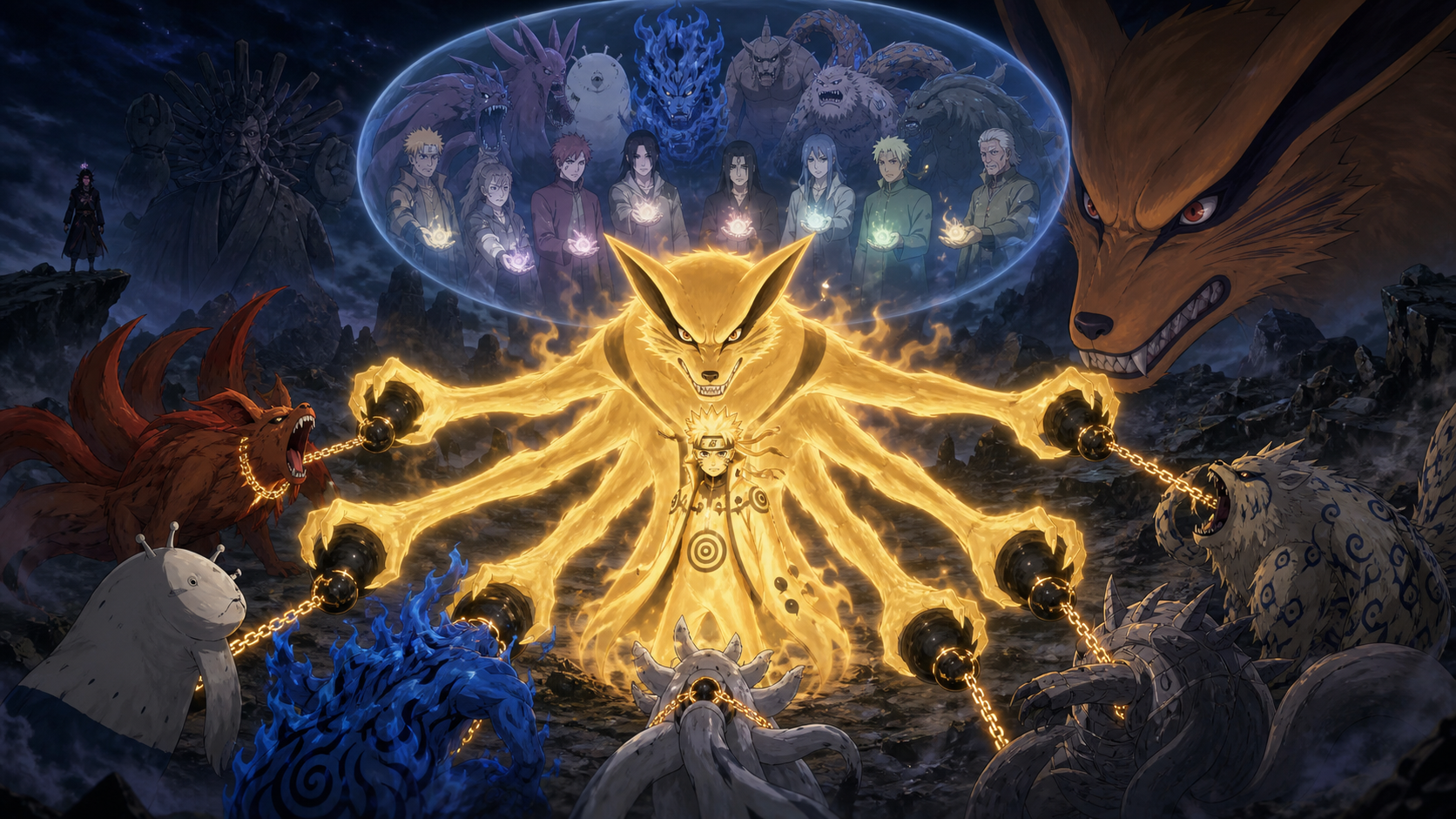
Naruto and Kurama’s first full Tailed Beast Mode turns enormous power toward liberation, and five controlled beasts answer with names and chosen chakra.
Bottom line
“Two-Man Team” proves that Naruto and Kurama’s partnership changes more than chakra output. Their first full Tailed Beast Mode answers five controlled beasts at once, but the real victory comes when Naruto uses that power to remove every black receiver rather than destroy the hosts. Inside the shared consciousness, the tailed beasts and former jinchūriki give him their names, memories, and voluntary pieces of chakra before the masked man recalls them into the Demonic Statue. Kurama supplies scale; Naruto supplies the promise; both coordinate decisions under a strict time limit. The episode earns its title because neither partner disappears inside the other. Two minds act together, and that cooperation creates enough trust for an entire community of imprisoned beings to answer.
Kurama’s chakra surrounds Naruto
Opening the seal allows Naruto and Kurama to connect without the earlier struggle for extraction. A vast chakra avatar forms around Naruto.
The appearance resembles a full tailed-beast transformation while preserving Naruto’s visible presence. Partnership expands him without erasing him.
Tailed Beast Mode is relational power
Naruto did not tame Kurama into obedience. Kurama chose to share power after years of observing Naruto’s decisions.
The form therefore records an agreement. Greater scale is the visible consequence of a changed relationship, not the cause of that relationship.
Killer B recognizes the difference
B and Gyūki understand complete jinchūriki cooperation better than anyone nearby. They can see that Naruto’s new form comes from synchronization rather than stolen chakra.
Their example helped establish the possibility. Naruto and Kurama now demonstrate their own version instead of copying B’s personality or style.
The partnership has a time limit
Naruto and Kurama can sustain the new mode for only a few minutes. Fresh trust does not create perfect technical control on the first attempt.
The limit forces prioritization. They must choose the action that changes the control system before the transformation collapses.
Five tailed beasts prepare one answer
The remaining controlled jinchūriki enter full tailed-beast forms. Matatabi, Isobu, Kokuō, Saiken, and Chōmei face Naruto under the masked man’s command.
Their combined scale turns the battlefield into a clash among beings villages once kept separated and classified as national weapons.
The masked man weaponizes community
Tailed beasts share an origin and old memories, yet the controller forces them to attack one another through their hosts.
Domination does more than remove individual choice. Domination turns relationships into sources of pain and makes solidarity appear impossible.
Multiple Tailed Beast Bombs converge
The controlled beasts produce enormous chakra attacks from several directions. Any ordinary defense would fail under the combined force.
The formation again uses shared sight to coordinate timing. Destructive power becomes more dangerous because the operator has networked the bodies.
Naruto and Kurama meet scale with precision
Their chakra avatar intercepts and redirects the incoming attacks rather than allowing the blasts to strike allies and surrounding forces.
The response requires Kurama’s power and Naruto’s judgment. Raw output without careful direction would create another catastrophe.
One partnership challenges five controlled bodies
The numerical imbalance makes the episode’s argument visible. Five beasts under coercion generate enormous force; one beast cooperating with a host generates adaptability.
Cooperation does not automatically make Naruto stronger than every opponent. Cooperation lets two minds choose how and where strength should be used.
Kurama guides Naruto inside the avatar
Kurama communicates observations and timing instead of functioning as a silent battery. Naruto can adjust because another perspective remains active.
Their conversation is the tactical advantage the masked man’s receivers cannot reproduce. Commands travel one way; partnership exchanges information both ways.
Naruto keeps the receivers as the true targets
The transformed beasts fill the horizon, but Naruto does not confuse size with the source of the problem. Black rods still anchor the masked man’s control.
His goal remains liberation. Tailed Beast Mode gives him reach enough to pursue that goal across several enormous bodies.
Chakra arms create simultaneous access
Naruto extends chakra limbs toward the receivers embedded in the controlled beasts. Several targets have to be reached before the enemy can reorganize.
The form turns Naruto’s old habit of multiplying effort into a shared technique with Kurama. Distribution remains central to how he protects people.
Shadow clones preserve Naruto’s method
Even at this scale, Naruto relies on clones and coordinated angles rather than one royal finishing blow. His identity as a fighter survives the transformation.
Kurama’s power does not replace Naruto’s learned judgment. The partnership amplifies the way Naruto already solves problems.
Every receiver is pulled
Naruto removes the black rods from the five reanimated jinchūriki. The shared ocular-control network loses its physical anchors.
The achievement fulfills Son Gokū’s condition across the group. Naruto applies what one tailed beast taught him to the others without claiming ownership.
The inner meeting opens
Contact with the beasts and hosts brings Naruto into a shared consciousness space. The battlefield pauses long enough for identities hidden behind the transformations to become visible.
The scene replaces giant silhouettes with people who can introduce themselves. Liberation begins by restoring the information control tried to erase.
Matatabi names herself
The Two-Tails is Matatabi, not merely the beast once sealed inside Yugito Nii. Her name carries identity older than the Hidden Cloud’s military use.
Yugito’s presence connects that identity to the disciplined host Akatsuki killed and reanimation later exploited.
Isobu appears with Yagura
The Three-Tails is Isobu, and Yagura was his jinchūriki. Their pairing carries the damaged history of the Hidden Mist and the masked man’s earlier interference.
Naruto receives names where the enemy offered only functions. Remembering both prevents either being from disappearing inside the other’s biography.
Kokuō stands beside Han
The Five-Tails is Kokuō, paired in life with Han. Boil Release and physical power were expressions of their combined circumstances, not the total meaning of either person.
Naming restores distinction without denying connection. Host and beast remain separate beings whose histories crossed through a seal.
Saiken is more than Utakata’s hidden secret
The Six-Tails is Saiken. Naruto knew Utakata without knowing the tailed beast sealed within him.
The introduction completes information Naruto could not receive before Pain killed Utakata. Knowledge arrives too late for reunion, but not too late for remembrance.
Chōmei introduces another life Naruto missed
The Seven-Tails is Chōmei, partnered with Fū. Her youth and energy in life stand against the silent controlled body Naruto faced.
The name makes clear that two futures were stolen: Fū’s human future and Chōmei’s freedom beyond her host’s death.
Son Gokū returns to the circle
Son appears with Rōshi and confirms the connection formed during Naruto’s promise. His presence links the first receiver removal to the wider release.
Rōshi and Son did not achieve the partnership both might have wanted. Their shared appearance still allows Naruto to remember them together without treating them as one person.
The Sage’s old gathering echoes forward
The tailed beasts remember being young around the Sage of Six Paths, who gave them names and spoke of a future reunion.
Naruto’s arrival does not automatically fulfill every part of that hope. The resemblance matters because he has created a space where they can appear as a community again.
Names are entrusted, not collected
The introductions are gifts of information. Naruto does not compile names as credentials or evidence that he owns special access.
His responsibility is to remember and act accordingly. Knowledge creates obligation before status.
The beasts share chakra voluntarily
Each tailed beast leaves Naruto a portion of chakra through mutual contact. The exchange forms connections that the masked man did not authorize.
Power follows recognition. Naruto receives chakra because the beasts choose to support a person who tried to break their control.
The fist bumps replace receivers
Black rods transmitted commands into bodies. Fist bumps transmit chakra through agreement.
The visual parallel is simple and effective. Both systems create connection, but only one allows every participant to choose the connection.
The masked man recalls the beasts
The Demonic Statue pulls the tailed beasts away before physical freedom can last. Removing the receivers has not dissolved the larger extraction contract.
The enemy keeps possession of their chakra bodies, yet loses complete isolation. Naruto now carries names, memory, and voluntary links beyond the statue.
Capture cannot reverse consent
The masked man can recall the beasts but cannot make their chosen contact with Naruto unhappen. Control of location is not control of every relationship.
This is why the inner meeting matters strategically. The operator retains assets while losing monopoly over communication and loyalty.
Naruto remembers the hosts too
Yugito, Yagura, Rōshi, Han, Utakata, and Fū were not delivery systems for six introductions. Their lives remain part of what the enemy stole.
Naruto’s memory has to hold both sides of each seal. Honoring beasts by erasing hosts would reproduce the same reduction in reverse.
Kurama stands among his community again
Kurama’s partnership with Naruto places him in contact with the other tailed beasts after long separation and exploitation.
The moment gives his choice a community dimension. Helping Naruto may create a path toward freedom larger than one seal.
Naruto and Kurama exhaust the first transformation
The new mode reaches its limit after the receiver-removal effort. Their first use cannot remain active indefinitely.
Exhaustion keeps the breakthrough accountable. Partnership expands capacity without abolishing bodies, practice, or recovery.
The battlefield result is mixed
The jinchūriki control network is broken, but the tailed beasts return to the statue. Naruto gains relationships and chakra without gaining custody.
That mixed result is more meaningful than a clean collection of prizes. The episode measures victory through autonomy and trust rather than possession.
Kakashi sees new evidence
Kakashi and Guy witness Naruto operating at a scale that once represented his greatest danger. The same chakra now protects allies and releases enemies from control.
Their presence connects this transformation to the people who helped Naruto survive earlier losses of control.
B and Gyūki are no longer the only model
The war began with B as the rare jinchūriki who could fully cooperate with his beast. Naruto and Kurama have now reached their own operational partnership.
Two examples challenge the assumption that domination is necessary. Different personalities can build different agreements with the same core respect.
The title keeps both names in view
“Two-Man Team” refuses to describe Naruto as a lone hero wielding Kurama. The grammar assigns partnership even though Kurama is not human.
The phrase is imperfect in species terms and exact in relational terms: two people are making one plan together.
Tailed Beast Mode is cooperation made visible
The golden avatar looks like a power transformation, but its shape depends on Kurama opening the gate and coordinating chakra with Naruto. Neither participant reaches this form through domination alone.
The spectacle matters because relationship becomes battlefield capability without disappearing inside it. We can admire the scale while remembering that consent, timing, and communication produced the power.
The time limit protects the scene from false infinity
Naruto and Kurama cannot sustain their first full transformation forever. The boundary forces them to choose priorities instead of treating partnership as unlimited fuel.
Kurama needs to state capacity, Naruto needs to listen, and the outside team needs a plan for the moment the avatar falls. A limit is not weakness. It is information that makes shared risk possible.
Five bombs turn stolen solidarity into execution
The masked man makes five tailed beasts combine attacks that could erase the battlefield. Community knowledge and compatible power are forced into a weapon against the people trying to free them.
The horror is larger than destructive scale. Cooperation usually associated with trust has been reproduced through receivers and control, showing how authority can imitate unity while removing every choice that gives unity meaning.
Naruto and Kurama answer scale with placement
They do not merely create a larger explosion. Kurama guides Naruto toward the angle and timing needed to redirect catastrophic force without sacrificing everyone nearby.
Precision is a form of care. The stronger their avatar becomes, the more responsibility they carry for terrain, allies, and bodies caught inside the controlled formation.
Simultaneous receiver removal respects the real objective
Chakra arms reach each host while clones preserve Naruto’s method across multiple control points. The strategy breaks the network rather than celebrating destruction of the people trapped inside it.
Every removal still depends on the opening created by Kakashi, Guy, B, Gyūki, and the resistance of the tailed beasts themselves. Naruto delivers the action, not solitary ownership of liberation.
Matatabi introduces herself beyond Yugito’s technique
Her name separates the Two-Tails from the feline power viewers saw used through Yugito’s body. Matatabi becomes a participant in the inner gathering.
The introduction also protects Yugito’s memory. Host and tailed beast can be named together without collapsing one into the other or pretending their relationship is fully explained by shared combat.
Isobu and Yagura carry unresolved Kirigakure history
They appear together, linking a tailed beast to a former Mizukage whose rule remains entangled with manipulation and violence. Their presence raises questions the battlefield cannot settle.
Postwar investigation needs testimony from Isobu and survivors before assigning every action to Yagura. Recognition should open the archive, not close it with a convenient legend.
Kokuō and Han deserve stories beyond steam
The formation used Han’s pressure and Kokuō’s chakra as a tactical specialty. The inner meeting restores names to both beings behind that display.
A future record should include their relationship, village treatment, capture, and individual wishes. Technique summaries help fighters survive; biography keeps survival from becoming another excuse for erasure.
Saiken makes Utakata’s hidden relationship visible
Naruto knew Utakata without knowing he was a host or understanding the being sealed within him. Saiken’s introduction reveals another life obscured by secrecy.
Hotaru deserves that truth too, if Saiken chooses to share it. Utakata’s story cannot be completed only through Naruto’s recognition while the student who waited remains outside the record.
Chōmei restores Fū’s missing community
Fū’s desire for friendship is often remembered as personal loneliness. Chōmei’s presence shows that her life also included a relationship hidden from most human observers.
Naming Chōmei does not automatically define that bond as harmonious. It gives both participants a place to speak beyond the cheerful image and the village role imposed on them.
Fist bumps replace control rods with chosen connection
Each tailed beast shares chakra voluntarily, leaving Naruto with a link that the masked man did not command. The gesture records consent through contact rather than extraction.
The chakra is not a collection of trophies. Every piece remains tied to a name, memory, and future relationship Naruto is responsible for honoring after the crisis ends.
Chosen chakra creates a duty to preserve context
Naruto voluntarily receives chakra from six tailed beasts during an urgent inner-world meeting, and the exchange may later look like a convenient reserve of power. The context must travel with the gift. Each contribution follows receiver removal, recognition by name, and a decision made while the giver is being recalled into captivity. Consent under those conditions is real but specific. Naruto should not assume unlimited access, transfer the chakra to someone else, or let a village claim the link as military property. He needs to remember who gave what, why the connection was offered, and what promises remain unfinished. If future contact becomes possible, every tailed beast should be able to clarify or withdraw expectations around the bond. Kurama belongs in that conversation as a partner sharing Naruto’s body, not a gatekeeper who can authorize everyone else’s chakra. The Alliance also needs a confidential record that protects the existence of these links from researchers seeking another control system. The fist bumps replace receivers because they represent chosen contact. Turning them into classified inventory would reproduce the same violence with kinder imagery. Power arrives with accountability when Naruto carries the names, circumstances, and autonomy attached to every piece of chakra long after the battlefield stops displaying the difference. That responsibility includes the human hosts whose bodies made the meeting possible. Naruto must preserve Yugito, Yagura, Rōshi, Han, Utakata, and Fū beside the tailed beasts without claiming to know every private relationship between them. Remembrance becomes ethical when names remain connected, differences remain intact, and nobody is reduced to the route through which useful chakra reached the hero.
RaeRae’s verdict
“Two-Man Team” gives Naruto and Kurama a spectacular first transformation while keeping liberation as the real objective. They redirect Tailed Beast Bombs, create simultaneous openings, and remove five receivers, but none of those feats matters as much as what the opening allows the controlled beings to say.
The names and fist bumps reverse the masked man’s system. He connects bodies through rods, commands, and stolen eyes. Naruto connects people through listening, promises, and voluntary chakra. The enemy still recalls the beasts, so the episode avoids pretending trust immediately defeats infrastructure. Trust does create a network he cannot fully control.
RaeRae’s call
Naruto and Kurama become a two-person team because the gate opens by agreement, limits are spoken, and precision protects everyone around their power. Remove every receiver, name every host and tailed beast, and remember that the fist bumps are not trophies. They are chosen links carrying obligations far beyond this transformation.
Episode details and viewing routes
- Official episode reference: Naruto Official episode guide
- Licensed episode route: Crunchyroll licensed episode page
What I am carrying forward
Naruto and Kurama have completed their first Tailed Beast Mode operation and removed the black receivers from the remaining controlled jinchūriki. The masked man has recalled Matatabi, Isobu, Son Gokū, Kokuō, Saiken, and Chōmei into the Demonic Statue.
The tailed beasts and their hosts have entrusted Naruto with their names and voluntary chakra connections. Naruto and Kurama’s initial transformation has a time limit, but their partnership is now active. Episode 330 shifts attention toward the wider Alliance and its promise of victory.