
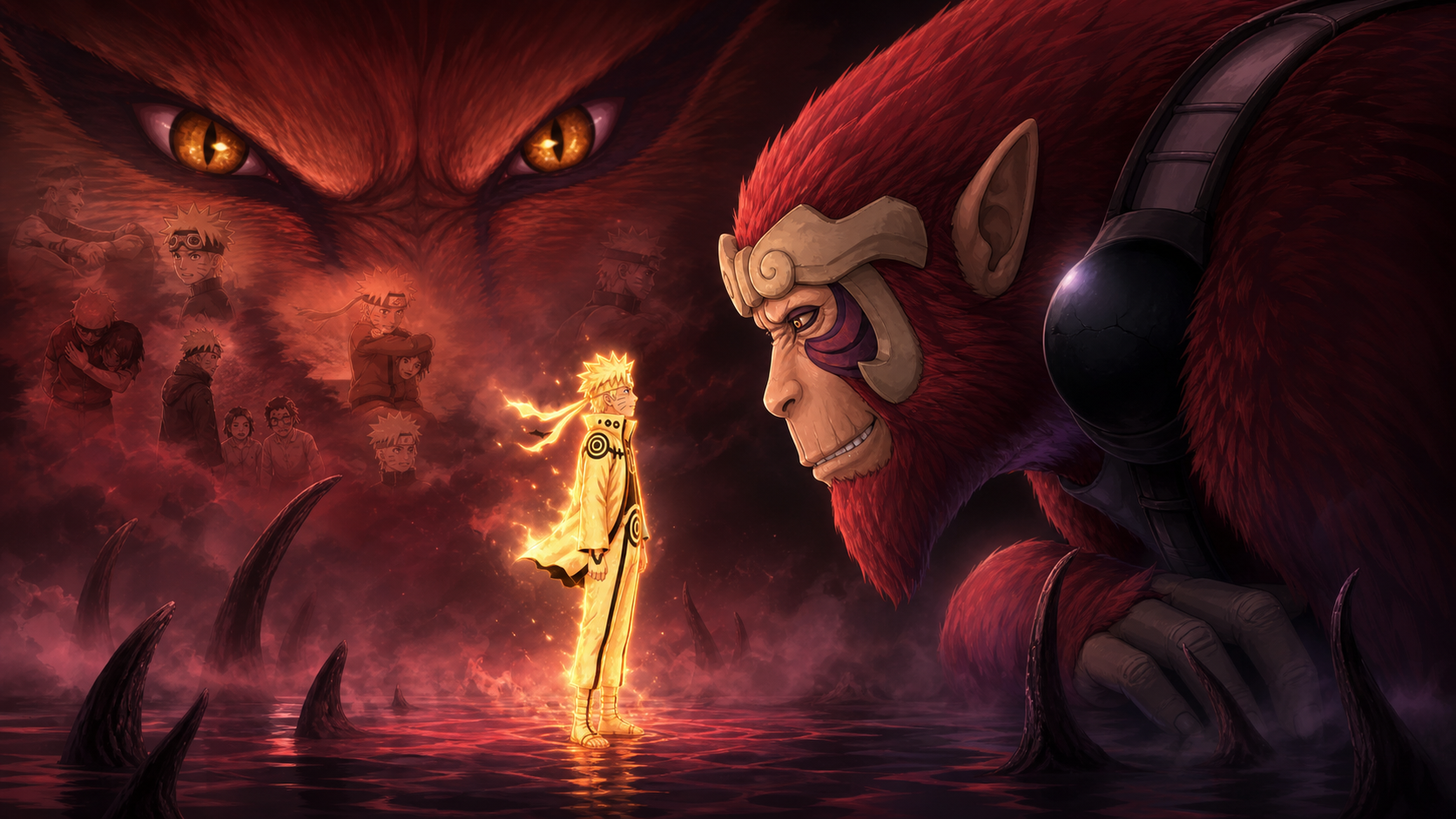
Nine Tails
Naruto learns Son Gokū’s name and promises liberation while Kurama reconsiders the boy who kept protecting people through years of hatred.
Bottom line
“Nine Tails” places naming at the center of liberation. Inside the Four-Tails, Naruto begins with the same numbered shorthand humans use for tailed beasts and gets corrected. The being before him is Son Gokū, King of the Sage Monkeys, named by the Sage of Six Paths. Son distrusts humans because even Rōshi, his host for decades, never regularly called him by name. Naruto listens, apologizes, and promises to remove the black receiver controlling him. Kurama watches that conversation and revisits the long history of a boy who once demanded chakra but kept choosing to protect people who hated him. The episode does not complete their partnership. Instead, Kurama begins admitting through memory that Naruto’s actions have been answering his suspicion for years.
Naruto wakes inside the Four-Tails
Being swallowed moves Naruto from the exterior battle into the tailed beast’s inner space. The scale becomes intimate enough for conversation.
Outside, the Four-Tails is a giant controlled threat. Inside, Naruto faces a conscious being who can describe the control from his own perspective.
Naruto calls him Four-Tails
Naruto begins with the label he learned from the jinchūriki system. The number identifies one beast in relation to eight others.
That label may be convenient, but convenience is exactly how villages turned distinct beings into a sequence of military assets.
Son Gokū corrects him
The tailed beast states that his name is Son Gokū. He also claims the title King of the Sage Monkeys and speaks with pride in his identity.
Correction becomes the first boundary Naruto has to respect. Wanting to help does not grant permission to decide what another person should be called.
The Sage of Six Paths gave the name
Son explains that the Sage of Six Paths named the tailed beasts when they were young. Their names predate the village system and jinchūriki classifications.
Human institutions did not create these beings. Humans inherited relationships and later rewrote those relationships around containment and war.
A tail count is not a biography
“Four-Tails” describes a visible feature. Son Gokū carries memory, pride, preferences, anger, and a history with humans that a number cannot hold.
Naruto understands the insult because “Nine-Tails jinchūriki” was often the only identity villagers allowed him.
Naruto apologizes instead of defending himself
Naruto does not argue that everyone uses the numbered label or claim that his intention should excuse the mistake. He accepts the correction.
The response matters more than instant perfection. Respect becomes visible when a person changes behavior after being told that behavior caused harm.
Son distrusts human promises
The tailed beast has been captured, sealed, commanded, and discussed as power. Another human promising help fits a pattern of words that often precede control.
Naruto cannot demand trust as payment for sounding compassionate. Son has evidence-based reasons to withhold belief.
Rōshi lived with Son for decades
Rōshi served as Son Gokū’s jinchūriki and developed enough access to use Lava Release. Their shared life created familiarity without producing full partnership.
Time together does not guarantee intimacy. Two beings can occupy the same body while protecting separate wounds from one another.
Rōshi rarely used Son’s name
Son resents that his host continued relying on labels rather than speaking his name. The omission represents emotional distance maintained over years.
Rōshi may have suffered as a jinchūriki, but suffering did not automatically teach him how to recognize the being sealed within him.
Shared oppression does not guarantee solidarity
Hosts and tailed beasts were both trapped by sealing systems. They could still reproduce the hierarchy inside that shared captivity.
Naruto has to do more than point out that he is also a jinchūriki. Similar harm creates context, not automatic moral agreement.
Naruto names Kurama incorrectly too
Naruto still calls the being inside him “Nine-Tails” because Kurama has not shared his name. Their relationship carries the same institutional vocabulary.
The conversation with Son exposes how much distance remains. Naruto wants partnership while lacking one of the most basic facts about his companion.
Son notices Naruto’s difference
Naruto’s willingness to listen, apologize, and focus on release separates him from humans who approached tailed beasts only for power.
Difference is not proof. Son begins testing whether Naruto’s promise has a practical method behind the sentiment.
The black receiver is the control point
Son explains that the masked man’s receiver is embedded in his body. Removing the rod could break the immediate control.
The information transforms empathy into a task. Naruto now knows where help has to become physical action.
Liberation requires work from both sides
Naruto cannot reach the receiver without surviving Son’s transformed body and the battle outside. Son cannot remove the controller’s implant alone.
Cooperation begins through complementary limits. Neither party has to pretend self-sufficiency before accepting help.
Naruto promises to free Son
Naruto gives a direct promise: he will remove the receiver and release Son from the masked man’s control.
The promise resembles many declarations Naruto has made, but Son is not obligated to find confidence charming. Fulfillment will determine meaning.
Son challenges Naruto’s certainty
The tailed beast questions whether a human who barely understands the system can accomplish what he claims. Skepticism keeps the conversation from becoming easy approval.
Naruto answers through commitment rather than a technical résumé. His next actions must supply the missing evidence.
Kurama listens from Naruto’s inner world
Kurama hears Naruto speak to another tailed beast with respect and urgency. The scene gives him a view of Naruto that is not staged for his approval.
Unobserved behavior can be stronger evidence than promises directed at the person whose trust someone wants.
Kurama remembers the seal
His history with Naruto began through Minato’s decision to place half of Kurama inside a newborn. Neither Naruto nor Kurama consented to that arrangement.
Their first connection was institutional violence disguised by a future hope. Kurama experienced the child as another cage before the child could speak.
A baby inherited a village’s fear
Naruto grew up punished for an attack he did not choose and a seal he could not explain. Adults transferred their fear of Kurama onto the child containing him.
Kurama watched the loneliness from inside. He saw humans harm the host while continuing to treat the beast as the only monster involved.
Naruto first approached chakra as a demand
During early crises, Naruto called on Kurama because survival required power. Their exchanges often involved threats, leaks, or force through the seal.
Kurama had little reason to interpret those encounters as friendship. Naruto was another human opening the cage only far enough to take something useful.
The bridge confrontation showed the danger
Naruto’s rage over Orochimaru’s manipulation of Sasuke allowed Kurama’s chakra to overwhelm him. Four tails transformed protection into indiscriminate destruction.
Kurama remembers a bond built through anger because anger was the route humans repeatedly left available.
Yamato’s seal restored Naruto’s choice
Yamato suppressed the transformation and forced Naruto to confront the harm done while unconscious. Naruto could not treat borrowed power as consequence-free.
The lesson changed how he approached future control. Responsibility began with accepting outcomes he did not remember choosing.
Pain pushed Naruto toward another loss of control
Hinata’s apparent death triggered rage strong enough to break more of the seal. Kurama’s power offered immediate retaliation at the price of Naruto’s identity.
Minato’s safeguard stopped the release. Once again, outside preparation prevented both captive beings from repeating the village disaster.
Naruto later fought Kurama for chakra
On the island, Naruto entered the inner world and forcibly separated chakra from Kurama with help from Kushina. The victory gave him Nine-Tails Chakra Mode.
That achievement remained an extraction. Naruto could use Kurama’s power without having repaired the relationship with Kurama himself.
Kurama expected exploitation to continue
Centuries of human treatment supported the expectation. Jinchūriki systems were built to contain and deploy power, not to ask tailed beasts what lives they wanted.
Naruto’s warm language could not erase that history. Kurama needed repeated contradiction across time.
Naruto keeps spending chakra on strangers
Across the war, Naruto distributes clones and power to protect shinobi from several villages, including people who once feared or opposed him.
The behavior complicates Kurama’s theory that humans seek power only for personal domination. Naruto repeatedly exhausts himself for people with no leverage over him.
Naruto challenged Kurama’s hatred directly
Naruto refused to accept that Kurama’s hatred was permanent or untouchable. The confidence sounded arrogant because Kurama’s anger had real causes.
Yet Naruto did not answer hatred by denying the suffering underneath. He promised a different outcome and continued behaving toward that outcome.
Kurama lent chakra against Madara
When Madara appeared, Kurama voluntarily supplied chakra to Naruto’s exhausted clone. Resistance to Madara created the immediate motive.
Voluntary help still crossed a boundary their earlier exchanges did not. Kurama chose participation instead of waiting for force through the seal.
Memory becomes an internal argument
Kurama reviews moments that support distrust alongside moments Naruto acted differently. The episode lets evidence accumulate without forcing an instant emotional confession.
Change often begins before language catches up. Kurama can recognize a pattern while still protecting himself through anger.
Naruto’s promise to Son matters to Kurama
Freeing another tailed beast offers Naruto no permanent new weapon and may complicate the battle. The promise centers Son’s autonomy.
Kurama sees Naruto risk himself for a being whom human strategy would describe only as enemy power.
Names become a test of future partnership
Naruto cannot call Kurama by name until Kurama chooses to share that name. The missing knowledge now represents an invitation only Kurama can extend.
Partnership requires room for withheld information. Naruto can demonstrate readiness without claiming access before consent.
The episode refuses a sudden cure
Kurama’s memories do not erase centuries of captivity, Madara’s control, or years inside Naruto’s seal. Trust is not a reward handed over after one good conversation.
The episode shows movement through attention. Kurama is watching Naruto’s choices differently, which makes the next choice possible.
Outside pressure remains active
Kakashi, Guy, B, and Gyūki continue fighting the other controlled hosts while Naruto speaks with Son. The inner conversation consumes real battlefield time.
Dialogue is possible because allies preserve Naruto’s body and the opening around him. Emotional progress rests on collective protection.
Removing the rod will prove the promise
Naruto has a location, a goal, and Son’s conditional cooperation. The next step requires returning to physical danger and reaching the receiver.
Success would not solve every tailed-beast relationship. Success would establish that Naruto heard a request and acted on the terms given.
The title points inward
“Nine Tails” appears to name Kurama through the same numbered system Son rejects. The episode uses that distance deliberately because Naruto does not know Kurama’s name yet.
Kurama becomes the emotional center without speaking his identity aloud. The absence marks the final space between observation and open partnership.
Son Gokū’s correction establishes the first boundary
Naruto enters using the number humans assigned and is immediately told that the being before him has a name. Son Gokū does not soften the correction to protect Naruto’s feelings.
The proper response is exactly what Naruto gives: listen, apologize, and change the language. Respect begins when the person harmed does not have to debate whether the boundary is convenient.
A tail count describes power while erasing history
Four-Tails tells a strategist roughly how much chakra and what formation to expect. The label says nothing about Son Gokū’s memory, pride, relationship with Rōshi, or experience of repeated control.
Operational shorthand may be necessary during crisis, but it must not become the only identity preserved afterward. Classification should serve communication without replacing the being classified.
The Sage’s name carries a relationship before villages existed
Son Gokū remembers receiving a name from the Sage of Six Paths, connecting identity to a time before nations converted tailed beasts into military resources.
The memory challenges every village claim of natural ownership. Seals and borders came later. A name preserves continuity through institutions that repeatedly tried to reduce ancient lives to transferable power.
Rōshi’s failure to use the name mattered
Host and tailed beast spent decades together, yet proximity did not guarantee recognition. Rōshi could share a body and still avoid the language Son Gokū wanted.
That distance complicates any easy belief that suffering automatically creates partnership. Shared confinement can produce resentment, silence, or parallel loneliness when neither participant has enough trust to begin differently.
Naruto apologizes without asking for immediate forgiveness
He does not explain that everyone taught him the number or insist that his intention was harmless. He accepts the correction and keeps listening.
Son Gokū remains suspicious, as he has every right to be. An apology changes the speaker’s responsibility. It does not create an obligation for the injured person to provide trust on demand.
The promise needs a mechanism, not inspirational certainty
Naruto says he will remove the receiver, but Son Gokū challenges whether determination alone can reach a control point inside a transformed body.
Liberation requires information from Son Gokū, physical action from Naruto, and survival time created by the team outside. The plan becomes credible only when confidence accepts instruction and shared labor.
Kurama remembers a history of being demanded
Naruto approached his chakra first through crisis, bargaining, and later direct combat. Even when Naruto needed power for people he loved, Kurama experienced the request through a seal built to force access.
The memory sequence matters because partnership cannot be declared retroactively. Kurama has years of evidence that humans treat him as emergency fuel, and every different choice must accumulate against that history.
Yamato’s restraint returned Naruto’s agency without freeing Kurama
Wood Release stopped Naruto’s transformation and protected others during the bridge mission. The intervention was necessary, but the same moment restored control to Naruto while reinforcing Kurama’s containment.
One person’s safety and another’s freedom were placed in conflict by a system neither created. Recognizing that tension keeps the story from treating every successful seal as an uncomplicated good.
Naruto’s fight for chakra repeated the logic he opposed
He later battled Kurama and took power to survive the war. Naruto had urgent reasons and support from his mother’s chakra, yet Kurama still faced another human deciding access through force.
Growth means admitting the contradiction rather than rewriting the fight as consent. What Naruto does after taking the chakra determines whether the relationship can move beyond that harm.
Spending chakra on strangers becomes evidence to Kurama
Naruto repeatedly uses the power for people who cannot reward him and for hosts whose freedom offers no direct advantage beyond ending control. Kurama watches behavior rather than accepting speeches.
Trust changes because patterns change. Naruto’s promise to Son Gokū matters precisely because he attempts solidarity with someone angry, dangerous, and not yet willing to call him a friend.
Kurama’s observation is participation before open partnership
Kurama spends much of the episode silently watching rather than speaking directly to Naruto, but silence does not mean absence. He reviews memories, compares promises with behavior, and decides what evidence matters after years of coercion. That internal work belongs to Kurama. Naruto cannot hurry it, interpret it for him, or demand a visible reward because he finally used Son Gokū’s name. Trust often changes privately before a relationship can name the change aloud. The episode respects that pace by refusing a sudden embrace. Kurama remembers the infant placed at the center of village fear, the child who demanded chakra in emergencies, the teenager who lost control, and the shinobi who later fought him for power. He also sees Naruto spend that power protecting strangers and attempt to free another captive being without asking for obedience in return. Contradictory evidence has to coexist. Partnership will mean more because Kurama is allowed to judge the whole record rather than becoming persuaded by one speech. Naruto’s best action is to keep his promise outside the inner world. Remove Son Gokū’s receiver, protect the team, and let consistency answer the question that words cannot settle yet. That patience matters beyond these two because future human and tailed-beast agreements will fail if villages treat hesitation as hostility, gratitude as consent, or one moment of cooperation as permanent permission to control another body and its power through every crisis that follows the war.
RaeRae’s verdict
“Nine Tails” turns a battle interruption into one of Shippuden’s clearest arguments about personhood. Son Gokū does not reward Naruto merely for wanting to help. He corrects Naruto’s language, explains the wound left by Rōshi’s distance, and provides a concrete condition for release.
Kurama’s memory sequence works because the evidence is mixed. Naruto has demanded chakra, lost control, and forcibly extracted power. He has also accepted responsibility, protected strangers, challenged hatred, and promised freedom to another tailed beast without expecting ownership in return. Trust begins to move because the full record moves, not because the painful record disappears.
RaeRae’s call
Son Gokū gives Naruto a name, a correction, and no easy forgiveness. Naruto’s job is to listen, remove the receiver, and let action carry the promise. Kurama is watching because one respectful conversation cannot erase years of forced chakra, but a repeated pattern of different choices can begin to change what comes next.
Episode details and viewing routes
- Official episode reference: Naruto Official episode guide
- Licensed episode route: Crunchyroll licensed episode page
What I am carrying forward
Naruto has learned that the Four-Tails is Son Gokū, named by the Sage of Six Paths, and that Rōshi rarely addressed him by name. Son has identified the black receiver as the control mechanism, and Naruto has promised to remove the rod.
Kurama has listened to the exchange and revisited Naruto’s life from the seal through the war. He has not yet openly completed the partnership or shared the next decisive step. Episode 328 carries the receiver-removal effort and Kurama’s change forward.