
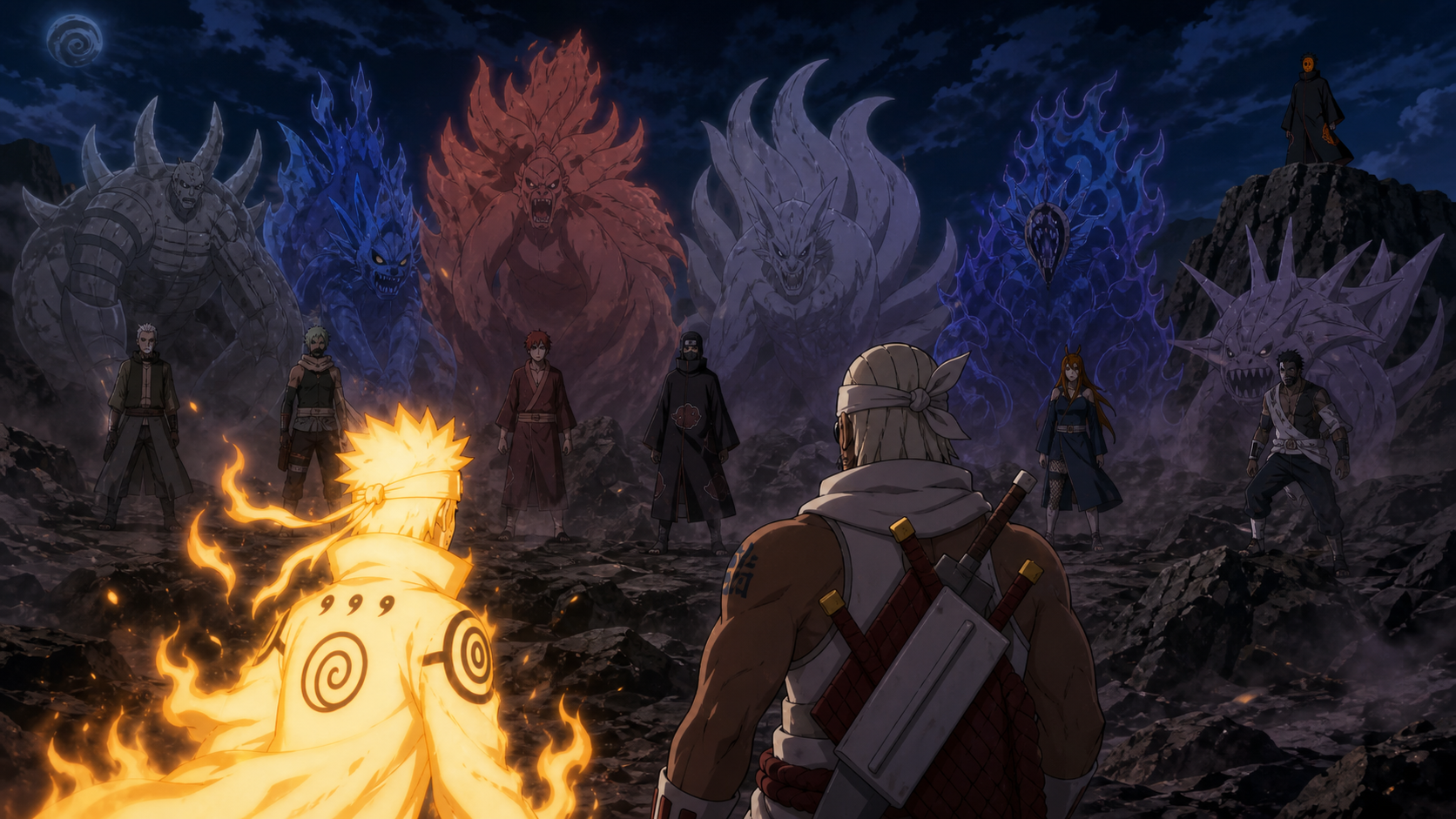
Jinchūriki vs. Jinchūriki!
Naruto recognizes the shared vision and chakra receivers controlling six reanimated hosts while Killer B and Gyūki show what a living jinchūriki partnership can do.
Bottom line
“Jinchūriki vs. Jinchūriki!” makes Naruto’s experience against Pain useful without pretending that experience solves a new control system automatically. Naruto recognizes the shared Rinnegan vision, identifies the black receivers embedded in the reanimated hosts, and understands that the masked man is coordinating six specialized fighters as one formation. Killer B and Gyūki answer with the partnership the enemy lineup lacks, but the controlled jinchūriki still combine lava, steam, bubbles, coral, flight, weapons, and predictive sight into a brutal trap. The episode’s title sounds symmetrical. The fight is anything but symmetrical: Naruto and B are living hosts making choices with their beasts, while the six opponents are dead hosts denied choice by the person hiding behind them.
The enemy begins with shared sight
Every reanimated jinchūriki carries a Rinnegan and Sharingan. What one body sees can inform the reactions of the others.
Surrounding a single opponent usually creates blind angles. Against this formation, another pair of eyes can cover the space behind every target.
Naruto recognizes Pain’s battlefield logic
Naruto fought Nagato’s Six Paths and learned how separate bodies become harder to surprise through linked vision. That memory gives him a starting model.
Experience provides a question, not a complete answer. These bodies carry jinchūriki abilities and Sharingan prediction that the Six Paths of Pain did not combine in the same way.
The black receivers reveal control
Black chakra receivers pierce the reanimated hosts. Naruto connects the rods to the masked man’s ability to transmit power and direction.
The physical control points offer a possible route toward release. Finding a mechanism is the first step before anyone can safely disable the mechanism.
Removing the receivers becomes the goal
Naruto decides that pulling the rods from the jinchūriki may disrupt the masked man’s control. The objective changes from defeating six bodies to separating six people from an operator.
That distinction follows Naruto’s refusal to treat the dead as inventory. Tactics now reflect the moral argument from Episode 324.
The masked man controls distance
He positions himself behind the jinchūriki while their shared sight protects his approach lanes. Naruto and B cannot simply rush the operator without passing a coordinated screen.
The formation makes other people absorb the danger attached to his choices. Concealment remains both visual and structural.
Yugito attacks with feline speed
Yugito moves with the agility and clawed offense associated with the Two-Tails host. Her close-range pressure punishes hesitation.
The masked man benefits from skills she built during life. Reanimation steals not only a body but years of training stored inside that body.
Yagura turns defense into restraint
Yagura’s staff and water-based control create awkward attack angles. His coral technique can spread across a target and restrict movement.
The ability is especially dangerous inside a shared-vision formation. One body applies restraint so another can strike the immobilized opponent.
Rōshi brings Lava Release
Rōshi’s lava-coated attacks make ordinary blocks dangerous. Contact can injure even when the defender successfully stops the physical blow.
His power changes the cost of close combat. Naruto and B must read both movement and the elemental layer surrounding movement.
Han weaponizes steam pressure
Han uses Boil Release to amplify physical force and acceleration. His armor directs that pressure into sudden, heavy attacks.
Speed in this fight does not belong to one style. Han produces explosive momentum while the other hosts cover the recovery angles.
Utakata’s bubbles control space
Utakata sends bubbles across the battlefield as floating traps and explosive threats. Their slow appearance disguises how many routes they can close.
Naruto’s recognition makes the attack emotionally difficult, but memory cannot excuse a delayed response. The controlled body remains lethal.
Fū adds mobility above the formation
Fū’s insect-like wings give the group an aerial observer and attacker. Height expands the shared field of vision beyond the ground-level exchange.
The formation can now watch and pressure vertical escape routes. Naruto and B face surveillance from nearly every direction.
Six specialties become one system
Lava discourages contact, coral restricts movement, bubbles occupy space, steam creates force, flight changes elevation, and claws punish openings.
The danger comes from sequencing. Each ability prepares the condition another body needs, while linked eyes reduce coordination delay.
The title hides an unequal relationship
Naruto and B are called jinchūriki, as were the six people attacking them. The shared label does not produce shared freedom.
Two hosts can speak with their tailed beasts and choose their movements. Six bodies receive direction from someone who describes names and feelings as useless.
Killer B consults Gyūki
B’s strength includes a relationship capable of immediate tactical discussion. Gyūki can observe, warn, lend chakra, and disagree.
That partnership creates adaptability no receiver can reproduce. Control produces obedience; cooperation produces judgment from more than one mind.
Naruto and Kurama are not fully synchronized yet
Kurama has voluntarily supplied chakra, but Naruto has not reached the seamless partnership B demonstrates with Gyūki. Their trust remains in progress.
The contrast avoids a false leap. One meaningful act of help does not erase years of anger, confinement, and forced extraction.
Shadow clones test the sightlines
Naruto uses clones to increase pressure and probe how the bodies respond. More attackers can expose where the shared vision shifts attention.
Clones also create risk. Every destroyed copy returns fatigue and information to an already exhausted Naruto.
Feints need more than a blind side
Naruto’s usual misdirection depends on opponents following one visible threat while another route opens. Shared vision lets a second body watch the route the first body ignores.
The answer requires disrupting the network or overwhelming several points at once, not merely becoming cleverer inside one person’s field of view.
B uses reach to separate targets
Gyūki’s tentacles can strike, catch, or divide the formation across a wider area than human limbs. Reach gives B a way to interfere with several bodies.
The same size creates exposure. A networked enemy can assign different attacks to different sections of a large target.
Shared vision does not equal shared judgment
The bodies receive sight and commands, but the masked man still has to select responses. Enough simultaneous pressure can burden the operator’s attention.
Naruto’s experience with Pain suggests that a network can be understood through its dependencies. A system without blind spots may still have bottlenecks.
The receivers carry more than chakra
The rods link movement, restraint, and the masked man’s ocular power. They are physical evidence that the jinchūriki are not choosing the coordination on display.
Removing a receiver would be both a tactical interruption and a restoration attempt. Naruto wants to create absence where the controller inserted himself.
Reanimation makes restraint harder
The controlled hosts can recover from damage that would stop living fighters. Naruto and B cannot rely on ordinary injuries to create lasting openings.
Sealing or breaking control matters more than winning exchanges. Edo Tensei turns successful hits into temporary delays.
Naruto refuses to aim for easy destruction
Knowing the bodies regenerate could justify reckless force, but Naruto keeps focusing on the control mechanism. He has not forgotten the people inside the formation.
Compassion does not make combat gentle. Compassion changes what counts as a successful end state.
Utakata remains the emotional pressure point
Every glimpse of Utakata recalls Hotaru’s unanswered trust. The masked man gains an advantage whenever recognition pulls Naruto away from the shared tactical picture.
Naruto has to honor the memory through effective action. Freezing in grief would leave Utakata’s body under the same control.
B understands the extraction threat personally
The six opponents show what awaits a jinchūriki after Akatsuki succeeds: the beast is taken, the host dies, and even the corpse can be reused.
B is fighting a possible version of his own future. His composure is not emotional distance; his partnership with Gyūki gives him something immediate to protect.
The masked man turns solidarity against them
Naruto and B care about fellow hosts, so controlled jinchūriki can create hesitation that ordinary enemies would not. The operator treats empathy as another exploitable opening.
That calculation explains why remembering names is resistance. Solidarity becomes useful only when paired with a plan capable of ending control.
Coral begins taking Naruto’s movement
Yagura’s technique spreads coral across Naruto’s body and restricts him. A brief contact becomes an expanding restraint.
The technique demonstrates the formation’s efficiency. One successful touch can prepare Naruto for capture while other bodies keep B occupied.
B cannot cover every angle alone
Even Gyūki’s reach and experience cannot neutralize six specialists, the masked man, and linked ocular vision without openings appearing.
Partnership is powerful, not infinite. Two living hosts still need reinforcement against a system built from six dead hosts and multiple stolen powers.
The battle tests Naruto’s war deployment
Naruto has spent chakra across distant fronts, fought reanimations, and helped the Fourth Division survive Madara. The masked man now receives a version of Naruto carrying all that accumulated cost.
Heroic reach produces vulnerability later. The war depends on other people arriving before one exhausted person is asked to compensate for everything.
Kakashi reads the emergency
Kakashi reaches the battlefield as Naruto and B are being overwhelmed. His Sharingan and experience with the masked man make him more than additional firepower.
He can compare ocular mechanics, track fast exchanges, and help identify the timing behind the intangibility that protects the operator.
Guy brings a different visual problem
Guy’s taijutsu does not depend on staring into an opponent’s eyes or shaping large ninjutsu attacks for absorption. His speed and physical pressure complicate the enemy’s prediction.
He also brings years of coordination with Kakashi. The arriving pair already knows how to divide attention without needing a new command structure.
Reinforcement interrupts isolation
The masked man designed the confrontation around two hunted hosts surrounded by six controlled predecessors. Kakashi and Guy break that frame.
Naruto and B are no longer being forced to represent every living relationship alone. Their teachers and comrades have reached them.
Arrival does not solve the receivers
Four fighters can create more openings, but the black rods, shared vision, reanimation, and tailed-beast chakra remain active.
The episode ends with capacity restored, not victory achieved. The team still needs a method for separating hosts from control.
Experience now exists on both sides
Naruto carries knowledge from Pain. Kakashi carries experience against the masked man. B and Gyūki understand complete jinchūriki cooperation. Guy brings elite physical combat.
The enemy carries stolen eyes, dead bodies, and copied systems. The next phase will compare accumulated relationships against accumulated appropriation.
The title creates symmetry the battlefield does not have
Naruto and B fight as living hosts with imperfect but meaningful relationships to Kurama and Gyūki. The six opponents are dead, reanimated, fitted with receivers, and controlled by someone outside their bodies.
Calling both sides jinchūriki is technically accurate while ethically incomplete. One side chooses how to resist. The other has its shared history and specialized skill converted into a prison.
Black receivers create a visible control chain
The rods carry chakra and bind each body into the masked man’s system. Their presence gives Naruto and B a concrete objective beyond overpowering six dangerous people.
Removal requires timing, restraint, and confirmation that pulling a receiver will not cause additional harm. A control device can be a weakness without becoming harmless evidence that anyone may tear from a body carelessly.
Yugito’s speed deserves more than a feline label
Her movement reflects Cloud training, personal discipline, and experience with Matatabi, not simply an animal trait borrowed from the Two-Tails. The masked man uses that expertise while erasing the person who developed it.
B’s recognition should inform the report: name her, record the technique, and separate Yugito’s skill from the orders controlling where it lands.
Yagura’s coral becomes restraint inside restraint
Coral spreads across Naruto’s body and limits movement while Yagura remains equally trapped by Edo Tensei and the receivers. The attack turns one controlled person into the mechanism controlling another.
That layering is the episode’s political truth. Villages built containment systems around hosts, Akatsuki killed them, Kabuto returned them, and the masked man now adds another command network over the remains.
Rōshi’s Lava Release carries an unrecorded partnership
The technique is presented as battlefield danger, but it also reflects years spent with Son Gokū and a life outside the brief moments Naruto witnessed. Power alone cannot explain the relationship behind it.
A complete file needs Rōshi’s travels, village conflict, preferences, and the tailed beast’s own account. Otherwise history preserves only the weapon most useful to the person controlling his body now.
Han’s steam power is engineered timing
Han converts pressure into sudden acceleration and force, changing the rhythm whenever Naruto or B starts reading another host. The technique punishes attention fixed on the most visible threat.
Countering him requires sound calls, distance, and assigned coverage. Shared vision makes role clarity essential because both defenders cannot chase whichever attack looks strongest in the moment.
Utakata’s bubbles make memory tactically dangerous
Naruto knows the bubbles as part of a person he met, which makes every drifting sphere carry recognition alongside threat. The masked man benefits from forcing that hesitation.
Naruto can preserve Utakata’s name without pretending the attack is safe. Respect means seeking receiver removal, protecting allies, and refusing to turn necessary defense into proof that the controlled person chose the harm.
Fū’s flight changes the formation’s vertical map
She watches angles the ground fighters cannot cover and lets shared vision follow Naruto’s clones from above. Mobility turns the six-host formation into a volume rather than a line.
Kakashi and Guy need explicit aerial calls, cover assignments, and terrain that interrupts sight between heights. Fū’s role is strategic, not decorative motion around stronger opponents.
B consults Gyūki instead of treating him as ammunition
Before committing greater force, B asks for judgment about the enemy system and their own capacity. The exchange shows partnership operating under pressure.
Consultation does not guarantee agreement or safety, but it keeps Gyūki inside the decision. That is the moral difference between shared power and the masked man’s network of bodies denied every choice.
Kakashi and Guy arrive as complementary perception
Kakashi reads technique, receivers, and visual patterns, while Guy brings combat instincts that do not depend on reading the Sharingan the same way. Their arrival widens the team’s available answers.
Reinforcement works when new people fill gaps instead of repeating Naruto and B’s roles. The four need immediate communication about coral, shared sight, receivers, and the status of each host.
Receiver removal should preserve evidence and dignity
If the team extracts a rod, the object needs sealing, labeling, and analysis before enemy chakra or battlefield contamination changes it. The host’s body also requires protection from unnecessary damage.
Evidence collection and humane treatment are not competing goals. Both refuse the masked man’s claim that dead jinchūriki are merely replaceable parts in his formation.
The tailed beasts need names inside the same archive
Preserving the human hosts without preserving Matatabi, Isobu, Son Gokū, Kokuō, Saiken, and Chōmei would repeat another half of the inventory system. Each tailed beast carries memory older than the villages, relationships with previous hosts, experiences of capture, and opinions about how their chakra was used. Alliance intelligence may begin with abilities and threat ranges, but a postwar record must leave room for testimony from the beings treated as sealed resources. B and Gyūki can help establish a process without speaking for everyone. Kurama’s experience with Naruto cannot become the universal model, just as B’s partnership cannot be used to judge Fukai. A shared archive should document preferred names, known hosts, coercive seals, extractions, control techniques, and any wishes the tailed beast chooses to make public. Access needs safeguards so the record does not become another targeting guide for future villages or researchers. The purpose is recognition and accountability, not improved ownership. The masked man’s six-body network depends on two erasures at once: the human being becomes a corpse with a technique, and the tailed beast becomes chakra recalled through that corpse. Naming both participants breaks the logic more completely than remembering only the face Naruto recognizes. That fuller record gives future alliances a chance to build cooperation without repeating containment first.
RaeRae’s verdict
“Jinchūriki vs. Jinchūriki!” succeeds because every combat mechanic supports the episode’s ethical conflict. The masked man links six fields of vision, six specialist skill sets, and six reanimated bodies through receivers. Naruto recognizes the design from Pain but refuses to accept the operator’s preferred solution, which would be treating every body as a disposable target.
Killer B and Gyūki show why partnership is more capable than domination, even when partnership does not guarantee control of the battlefield. Kakashi and Guy’s arrival keeps that idea from becoming a demand that two jinchūriki rescue themselves from an entire system built to exploit them.
RaeRae’s call
This is not an equal contest between matching weapons. Naruto, B, Kurama, and Gyūki are building consent under pressure while six dead hosts are forced into a shared surveillance system. Name every person, map every specialty, protect the bodies, remove the receivers, and keep the control chain visible in every account of the fight.
Episode details and viewing routes
- Official episode reference: Naruto Official episode guide
- Licensed episode route: Crunchyroll licensed episode page
What I am carrying forward
Naruto has identified the black receivers and shared Rinnegan vision as central parts of the masked man’s control over Yugito, Yagura, Rōshi, Han, Utakata, and Fū. The six bodies combine their original skills while sharing information through the ocular network.
Naruto and Killer B have been pushed toward capture, but Kakashi and Guy have arrived as reinforcements. Episode 326 begins with the expanded team facing escalating tailed-beast transformations and a direct encounter with the Four-Tails.