
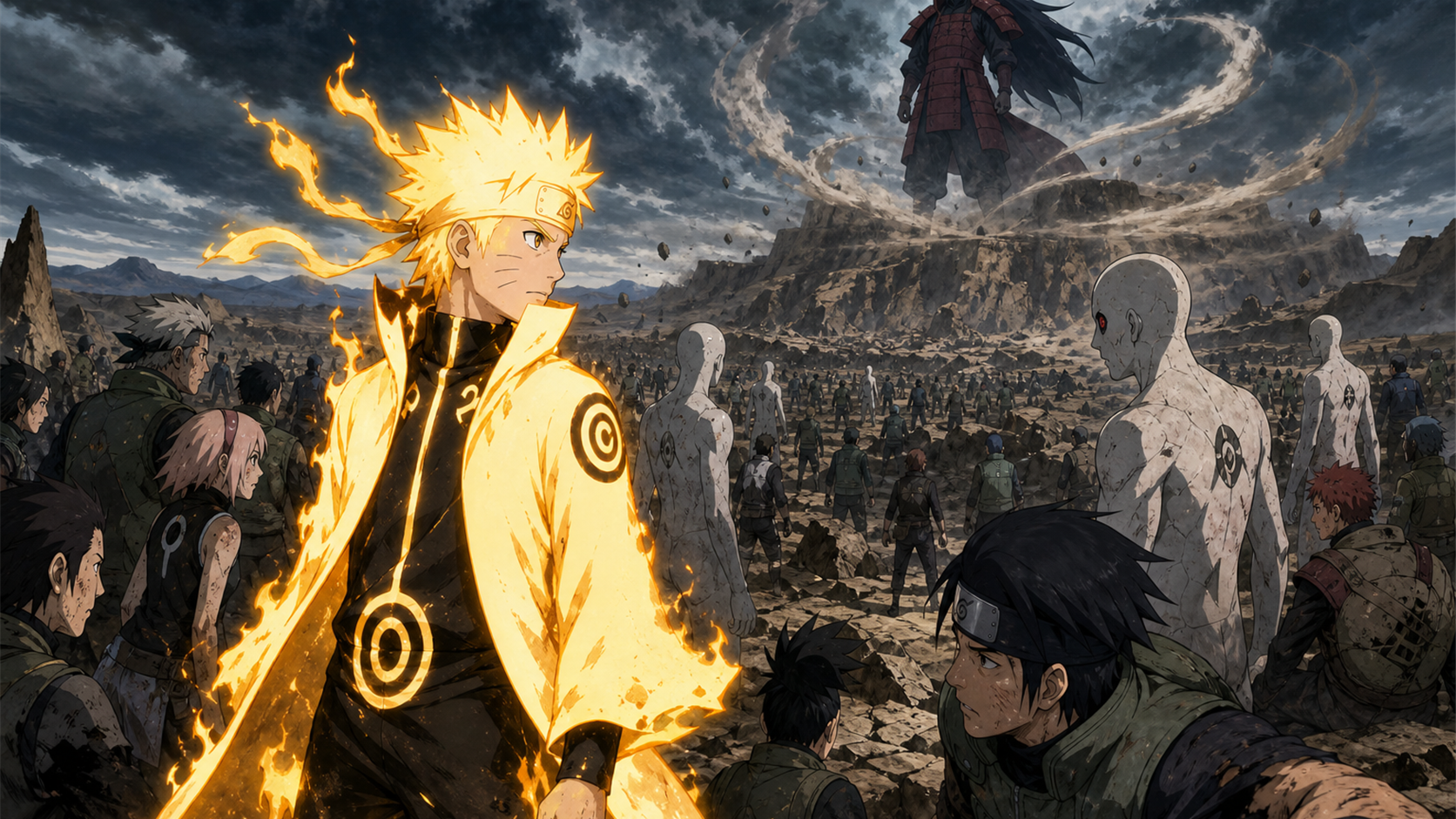
Reinforcements Arrive
Naruto restores trust by exposing White Zetsu infiltrators, then the real Madara arrives and turns relief into a warning.
Bottom line
“Reinforcements Arrive” pays off Naruto’s decision to divide himself across the war. His shadow clones reach multiple battlefields, expose White Zetsu infiltrators through their hostile emotional signatures, and restore enough trust for the Allied Forces to fight as units again. That victory lasts about five minutes before Kabuto uses Mū to summon his real trump card: the actual Madara Uchiha. Gaara sees Edo Tensei eyes, Temari remembers that the masked “Madara” is moving elsewhere with reanimated jinchūriki, and the Alliance finally understands that the name they organized the war around belongs to two different men. The episode changes the scale cleanly. Naruto solves the identity crisis inside the army while Kabuto introduces a historical monster who makes every previous reanimation look like preparation.
White Zetsu keeps the battlefields suspicious
White Zetsu can copy faces, voices, and chakra closely enough to pass among Allied soldiers. The remaining fighters know the enemy may look exactly like a friend.
Trust collapses because ordinary recognition no longer proves identity. Every request for help can become an opening for murder.
The Alliance cannot fight while interrogating everyone
Security checks slow movement and turn squads inward. Fighters spend attention proving themselves instead of watching the actual front.
That cost is part of White Zetsu’s design. Infiltration does not need to replace every soldier when doubt can paralyze the rest.
Naruto brings a new detection method
Nine-Tails Chakra Mode lets Naruto sense negative emotions and hostile intent. A transformed White Zetsu can mimic physical and chakra information without hiding the malice behind the disguise.
The distinction gives the Alliance a test based on what the infiltrator carries internally rather than how the copied body appears.
Shadow clones spread the answer
Naruto sends clones to several fronts instead of keeping his full strength in one place. Each clone brings the same sensory advantage to a different crisis.
The strategy trades durability for coverage. A clone can vanish after one strong hit, but a few seconds of correct identification can save an entire unit.
The Third Division receives help
White Zetsu reinforcements press the Third Division until a Naruto clone arrives. The clone identifies false allies and attacks the enemy inside the formation.
Naruto does not need to learn every soldier’s biography. He supplies the missing detection layer so local commanders can resume their own work.
The Daimyō Protection Squad keeps fighting
Elsewhere, the squad guarding the feudal lords continues against Black Zetsu. Their mission remains politically and strategically important even while larger battles dominate the episode.
A Naruto clone reaches Mei’s area and helps pressure the enemy. Reinforcement means connecting neglected fronts, not only appearing where the biggest explosion waits.
Reports begin changing at headquarters
Alliance command receives updates that Naruto’s clones are turning several fronts. Separate victories become a pattern visible through the communications network.
The network matters because no single fighter can see the war-wide effect. Headquarters can redirect confidence and resources once the pattern becomes reliable.
Tsunade gets her answer to A
Tsunade had argued that Naruto should enter the war while A tried to contain him for protection and strategy. The incoming reports prove his participation is solving a threat nobody else could efficiently detect.
Her smug gesture is earned without making A foolish. His concern about exposing the Nine-Tails host remained real; the battlefield need became greater.
A accepts results without celebration
The Raikage dismisses the exchange rather than offering a warm concession. His restraint fits a commander who still knows Naruto and B are the enemy’s primary targets.
Being wrong about one deployment decision does not remove responsibility for the larger capture risk.
Naruto restores operational trust
Once a clone identifies the infiltrators, soldiers can fight beside one another again. Trust returns through a dependable process rather than a speech asking everyone to believe harder.
The emotional effect is enormous. A unit that can share a back line, warning, and medical station is stronger than the same fighters isolated by suspicion.
Trust repair needs more than killing the copies
Some soldiers accused real comrades, withheld treatment, or watched a familiar face attack without knowing whether the person had changed sides. Naruto can identify the current infiltrators, but his sensing cannot erase those memories.
Command should record who was copied, confirm survivors, reconnect separated squads, and give medics a verified chain for patients and supplies. White Zetsu attacked relationships as well as bodies. Restoring a usable roster is part of restoring the army.
One teenager becomes a distributed security system
Naruto’s contribution is impressive and uncomfortable. The Alliance relies on his unique emotional sensing to authenticate thousands of adults across several nations.
Command should use the immediate advantage while studying how to build a repeatable method. A war cannot safely depend forever on one exhausted host.
Every clone spends the same finite chakra
Shadow clones divide Naruto’s power and return exhaustion when they disappear. Success across multiple fronts can hide the cost accumulating in the original body.
Kurama’s chakra makes the scale possible, but partnership does not create an unlimited resource. Headquarters needs to prioritize where the sensory advantage matters most.
The Sensor Division checks the masked man
With the Zetsu crisis easing, command asks for the status of the person believed to be Madara. Ao reports movement involving the masked man and a group of reanimated jinchūriki.
The report places him far from the Fourth Division. That location becomes crucial when another figure appears under the same name.
Ao’s report also protects command from collapsing two enemies into one outdated assumption. Sensors provide movement and chakra evidence; battlefield witnesses provide appearance; leaders have to compare both before naming the person directing each force.
Kabuto prepares the trump card
Kabuto decides to deploy the body he used to force the masked man into cooperation. The summon is not another useful specialist or emotional distraction.
Madara’s remains were leverage from the moment Kabuto revealed the coffin. Bringing him to the field turns private blackmail into public catastrophe.
Mū survived through division
The Second Tsuchikage had split his body before the Alliance sealed the visible half. Ōnoki realizes the technique left another portion active.
The oversight proves that sealing one body is not enough when an opponent can divide mass and chakra. Verification has to match the target’s actual mechanics.
Kabuto uses Mū as the summoner
Mū performs the battlefield summon under Kabuto’s control. The reanimated victim becomes the delivery system for another reanimated victim.
Kabuto stays protected while stacking stolen bodies between himself and every consequence.
The coffin opens violently
The summoned fighter blasts the coffin lid away with enough force that Mū has to avoid the impact. The entrance communicates impatience before the newcomer says much.
Most Edo Tensei bodies emerge as controlled assets. This one behaves like someone who expects the world to move around him.
A sensor detects two new presences
The Fourth Division receives warning that Mū is active and another fighter has appeared. The information gives Gaara and Ōnoki only moments to assess the change.
Sensors cannot supply the identity immediately. They provide the time needed for eyes and historical knowledge to do the rest.
Ōnoki recognizes Madara Uchiha
The Tsuchikage names the man standing beside Mū as Madara. His generation carries direct knowledge of the era and power attached to that face.
Recognition from Ōnoki has more weight than rumor. He understands that the legend was not only propaganda built around a missing-nin.
Gaara reads the Edo Tensei eyes
Gaara notices the characteristic reanimated appearance and concludes that Madara is dead. The man before them is not the masked commander arriving in person.
That observation changes the question from “why has Madara joined the field?” to “who has been wearing Madara’s name?”
Temari remembers the second location
Temari points out that the masked man is active elsewhere with his own force. Two simultaneous positions remove any simple disguise explanation.
Her battlefield awareness prevents the group from treating Ōnoki’s recognition as the whole answer. Both pieces have to remain true.
The war’s founding claim breaks apart
The masked man declared war while presenting himself as Madara Uchiha. Nations formed the Alliance in response to that identity and the threat behind the name.
The real Madara’s corpse now proves the declaration included a lie. The strategic threat remains, but the person directing that threat is unknown.
A false name still produced real power
The masked man controlled Akatsuki resources, the Demonic Statue, White Zetsu, and reanimated jinchūriki regardless of his legal identity. Exposing the lie does not make him harmless.
Names shape fear and legitimacy. Capability determines what the battlefield still has to survive.
Kabuto changes the balance with one body
Madara is not valuable merely because of reputation. Kabuto selected and prepared a body with extraordinary Uchiha power, historical knowledge, and his own agenda.
The summon may pressure the Alliance and the masked man at once. Kabuto gains leverage only while he can maintain meaningful control.
Edo Tensei control may be the next problem
Several powerful reanimated fighters have resisted orders through emotion or technique. Madara’s confidence suggests Kabuto has summoned someone unlikely to behave like obedient inventory.
The stronger the asset, the more catastrophic a control failure becomes. Kabuto’s pride keeps treating that risk as proof of mastery.
Gaara and Ōnoki face historical scale
The Fourth Division had already fought former Kage and survived. Madara stands above ordinary Kage history as one of the founders whose conflict shaped the village system itself.
Gaara brings current command while Ōnoki brings memory. Neither advantage promises enough power to stop the newcomer.
Naruto is absent from the new reveal
Naruto’s clones are solving crises across other fronts while Madara appears before the Fourth Division. Distributed reinforcement means Naruto cannot personally stand at every turning point.
The Alliance still needs commanders who act without waiting for the hero. Naruto creates time; he cannot replace the army.
The episode transitions back to manga momentum
After several anime-original character stories, Episode 321 returns to the central war and adapts the identity shift surrounding Madara. The change feels deliberate rather than dismissive.
The prior episodes established how Edo Tensei weaponizes personal history. Madara now expands that violation into world history.
The title has two meanings
Naruto’s clones are the reinforcements the Alliance requested and immediately understands. Madara is the reinforcement Kabuto delivers to the enemy side.
One arrival restores trust. The other destroys certainty about the war’s central identity.
Naruto’s detection restores movement before it restores trust
His ability to sense hostile intent lets divisions identify White Zetsu copies quickly and resume coordinated fighting. That operational relief matters because constant suspicion had turned every ally into a possible threat.
The emotional damage lasts longer. Soldiers falsely accused one another, watched familiar faces transform, and learned that appearance could not guarantee safety. Removing infiltrators is the first repair, not the final one.
Headquarters needs evidence beyond one chakra signature
Naruto’s detection is effective, but a war-wide security system should not depend on one teenager maintaining hundreds of clones. Injury, exhaustion, interference, or enemy adaptation could remove the entire method at once.
Sensor teams need to record confirmed patterns, compare transformations, build paired verification, and create fallbacks. Naruto can provide the breakthrough while adults turn that breakthrough into infrastructure that survives without consuming him.
Every shadow clone carries a labor cost
The clones look like instant reinforcement across distant fronts, yet each one spends Naruto’s chakra, attention, and accumulated experience. The spectacle can hide how much one body is being asked to distribute.
Command should track deployment, losses, rest, and recall priorities instead of treating clones as free personnel. A technique that multiplies presence does not multiply consent, recovery time, or the physical person who absorbs every return.
The Daimyō Protection Squad deserves visible credit
The squad keeps political leaders alive while infiltration destabilizes the wider Alliance. Their battlefield lacks the glamour of confronting Madara, but failure there could collapse funding, legitimacy, and coordination.
Protection work is successful when catastrophe does not happen, which makes it easy to erase. Reports should name the guards, sensors, communicators, medics, and civilians who maintained the position before Naruto’s clone arrived.
Tsunade’s judgment is vindicated without becoming flawless
She argued that Naruto needed to participate, and reports now show his clones saving divisions and exposing infiltrators. The decision produces real results.
Vindication does not erase the ethical question of placing enormous war responsibility on him. Tsunade should defend his agency while limiting extraction. Being right that Naruto could help is not the same as proving command may ask anything from him.
A accepts the result but still owes a policy response
The Raikage sees that Naruto changed the battlefield and does not waste time pretending otherwise. His acceptance allows headquarters to use new information immediately.
Leadership requires more than acknowledging success after resistance. A should help establish clone limits, fallback detection, medical monitoring, and authority for Naruto to withdraw. Otherwise the Alliance converts a disputed deployment into an unlimited obligation.
Mū’s divided body exposes incomplete confirmation
The Second Tsuchikage survives by splitting himself, leaving the Alliance with a sealed outcome that looked final while another body remained active. The gap gives Kabuto a hidden summoner.
High-level targets need sensory confirmation across chakra mass, known division techniques, and battlefield remains. A completed seal should trigger verification, perimeter control, and continued monitoring rather than immediate reassignment of every specialist.
Kabuto uses a coerced person to open the coffin
Mū becomes both captive fighter and delivery mechanism for Madara. The summoning makes Kabuto’s control chain visible: one violated body is forced to introduce another.
Alliance reports should distinguish what Mū does physically from what he chooses. That distinction matters for history, survivors, and any attempt to communicate during a lapse in control. Edo Tensei turns action into unreliable evidence of intent.
The Sensor Division catches the scale change first
Before every fighter understands the coffin, a sensor identifies two presences and signals that the battlefield has changed. That warning gives Gaara and Ōnoki seconds to interpret what sight alone cannot explain.
Sensors deserve direct channels, clear confidence language, and protection from commanders who demand certainty too early. Their work often begins where information is incomplete, which makes careful reporting more valuable than dramatic prediction.
Ōnoki’s recognition carries historical trauma
He does not encounter Madara as a legend from a textbook. The face connects to personal memory, village history, and a scale of violence younger fighters have never witnessed.
Command should use his knowledge without assuming age removes fear. Ōnoki can identify techniques and strategy while still needing support. Expertise formed through trauma remains expertise, but leaders must not treat the survivor as an emotionless archive.
Gaara separates evidence from the enemy’s old claim
The real Madara’s Edo Tensei eyes prove that the masked man elsewhere cannot be the resurrected body standing before them. Gaara immediately compares location, technique, and identity instead of clinging to the familiar name.
That response is intelligence discipline. A false identity can still command real armies and shape policy, but exposure changes what questions become possible. The Alliance now needs separate files for the resurrected Madara and the masked operator.
Trust repair needs names, records, and follow-through
White Zetsu infiltration harms far more than formations. Soldiers were forced to doubt teammates, accuse people they knew, and sometimes attack before proof could arrive. Naruto’s detection ends immediate uncertainty, but the Alliance still owes a record of false accusations, injuries, disappearances, and decisions made under compromised information. Private debriefs should let soldiers describe what they saw without punishment for reasonable fear. Command must distinguish misconduct from mistakes created by an enemy designed to corrupt trust. Units also need a way to correct rumors before suspicion follows innocent people home. Naruto cannot perform that repair through another wave of clones. Captains, medics, counselors, and records officers have to rebuild relationships after the front stabilizes. The same rule applies to the masked man’s stolen identity. Headquarters should issue a clear correction that the resurrected Madara and the masked commander are separate people, while admitting what remains unknown. Trust grows when leaders update the story publicly instead of protecting earlier certainty. Reinforcements arrive in bodies, information, and honest revision. The third form may be the one that keeps the Alliance together after Naruto leaves each battlefield. Every division deserves to know which safeguards failed, which witnesses were cleared, and what commanders will change before the next infiltrator tests the same wound.
RaeRae’s verdict
“Reinforcements Arrive” efficiently closes the White Zetsu authentication crisis while opening the war’s largest identity problem. Naruto’s sensory clones give the Alliance a practical reason to trust again, and headquarters finally sees the value of his deployment across several fronts.
Madara’s entrance works because the episode lets Gaara, Ōnoki, and Temari assemble the contradiction. The real man is dead and reanimated in front of them. The masked commander is alive elsewhere. Kabuto has not only summoned power; he has exposed the lie holding the enemy coalition together.
RaeRae’s call
Naruto restores battlefield movement, but adults must turn his breakthrough into a system that does not require one teenager to remain everywhere. Credit the support divisions, verify every seal, protect sensors, and split the intelligence record now that the real Madara has shattered the masked man’s borrowed identity.
Episode details and viewing routes
- Official episode reference: Naruto Official episode guide
- Licensed episode route: Crunchyroll licensed episode page
What I am carrying forward
Naruto’s clones have reached the major battlefields, identified disguised White Zetsu, and helped the Alliance regain momentum. The masked man continues moving with reanimated jinchūriki.
Mū’s surviving half has summoned the real reanimated Madara before Gaara, Ōnoki, Temari, and the Fourth Division. Episode 322 begins the answer to what Madara can do and leaves the masked man’s true identity unresolved.