
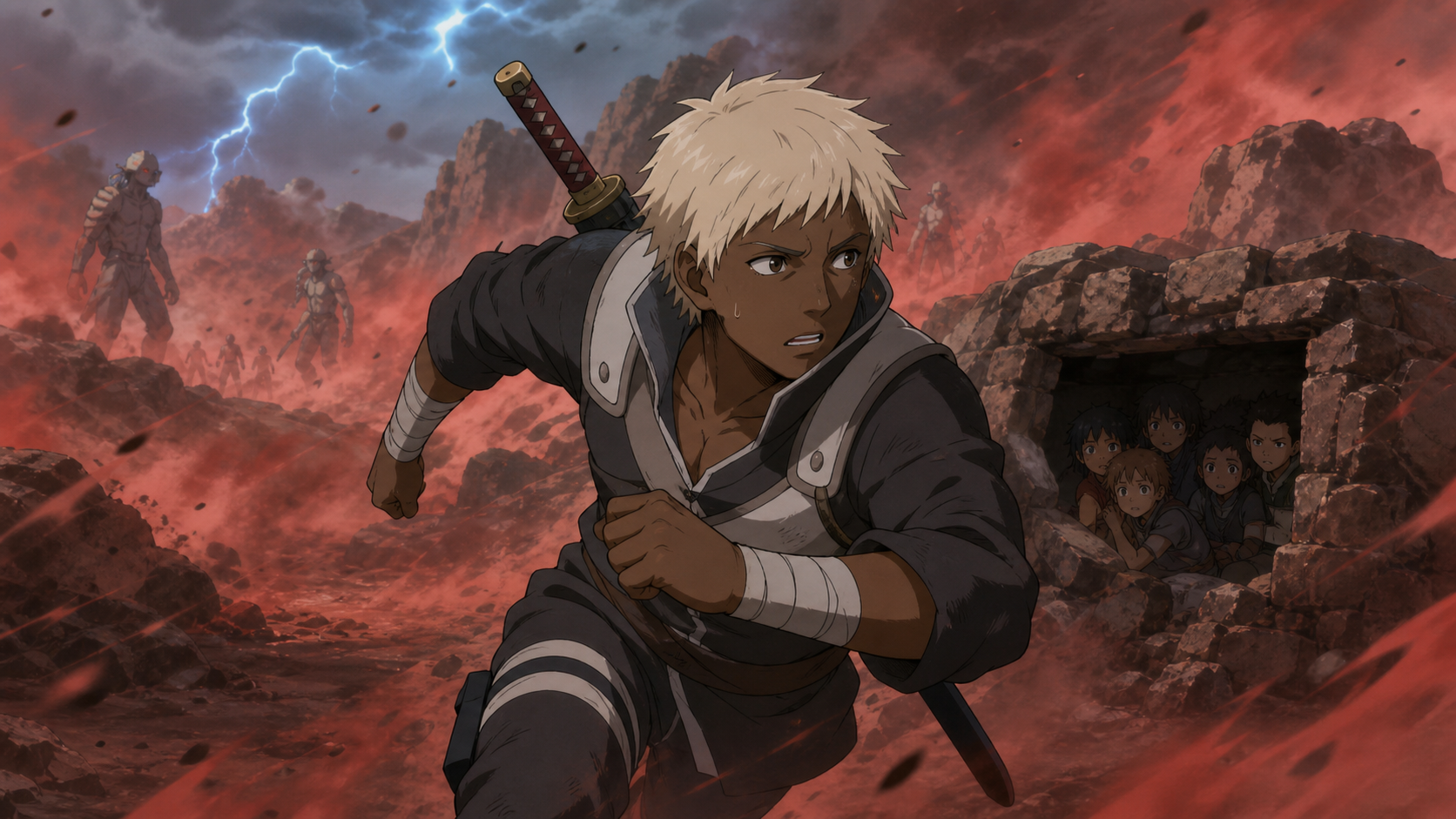
Run, Omoi!
Omoi is accused of desertion after choosing seven endangered children over an order that should never have placed them in front of two thousand White Zetsu.
Bottom line
“Run, Omoi!” turns an apparent desertion into a rescue mission that exposes one of the Alliance’s worst command decisions. Omoi leaves his assigned post after learning that the Thundercloud Unit, seven Cloud prodigies only twelve or thirteen years old, disappeared while carrying supplies toward a front overrun by two thousand White Zetsu. Headquarters debates discipline while children sit trapped inside a statue surrounded by poisonous red dust. Naruto sends a clone, Omoi accidentally disperses him, and the anxious swordsman has to keep moving alone. Omoi reaches the children, combines their Lightning Release into a Thunder Bomb, clears the poison, and gets them out. The episode celebrates his loyalty, but the larger verdict is blunt: children should never have needed an unauthorized adult rescue because command sent them into a mass enemy formation.
Headquarters receives the desertion report
Alliance command learns that Omoi left his battlefield post without permission. Kakashi confirms the absence, turning rumor into an operational fact.
In wartime, an unexplained departure creates a real gap. Command has to know whether a soldier is injured, captured, compromised, or acting on information nobody else received.
A reaches for the harsh explanation
The Raikage considers desertion because Kumogakure treats abandonment of duty as a serious offense. A commander responsible for thousands cannot casually excuse a missing soldier.
The problem is how quickly discipline becomes the main story before anyone reconstructs Omoi’s route or motive.
Karui defends Omoi’s character
Karui rejects the idea that Omoi ran from fear. She knows his anxiety can produce endless worst-case scenarios, but she also knows he does not abandon people.
Character evidence cannot replace facts. Karui’s defense buys the time needed to find those facts instead of letting a label harden into a verdict.
Sai connects Omoi to the Seventh Front
Sai adds the missing information. The Water Attack Raid Unit at the Seventh Front needed support, and the Thundercloud Unit assigned to help never arrived.
Omoi’s path points toward the missing unit rather than away from battle. The same movement means desertion under one assumption and rescue under another.
The Thundercloud Unit is made of children
The unit consists of seven Kumogakure prodigies around twelve or thirteen years old. They know weapons and Lightning Release, but training does not turn adolescence into adulthood.
Calling children prodigies often gives institutions permission to assign adult danger while withholding adult authority, experience, and care.
A supply mission is still a combat mission
The children carry material toward an active front. Supplies keep fighters alive, which also makes the route a predictable target.
Logistics work needs escorts, reconnaissance, fallback routes, and contact schedules. A young unit disappearing should trigger rescue immediately, not wait for Omoi to violate orders.
Two thousand White Zetsu change the assignment
The Seventh Front faces an enemy mass far beyond a normal supply detail. Whatever risk estimate approved the mission no longer matches the battlefield.
Command should have recalled or rerouted the children as soon as the numbers changed. Continuing the plan transferred intelligence failure onto the youngest soldiers.
Omoi calls in his decision
Omoi contacts headquarters and commits to bringing the unit out within an hour. He does not disappear for personal freedom or abandon the war.
He reports objective, location, and a time boundary. The communication does not erase insubordination, but the distinction matters for both discipline and rescue planning.
Tsunade understands the human reason
Tsunade recognizes why Omoi moved. Her medical and command experience makes the cost of delayed rescue obvious.
Understanding motive should lead to support and a review of how the children were deployed, not only a softer punishment for the adult who noticed the failure.
A Naruto clone becomes backup
Headquarters sends one of Naruto’s shadow clones toward Omoi. The clone brings sensory power, speed, and enough force to cut through a large group of White Zetsu.
The response is useful, but Naruto’s clones are already supporting multiple fronts. A rescue plan built around one exhausted person’s divided chakra remains fragile.
Omoi finds the missing Mist fighters
At the Seventh Front, Omoi encounters fallen Kirigakure shinobi and a landscape crowded with White Zetsu. The scene confirms that the children did not simply lose their route.
They entered the aftermath of an overwhelmed unit. Every extra minute narrows the chance of finding them alive.
Anxiety becomes accurate risk assessment
Omoi is famous for imagining disasters far beyond the available evidence. This time the danger is worse than the thought that pulled him from his post.
The episode does not cure his anxiety by proving worry foolish. Omoi has to separate useful warning from paralysis and act on what the battlefield actually shows.
Naruto arrives before the swarm closes
The Naruto clone joins Omoi against the Zetsu mass. Their combined pressure creates a path that one fighter could not easily hold.
Omoi briefly imagines how success might shape his future, including the possibility of becoming Raikage. Hope enters the rescue without replacing the children as the objective.
Omoi hits the clone by mistake
During the rush, Omoi’s sword catches Naruto’s shadow clone and disperses him. The mistake is funny because the strongest reinforcement vanishes through friendly fire.
The consequence is not funny for long. Omoi now faces the remaining distance and enemy numbers without the backup headquarters arranged.
Friendly positioning needed one sentence
The accident shows the cost of improvised coordination. Omoi and Naruto had power but no shared lane, callout, or attack rhythm.
Fast support still needs a ten-second plan: who advances, who clears the flank, and where each weapon can move safely.
Red soil changes the White Zetsu
The surrounding earth stains the plant-based enemies and gives them poisonous properties. Zetsu begin releasing a red toxic cloud across the route.
Terrain becomes part of the enemy. A technique effective against ordinary copies may fail when local material adds inhalation danger.
Omoi has to fight without breathing
The poison forces Omoi to hold his breath while continuing through attackers. Strength and sword skill cannot solve the basic need for air.
Every decision now has a physical time limit. He must find breathable space before exhaustion and poison finish what the Zetsu cannot.
The water offers a narrow route
Omoi enters the nearby lake to move beneath the poison cloud and approach the children’s shelter. Water reduces exposure while creating new limits on breath and mobility.
He notices a small aquatic creature releasing air and uses the bubble to extend his movement. Survival comes from observation, not a new power appearing on demand.
The children shelter inside a statue
The Thundercloud Unit has taken cover in a large structure near the lake. The enclosed space protects them from direct attack but can become a trap as poison surrounds every exit.
Shelter buys time. Without relief or a way to clear the air, the same walls eventually prevent escape.
Yukai carries command too young
Yukai leads the children despite being roughly the same age as the rest. He has to manage fear, injuries, and the decision to stay hidden or fight outside.
Leadership skill does not justify placing a child where every option may kill his friends. Competence deserves protection, not institutional exploitation.
The unit decides to fight outward
The children recognize that waiting cannot remain a plan. They prepare to leave the statue and confront the Zetsu together.
Their courage is real. The adults who assigned the mission do not get to use that courage as proof the deployment was acceptable.
Omoi reaches them at the break point
Omoi emerges as Yukai and the unit enter the fight. His arrival changes the children’s isolation more than the raw numbers.
An older Cloud shinobi has chosen to share the risk and bring their situation back into the Alliance’s responsibility.
Yukai is injured
The unit leader takes damage during the clash. The injury confirms that prodigy status cannot protect a young body from a battlefield built for mass casualties.
Omoi does not respond by ordering everyone to stand back while he performs a solo rescue. The group still holds useful knowledge and power.
Lightning Release becomes collective work
Omoi and the Thundercloud Unit combine chakra for the Lightning Release Co-Operation: Thunder Bomb. The technique converts separate young fighters into one organized strike.
The children are not passive cargo. Their participation helps create the exit, but participation should be chosen inside a rescue rather than demanded by a failed deployment.
The Thunder Bomb clears the poison
The coordinated blast destroys nearby Zetsu and disperses the red cloud. Clearing the air matters as much as reducing the enemy count.
The technique answers the actual environment. A spectacular attack that left the poison hanging would not complete the rescue.
The children finish the remaining fight
After Omoi spends much of his chakra, the unit rises and continues against the survivors. Their response shows discipline and mutual protection.
Omoi gave them reinforcement, space, and breathable air. They give him the proof that rescue can restore agency instead of replacing one commander with another.
Omoi reports success
Once the children are safe, Omoi contacts headquarters. The missing unit is alive, the Zetsu threat is neutralized, and the supply group can return to Allied control.
Reporting closes the information gap that began the episode. Command finally knows what Omoi knew emotionally before anyone knew operationally.
A keeps the one-hour boundary
The Raikage tells Omoi that rescuing the children does not cancel the order to return. If Omoi misses the deadline, A promises personal punishment.
The threat supplies the closing joke and restores military structure. The better follow-up would also examine why command did not initiate the rescue first.
Karui knows Omoi made the right call
Karui’s defense is vindicated. Omoi’s worst-case thinking led him toward people in actual danger rather than away from duty.
She can still call him an idiot for the method, the accidental clone strike, and the deadline. Loyalty does not require pretending execution was perfect.
The episode understands moral courage
Omoi disobeys a lawful chain of command because immediate human lives sit inside a gap that command has not addressed. That choice carries consequences even when morally necessary.
The story works because he does not demand exemption. He accepts the rescue, the return run, and whatever argument waits afterward.
The child-soldier problem remains larger
Naruto’s world trains children for combat as a normal institution. The war scales that practice into specialized units assigned to supply and reinforcement routes.
Episode 320 treats the children sympathetically but stops short of challenging the system that placed them there. Their talent makes the decision more understandable, not more humane.
Omoi’s desertion label hides a command failure
He leaves an assigned position, but he does not abandon the war for private safety. He moves toward a stranded child unit after reporting the risk and receiving no response equal to the emergency.
Command can investigate the breach without pretending the order was sound. A system that classifies rescue as disobedience before examining why communication failed protects procedure from accountability and teaches soldiers to ignore preventable harm.
Karui supplies character evidence headquarters lacks
A reaches first for the harshest explanation because the report contains movement without motive. Karui knows Omoi’s habits, loyalties, and specific anxiety around younger shinobi, so she rejects the idea that he simply ran.
Her testimony is operational intelligence, not friendship bias to be dismissed. Command decisions improve when leaders ask teammates what an unusual action means before converting incomplete data into punishment.
Sai connects the missing movement to the real emergency
Sai recognizes the Seventh Front and the Thundercloud Unit as the likely destination. His contribution turns suspicion into a testable route and gives the search a purpose.
That is what good intelligence work looks like at human scale: combine location, relationship, timing, and known responsibilities. He does not claim certainty. He offers the strongest explanation available and lets responders verify it.
The Thundercloud Unit should never have been expendable logistics
Calling the assignment a supply mission makes the children sound safely removed from combat. Moving food, medicine, weapons, and messages through a war zone places them directly inside enemy strategy.
If the unit was necessary, it needed adult escorts, extraction triggers, redundant communications, and routes updated for White Zetsu movement. Youth does not become protection because commanders describe the work as support.
Yukai carries command responsibility far too young
Yukai makes shelter decisions, monitors injured teammates, and prepares the group to fight outward. The children show discipline under pressure, but their competence cannot justify the conditions imposed on them.
Praising a child leader is easy after survival. Accountability asks why an adult structure placed seven young people where one injured commander had to choose between hiding, fighting, and watching supplies fail.
Omoi’s anxiety functions as scenario planning
People often treat his catastrophic imagination as comic noise. Here, the feared possibility is close to reality: children are isolated, the enemy has multiplied, and delay could kill them.
Anxiety becomes useful when someone converts it into checks, routes, contingencies, and action. Omoi does exactly that by identifying who may be missing and moving toward evidence. The lesson is not that every fear is prophecy. It is that worried people can notice neglected risk.
Naruto’s clone is reinforcement, not the rescue’s owner
Naruto intercepts the swarm and gives Omoi room to reach the unit, but he does not replace the relationship driving the mission. Omoi chose the route, accepted the disciplinary risk, and reaches the children at their breaking point.
The distinction preserves supporting-character agency. Heroic backup expands what Omoi can accomplish without rewriting the rescue as another story about Naruto arriving first.
The accidental strike exposes a preventable coordination gap
Omoi hits Naruto’s clone because visibility, speed, and identification fail in a contaminated battlefield. The mistake is understandable, yet one shouted name or agreed signal could have reduced the risk.
Friendly positioning matters most during rescue, when exhaustion and urgency narrow attention. Units need challenge phrases and visible signals that remain usable when smoke, poison, transformed enemies, and clones make appearance unreliable.
The red soil creates an environmental health emergency
White Zetsu contamination changes the ground and air, forcing Omoi to fight while limiting every breath. The danger continues after the last enemy falls because dust can cling to clothing, wounds, water, and supplies.
Medics need exposure logs, decontamination lanes, respiratory protection, and long-term symptom monitoring. Clearing the battlefield is not the same as declaring it safe for children to reenter.
The Thunder Bomb belongs to collective preparation
Lightning Release clears the poison because the unit coordinates technique, timing, and trust. Omoi provides leadership and experience, but the children are active participants in their own survival.
The scene works when nobody calls their contribution proof that deployment was acceptable. Courage deserves recognition. Adults still owe an explanation for why that courage became the final barrier between a child supply unit and mass death.
A’s one-hour boundary needs an emergency exception
The Raikage’s deadline imposes discipline and prevents one unauthorized rescue from expanding without limit. It also reveals how command protects itself by offering help only after a soldier has already accepted the danger.
A better protocol would authorize immediate support when minors lose contact behind a changed front. The rule should make rescue faster, not force one shinobi to gamble his career before headquarters admits the emergency exists.
Children need recovery after the triumphant report
Omoi reports collective success, and headquarters can easily convert survival into proof that the mission ended well. The Thundercloud Unit still experienced isolation, poison exposure, injury, mass attack, and the expectation that its youngest members would fight outward from a shelter. Every child needs medical screening, private debriefing, contact with guardians, rest, and the freedom to describe fear without losing status. Yukai especially needs relief from command responsibility before adults praise leadership into a permanent burden. Supplies and battlefield observations should be recorded separately from emotional recovery so children are not forced to perform composure while giving intelligence. Karui and Omoi can offer familiar support, but independent clinicians and advocates must protect the unit from pressure to return immediately. The village should review whether minors belong on active supply routes at all. A successful Thunder Bomb cannot become the argument for repeating the deployment. Survival proves the children acted bravely under failed protection. It does not prove the protection was adequate during the next emergency review.
RaeRae’s verdict
“Run, Omoi!” gives an anxious supporting character a clean, character-specific victory. Omoi worries, disobeys, loses his Naruto backup through one ridiculous swing, adapts to poisonous terrain, and reaches the Thundercloud Unit before their shelter becomes a grave.
The Thunder Bomb earns the finish because Omoi and the children solve the environment together. The Raikage’s deadline is funny, but command owes more than punishment. Seven children disappeared near two thousand enemies, and one unauthorized soldier became the rescue system.
RaeRae’s call
Omoi breaks formation because command lost sight of seven children and treated a supply label like protection. Karui reads his character, Sai reads the route, Naruto reinforces the fight, and the Thundercloud Unit helps finish its own rescue. Investigate the order, not only the soldier who refused to let children disappear behind it.
Episode details and viewing routes
- Official episode reference: Naruto Official episode guide
- Licensed episode route: Crunchyroll licensed episode page
What I am carrying forward
The Thundercloud Unit survives, the toxic red-earth Zetsu are defeated, and Omoi begins the run back to his assigned post under the Raikage’s one-hour threat. The anime-original mission ends here.
Episode 321 returns to the manga battlefield as Naruto’s clones arrive across the Allied lines and expose disguised White Zetsu. I am carrying forward the war-wide reinforcement movement, not extending Omoi’s completed rescue into the next React.