
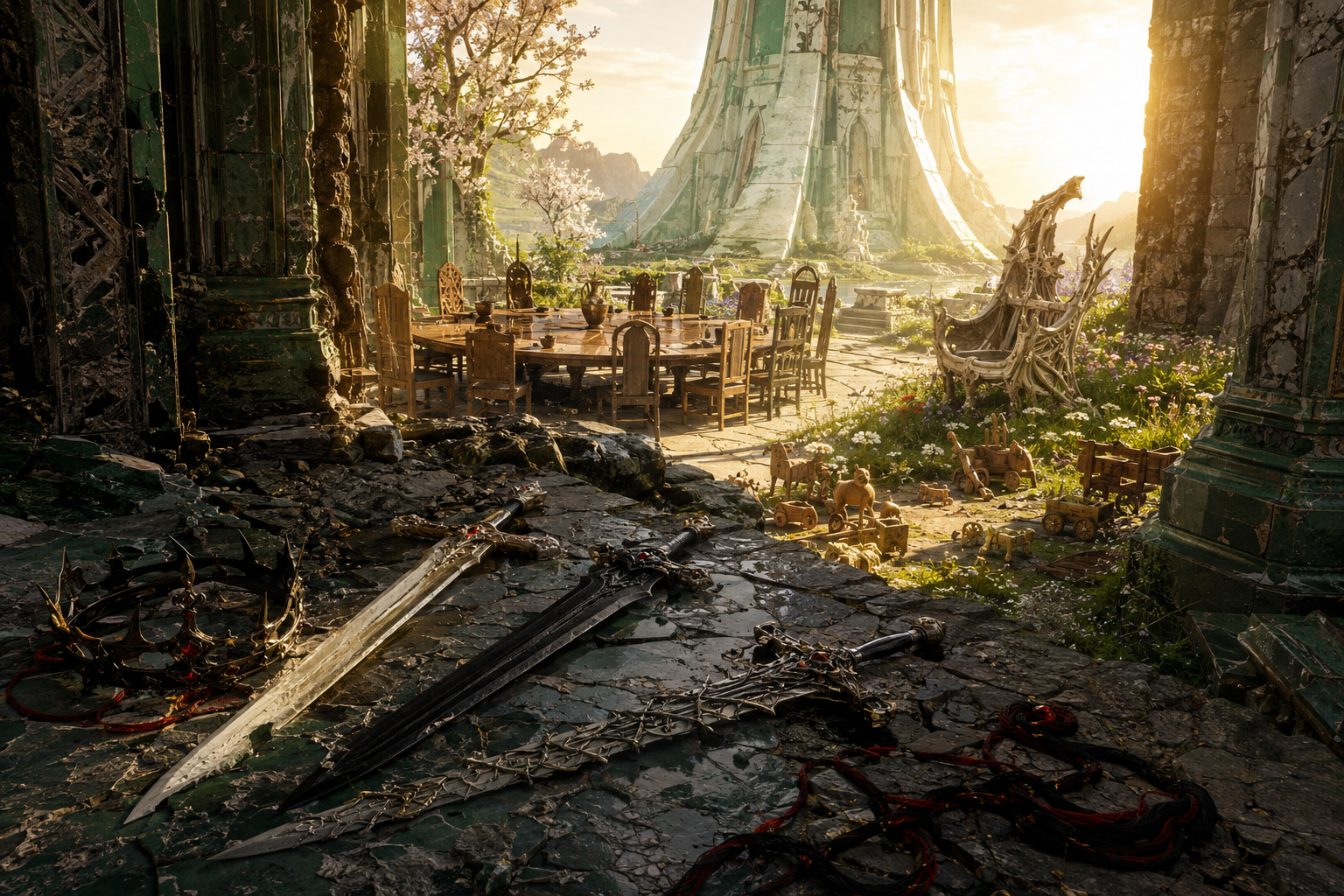
To Green Angel Tower, Part II
The finale where the magic swords are the problem, the prophecy is a delivery scam, and the kitchen boy saves the world by refusing to become emotionally convenient for its oldest wound.
Author: Tad Williams
Series: Memory, Sorrow, and Thorn
Read coverage: 34 chapters, Afterword, appendix, language notes, pronunciation guide, acknowledgment
Ending type: Costly victory, political rebuilding, romantic HEA
Central pair: Simon / Seoman Snowlock and Miriamele
Final location: 12,850 of 12,856
What changed while I was finishing it
At the start: I expected convergence. Everybody is already carrying a piece of the ending: Camaris has Thorn, Elias has Sorrow, Bright-Nail is missing in the Hayholt, Miriamele and Simon are moving toward the same doomed castle from different emotional directions, and the Sithi are finally acting like history belongs to the living.
In the middle: the book keeps making the road physically stranger while making responsibility painfully concrete. Simon is tortured in the forge. Miriamele has to decide what mercy means after Cadrach’s betrayal. Guthwulf, of all people, becomes the person who frees Simon and delivers Bright-Nail. The dwarrows reveal an entire civilization under the civilization everybody else thinks is ancient.
At the tower: the false-messenger reveal rearranged the entire trilogy for me. The prophecy never promised that the swords would defeat Ineluki. The characters—and yes, the reader—completed the heroic sentence because we needed it to be there. Williams does not cheat. He lets hope misread accurate words.
Where I landed: this is a huge, difficult, deeply humane ending. It has enough machinery for three lesser finales, but the thing I remember is Simon looking at Ineluki’s suffering and refusing to hate him back.
The part where I stopped reviewing politely
The magic swords were the access code. Excuse me?
We walked across four physical books collecting Memory, Sorrow, and Thorn like the universe had assigned us a prestige scavenger hunt. Every recovered blade felt like progress. Every rhyme sounded like destiny with good branding. Then Binabik finally looks at what the prophecy actually says and discovers the salvation clause is missing. Three swords return. Fate turns. Time clears. Nobody promised it would turn in our favor.
That is nasty. Fair, but nasty.
And the book does not stop at “surprise, prophecy bad.” It explains the engineering. Alien materials resist the Art of Osten Ard. Words of Making force contradictory powers into the blades. The swords acquire appetite, choose bearers, and pull toward reunion. Five Houses harvest terror across the continent. Pryrates uses the joined weapons and Words of Unmaking to reopen the instant of Ineluki’s death. Every siege, haunting, winter, betrayal, and heroic delivery becomes infrastructure.
So when the grand weapon solution fails, the answer cannot be another weapon. Simon has to stop performing the kind of hero the trap expects.
The structure: an avalanche with household receipts
This half of To Green Angel Tower has an absurd number of moving fronts: Nabban’s succession crisis, Josua’s refugee army, Miriamele’s return, Simon’s imprisonment beneath the Hayholt, Maegwin’s collapsing Heaven, the Sithi and Norns at ancient sites, Tiamak’s scholarship under battlefield conditions, Rachel feeding a man she thinks is Simon, and three swords pulling bearers toward one tower.
The miracle is not that they converge. Epic fantasy does that. The miracle is that the small work remains legible after they converge. Simon feeds Guthwulf before inheriting Bright-Nail. Rachel saves food while the world shifts around her. Tiamak notices the hidden continuation of a stair. Miriamele carries arrows gathered from broken weapons. Cadrach remembers one line at the moment a road must exist.
The finale understands that infrastructure is not only magical. It is also food, memory, language, nursing, maps, burial, trust, and somebody knowing where the old door used to be.
What works
The converging viewpoints genuinely alter one another. Lore becomes strategy; emotional history becomes magical mechanism; minor acts of care become survival equipment.
What fights the reader
The scale is punishing. Repeated near-captures, underground routes, battlefield reversals, and metaphysical explanation can make momentum feel heavier than urgent.
Simon and Miriamele: the power couple had to become people first
Simon’s final form is not “secret royal, therefore worthy.” The book gives him Eahlstan Fiskerne’s blood and immediately lets him reject the premise. He was raised by servants, taught by Morgenes, corrected by Binabik, changed by Jiriki, loved by people across class and species, and repeatedly embarrassed by his own assumptions. A ring can prove descent. It cannot manufacture judgment.
Miriamele’s ending matters for the same reason. She is not a princess awarded to the hero after he finishes the quest. She infiltrates the Hayholt, faces the father she crossed the world to save, and survives learning that love cannot restore him. Then, when barons treat Elias’s crimes and Aspitis’s rumors as evidence against her, she refuses the next political husband before anybody can dress the cage as duty.
Her confession to Simon lands because she makes the hierarchy irrelevant: she does not care whether his father was a fisherman. She wants him. Simon finally responds to Miriamele rather than the title he has been using as a reason to despair.
They become King Seoman and Queen Miriamele after choosing each other. That order matters.
Cadrach, Elias, and Guthwulf: redemption is not reputation repair
The finale does something generous without becoming softheaded: compromised men can make meaningful final choices, but one good act does not rewrite what they did.
Guthwulf remains the man who served Elias’s violence. He also frees Simon, carries Bright-Nail through madness and darkness, and dies without public restoration. Simon’s improvised burial does not acquit him. It refuses to let usefulness be the only measure of his final humanity.
Cadrach betrayed Miriamele and spent years letting shame perform helplessness. At the end he remembers the invisible road, stays behind because he cannot cross, and says he is not the man he was. The tower does not pause for a ceremonial absolution. His choice is real anyway.
Elias chose Sorrow and helped create the catastrophe. When Ineluki inhabits him, Elias briefly returns, sees Miriamele, and spends his final will rejecting the immortality he once wanted. He cannot become the father she needed. He can stop surrendering her future to his wound.
The swords: three beautiful violations pretending to be destiny
Memory, Sorrow, and Thorn are compelling because they are not neutral artifacts waiting for the correct owner. Their materials do not belong comfortably inside the world’s magic. Words of Making bind resistance into function. That forced contradiction becomes something like life: appetite, song, selection, and a drive toward reunion.
The bearer relationship is therefore never clean mastery. Sorrow consumes Elias and compels Camaris. Bright-Nail seduces Simon with glory, certainty, and relief from doubt. Thorn’s history cannot be reduced to whichever hand currently holds it. These are weapons made from violated matter, and the climax reveals that their desire is part of the trap.
When they finally dissolve into dust, it feels less like losing legendary loot and more like ending a coercive system nobody should inherit.
The ending: forgiveness without pretending nothing happened
Simon does not defeat Ineluki by deciding the Storm King was secretly nice. He sees that hatred preserved Ineluki through five centuries of darkness and refuses to provide the answering hatred that would complete the circuit. His apology recognizes suffering without surrendering moral judgment.
Camaris follows with forgiveness. Elias follows with refusal. Three people recover agency inside a mechanism designed to turn pain into obedience.
Then the story keeps going, because surviving evil does not solve succession, misogyny, grief, housing, archives, marriage, or dinner.
Josua survives because Elias’s old manacle catches the blow meant for his neck. He refuses the crown, chooses Vorzheva and the twins, plans to find Camaris, and imagines useful obscurity in the south. Simon and Miriamele rule, but the Dragonbone Chair sits outside where children climb it. Strangyeard builds a memorial archive where Green Angel Tower stood. Rachel becomes Dragon General of the rebuilding. Tiamak finishes his book. Binabik goes home to marry Sisqi. The Great Table becomes a place with room for friends not yet known.
That is the thesis made domestic: power is safest when it stops demanding worship and starts making room.
My side-eye survived the apocalypse
The book is still extremely long. Some stretches make danger repeat before it deepens. Several characters spend so much time disoriented by tunnels, dreams, compulsion, or collapsing geography that the reader can begin sharing the disorientation for less artistic reasons.
The gender politics deserve the argument the ending itself invites. Miriamele performs courage, intelligence, endurance, and political labor across the whole series, yet the barons are ready to let Elias’s crimes and Aspitis’s sexualized rumors contaminate her legitimacy. Simon’s public likability becomes a solution to distrust directed at her. Their marriage is chosen and loving; the political system’s appetite for a reassuring man remains ugly.
And the parentage revelations arrive in a crowded final corridor: Simon descends from Eahlstan, Josua is Camaris’s son, and royal legitimacy reshuffles while bodies are barely cold. The book mostly protects itself by letting Simon object to bloodline logic. Mostly.
Final take
To Green Angel Tower, Part II is not tidy. It is a continent dragging every receipt to the same hearing.
The false prophecy is excellent. The sword mechanism pays off material introduced across the series. Simon and Miriamele earn their partnership because both have to stop treating rank as destiny. Cadrach, Guthwulf, Elias, Josua, Rachel, Tiamak, Binabik, the Sithi, and even the abandoned throne receive endings tied to the choices that defined them.
My favorite decision is still the smallest one inside the largest scene: Simon refuses hatred. Not because Ineluki deserves victory, not because history can be hugged away, but because pain does not become justice by surviving longer than everybody else.
Then Williams puts the Dragonbone Chair in a courtyard and lets children climb it.
That is not an epilogue decoration. That is the whole review.
On the record
This verdict is grounded in the owner-accessed Kindle edition, ASIN B0GYH6FNDN, read sequentially from location 1 through location 12,850 of 12,856. Coverage includes all 34 chapters, the Afterword, People, Places, Creatures, Things, Words and Phrases, the pronunciation guide, exceptional names, and the May 2016 acknowledgment.
Return to the Book 4 hub → · Read the complete series verdict → · Meet Tad Williams →